


Overview
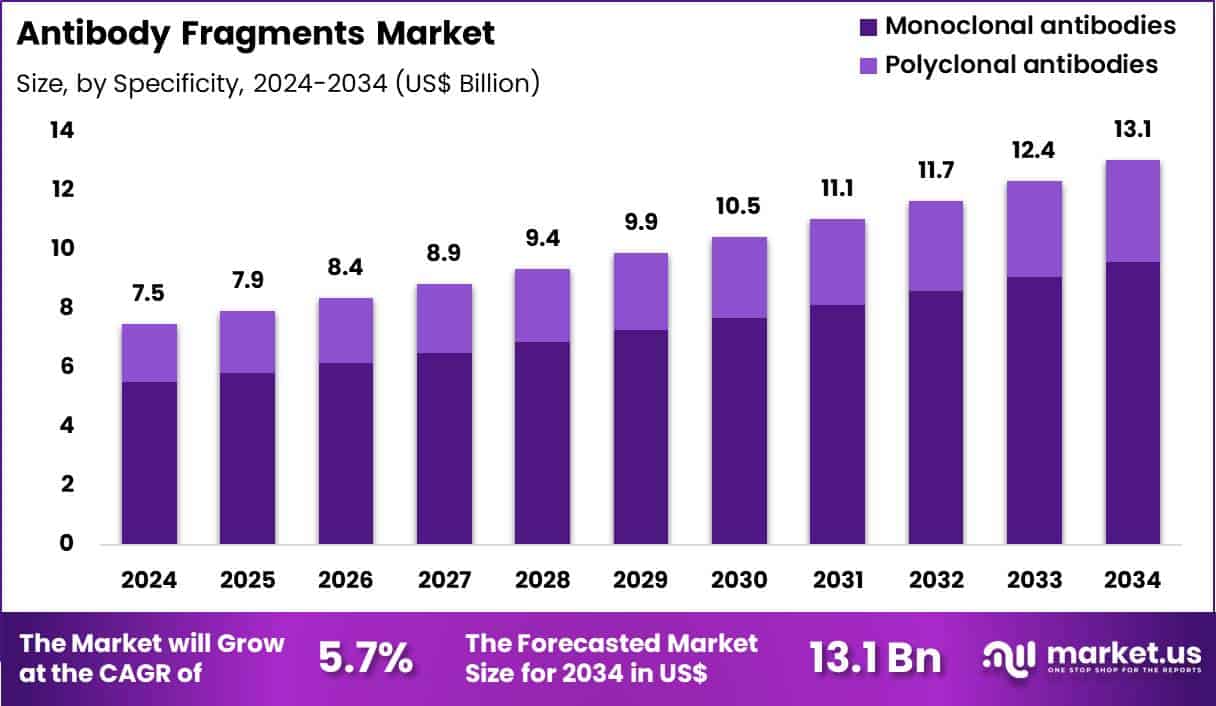
New York, NY – Oct 21, 2026 – Global Antibody Fragments Market size is expected to be worth around US$ 13.1 Billion by 2034 from US$ 7.5 Billion in 2024, growing at a CAGR of 5.7% during the forecast period 2025 to 2034. In 2024, North America led the market, achieving over 49.8% share with a revenue of US$ 3.7 Billion.
Antibody fragments are engineered or naturally derived portions of antibodies that retain the ability to recognize and bind specific antigens. These fragments, including antigen-binding fragments (Fabs), single-chain variable fragments (scFvs), and single-domain antibodies (nanobodies), are gaining importance in biotechnology and pharmaceutical research due to their small size, high specificity, and potential for improved tissue penetration.
The growing demand for targeted therapies, advancements in antibody engineering, and increasing investments in biopharmaceutical research are supporting the development of antibody fragment-based products. These molecules are being investigated and utilized across several applications, including cancer treatment, infectious disease research, autoimmune disorders, diagnostic assays, and targeted drug delivery.
Compared with full-length monoclonal antibodies, antibody fragments may offer advantages such as reduced molecular size, improved tissue access, and greater flexibility in molecular engineering. However, certain limitations, including shorter circulation time and challenges associated with stability and manufacturing, continue to influence product development and commercialization.
Technological advancements in recombinant DNA technology, protein engineering, and high-throughput screening are further expanding the potential applications of antibody fragments. Pharmaceutical companies, biotechnology firms, and research institutions are increasingly focusing on developing innovative fragment-based therapeutics and diagnostic solutions.
As precision medicine and targeted biologics continue to advance, the antibody fragments market is expected to present new opportunities for research, product innovation, and commercial expansion. Continued clinical development and manufacturing improvements will remain important factors shaping the market’s future growth.
Key Takeaways
- In 2024, the market was valued at US$ 7.5 billion and is projected to grow at a CAGR of 5.7%, reaching US$ 13.1 billion by 2034.
- By specificity, the market is segmented into monoclonal and polyclonal antibodies, with monoclonal antibodies dominating the segment with a 73.6% market share.
- By application, the market is categorized into immunodeficiency, cancer, and others, with immunodeficiency accounting for a significant 41.8% share.
- By type, the market is divided into FAB, sdAb, scFv, and others, with FAB fragments leading the segment with the largest revenue share of 39.4%.
- Regionally, North America dominated the market, accounting for 49.8% of the total market share.
Key Market Segments
- Specificity Analysis: Monoclonal antibodies dominated the specificity segment with a 73.6% market share, supported by high targeting precision, consistent performance, and scalable manufacturing. Their ability to bind specific epitopes improves reproducibility across therapeutic and diagnostic applications. Standardized production processes also strengthen quality control and development efficiency. Increasing investment in targeted therapies, bispecific formats, and next-generation biologics is expected to support continued segment growth.
- Application Analysis: Immunodeficiency accounted for 41.8% of the application segment, driven by demand for precise diagnostics and specialized immune disorder research. Antibody fragments support immunoassays, immune profiling, and receptor interaction studies through their specificity and flexible design. Expanding screening programs and rising research investment are further supporting adoption. Continued demand for accurate immune monitoring is expected to strengthen the segment’s market position.
- Type Analysis: Fab fragments dominated the type segment with a 39.4% market share, supported by their antigen-binding capabilities, established development processes, and broad applicability. Their smaller size compared with full-length antibodies enables improved tissue penetration, while reduced Fc-related effects support targeted applications. Fab fragments are widely used in diagnostics, imaging, and therapeutic research. Advances in manufacturing and purification technologies are expected to support continued adoption.
Regional Analysis
North America Leads the Antibody Fragments Market
North America dominated the global antibody fragments market in 2024, accounting for 49.8% of the market share. Regional growth is supported by strong biotechnology research, advanced protein engineering capabilities, and increasing clinical development of fragment-based biologics for cancer and inflammatory disorders.
Investments in antibody discovery, phage-display libraries, and targeted therapies are further strengthening market development. Collaborations between pharmaceutical companies and biotechnology firms are also supporting innovation and manufacturing scalability.
Asia Pacific Expected to Record the Highest CAGR
The Asia Pacific region is expected to register the highest CAGR during the forecast period, driven by expanding patient populations, growing biotechnology investments, and government support for biomedical research. China is advancing antibody engineering through large-scale research programs, while India is strengthening recombinant fragment production capabilities.
Japan contributes through advanced analytical technologies and biologics research. Increasing international collaborations, improving manufacturing infrastructure, and supportive regulatory initiatives are expected to create significant opportunities for antibody fragment development across the region.
Emerging Trends
- Growing development of nanobody-based medicines: Nanobodies, which are small, single-domain antibody fragments, are gaining attention because of their compact structure, target-binding ability, and potential for stable production. Research is expanding into treatments for cancer, inflammatory conditions, and neurological diseases, although many candidates remain under clinical investigation.
- Increasing use of artificial intelligence in antibody design: Artificial intelligence and protein structure prediction tools are being explored to identify suitable antibody fragments, improve target binding, and guide molecular design. These methods may help researchers shorten early discovery stages and develop candidates with specific properties, although laboratory and clinical validation remains essential.
- Expansion of engineered and bispecific antibody fragments: Researchers are developing engineered fragments that recognize two targets or combine different biological functions within one molecule. Such designs may help address complex diseases by acting on multiple disease-related pathways. Their development creates opportunities for biotechnology companies focused on next-generation targeted medicines.
- Greater focus on improving circulation time in the body: Many antibody fragments leave the bloodstream faster than conventional antibodies because of their smaller size. Researchers are investigating molecular modifications and fusion technologies to extend their presence in the body while preserving target binding. These improvements could support more practical dosing schedules for certain treatments.
- Development of synthetic antibody-fragment libraries: Synthetic and engineered antibody libraries are providing alternative ways to discover target-specific molecules. These approaches allow researchers to modify binding regions and screen large numbers of candidates without relying entirely on conventional animal-based antibody discovery. This may improve discovery flexibility and support more standardized development processes.
Use Cases
- Targeted treatment of specific diseases: Antibody fragments can bind to selected proteins involved in disease processes and block their activity. For example, caplacizumab is a nanobody-based medicine used to treat acquired thrombotic thrombocytopenic purpura, a rare blood disorder. This provides a clinical example of fragment-based treatment.
- Cancer detection and molecular imaging: Radiolabelled antibody fragments are being studied as imaging agents to identify cancer-related markers in the body. Their small size and rapid clearance can support high-contrast imaging, including positron emission tomography (PET). Several approaches remain investigational and require further clinical evaluation.
- Laboratory diagnostic tests: Recombinant antibody fragments, including single-chain variable fragments (scFv), can be used to detect proteins, antigens, and pathogens in laboratory assays. They are suitable for selected formats such as enzyme-linked immunosorbent assays (ELISA), helping researchers develop specific and adaptable diagnostic tests.
- Targeted delivery of drugs and other therapeutic agents: Antibody fragments can be linked to drugs, nanoparticles, or radioactive substances to direct them toward cells carrying a particular molecular target. This approach is being explored to improve the delivery of therapeutic materials to diseased tissues while limiting unnecessary exposure elsewhere in the body.
- Biomedical research and protein analysis: Researchers use antibody fragments to study protein interactions, identify disease-related biomarkers, and examine biological pathways. Their modular structure allows specific binding regions to be engineered for different experiments, making them useful tools in drug discovery, protein characterization, and the development of new biotechnology methods.
Frequently Asked Questions About Antibody Fragments
- What are the main types of antibody fragments?
The main types include antigen-binding fragments (Fab), F(ab′)₂ fragments, single-chain variable fragments (scFv), and single-domain antibodies. Each has different structural properties, binding characteristics, and potential uses in treatment, diagnostic testing, molecular imaging, and laboratory research. - How do antibody fragments differ from full-length antibodies?
Antibody fragments are generally smaller than full-length antibodies and can offer faster tissue penetration and quicker clearance from the bloodstream. However, their shorter circulation time may reduce treatment effectiveness unless suitable engineering methods are used. - What are the major medical applications of antibody fragments?
Antibody fragments are used or investigated in targeted treatments, cancer imaging, laboratory diagnostic tests, biomarker detection, and drug delivery. Their specific applications depend on the fragment type, the target being recognized, and the level of clinical validation achieved. - Are antibody fragments used in cancer treatment?
Yes. Some antibody-fragment-based medicines have reached clinical use, while other candidates are being studied for cancer treatment. Research includes blocking disease-related proteins, delivering therapeutic agents, and improving the detection of cancer biomarkers through molecular imaging. - What factors are driving growth in the antibody fragments market?
Market growth is supported by demand for targeted medicines, advances in protein engineering, increasing diagnostic research, and the development of nanobody-based products. Greater interest in precision medicine is also encouraging research into antibody fragments for specific disease targets. - What are the major opportunities in the antibody fragments market?
Opportunities include developing next-generation targeted medicines, improving cancer imaging, creating more adaptable diagnostic assays, and engineering fragments with longer circulation times. Artificial intelligence-assisted design may further support discovery, although successful commercialization requires evidence of safety, performance, and manufacturing consistency. - What is the future outlook for the antibody fragments market?
The market outlook is supported by continued research into targeted biologics, nanobodies, and engineered antibody formats. Future growth will depend on clinical trial outcomes, regulatory decisions, manufacturing capabilities, and the successful conversion of experimental technologies into commercially viable healthcare products.
Conclusion
The antibody fragments market is expected to witness steady growth, supported by advances in antibody engineering, increasing demand for targeted therapies, and expanding applications in diagnostics and biomedical research. Fab fragments currently hold a leading position by type, while monoclonal antibodies dominate the specificity segment.
North America remains the leading regional market, whereas Asia Pacific is expected to offer strong growth opportunities. Emerging technologies, including artificial intelligence, synthetic antibody libraries, and nanobody development, are further supporting innovation.
However, challenges related to stability, circulation time, manufacturing, and regulatory approval will influence commercialization. Continued research and technological progress will remain essential for long-term market expansion.
Discuss your needs with our analyst
Please share your requirements with more details so our analyst can check if they can solve your problem(s)



