


Overview
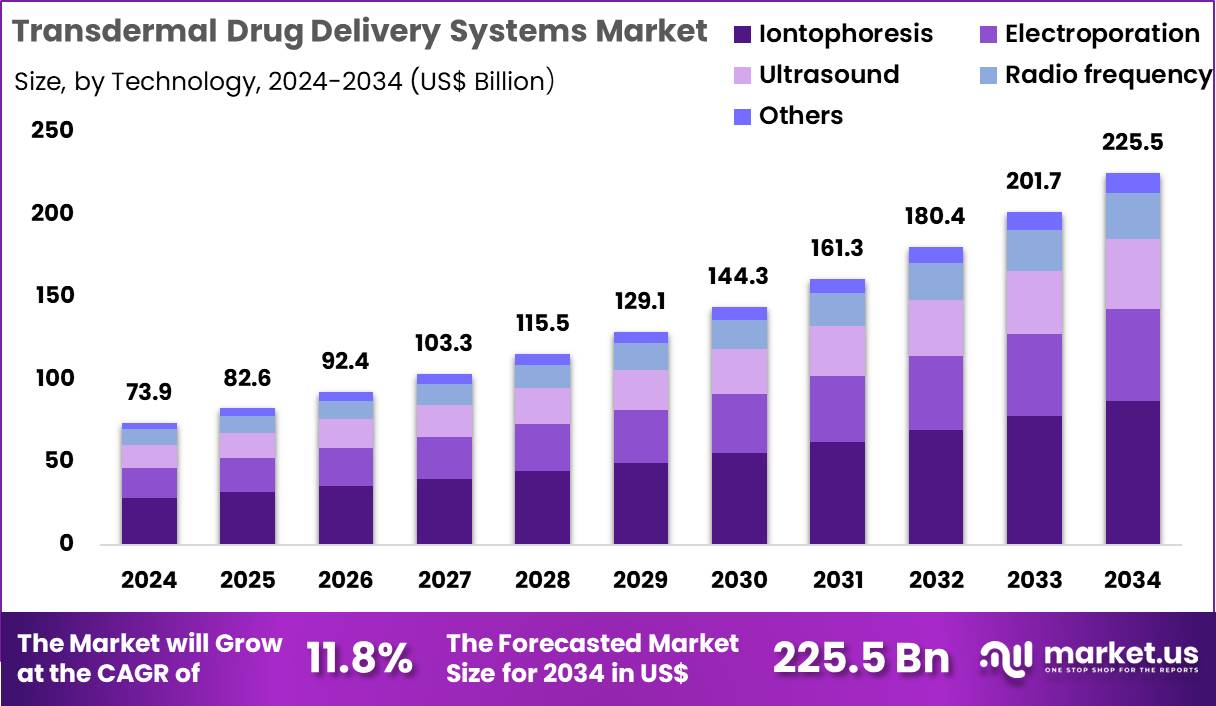
New York, NY – Oct 21, 2026 – Global Transdermal Drug Delivery Systems Market size is expected to be worth around US$ 225.5 Billion by 2034 from US$ 73.9 Billion in 2024, growing at a CAGR of 11.8% during the forecast period 2025 to 2034. In 2024, North America led the market, achieving over 39.7% share with a revenue of US$ 29.3 Billion.
Transdermal Drug Delivery Systems (TDDS) are innovative pharmaceutical technologies designed to deliver therapeutic drugs through the skin and into the bloodstream. These systems provide an alternative to conventional drug administration methods, including oral medications and injections, offering improved convenience and patient compliance.
The growing interest in transdermal drug delivery is driven by its potential to provide controlled and sustained drug release, reduce fluctuations in drug concentrations, and minimize certain gastrointestinal side effects associated with oral administration. Transdermal patches are among the most widely used formats, while advanced technologies such as microneedles, iontophoresis, and novel polymer-based formulations are expanding the possibilities for drug delivery.
TDDS applications include pain management, hormone replacement therapy, smoking cessation, and the treatment of selected chronic conditions. Ongoing research is focused on improving drug permeability, enhancing formulation stability, and enabling the delivery of a broader range of therapeutic compounds.
Technological advancements, increasing demand for patient-friendly treatment options, and continued investment in pharmaceutical research are supporting the development of next-generation transdermal delivery solutions. However, challenges related to skin permeability, drug compatibility, manufacturing costs, and regulatory requirements remain important considerations.
As pharmaceutical innovation continues, transdermal drug delivery systems are expected to play an increasingly important role in developing convenient, controlled, and patient-centered drug administration approaches.
Key Takeaways
- In 2024, the market was valued at US$ 73.9 billion and is projected to reach US$ 225.5 billion by 2034, growing at a CAGR of 11.8%.
- By technology, the market is segmented into iontophoresis, electroporation, radio frequency, ultrasound, and others. Iontophoresis dominated the segment with a 38.6% market share.
- By application, the market is categorized into pain management, cardiovascular, gastrointestinal, cancer, and others. Pain management accounted for the largest share at 49.8%.
- Regionally, North America dominated the market, accounting for a 39.7% share.
Key Market Segments
- Technology Analysis: Iontophoresis dominated the technology segment with a 38.6% market share, driven by its controlled, needle-free drug delivery mechanism. Its ability to improve dosing precision, patient comfort, and treatment adherence supports adoption across pain management, physiotherapy, and outpatient care settings.
- Application Analysis: Pain management led the application segment with a 49.8% market share, supported by rising chronic pain cases and demand for convenient, non-invasive treatments. Transdermal delivery offers sustained drug release, improved adherence, and reduced gastrointestinal burden, strengthening its adoption in long-term pain management.
Regional Analysis
North America Market Analysis
North America accounted for 39.7% of the global transdermal drug delivery systems market in 2024, supported by advanced healthcare infrastructure, rising chronic disease prevalence, and increasing demand for non-invasive drug administration. Technological advancements in transdermal patches, including microneedles and iontophoresis, have improved drug delivery efficiency and patient adherence.
Pharmaceutical companies are increasingly adopting these systems to reduce gastrointestinal side effects and provide controlled drug release. Supportive FDA approvals and collaborations between research institutions and manufacturers have further strengthened market development. In 2022, the FDA approved Adlarity, a donepezil transdermal system for Alzheimer’s disease, offering weekly administration.
Asia Pacific Market Analysis
Asia Pacific is projected to register the highest CAGR during the forecast period, driven by rising healthcare expenditure, increasing chronic disease cases, and pharmaceutical innovation in China, India, and Japan. Manufacturers are developing cost-effective patches and advanced formulations to improve treatment accessibility.
Investments in research, domestic manufacturing, and biotechnology are supporting regional expansion. In 2023, India introduced the Promotion of Research and Innovation in Pharma MedTech (PRIP) scheme to strengthen pharmaceutical research and innovation, supporting the development of advanced drug delivery technologies.
Emerging Trends
- Growing development of microneedle-based delivery systems: Microneedle patches are gaining research attention because they use tiny projections to cross the skin’s outer barrier. Dissolving and polymer-based microneedles are being studied for delivering vaccines, biological medicines, and drugs that are difficult to administer through conventional patches. Commercial growth will depend on safety, manufacturing costs, and regulatory approval.
- Increasing focus on long-acting drug delivery: Pharmaceutical developers are investigating formulations that release medicines over longer periods, reducing the need for frequent administration. Research includes advanced adhesive patches, specialised polymer systems, and long-acting microneedles. These approaches could improve convenience and treatment adherence, although their performance depends on the medicine, formulation, and intended duration of action.
- Adoption of advanced skin-penetration technologies: Techniques such as iontophoresis, ultrasound-assisted delivery, and other physical enhancement methods are being studied to improve the movement of medicines through the skin. These technologies may help address the limitations of conventional patches, particularly for drugs that do not readily cross the skin barrier.
- Development of customised and 3D-printed microneedles: Three-dimensional printing is being explored to produce microneedle structures with greater control over shape, size, and design. This could support more precise formulation development and specialised delivery requirements. However, consistent product quality, scalable manufacturing, material safety, and production costs remain important commercial considerations.
- Expansion of research into biologics and complex medicines: Research is increasingly examining whether microneedles and other advanced systems can deliver peptides, proteins, nucleic acids, and other complex therapeutic substances through the skin. These developments could broaden the range of medicines suitable for transdermal delivery, although many applications remain under investigation and are not yet established treatments.
Use Cases
- Smoking cessation and nicotine replacement therapy: Nicotine patches are used to help adults manage nicotine withdrawal when quitting smoking. The medicine is absorbed through the skin and released throughout the day. This application represents an established use case for transdermal delivery, supported by CDC guidance on smoking cessation treatments.
- Pain management and chronic pain treatment: Transdermal patches are used to deliver selected pain medicines over a controlled period. They can be useful when sustained medicine delivery is required and the drug is suitable for absorption through the skin. Product selection, dosing, and monitoring depend on the medicine and patient’s clinical condition.
- Hormone replacement and hormone therapy: Transdermal systems are used to administer certain hormones, including oestrogen, through the skin. They provide an alternative to some oral formulations and can support regular hormone administration. Demand in this application is influenced by treatment needs, product availability, clinical guidelines, and patient preference.
- Prevention of motion sickness and postoperative nausea: Scopolamine transdermal patches are used to prevent nausea and vomiting associated with motion sickness and certain surgical procedures. According to the FDA, the approved adult patch can deliver medicine for up to three days, making it a practical option when prolonged symptom prevention is needed.
- Vaccines and specialised therapeutic delivery: Microneedle-based systems are being investigated for vaccine administration and delivery of selected biological medicines. Their potential advantages include reduced reliance on conventional injection needles and easier administration in some settings. However, many applications remain at the research or development stage rather than being widely available clinical products.
Frequently Asked Questions About Transdermal Drug Delivery Systems
- How do transdermal drug delivery systems work?
These systems place a medicine in contact with the skin, allowing the active ingredient to pass through its outer barrier. Depending on the product, absorption may occur naturally or be enhanced through specialised formulations or delivery technologies. - What are the main advantages of transdermal drug delivery systems?
Transdermal systems can provide convenient administration, controlled medicine release, and reduced dosing frequency for suitable drugs. They can also avoid initial passage through the digestive system and liver, although absorption, effectiveness, and patient suitability vary by medicine. - What are the main limitations of transdermal drug delivery systems?
The skin acts as a protective barrier, restricting the delivery of many medicines. Some products can cause irritation or adhesive problems, while absorption may vary with skin condition, formulation, and external factors. Not every medicine is suitable for this delivery route. - Which medicines can be administered through transdermal patches?
Selected medicines for smoking cessation, pain management, hormone therapy, and prevention of motion sickness can be administered through transdermal patches. Suitability depends on the drug’s properties, required dose, absorption characteristics, and availability of an approved formulation. - What factors are driving the transdermal drug delivery systems market?
Market growth is supported by demand for convenient treatment options, interest in controlled drug release, and advances in skin-penetration technologies. Research into microneedles and long-acting formulations is also creating potential opportunities for pharmaceutical manufacturers and technology developers. - Which technology segments are important in this market?
Important technology segments include conventional drug-in-adhesive patches, matrix and reservoir systems, microneedle platforms, and enhanced delivery methods such as iontophoresis. Each segment differs in drug compatibility, manufacturing requirements, delivery performance, and level of commercial maturity. - What are the major opportunities in the transdermal drug delivery systems market?
Potential opportunities include long-acting formulations, advanced microneedle products, improved delivery of complex medicines, and specialised treatment applications. Commercial success will depend on clinical evidence, regulatory approval, product affordability, manufacturing scalability, and the ability to demonstrate meaningful benefits over existing treatments.
Conclusion
The transdermal drug delivery systems market is positioned for significant growth, supported by advances in drug delivery technologies and increasing demand for convenient, patient-friendly treatments. The market is projected to grow from US$ 73.9 billion in 2024 to US$ 225.5 billion by 2034, at a CAGR of 11.8%.
North America remains the leading regional market, while Asia Pacific offers strong growth potential. Pain management and iontophoresis represent important market segments. Emerging technologies, including microneedles and long-acting formulations, are expected to create new opportunities. However, skin permeability, manufacturing costs, and regulatory requirements remain key challenges for market participants.
Discuss your needs with our analyst
Please share your requirements with more details so our analyst can check if they can solve your problem(s)



