


Overview
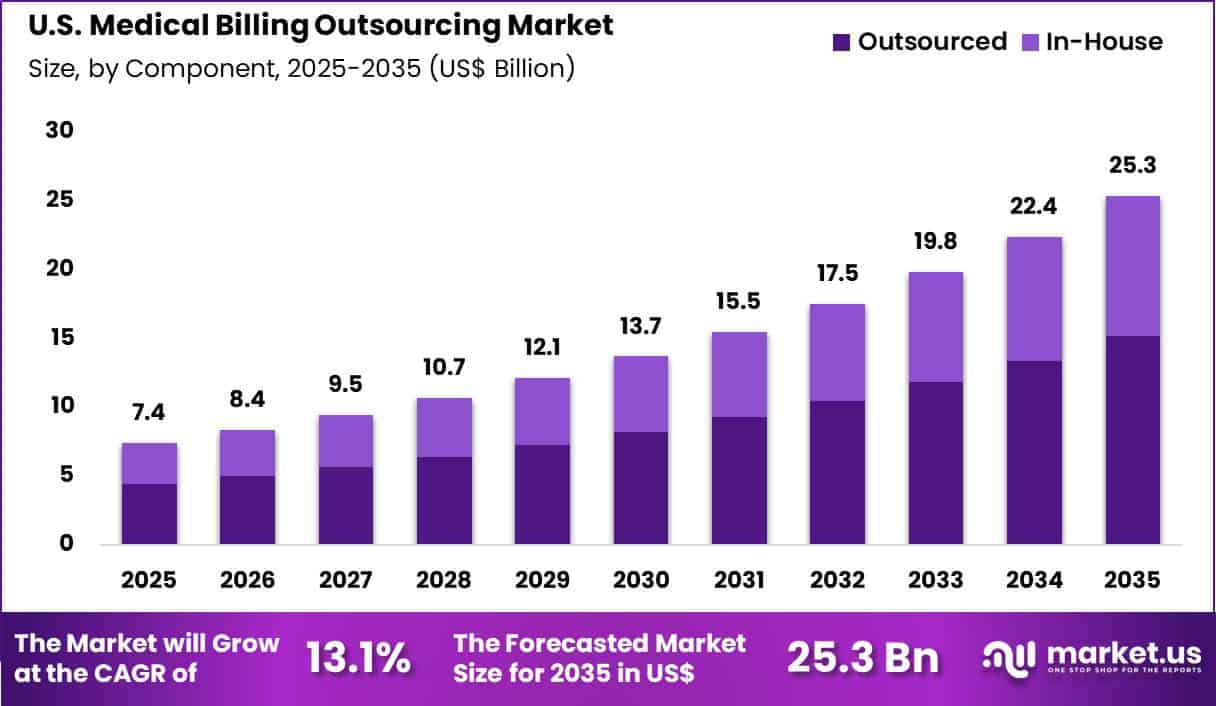
New York, NY – June 22, 2026 – The U.S. Medical Billing Outsourcing Market size is expected to be worth around US$ 25.3 Billion by 2035 from US$ 7.4 Billion in 2025, growing at a CAGR of 13.1% during the forecast period 2026-2035.
The U.S. medical billing outsourcing market is experiencing significant growth, driven by the increasing complexity of healthcare reimbursement processes, evolving regulatory requirements, and the growing need for operational efficiency among healthcare providers. Medical billing outsourcing involves the delegation of revenue cycle management functions, including claims processing, coding, payment collection, and insurance verification, to specialized third-party service providers.
Healthcare organizations across the United States are increasingly adopting outsourced billing solutions to reduce administrative burdens, minimize claim denials, improve cash flow, and enhance overall revenue cycle performance. The growing volume of patient data, expansion of health insurance coverage, and continued shift toward value-based care models are further supporting market expansion.
Advanced technologies such as artificial intelligence, automation, cloud-based platforms, and data analytics are being integrated into medical billing services, enabling faster claims processing and improved accuracy. These technological advancements are helping providers streamline operations while maintaining compliance with changing healthcare regulations.
The market serves a broad range of end users, including hospitals, physician practices, ambulatory surgical centers, diagnostic laboratories, and specialty clinics. Outsourcing providers offer customized solutions tailored to the specific needs of healthcare organizations of varying sizes.
With increasing pressure to optimize costs and improve financial performance, the U.S. medical billing outsourcing market is expected to witness continued growth over the coming years, supported by digital transformation initiatives and the ongoing demand for efficient healthcare administration services.
Key Takeaways
- The U.S. medical billing outsourcing market was valued at US$ 7.4 Billion in 2025 and is projected to reach US$ 25.3 Billion by 2035, expanding at a CAGR of 13.1% during the forecast period.
- Based on service type, the market is categorized into full-service outsourcing, hybrid outsourcing, billing software as a service (SaaS), and consulting and advisory services. Among these, full-service outsourcing emerged as the leading segment, accounting for 42.2% of the total market share.
- By component, the market is segmented into in-house and outsourced solutions. The outsourced segment dominated the market, representing 59.8% of the overall revenue share.
- In terms of end use, the market is classified into hospitals, physician offices, and others. Hospitals held the largest market share, contributing 48.6% of the total revenue in 2025.
Market Segmentation
- Service Analysis: Full-service outsourcing accounted for 42.2% of market growth, driven by increasing reimbursement complexity and regulatory requirements. Healthcare providers outsource coding, claims management, and revenue cycle functions to improve billing accuracy, accelerate reimbursements, reduce administrative burdens, optimize costs, and strengthen financial performance.
- Component Analysis: Outsourced components represented 59.8% of market growth as healthcare organizations shifted billing operations to specialized providers. Outsourcing reduces administrative expenses, improves claim processing efficiency, lowers rejection rates, and supports revenue cycle management through certified coding expertise, automation, and advanced analytics.
- End-Use Analysis: Hospitals accounted for 48.6% of market growth due to high volumes of complex claims and reimbursement activities. Outsourced billing services support coding compliance, claims processing, and revenue cycle optimization, helping hospitals reduce denials, improve cash flow, and maintain financial stability.
Emerging Trends
- Tailored Services for Telehealth Billing: Growing telehealth adoption is increasing demand for specialized billing services. Outsourcing providers offer customized solutions that address complex coding requirements, evolving reimbursement policies, and compliance standards. These services improve claim accuracy, reduce denials, accelerate payments, and support efficient virtual healthcare delivery.
- Stronger Focus on Security and Compliance: Medical billing outsourcing firms are strengthening cybersecurity capabilities to protect sensitive patient information and maintain regulatory compliance. Investments in advanced security systems, employee training, and data protection frameworks help prevent breaches, support HIPAA compliance, and enhance client confidence in outsourced services.
- Innovation Through Blockchain and Emerging Tech: Medical billing providers are exploring blockchain, machine learning, and advanced automation technologies to improve transparency, efficiency, and billing accuracy. These innovations support fraud reduction, streamline transaction verification, enhance record management, and create competitive advantages for outsourcing firms pursuing digital transformation.
- Use of Global Talent to Meet Demand: Outsourcing companies increasingly leverage global talent pools to address growing demand for skilled billing professionals. Teams in countries such as India and the Philippines provide cost-effective expertise, continuous service availability, knowledge of U.S. billing standards, and scalable operational support.
Use Cases
- Improving Efficiency for Hospitals and Clinics: Medical billing outsourcing enables hospitals and clinics to improve operational efficiency by transferring coding, claims processing, and revenue cycle responsibilities to specialized providers. This reduces administrative workloads, minimizes billing errors, accelerates reimbursement cycles, lowers overhead costs, and enhances productivity.
- Support for Telemedicine Providers: Telemedicine providers utilize outsourced billing services to manage complex virtual care reimbursement requirements. Specialized billing teams ensure accurate coding, regulatory compliance, and timely claim submission. These capabilities reduce claim denials, improve revenue collection, and allow providers to prioritize patient care.
- Preparing for Regulatory Changes: Outsourced billing providers help healthcare organizations adapt to changing regulations, coding standards, and payer requirements. Continuous monitoring of policy updates ensures compliance, reduces financial risks, minimizes billing errors, supports audit preparedness, and enables providers to focus on healthcare delivery.
- Enhancing Financial Visibility: Medical billing outsourcing firms provide reporting tools and analytics that improve financial visibility across healthcare organizations. Detailed insights into claims, denials, reimbursements, and collections support informed decision-making, strengthen cash flow management, optimize revenue cycle performance, and improve profitability.
Frequently Asked Questions on U.S. Medical Billing Outsourcing
- Why are healthcare providers outsourcing medical billing services?
Healthcare providers increasingly outsource medical billing services to reduce operational costs, improve billing accuracy, enhance claim approval rates, and focus more on patient care. Outsourcing also helps organizations manage evolving reimbursement regulations and complex payer requirements more effectively. - What factors are driving the growth of the U.S. medical billing outsourcing market?
The U.S. medical billing outsourcing market is driven by rising healthcare administrative costs, increasing claim complexities, expanding regulatory compliance requirements, and growing demand for efficient revenue cycle management. Healthcare providers are adopting outsourcing solutions to improve financial performance and operational productivity. - Which services are commonly included in medical billing outsourcing?
Medical billing outsourcing services typically include medical coding, claims processing, eligibility verification, accounts receivable management, denial management, payment posting, reimbursement tracking, and revenue cycle management. Comprehensive service offerings help healthcare providers optimize billing workflows and improve cash flow. - Why does full-service outsourcing dominate the market?
Full-service outsourcing dominates the market because healthcare providers seek end-to-end billing support from specialized vendors. These services combine coding, claims management, compliance monitoring, and revenue cycle optimization, enabling organizations to improve reimbursement efficiency while reducing administrative burdens and staffing requirements. - How does outsourcing improve revenue cycle management?
Outsourcing improves revenue cycle management by leveraging experienced billing professionals, automated technologies, and analytics-driven processes. These capabilities help reduce claim denials, improve billing accuracy, accelerate payment collections, and provide greater visibility into financial performance and reimbursement trends. - Which healthcare facilities are the largest users of outsourced billing services?
Hospitals represent the largest users of outsourced medical billing services due to their high patient volumes and complex reimbursement structures. Outsourcing helps hospitals manage extensive claims processing requirements, maintain regulatory compliance, and improve overall revenue cycle efficiency and financial stability. - How do technological advancements support medical billing outsourcing?
Technological advancements such as artificial intelligence, automated coding systems, cloud-based billing platforms, and predictive analytics improve billing accuracy and operational efficiency. These technologies enable outsourcing providers to process claims faster, reduce errors, and strengthen revenue cycle outcomes.
Conclusion
The U.S. medical billing outsourcing market is positioned for strong long-term growth, supported by increasing healthcare administrative complexity, evolving reimbursement regulations, and the growing need for cost-efficient revenue cycle management. Healthcare providers are increasingly relying on outsourced billing solutions to improve operational efficiency, reduce claim denials, enhance compliance, and strengthen financial performance.
Technological advancements, including artificial intelligence, automation, cloud platforms, and analytics, continue to improve billing accuracy and processing efficiency. Rising adoption of telehealth, greater emphasis on data security, and access to global talent pools are further expanding market opportunities, supporting sustained market development through 2035.
Discuss your needs with our analyst
Please share your requirements with more details so our analyst can check if they can solve your problem(s)




