


Overview
New York, NY – Aug 07, 2026 – The Global Cloud-Based Drug Discovery Platform Market size is expected to be worth around US$ 10.2 Billion by 2034 from US$ 3.1 Billion in 2024, growing at a CAGR of 12.6% during the forecast period 2025 to 2034. North America held a dominant market position, capturing more than a 40.3% share and a US$1.2 Billion market value for the year.
The global cloud-based drug discovery platform market is witnessing strong growth as pharmaceutical and biotechnology companies adopt cloud technologies to improve research efficiency, reduce development timelines, and manage increasingly complex scientific data. Traditional drug discovery remains a challenging process, often requiring 10–15 years to bring a new medicine from discovery to approval, with average development costs exceeding US$2 billion due to high failure rates.
Cloud-based platforms are enabling researchers to process large-scale datasets from genomics, proteomics, molecular modeling, and chemical libraries with greater speed and accuracy. These solutions provide access to scalable computing resources, reducing the need for expensive in-house infrastructure. The U.S. FDA Center for Drug Evaluation and Research (CDER) reported an average of around 50 novel drug approvals annually between 2018 and 2024, increasing pressure on companies to accelerate discovery and development workflows.
The integration of artificial intelligence (AI) and machine learning (ML) is a major growth driver, allowing researchers to analyze millions of compounds, predict molecular interactions, and identify promising drug candidates faster. The global pharmaceutical industry invests more than US$200 billion annually in research and development, creating significant demand for advanced digital discovery platforms.
Strategic technology adoption is also increasing, with companies focusing on AI-powered drug design and collaborative research ecosystems. In December 2024, BenevolentAI announced a strategic transformation to strengthen its AI-driven drug discovery approach. Growing digital transformation, rising data volumes, and the need to reduce drug development risks are expected to accelerate the adoption of cloud-based drug discovery platforms worldwide.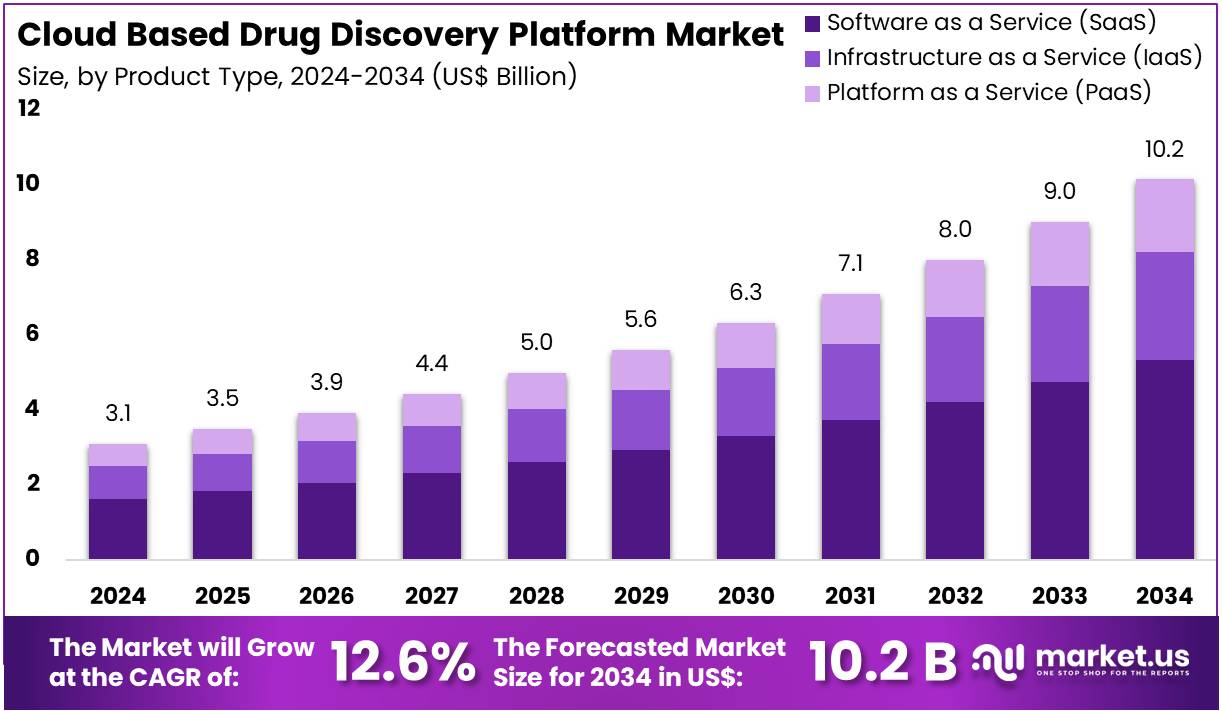
Key Takeaways
- In 2024, the cloud-based drug discovery platform market generated US$ 3.1 billion in revenue and is projected to reach US$ 10.2 billion by 2034, expanding at a CAGR of 12.6% during the forecast period.
- Based on product type, the market is segmented into Software as a Service (SaaS), Infrastructure as a Service (IaaS), and Platform as a Service (PaaS). Among these, Software as a Service (SaaS) dominated the market in 2023, accounting for a 52.6% market share.
- By application, the cloud-based drug discovery platform market is categorized into pharmaceutical vendors, CROs, biotech vendors, and others. Among these, pharmaceutical vendors represented a leading segment, capturing a 45.2% market share.
- Regionally, North America emerged as the leading market in 2023, holding a significant 40.3% share due to strong pharmaceutical R&D activities, advanced digital infrastructure, and increasing adoption of AI-driven drug discovery solutions.
Statistical Information
- Pharmaceutical Innovation Requires Faster Drug Approval Processes: The demand for efficient drug discovery solutions is increasing as regulatory agencies continue to support accelerated development pathways. In 2024, the FDA approved 33 out of 50 novel drugs (66%) through one or more expedited programs, including Fast Track, Breakthrough Therapy, Priority Review, and Accelerated Approval programs.
- Pharmaceutical R&D Spending Continues to Increase, Driving Digital Adoption: The pharmaceutical industry continues to invest heavily in research and development, increasing the need for efficient digital research platforms. According to the Pharmaceutical Research and Manufacturers of America (PhRMA), U.S. biopharmaceutical companies invested approximately US$96 billion in R&D during 2023, supporting the adoption of advanced technologies for drug discovery and development.
- FDA Novel Drug Approvals: The FDA CDER approved 46 novel drugs in 2025, including 34 new molecular entities and 12 therapeutic biologics. 85% were approved in the first review cycle, and 72% used at least one expedited development or review program, reflecting accelerated timelines enabled by digital and cloud-based development tools.
- Clinical Trial Pipeline Volume: As of July 1, 2026, ClinicalTrials.gov registered 591,832 total studies, including 218,766 interventional drug or biological studies. Of these, 37,846 were recruiting, not yet recruiting, or active but not recruiting, representing active cloud-enabled trial management systems.
- PubChem and ChEMBL Data Volumes: PubChem contains 123,929,509 compound records and 347,057,467 substance records as of July 1, 2026. ChEMBL_37 lists 2,921,148 distinct compounds and 24,527,044 bioactivity measurements, all accessible through cloud-based APIs for drug discovery screening.
- Virtual Screening Success Rates: A 2024 Scientific Reports study evaluated AI-based virtual screening across 318 projects, identifying at least one bioactive compound in 215 of 296 academic target projects (73% success rate). The average hit rate was 5.5%, with dose-response validation in 84% of experiments.
- Clinical Development Failure Rates: The overall Phase 1-to-approval likelihood for drug development is 7.9%, implying a 92.1% failure rate. Oncology and neurology show even lower success rates at 5.3% and 5.9% respectively, driving demand for cloud-based AI tools to improve early-stage triage.
- FDA Generative AI and Cloud Tool Adoption: FDA’s generative AI adoption rate increased from 1% in early 2025 to over 80% by mid-2026, with some centers exceeding 90% usage. The agency deployed enterprise AI using Google’s Gemini and Anthropic’s Claude models via cloud infrastructure, reducing administrative tasks from 10 days to 20 minutes in early pilots.
- Cloud Migration Timelines and ROI: Early movers in cloud adoption report 15% to 25% reduction in overall R&D IT spending and 20% to 30% faster time-to-insight from experimental data. These improvements translate to earlier candidate selection, reduced attrition in late-stage development, and ultimately faster regulatory approval timelines for novel therapeutics.
Regional Analysis
North America led the market by securing a market share of 40.3% in 2023.
North America remains a major hub for cloud-based drug discovery platforms due to its strong pharmaceutical, biotechnology, and artificial intelligence ecosystem. The region benefits from advanced research infrastructure, high pharmaceutical R&D spending, and increasing adoption of cloud-based solutions for molecular analysis, clinical research, and drug development.
The U.S. healthcare research ecosystem is supported by significant government funding, with the National Institutes of Health (NIH) providing US$36.94 billion in extramural research funding in FY 2024, supporting more than 407,000 jobs and generating US$94.58 billion in economic activity. The Asia Pacific region is experiencing rapid growth in cloud-based drug discovery adoption due to expanding biotechnology sectors, increasing research investments, and modernization of healthcare infrastructure.
China is strengthening its scientific capabilities, with total R&D expenditure exceeding 3.6 trillion yuan in 2024, representing an 8.3% increase compared with the previous year. The region’s growing number of biotech startups, contract research organizations (CROs), and investments in AI-driven healthcare solutions are supporting wider adoption of cloud platforms. Increasing clinical research activity and demand for faster drug discovery processes are expected to further accelerate regional growth.
Emerging Trends
- Artificial Intelligence Integration in Drug Discovery: AI is becoming a key trend in cloud-based drug discovery platforms by helping researchers analyze biological data, predict molecular interactions, and identify potential drug candidates faster. The FDA reported 500+ drug development submissions involving AI components between 2016 and 2023, showing rising adoption of AI in pharmaceutical research.
- Expansion of Cloud-Based Biomedical Data Management: Growing volumes of genomic, proteomic, and clinical datasets are increasing demand for scalable cloud infrastructure. NIH’s STRIDES Initiative provides researchers access to cloud computing resources, supporting advanced biomedical research and large-scale data analysis.
- Growth of Precision Medicine Research: Cloud platforms are supporting personalized medicine by enabling analysis of genetic and health data. NIH’s All of Us Research Program aims to collect health information from more than 1 million participants, creating a large biomedical dataset for AI-based discoveries.
- AI-Based Molecular Screening and Drug Design: Pharmaceutical companies are increasingly using AI-powered cloud platforms to screen chemical libraries, predict molecular behavior, and improve early-stage drug discovery. These technologies help researchers analyze large datasets and prioritize promising drug candidates more efficiently.
- Increasing Collaborative Drug Research Models: Cloud platforms enable secure collaboration between pharmaceutical companies, biotechnology firms, and academic institutions. With more than 500,000 clinical studies registered globally on ClinicalTrials.gov, efficient data-sharing systems are becoming important for modern research workflows.
Use Cases
- Drug Target Identification: Cloud-based platforms help researchers analyze genomic and biological datasets to identify disease-related targets. AI algorithms can evaluate complex biological relationships, supporting faster target discovery and validation during early drug development stages.
- Virtual Screening of Drug Compounds: Researchers use cloud computing to digitally screen thousands or millions of chemical compounds, helping identify potential drug candidates before laboratory testing. This approach improves research efficiency and reduces time spent on early-stage compound evaluation.
- Genomic Data Analysis for Personalized Medicine: Cloud platforms allow scientists to process large genomic datasets for identifying disease patterns and developing targeted therapies. NIH’s All of Us Research Program provides researchers with secure access to genomic and health information for biomedical discoveries.
- Clinical Trial Data Management: Cloud-based solutions support clinical trial operations by managing patient information, research datasets, and analytics. With 500,000+ registered clinical studies worldwide, digital platforms help researchers organize and analyze complex clinical research data.
- Drug Repurposing Using AI Analytics: Cloud-based AI tools help researchers discover new uses for existing medicines by analyzing molecular, clinical, and disease-related datasets. These platforms accelerate drug repurposing efforts by identifying potential therapeutic opportunities more efficiently.
Frequently Asked Questions on Cloud Based Drug Discovery Platform
- Why is the cloud-based drug discovery platform market growing?
The market is growing due to increasing drug development complexity, rising adoption of artificial intelligence, and demand for faster research processes. Cloud platforms provide scalable computing power, improve collaboration, and help pharmaceutical companies reduce infrastructure costs. - How does artificial intelligence support cloud-based drug discovery platforms?
Artificial intelligence helps cloud-based drug discovery platforms analyze biological data, predict molecular interactions, identify potential drug candidates, and improve screening processes. AI-driven solutions enable researchers to evaluate large datasets faster and support more efficient early-stage drug development. - What are the major applications of cloud-based drug discovery platforms?
Major applications include drug target identification, virtual compound screening, molecular modeling, genomic analysis, clinical trial data management, and drug repurposing. These platforms help pharmaceutical companies, biotechnology firms, and research organizations improve discovery efficiency and accelerate innovation. - Which organizations use cloud-based drug discovery platforms?
Cloud-based drug discovery platforms are mainly used by pharmaceutical companies, biotechnology firms, contract research organizations (CROs), academic institutions, and research laboratories. These organizations use cloud solutions to manage complex datasets and improve collaboration across global research teams. - How do cloud platforms improve drug development efficiency?
Cloud platforms improve efficiency by providing high-performance computing, automated data analysis, and secure collaboration tools. Researchers can process large genomic, chemical, and clinical datasets quickly, helping identify promising drug candidates and reducing delays during early research stages. - What role does genomics play in cloud-based drug discovery?
Genomics plays an important role by generating large biological datasets used for identifying disease targets and developing personalized therapies. Cloud platforms provide the computing capacity required to analyze genomic information and support data-driven drug discovery approaches. - Why is North America a leading region in the cloud-based drug discovery platform market?
North America leads due to its strong pharmaceutical industry, advanced healthcare infrastructure, high research investments, and early adoption of AI technologies. The presence of major biotechnology companies and research institutions supports widespread use of cloud-based discovery solutions. - What is the future outlook for the cloud-based drug discovery platform market?
The future outlook remains positive as pharmaceutical companies increasingly adopt digital research tools. Growing biomedical data volumes, rising AI integration, and demand for cost-effective drug development solutions will continue driving adoption of cloud-based discovery platforms globally.
Conclusion
The cloud-based drug discovery platform market is transforming pharmaceutical research by enabling faster, data-driven, and cost-efficient drug development processes. Increasing adoption of artificial intelligence, machine learning, genomics, and cloud computing is helping researchers analyze complex datasets and identify promising drug candidates more effectively. Growing investments in biomedical research, precision medicine, and digital infrastructure are further supporting market expansion.
North America continues to lead due to strong pharmaceutical innovation, while Asia Pacific shows significant growth potential through rising biotechnology activities. As the demand for accelerated drug discovery increases, cloud-based platforms will remain essential for improving research collaboration, efficiency, and therapeutic development.
Discuss your needs with our analyst
Please share your requirements with more details so our analyst can check if they can solve your problem(s)




