


Overview
New York, NY – July 29, 2026 – The Global Medical Specialty Bags Market Size is expected to be worth around US$ 25.6 Billion by 2034 from US$ 10.9 Billion in 2024, growing at a CAGR of 4.5% during the forecast period 2025 to 2034. North America held a dominant market position, capturing more than a 37.8% share and holds US$ 4.1 Billion market value for the year.
The global Medical Specialty Bags Market is witnessing steady growth as healthcare systems worldwide increase their focus on patient safety, infection prevention, and advanced medical care. Rising cases of chronic diseases, expanding surgical procedures, and the growing elderly population are significantly increasing the demand for specialized medical bags used for blood collection, intravenous therapy, ostomy care, enteral feeding, and urinary drainage.
According to the American Cancer Society, nearly 90% of bladder cancer cases occur in people aged 55 years and older, highlighting the increasing need for urinary drainage and fluid management products among aging patients. In addition, the World Health Organization (WHO) reports that approximately 120 million units of blood are donated globally every year, creating continuous demand for sterile blood collection and storage bags used in transfusion services.
Growing awareness of healthcare-associated infections (HAIs) is another major factor supporting market expansion. The Centers for Disease Control and Prevention (CDC) estimates that 1 in every 31 hospitalized patients in the United States has at least one HAI on any given day, encouraging hospitals to adopt single-use disposable medical bags that reduce contamination risks and improve patient safety.
Technological innovation is further strengthening market growth. Manufacturers are introducing medical specialty bags with improved barrier materials, enhanced durability, RFID-enabled tracking systems, and dual-chamber drug delivery technologies that simplify medication preparation and storage. These advancements improve operational efficiency while supporting better clinical outcomes. With increasing healthcare investments, expanding hospital infrastructure, and continuous product innovation, the Medical Specialty Bags Market is expected to maintain a positive growth trajectory over the coming years.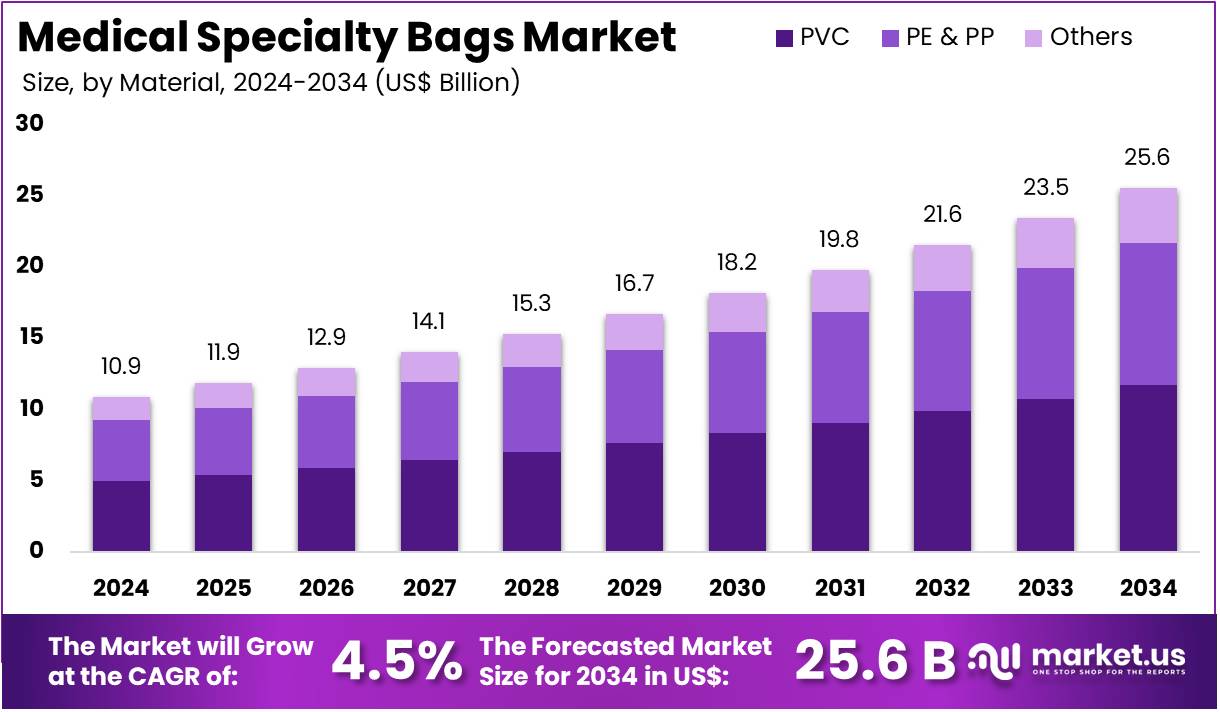
Key Takeaways
- The global Medical Specialty Bags Market was valued at US$ 10.9 billion in 2024 and is projected to reach US$ 25.6 billion by 2034, expanding at a CAGR of 4.5% during the forecast period.
- By product type, the market is segmented into intravenous fluid bags, sterile collection & drainage bags, ostomy bags, continuous ambulatory peritoneal dialysis bags, and others. Among these, ostomy bags accounted for the largest share of 38.5%.
- Based on material, the market is categorized into PVC, PE & PP, and others. PVC emerged as the leading material segment, capturing 45.8% of the market share.
- By end user, the market is classified into hospitals, ambulatory surgery centers (ASCs), and others. Hospitals dominated the segment with a 52.7% revenue share.
- North America held the leading regional position, accounting for 37.8% of the global Medical Specialty Bags Market share.
Statistical Information
- Rising Burden of Bladder Cancer Supports Urinary Drainage Bag Demand: The U.S. National Cancer Institute (SEER Program) estimates 84,530 new bladder cancer cases and 17,870 deaths in 2026. Bladder cancer represents 4.0% of all new cancer cases in the United States, creating continuous demand for urinary drainage and ostomy-related medical specialty bags.
- Healthcare-Associated Infections Drive Adoption of Disposable Medical Bags: According to the U.S. Centers for Disease Control and Prevention (CDC), 1 in every 31 hospital patients has at least one healthcare-associated infection (HAI) on any given day. The CDC also estimated 687,000 HAIs in U.S. acute-care hospitals and approximately 72,000 HAI-related deaths during hospitalization, reinforcing the need for single-use sterile medical bags.
- Blood Collection and Storage Continue to Create Strong Demand: The World Health Organization (WHO) reports that approximately 120 million blood donations are collected globally each year. In the United States, the CDC reports over 14 million units of blood are transfused annually, while 29,000 units of red blood cells are required every day, supporting sustained demand for sterile blood bags.
- Growing Elderly Population Increases Demand for Medical Specialty Bags: The American Cancer Society states that about 90% of bladder cancer cases occur in people aged 55 years and older, while the median age at diagnosis is 73 years. Older patients frequently require urinary drainage bags, ostomy bags, and other fluid management products during treatment and long-term care.
- Bladder Cancer and Age/Gender Patterns: An analysis published in 2023 reports that in the United States, 90% of bladder cancer diagnoses occur in people over 55 years and 80% occur in people over 65, confirming a strong link with older age.
- Global Blood Supply and Need for Blood Bags: WHO data show median blood donation rates of 28.9 per 1,000 population in high‑income countries versus 8.5 and 4.5 per 1,000 in lower‑middle and low‑income countries, respectively, indicating strong demand concentration where transfusion infrastructure is more developed.
- Regulatory Requirements for Blood Storage Bags: U.S. FDA regulations (21 CFR 610.53) prescribe storage temperatures of 1–6 °C for whole blood and red blood cells with maximum dating periods of 21–42 days depending on anticoagulant and additive solution, and up to 10 years for certain frozen products at −65 °C or colder.
- Age‑Linked Hospitalization and Device Need: WHO notes that by 2030, the number of people aged 60 years and older will grow by 56% from 962 million (2017) to 1.4 billion, and will more than double to 2.1 billion by 2050, outpacing growth in younger age groups.
- Hospitals Are the Largest Users of Medical Specialty Bags: According to the American Hospital Association (AHA), the United States had 6,120 hospitals in 2024, with more than 913,000 staffed hospital beds. These facilities are the primary users of IV fluid bags, urinary drainage bags, blood bags, ostomy bags, and enteral feeding bags, supporting continuous product demand.
Regional Analysis
North America held the leading regional position, accounting for 37.8% Market share
North America dominated the Medical Specialty Bags Market in 2024 due to its advanced healthcare infrastructure, high healthcare spending, and rapid adoption of innovative medical technologies. The United States remains the largest contributor, supported by strong hospital networks and continuous investments in medical devices and infusion systems.
According to the Centers for Medicare & Medicaid Services (CMS), U.S. national health expenditure reached US$ 4.9 trillion in 2023, increasing 7.5% from the previous year and accounting for approximately 17.6% of GDP. This substantial investment supports widespread adoption of advanced disposable medical products, including intravenous, blood, drainage, and specialty bags.
Additionally, manufacturers continue expanding domestic production through automation and advanced manufacturing technologies, strengthening supply chain resilience and product quality. The Asia-Pacific region is projected to record the fastest growth during the forecast period, driven by expanding healthcare infrastructure, rising healthcare expenditure, and increasing access to medical services.
China remains a key growth market as healthcare coverage and medical insurance participation continue to expand. According to China’s National Healthcare Security Administration, over 1.33 billion people were enrolled in the country’s basic medical insurance program by the end of 2023, reflecting broad healthcare access and increasing utilization of medical supplies across hospitals and healthcare facilities.
Emerging Trends
- Growing adoption of single-use sterile medical bags: Hospitals are increasingly replacing reusable products with disposable specialty bags to reduce infections. According to the CDC, 1 in every 31 hospitalized patients has at least one healthcare-associated infection (HAI), encouraging wider use of sterile, single-use medical bags for safer patient care.
- Increasing use of advanced IV and catheter technologies: Healthcare providers are adopting improved IV bags, catheter systems, and infusion accessories with better safety features. The WHO reports that up to 70% of hospitalized patients require a peripheral catheter during their hospital stay, driving demand for high-quality specialty bags and infusion products.
- Focus on infection prevention through regulatory guidance: Government agencies continue promoting safer infusion practices. The CDC recommends using IV bags and administration sets for one patient only to prevent cross-contamination, accelerating demand for disposable medical specialty bags across hospitals and outpatient facilities.
- Expansion of automated manufacturing and supply resilience: Medical device manufacturers are investing in automated production to improve product quality and ensure reliable supply. This trend gained momentum following recent IV bag shortages, prompting healthcare systems and manufacturers to strengthen domestic production capabilities and inventory management.
- Continuous improvement in infection-control performance: Hospitals are increasingly adopting advanced sterile medical products as infection prevention programs expand. The CDC’s 2024 HAI Progress Report showed 9% lower CLABSI, 10% lower CAUTI, and 11% lower C. difficile infections compared with 2023, reflecting ongoing improvements in infection-control practices.
Use Cases
- Intravenous therapy and medication delivery: Medical specialty bags are widely used for IV fluids, antibiotics, nutrition, and emergency medicines. Since up to 70% of hospitalized patients receive peripheral catheters, IV bags remain essential for routine inpatient treatment and emergency care.
- Blood collection, storage, and transfusion: Sterile blood bags are essential for blood donation and transfusion services. The World Health Organization reports that approximately 120 million blood donations are collected globally each year, creating continuous demand for safe blood collection and storage bags.
- Urinary drainage and long-term patient management: Urinary collection bags are extensively used for patients with bladder disorders, surgeries, and mobility limitations. Their use supports infection prevention, accurate urine monitoring, and improved comfort during long-term hospital and home healthcare treatment.
- Ostomy care for chronic gastrointestinal conditions: Ostomy bags help patients recovering from colorectal cancer, inflammatory bowel disease, or bowel surgery maintain daily activities safely. Improved pouch materials and skin-friendly adhesives are enhancing patient comfort, hygiene, and long-term quality of life.
- Dialysis and specialized fluid management: Specialty bags are essential for peritoneal dialysis, enteral feeding, and sterile fluid collection. During recent IV and dialysis solution supply disruptions, healthcare agencies emphasized careful management of these products, highlighting their critical role in maintaining uninterrupted patient treatment.
Frequently Asked Questions on Medical Specialty Bags
- What factors are driving the growth of the Medical Speciality Bags Market?
The market is expanding due to the increasing elderly population, rising prevalence of chronic diseases, growing number of surgeries, and stronger infection prevention measures. Higher healthcare spending, greater use of disposable medical devices, and continuous innovation in bag materials and designs are also supporting market growth. - Which product segment holds the largest share in the Medical Specialty Bags Market?
Among product categories, ostomy bags account for the largest market share because of the increasing number of patients undergoing colorectal and bladder surgeries. The growing prevalence of inflammatory bowel disease and colorectal cancer also contributes to the sustained demand for ostomy care products. - Why is PVC widely used in medical specialty bags?
PVC remains the leading material because it offers excellent flexibility, durability, transparency, and compatibility with medical fluids. It is commonly used in IV bags, blood bags, and drainage bags due to its cost-effectiveness and ability to maintain product sterility throughout storage and transportation. - Why do hospitals represent the largest end-user segment?
Hospitals perform a high volume of surgeries, emergency procedures, blood transfusions, dialysis treatments, and intravenous therapies every day. These activities require large quantities of sterile medical specialty bags, making hospitals the primary consumers compared with ambulatory surgery centers and other healthcare facilities. - Why does North America dominate the Medical Specialty Bags Market?
North America leads the market because of its advanced healthcare infrastructure, high healthcare expenditure, widespread adoption of innovative medical technologies, and strong presence of medical device manufacturers. Favorable regulatory standards and increased investment in hospital modernization further support regional market leadership. - How are technological advancements influencing the Medical Specialty Bags Market?
Manufacturers are developing specialty bags with RFID tracking, multilayer barrier materials, dual-chamber systems, and improved leak-resistant designs. These innovations enhance medication safety, improve storage stability, reduce contamination risks, and increase efficiency for healthcare professionals in hospitals and outpatient settings. - What role do medical specialty bags play in infection prevention?
Disposable medical specialty bags help minimize cross-contamination by reducing the need for product reuse. Hospitals increasingly rely on sterile single-use bags for blood collection, fluid administration, drainage, and enteral feeding to improve patient safety and reduce healthcare-associated infection risks.
Conclusion
The Medical Specialty Bags Market is expected to maintain steady growth, supported by rising healthcare needs, an aging population, and increasing cases of chronic diseases requiring long-term fluid management. Growing emphasis on infection prevention is accelerating the adoption of sterile, single-use medical bags across hospitals and other healthcare settings.
Continuous advancements in materials, manufacturing technologies, and smart product features are improving safety, efficiency, and patient outcomes. North America remains the leading regional market due to strong healthcare infrastructure, while Asia-Pacific is emerging as the fastest-growing region with expanding healthcare investments and increasing access to quality medical services.
Discuss your needs with our analyst
Please share your requirements with more details so our analyst can check if they can solve your problem(s)




