


Overview
New York, NY – Aug 05, 2026 – The Global Pharmacy Information Systems Market size is expected to be worth around US$ 15.2 Billion by 2034 from US$ 6.4 Billion in 2024, growing at a CAGR of 9.0% during the forecast period from 2025 to 2034. In 2024, North America led the market, achieving over 37.7% share with a revenue of US$ 2.4 Billion.
Pharmacy Information Systems (PIS) are becoming an essential part of modern healthcare by improving medication management, enhancing patient safety, and supporting efficient pharmacy operations. These digital platforms help healthcare providers manage electronic prescriptions, patient medication records, inventory, billing, and clinical workflows through a centralized system. The growing use of electronic health records (EHRs) and digital healthcare technologies is accelerating the adoption of PIS across hospitals, retail pharmacies, and long-term care facilities.
Pharmacy Information Systems integrate advanced features such as Computerized Provider Order Entry (CPOE), Clinical Decision Support Systems (CDSS), barcode medication administration, and automated inventory management. According to the World Health Organization (WHO), medication-related errors cause at least US$ 42 billion in global healthcare costs each year, highlighting the need for technologies that improve medication safety. The U.S. Food and Drug Administration (FDA) reports that more than 100,000 prescription medicines and numerous over-the-counter products require effective digital management throughout the healthcare system.
The Centers for Disease Control and Prevention (CDC) estimates that more than 60% of U.S. adults use at least one prescription medication annually, increasing the demand for efficient pharmacy information solutions. The adoption of Pharmacy Information Systems continues to expand as healthcare providers focus on reducing medication errors, improving regulatory compliance, and optimizing pharmacy operations.
With increasing investments in healthcare digitalization, cloud-based platforms, interoperability, and clinical decision support technologies, Pharmacy Information Systems are expected to play a vital role in strengthening healthcare delivery, improving patient outcomes, and supporting the future of connected and data-driven pharmacy services.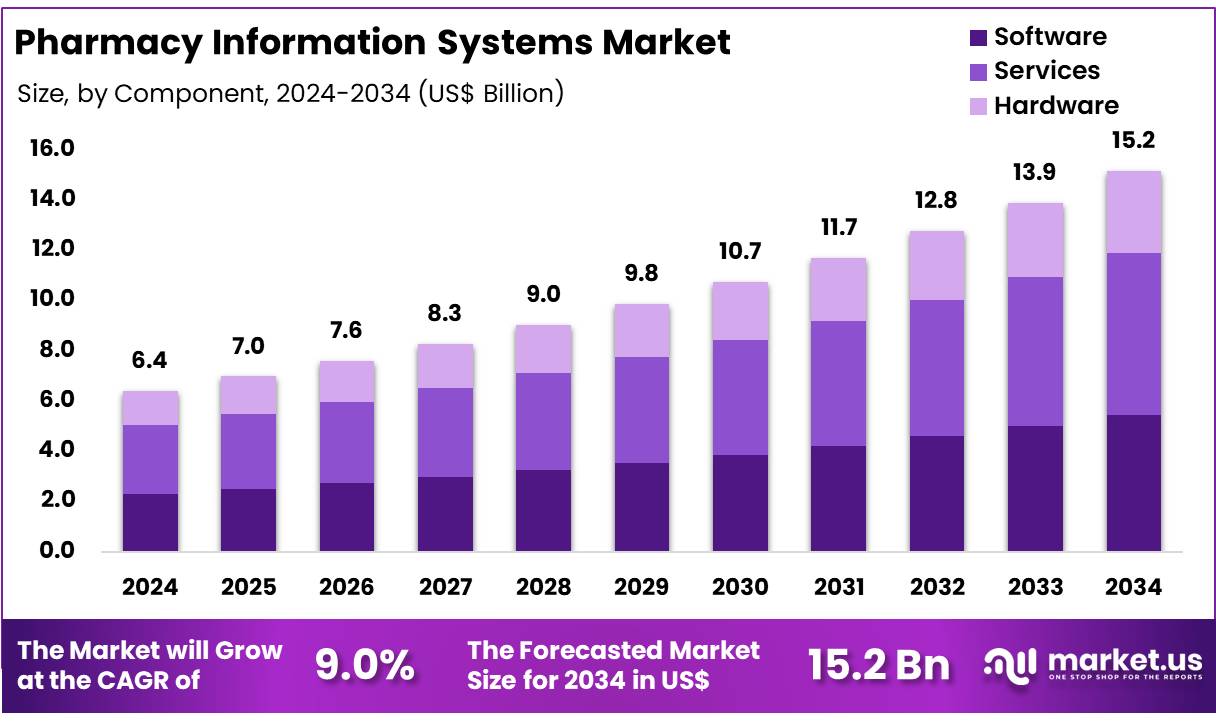
Key Takeaways
- Market Size: The global Pharmacy Information Systems market is projected to grow from US$ 6.4 billion in 2024 to approximately US$ 15.2 billion by 2034.
- Market Growth: The market is anticipated to expand at a compound annual growth rate (CAGR) of 9.0% during the forecast period from 2025 to 2034.
- Component Analysis: In 2024, the services segment led the market, accounting for 42.6% of the overall market share.
- Deployment Model Analysis: The leading deployment model segment captured 39.8% of the total market share in 2024.
- Application Analysis: Inventory management emerged as the largest application segment in 2024, representing 25.4% of the global market.
- End-Use Analysis: Inpatient pharmacies dominated the end-use segment in 2024, holding 63.9% of the total market share.
- Regional Analysis: North America maintained its leading position in 2024, capturing 37.7% of the global market and generating a market value of US$ 2.4 billion.
Statistical Information
- Medication Safety Drives Adoption of Pharmacy Information Systems: Medication safety remains one of the strongest reasons healthcare providers implement Pharmacy Information Systems (PIS). The World Health Organization (WHO) estimates that medication errors cost the global healthcare system approximately US$42 billion every year. Electronic prescribing, clinical decision support, and automated medication verification available in PIS help reduce prescribing and dispensing errors while improving patient safety.
- Computerized Provider Order Entry (CPOE) Reduces Medication Errors: Computerized Provider Order Entry (CPOE), a core function of many Pharmacy Information Systems, significantly improves medication safety. A nationwide U.S. analysis found that processing medication orders through CPOE reduced the likelihood of medication errors by 48%. Researchers also estimated that CPOE prevented approximately 17.4 million medication errors annually in U.S. hospitals.
- Hospital Pharmacy Informatics Adoption Continues to Expand: The American Society of Health-System Pharmacists (ASHP) reported that nearly 33% of U.S. hospitals had completely electronic health records, while adoption of clinical decision support, computerized prescriber order entry (CPOE), electronic prescribing, and barcode medication administration continued to increase as priorities for hospital pharmacies.
- Clinical Decision Support Improves Medication Management: Clinical Decision Support Systems (CDSS), integrated into Pharmacy Information Systems, help pharmacists identify drug interactions, allergies, and dosing issues. The National Center for Biotechnology Information (NCBI) reports that multiple studies found CPOE combined with decision support significantly reduced medication errors, with one hospital reporting approximately a 40% reduction following implementation.
- High Prescription Medicine Usage Increases Demand for Digital Pharmacy Systems: According to the U.S. Centers for Disease Control and Prevention (CDC), approximately 59% of U.S. adults used at least one prescription medication within the previous 12 months, creating substantial demand for efficient pharmacy information systems to manage prescriptions, refills, medication histories, and patient safety.
- Electronic Prescribing Continues to Expand Across the U.S.: Electronic prescribing (e-prescribing), a major component of Pharmacy Information Systems, has become the standard in the United States. According to the Centers for Medicare & Medicaid Services (CMS), more than 80% of all prescriptions covered under Medicare Part D are transmitted electronically, improving prescription accuracy and reducing transcription errors.
- Barcode Medication Administration Improves Patient Safety: Barcode Medication Administration (BCMA), commonly integrated with Pharmacy Information Systems, helps ensure the right patient receives the right medication at the correct dose and time. The U.S. Agency for Healthcare Research and Quality (AHRQ) reports that BCMA systems can reduce medication administration errors by up to 50% in hospital settings.
- Adverse Drug Events Result in Significant Hospitalizations: Medication-related harm remains a major healthcare challenge. According to the Agency for Healthcare Research and Quality (AHRQ), adverse drug events (ADEs) account for more than 1.5 million preventable injuries each year in the United States and contribute to substantial healthcare utilization, reinforcing the need for advanced Pharmacy Information Systems.
- Hospital Pharmacies Are Expanding Automation: According to the American Society of Health-System Pharmacists (ASHP) National Survey, approximately 97% of hospitals use automated dispensing cabinets, while barcode verification and pharmacy automation technologies continue to expand to improve medication distribution efficiency and patient safety.
- Older Adults Drive Prescription Medication Demand: According to the U.S. Centers for Disease Control and Prevention (CDC), approximately 89% of adults aged 65 years and older reported using at least one prescription medication during the previous 12 months. This high medication utilization increases the need for Pharmacy Information Systems that support medication reconciliation and chronic disease management.
Regional Analysis
North America held a dominant market position, capturing more than 37.7% share
In 2024, North America dominated the Pharmacy Information Systems market due to widespread adoption of electronic health records (EHRs), advanced healthcare IT infrastructure, and supportive government initiatives promoting digital health. The United States led regional growth with strong hospital networks, pharmacy automation, and strict medication safety regulations.
Europe held the second-largest share, supported by increasing implementation of e-prescriptions, interoperable healthcare systems, and national digital health strategies. Countries such as Germany, France, and the Nordic nations continue investing in integrated pharmacy management technologies. Asia-Pacific is expected to witness the fastest growth, driven by expanding healthcare infrastructure, rapid digitalization, rising healthcare spending, and government programs encouraging electronic prescribing in countries including China, Japan, and India.
Meanwhile, the Rest of the World, including Latin America, the Middle East, and Africa, is gradually adopting pharmacy information systems as healthcare modernization initiatives expand. Although infrastructure limitations and funding challenges remain, ongoing digital health investments are expected to support steady regional market growth over the coming years.
Emerging Trends
- Expansion of Electronic Prescribing (e-Prescribing): Electronic prescribing is becoming a standard practice across healthcare systems to reduce prescription errors and improve patient safety. The U.S. Centers for Medicare & Medicaid Services (CMS) has finalized the NCPDP SCRIPT 2023011 standard, which becomes mandatory for Medicare Part D by January 1, 2028, supporting secure and standardized prescription exchange.
- Greater Integration with Electronic Health Records (EHRs): Pharmacy information systems are increasingly integrated with EHR platforms, enabling pharmacists and physicians to access complete medication histories. According to the CDC National Electronic Health Records Survey, nationwide EHR adoption has expanded significantly since 2008, improving medication reconciliation and coordinated patient care.
- Growth of Real-Time Prescription Benefit Tools: Hospitals and pharmacies are adopting real-time prescription benefit technologies that display insurance coverage, patient costs, and medication alternatives during prescribing. These tools help improve affordability, reduce treatment delays, and support better prescribing decisions across healthcare organizations.
- Increasing Use of AI and Clinical Decision Support: Artificial intelligence is being incorporated into pharmacy systems to identify drug interactions, optimize medication therapy, and support clinical decisions. The U.S. FDA processes more than 300,000 electronic regulatory submissions annually, highlighting the growing need for standardized digital pharmacy data and automated workflows.
- Improved Health Information Exchange and Interoperability: Governments continue promoting interoperable healthcare systems that securely exchange prescription and patient medication data. Secure information sharing between pharmacies, hospitals, and healthcare providers improves care coordination, reduces duplicate therapies, and enhances medication safety while maintaining patient privacy.
Use Cases
- Medication Error Prevention: Pharmacy information systems automatically check for allergies, duplicate therapies, and drug interactions before medicines are dispensed. These safety features help pharmacists reduce dispensing errors and improve patient outcomes in hospitals, clinics, and retail pharmacies.
- Hospital Pharmacy Inventory Management: Healthcare facilities use pharmacy information systems to monitor medicine inventory, automate stock replenishment, and reduce medication shortages. Digital inventory tracking improves operational efficiency, minimizes wastage, and ensures critical medicines remain available for patient care.
- Electronic Prescription Processing: Pharmacies receive prescriptions electronically from healthcare providers, reducing paperwork and improving dispensing speed. Electronic prescription workflows also minimize handwriting errors, improve prescription accuracy, and support faster medication delivery to patients.
- Support for Regulatory Compliance: Pharmacy information systems help healthcare organizations maintain accurate medication records, generate audit reports, and comply with national healthcare regulations. Automated documentation reduces administrative workload while supporting quality assurance and patient safety initiatives.
- Integration with Digital Healthcare Services: Modern pharmacy information systems connect with telemedicine platforms, laboratory systems, and electronic health records to provide complete medication management. This integration enables healthcare professionals to access real-time patient information and deliver more coordinated, efficient, and personalized care.
Frequently Asked Questions on
- What is the Pharmacy Information Systems Market?
The Pharmacy Information Systems Market includes software solutions designed for hospitals, retail pharmacies, and healthcare organizations to automate pharmacy operations. Market growth is driven by increasing healthcare digitalization, electronic prescribing adoption, and rising demand for accurate medication management systems. - What are the major drivers of the Pharmacy Information Systems Market?
Key market drivers include increasing implementation of electronic health records, rising medication safety concerns, growing hospital automation, expanding healthcare IT investments, and government initiatives supporting digital healthcare. These factors encourage healthcare providers to adopt integrated pharmacy management solutions. - Which healthcare settings use Pharmacy Information Systems?
Pharmacy information systems are widely used in hospitals, retail pharmacies, specialty pharmacies, long-term care facilities, and outpatient clinics. These organizations use the systems to improve prescription accuracy, manage inventories efficiently, reduce medication errors, and enhance overall patient care quality. - What is the future outlook for the Pharmacy Information Systems Market?
The market is expected to grow steadily due to increasing adoption of cloud-based pharmacy software, artificial intelligence, telepharmacy, and interoperable healthcare systems. Rising healthcare digitalization and continuous investments in hospital information technology will create significant opportunities for future market expansion. - How does a Pharmacy Information System improve patient safety?
A Pharmacy Information System improves patient safety by identifying potential drug interactions, allergy risks, duplicate therapies, and incorrect dosages before medicines are dispensed. Automated clinical alerts help pharmacists and healthcare providers reduce medication errors and improve treatment outcomes. - What technologies are commonly integrated with Pharmacy Information Systems?
Modern Pharmacy Information Systems integrate with electronic health records, laboratory information systems, computerized physician order entry, barcode medication administration, cloud platforms, and telepharmacy solutions. These integrations enable seamless data exchange, faster prescription processing, and improved healthcare coordination. - Why are hospitals investing in Pharmacy Information Systems?
Hospitals invest in Pharmacy Information Systems to automate medication management, improve inventory control, reduce dispensing errors, and enhance operational efficiency. These systems also support regulatory compliance, optimize pharmacy workflows, and improve communication among healthcare professionals. - How does cloud technology benefit Pharmacy Information Systems?
Cloud-based Pharmacy Information Systems provide secure remote access, lower infrastructure costs, automatic software updates, and easier scalability. They also improve collaboration between multiple pharmacy locations while enabling healthcare organizations to manage patient and medication data more efficiently. - What role does artificial intelligence play in Pharmacy Information Systems?
Artificial intelligence helps Pharmacy Information Systems analyze prescription data, identify medication risks, predict inventory demand, and support clinical decision-making. AI-powered tools also improve pharmacy workflow efficiency and assist healthcare professionals in delivering safer and more personalized patient care. - How do Pharmacy Information Systems support regulatory compliance?
Pharmacy Information Systems maintain accurate electronic medication records, automate reporting, and generate audit trails required by healthcare authorities. These capabilities help healthcare organizations comply with national regulations, pharmacy standards, and patient safety requirements while reducing administrative workload.
Conclusion
The Pharmacy Information Systems market is experiencing steady growth as healthcare organizations increasingly adopt digital technologies to improve medication management, patient safety, and operational efficiency. Rising implementation of electronic health records, e-prescribing, cloud-based platforms, and artificial intelligence is transforming pharmacy workflows across hospitals, retail pharmacies, and specialty care facilities.
Government initiatives supporting healthcare digitalization and interoperability continue to accelerate market adoption worldwide. While implementation costs and cybersecurity concerns remain challenges, ongoing investments in healthcare IT infrastructure and growing demand for integrated pharmacy solutions are expected to create significant long-term opportunities, making pharmacy information systems an essential component of modern healthcare delivery.
Discuss your needs with our analyst
Please share your requirements with more details so our analyst can check if they can solve your problem(s)




