


Overview
New York, NY – July 29, 2026 – The Global Latex Agglutination Test Kits Market size is expected to be worth around US$ 1.2 Billion by 2034 from US$ 0.7 Billion in 2024, growing at a CAGR of 5.8% during the forecast period 2025 to 2034. In 2024, North America led the market, achieving over 42.4% share with a revenue of US$ 0.3 Billion.
The global latex agglutination test kits market is witnessing strong and sustained growth, underpinned by the rising incidence of infectious and autoimmune diseases and the accelerating shift toward rapid, decentralized diagnostic solutions. Latex agglutination kits provide a convenient, cost‑effective method for detecting a broad spectrum of pathogens and biomarkers, making them a preferred option in hospital laboratories, decentralized point‑of‑care settings, and research institutions.
Recent market analyses indicate that the latex agglutination test kits market was valued at approximately US$ 630–640 million in 2023 and is forecast to exceed US$ 1.08 billion by 2033, reflecting a robust compound annual growth rate of about 5.5–5.7 % over the period. This upward trajectory is closely linked to the growing global burden of infectious diseases. The World Health Organization reports that cardiovascular diseases alone account for an estimated 17.9 million deaths per year worldwide, underscoring the scale of unmet diagnostic needs across major disease areas.
At the same time, the U.S. Centers for Disease Control and Prevention is working with 190 countries to strengthen laboratory detection of vaccine‑preventable and emerging pathogens, and with more than 1,800 laboratories and clinical sites to expand molecular testing capacity for HIV, tuberculosis, and other infections. These initiatives, combined with increasing numbers of training programs in laboratory techniques such as latex agglutination, are expected to further accelerate adoption of latex agglutination test kits globally.
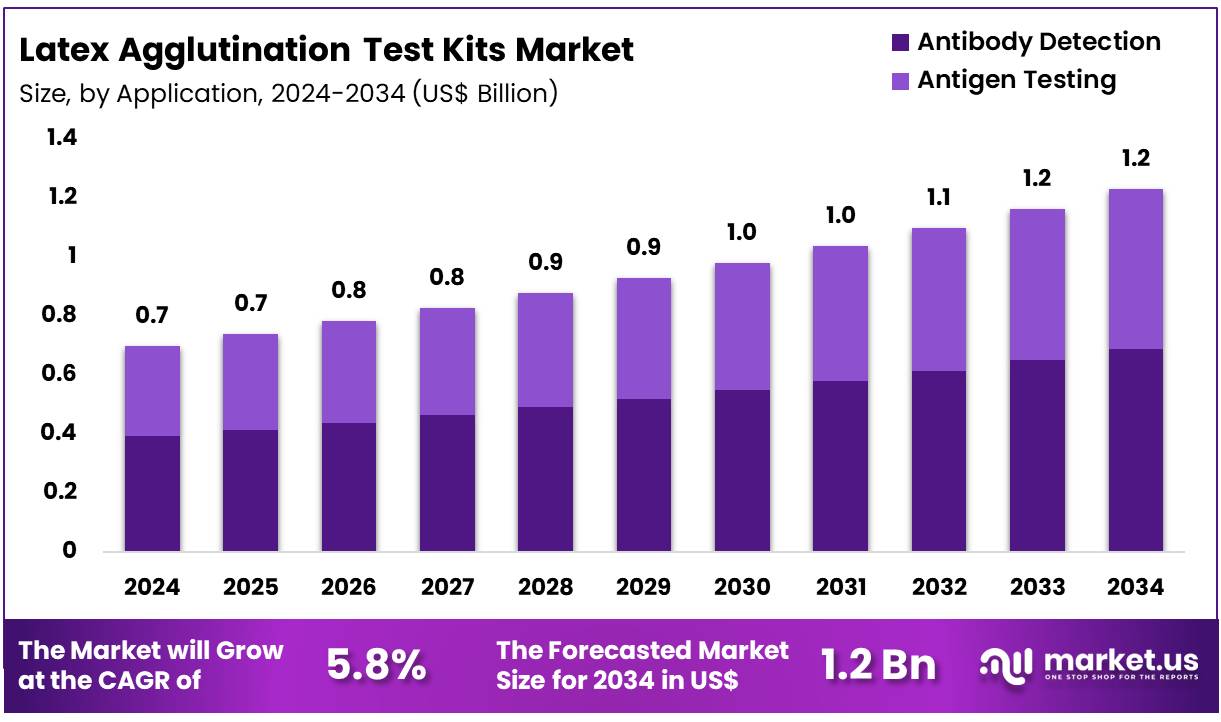
Key Takeaways
- In 2024, the latex agglutination test kits market generated revenues of US$ 0.7 billion and is expanding at a compound annual growth rate (CAGR) of 5.8%, with projections indicating it will reach approximately US$ 1.2 billion by 2034.
- By product type, the market is categorized into ELISA, serum neutralization, indirect fluorescent, and hemagglutination inhibition, with ELISA emerging as the leading segment in 2023, accounting for 38.7% of the market share.
- From a technology perspective, the market is segmented into blood, cerebrospinal fluid, urine, and others, with blood‑based testing representing the most significant portion, capturing 41.5% of the market.
- In terms of application, the market is divided into antibody detection and antigen testing, where antibody detection remains the dominant segment, generating 55.9% of total revenue in the latex agglutination test kits market.
- Across end‑user categories, the market is segmented into hospital pharmacies, online pharmacies, and retail pharmacies, with hospital pharmacies holding the leading position and contributing 47.6% of revenue.
- Regionally, North America continues to lead the latex agglutination test kits market, securing a 42.4% share of global revenues in 2023.
Statistical Information
- Global Burden Of Infectious Diseases And Need For Rapid Diagnostics: The World Health Organization estimates that noncommunicable diseases cause 41 million deaths annually, representing 74% of all global deaths, while communicable diseases, maternal, neonatal, and nutritional conditions together account for about 26% of global mortality, underscoring the scale of demand for timely diagnostics alongside chronic disease care.
- Performance Characteristics Of Latex Agglutination Assays: A clinical evaluation of a simple latex agglutination assay for rapid serodiagnosis of human gnathostomiasis reported a mean overall sensitivity of 82.3% and mean overall specificity of 94.6%, demonstrating that latex agglutination can deliver high diagnostic accuracy in real‑world patient testing while remaining easy to perform without extensive technical expertise.
- Public Health Surveillance And Laboratory Capacity Strengthening: CDC global health programs support interoperable surveillance systems and laboratory networks in more than 60 countries, using standardized data to detect, identify, and monitor disease threats; these efforts underpin the deployment and sustained use of rapid diagnostic tools, including agglutination‑based assays, within national public health laboratories and partner facilities.
- Performance statistics for cryptococcal antigen kits: The study found that 10 of the 24 kits (41.7%) were reliable for detecting and titrating antigen in clinical materials, while 14 of 24 kits (58.3%) were rated unsatisfactory because their latex suspensions failed to agglutinate the positive polysaccharide control at acceptable levels.
- Clinical Usage and Performance Evidence: A clinical study on von Willebrand factor detection using rapid latex agglutination (Malaysia) reported that the assay correctly identified von Willebrand disease cases with a sensitivity of 90.9% and specificity of 93.3%, supporting its use as a routine screening tool in hematology labs.
- Global Cryptococcal Disease Burden Drives Antigen Testing Demand: Cryptococcal meningitis remains a major driver for latex agglutination-based antigen testing. WHO estimates that cryptococcal meningitis causes approximately 152,000 cases and 112,000 deaths annually worldwide, mainly affecting people with advanced HIV infection. Rapid antigen detection helps enable early diagnosis and treatment.
- HIV-Associated Infections Increase Diagnostic Testing Requirements: Cryptococcal meningitis is strongly linked with immune suppression, especially HIV infection. WHO reports that cryptococcal meningitis contributes to around 15% of AIDS-related deaths globally, creating continued demand for cryptococcal antigen detection methods, including latex agglutination tests.
Regional Analysis
North America continues to lead the latex agglutination test kits market, securing a 42.4% share
North America remains a leading market for latex agglutination test kits, supported by advanced healthcare infrastructure, high diagnostic testing capacity, and the continued burden of infectious diseases. The United States experiences significant demand for rapid diagnostic solutions due to seasonal and emerging infections.
According to the CDC, the 2023–2024 influenza season resulted in approximately 40 million illnesses, 470,000 hospitalizations, and 28,000 deaths, highlighting the importance of quick and accessible diagnostic methods. The presence of well-established clinical laboratories, hospitals, and point-of-care testing networks further supports adoption of these kits.
Asia Pacific is projected to witness strong growth, driven by increasing infectious disease prevalence, expanding healthcare access, and government-led disease surveillance programs. WHO highlights the continued need for rapid and accurate diagnostic testing, particularly for diseases such as tuberculosis, where early detection is essential for effective treatment. Growing investments in healthcare infrastructure and increasing availability of diagnostic facilities across developing economies are expected to accelerate the adoption of affordable latex agglutination testing solutions.
Emerging Trends
- Growing Adoption of Rapid Point-of-Care Diagnostic Testing: Latex agglutination test kits are increasingly used in point-of-care settings because they provide quick results without complex laboratory equipment. These tests can deliver outcomes within approximately 15 minutes to 1 hour, supporting faster clinical decisions, especially in emergency and resource-limited healthcare environments.
- Increasing Use in Infectious Disease Surveillance Programs: Governments and healthcare organizations are expanding infectious disease monitoring programs, increasing demand for simple diagnostic methods. Latex agglutination tests are used for detecting bacterial and fungal infections, including meningitis-related pathogens and cryptococcal infections. WHO-supported evaluations reported CSF latex testing sensitivity of 98.2% and specificity of 96.8% across 16 studies.
- Expansion of Diagnostic Applications Beyond Traditional Testing: Latex agglutination technology is being applied across multiple diseases, including tuberculosis, streptococcal infections, leptospirosis, and toxin detection. The ability to detect specific antigens or antibodies from blood, urine, saliva, and cerebrospinal fluid increases its usefulness across hospitals and clinical laboratories.
- Rising Demand for Affordable Diagnostics in Low-Resource Regions: Healthcare systems in developing regions are focusing on low-cost diagnostic solutions that require minimal infrastructure. Latex agglutination tests support decentralized testing because they are easy to perform and do not require advanced instruments. Studies on leptospirosis testing showed results could be obtained within minutes with high usability in peripheral healthcare facilities.
- Integration of Digital Technologies for Quantitative Test Interpretation: Emerging innovations are combining agglutination-based testing with digital imaging and artificial intelligence to improve accuracy and automation. Research using mobile imaging and deep learning demonstrated quantitative particle agglutination analysis with 189 measurements from 88 patient samples, supporting future smart diagnostic platforms.
Use Cases
- Rapid Detection of Cryptococcal Infections in Immunocompromised Patients: Latex agglutination tests are widely used for detecting cryptococcal antigen in cerebrospinal fluid, particularly among people with HIV. WHO evaluations showed strong diagnostic performance, making these tests valuable for early treatment decisions and reducing complications from fungal meningitis.
- Screening for Bacterial Meningitis and Respiratory Infections: Hospitals use latex agglutination kits to identify bacterial antigens associated with serious infections such as meningitis. The method enables faster identification compared with conventional culture methods, helping physicians begin appropriate antimicrobial treatment sooner.
- Tuberculosis Diagnosis and Mass Screening Programs: Latex agglutination assays are being explored as supportive diagnostic tools for tuberculosis, especially where laboratory resources are limited. Research involving 1,058 patient samples demonstrated sensitivity of 94% for pulmonary tuberculosis and 87% for extrapulmonary tuberculosis detection.
- Veterinary and Zoonotic Disease Detection Applications: Latex agglutination testing is increasingly useful for identifying infections transmitted between animals and humans, including diseases such as leptospirosis. These applications support agricultural health monitoring and public health surveillance by enabling rapid screening with limited laboratory requirements.
- Hospital Laboratory Screening for Antigen and Antibody Detection: Clinical laboratories use latex agglutination kits for detecting specific antigens and antibodies in samples such as blood, urine, and cerebrospinal fluid. Their simple workflow, rapid turnaround time, and ability to support multiple diagnostic areas make them suitable for routine laboratory testing.
Frequently Asked Questions on Latex Agglutination Test Kits Market
- How do latex agglutination test kits work?
Latex agglutination tests work by mixing patient samples with latex particles coated with antibodies or antigens. If the targeted pathogen or biomarker exists, the particles bind together and create visible agglutination. This reaction helps provide rapid diagnostic information within minutes. - What factors are driving the growth of the latex agglutination test kits market?
The latex agglutination test kits market is growing due to increasing infectious disease prevalence, rising demand for rapid diagnostics, expanding healthcare infrastructure, and greater adoption of point-of-care testing. Their low cost, simple operation, and quick results support widespread clinical usage globally. - Which diseases can be detected using latex agglutination test kits?
Latex agglutination test kits are used for detecting various infectious diseases, including bacterial meningitis, cryptococcal infections, streptococcal infections, tuberculosis-related conditions, and other microbial diseases. These tests support early diagnosis by identifying specific antigens or antibodies present in patient samples. - Why are latex agglutination tests preferred in developing regions?
Latex agglutination tests are preferred in developing regions because they require minimal equipment, trained personnel, and infrastructure compared with advanced diagnostic technologies. Their affordability and rapid performance make them suitable for rural healthcare centers and resource-limited settings requiring accessible disease detection solutions. - What role do hospitals and diagnostic laboratories play in market growth?
Hospitals and diagnostic laboratories are major users of latex agglutination kits because they require fast and reliable testing methods for infectious diseases. Increasing laboratory networks, higher patient testing volumes, and demand for efficient diagnostic workflows continue to support market expansion worldwide. - What are the major applications of latex agglutination test kits?
Major applications of latex agglutination test kits include infectious disease diagnosis, antigen detection, antibody testing, cerebrospinal fluid analysis, blood testing, and veterinary diagnostics. Their ability to analyze different biological samples makes them valuable across clinical, research, and public health environments. - How is technology advancement influencing the latex agglutination test kits market?
Technological advancements are improving latex agglutination test kits through enhanced sensitivity, better specificity, automated interpretation systems, and integration with digital diagnostic platforms. These innovations help reduce human errors, improve testing accuracy, and increase adoption across modern healthcare facilities. - Which regions are expected to witness significant growth in the latex agglutination test kits market?
North America currently represents a strong market due to advanced healthcare systems and diagnostic infrastructure. Asia Pacific is expected to experience significant growth because of rising infectious disease burden, healthcare investments, expanding laboratories, and increasing adoption of affordable diagnostic technologies.
Conclusion
The latex agglutination test kits market is expected to grow steadily due to increasing infectious disease prevalence, rising demand for rapid diagnostics, and expanding healthcare access worldwide. These kits remain valuable because of their affordability, simple operation, and ability to deliver quick results in hospitals, laboratories, and resource-limited settings.
North America continues to lead due to strong healthcare infrastructure, while Asia Pacific offers significant growth opportunities through improved diagnostic networks and government health initiatives. Technological advancements, digital integration, and broader clinical applications will further enhance market adoption. However, competition from advanced molecular testing methods remains a key challenge for future growth.
Discuss your needs with our analyst
Please share your requirements with more details so our analyst can check if they can solve your problem(s)




