


Overview
New York, NY – Aug 06, 2026 – The Global Stereotactic Planning Software Market Size is expected to be worth around US$ 463.9 Million by 2034 from US$ 304.5 Million in 2024, growing at a CAGR of 4.3% during the forecast period 2025 to 2034. North America held a dominant market position, capturing more than a 38.9% share and holding a US$ 118.5 Million market value for the year.
The stereotactic planning software market is growing steadily due to the rising prevalence of brain tumors, neurological disorders, and cancer cases requiring highly accurate radiation therapy. The software is an essential tool for stereotactic radiosurgery (SRS) and stereotactic radiotherapy, helping clinicians create precise treatment plans, improve tumor targeting, and reduce radiation exposure to surrounding healthy tissues.
The increasing burden of neurological cancers is a major growth factor. According to the American Brain Tumor Association, more than 90,000 new primary brain and central nervous system tumor cases are diagnosed annually in the United States, while nearly 700,000 people are living with a brain tumor diagnosis. Globally, central nervous system cancers contribute to more than 300,000 new cases each year, increasing the demand for advanced treatment planning solutions.
The need for precision oncology is further driving adoption. The National Cancer Institute reports that the five-year relative survival rate for malignant brain tumors is approximately 36%, highlighting the importance of targeted therapies. Stereotactic planning software enables radiation delivery accuracy of around 1 millimeter, supporting improved clinical outcomes.
Technological advancements, including artificial intelligence (AI), automated treatment planning, and advanced imaging integration, are transforming the market. AI-powered solutions help analyze complex patient data and optimize personalized treatment plans. With more than 50,000 radiation therapy centers worldwide and increasing adoption of minimally invasive cancer treatments, demand for advanced stereotactic planning software is expected to rise significantly in the coming years.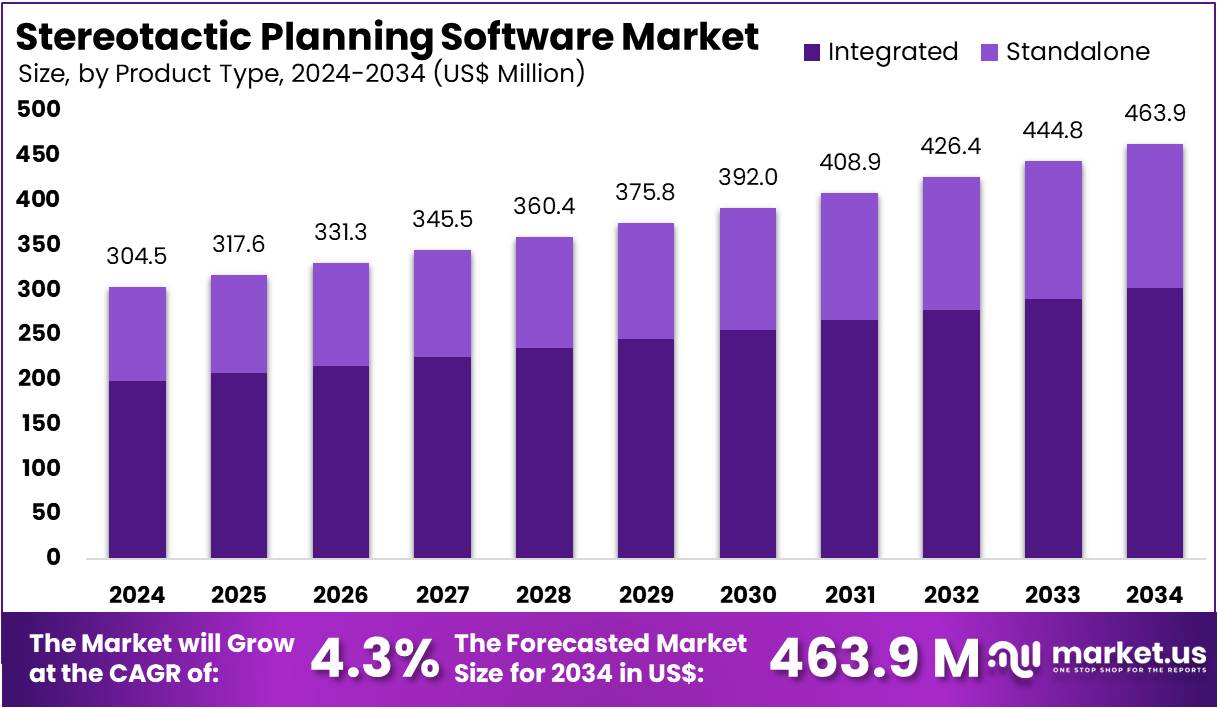
Key Takeaways
- In 2024, the stereotactic planning software market generated revenue of US$ 304.5 million and is projected to grow at a CAGR of 4.3%, reaching approximately US$ 463.9 million by 2034.
- Based on product type, the market is segmented into integrated and standalone solutions. The integrated segment dominated in 2023, accounting for a 65.3% market share.
- By application, the market is categorized into CT images, PET/CT, and MRI images. Among these, the CT images segment held a leading position with a 45.2% share in 2023.
- Regionally, North America dominated the stereotactic planning software market in 2023, capturing a significant 38.9% market share due to advanced healthcare infrastructure and high adoption of radiation therapy technologies.
Statistical Information
- Rising Brain Tumor Incidence Increasing Demand for Precision Treatment Planning: The increasing number of brain and central nervous system (CNS) tumors is driving the need for advanced stereotactic planning software. In the United States, approximately 24,740 new malignant brain and spinal cord tumor cases are estimated for 2026, representing about 1.2% of all new cancer cases. Additionally, around 18,350 deaths are expected from these cancers, highlighting the need for highly accurate radiation treatment approaches.
- Poor Survival Outcomes Highlight the Need for Advanced Stereotactic Radiation Solutions: Brain and other nervous system cancers continue to have significant unmet clinical needs. Data from the National Cancer Institute’s SEER program shows that the five-year relative survival rate for brain and other nervous system cancers is approximately 32.9% based on cases diagnosed between 2016–2022. This survival challenge supports the adoption of precise radiation planning technologies that improve tumor targeting.
- Growing Volume of Brain and CNS Tumor Cases Supports Imaging-Based Planning Demand: The Central Brain Tumor Registry of the United States (CBTRUS) reported an average annual incidence rate of 25.34 cases per 100,000 population for primary malignant and non-malignant brain and CNS tumors during 2017–2021. The report also recorded 87,053 deaths related to malignant brain and CNS tumors during the same period, demonstrating the continued need for advanced treatment planning platforms.
- Large-Scale Radiation Therapy Data Supports Advanced Planning Software Development: Radiotherapy planning systems increasingly depend on integration of large clinical datasets. A recent multi-institutional framework demonstrated successful processing of 6,022 patients and 13,871 treatment plans with a 99.76% processing success rate, showing the importance of digital treatment planning infrastructure in radiation oncology.
- AI Automation Can Reduce Treatment Planning Time and Improve Workflow Efficiency: AI-driven radiation therapy planning technologies are being developed to reduce manual workload and improve consistency. Research on AI-based treatment planning demonstrated the ability to generate radiation therapy plans rapidly by using deep-learning models trained on more than 10,000 clinical cases, supporting faster and standardized treatment workflows.
- High Localized Diagnosis Rates Increase Need for Precise Tumor Targeting: According to SEER cancer statistics, approximately 77% of brain and nervous system cancer cases are diagnosed at the localized stage, where precise treatment planning can play an important role in controlling tumors while minimizing damage to healthy brain structures.
- Radiation Therapy Software Regulation Supports Growth of Advanced Planning Platforms: The FDA classifies radiation therapy image processing software as Class II medical devices under regulation 892.2050, requiring regulatory review through pathways such as 510(k). This regulatory framework supports the development of safe and clinically validated software solutions for radiation treatment workflows.
- Global Expansion of Radiotherapy Infrastructure Supports Treatment Planning Software Adoption: The increasing availability of radiotherapy infrastructure worldwide is creating demand for advanced treatment planning systems. The International Atomic Energy Agency (IAEA) Directory of Radiotherapy Centres (DIRAC) tracks more than 8,500 radiotherapy centers and over 20,000 radiotherapy units across 150+ countries, demonstrating the growing global radiation oncology ecosystem.
- Growing Cancer Burden Creates Need for Personalized Radiation Approaches: The World Health Organization (WHO) estimates that cancer caused nearly 10 million deaths worldwide in 2022, with approximately 20 million new cancer cases diagnosed globally. The increasing complexity of cancer treatment requires personalized approaches supported by advanced imaging and treatment planning technologies.
Regional Analysis
North America led the market by securing a market share of 38.9% in 2023.
North America holds a leading position in the stereotactic planning software market due to advanced healthcare infrastructure, high adoption of radiation oncology technologies, and strong investment in cancer research. The United States continues to experience a significant cancer burden, with the National Cancer Institute reporting approximately 2 million new cancer cases expected in 2024, increasing demand for precise treatment planning solutions such as stereotactic radiosurgery.
The region also benefits from rapid adoption of artificial intelligence in healthcare, with the U.S. FDA authorizing more than 950 AI-enabled medical devices by 2024, supporting innovation in medical imaging and treatment planning. Strong presence of leading healthcare technology companies and increasing integration of CT, MRI, and PET imaging systems further strengthen market growth.
Asia Pacific is expected to witness significant growth due to rising cancer incidence, healthcare modernization, and increasing adoption of advanced medical technologies. According to WHO, Asia accounts for nearly half of global cancer cases and cancer deaths, creating demand for improved oncology treatment solutions.
Countries including China, Japan, and South Korea are investing heavily in digital healthcare infrastructure and precision medicine. Expansion of hospitals, increasing access to radiation therapy, and government-supported healthcare technology programs are expected to accelerate the adoption of stereotactic planning software across the region.
Emerging Trends
- Growing Integration of Artificial Intelligence in Treatment Planning: Artificial intelligence is becoming a major trend in stereotactic planning software by improving image analysis, treatment optimization, and workflow automation. The U.S. FDA reported authorization of more than 950 AI-enabled medical devices by August 2024, supporting wider adoption of AI-based healthcare technologies.
- Increasing Adoption of Personalized Radiation Therapy Solutions: Personalized treatment planning is gaining importance as oncology care becomes more patient-specific. The National Cancer Institute estimates nearly 2 million new cancer cases in the United States in 2024, increasing demand for software that uses patient imaging data to develop accurate stereotactic radiation treatment plans.
- Advanced Imaging Integration with CT, MRI, and PET Technologies: Stereotactic planning platforms are increasingly integrating CT, MRI, and PET imaging technologies to improve tumor identification and treatment accuracy. The FDA recognizes medical imaging systems as essential tools supporting radiation oncology workflows and advanced treatment planning processes.
- AI-Based Automation for Faster Radiation Treatment Workflows: Automated segmentation, dose calculation, and treatment optimization are improving radiation therapy efficiency. AI-powered solutions help analyze large clinical datasets and reduce manual workload, enabling radiation specialists to develop more consistent and accurate treatment plans for complex cancer cases.
- Growth of Precision Oncology and Minimally Invasive Treatments: Precision oncology is increasing demand for stereotactic planning software due to its ability to deliver highly targeted radiation therapy. The World Health Organization reported nearly 20 million new cancer cases and 10 million cancer deaths globally in 2022, highlighting the need for advanced treatment technologies.
Use Cases
- Brain Tumor and Central Nervous System Cancer Treatment: Stereotactic planning software is widely used for brain tumors and neurological lesions by enabling accurate radiation targeting. The American Cancer Society reports approximately 24,000 new brain and spinal cord cancer cases annually in the U.S., supporting demand for advanced treatment planning systems.
- Treatment Planning for Brain Metastases: The software supports stereotactic radiosurgery for brain metastases by helping physicians deliver focused radiation while protecting healthy brain tissue. The National Cancer Institute estimates brain metastases occur in approximately 10%–30% of adults with cancer, increasing the need for precision radiation planning.
- Stereotactic Body Radiation Therapy (SBRT) Applications: Stereotactic planning software is used for SBRT procedures targeting tumors in the lung, liver, spine, and prostate. The National Cancer Institute states that around 50% of cancer patients receive radiation therapy during treatment, supporting continued adoption of advanced planning solutions.
- Adaptive Radiation Therapy and Real-Time Treatment Optimization: Advanced planning software supports adaptive radiation therapy by updating treatment plans based on changing patient anatomy. The International Atomic Energy Agency promotes advanced radiotherapy approaches to improve treatment accuracy and expand access to modern cancer care technologies.
- Integration with Hospital Digital Healthcare Systems: Stereotactic planning software is increasingly connected with hospital information systems, imaging platforms, and oncology databases to improve workflow efficiency. The IAEA reports more than 8,500 radiotherapy centers worldwide, creating a strong environment for adoption of digital treatment planning solutions.
Frequently Asked Questions on Stereotactic Planning Software Market
- What factors are driving the growth of the stereotactic planning software market?
The market growth is driven by rising cancer incidence, increasing adoption of precision oncology, growing demand for minimally invasive treatments, and advancements in artificial intelligence. Healthcare providers are increasingly using advanced planning tools to improve radiation accuracy and patient outcomes. - How does artificial intelligence impact stereotactic planning software?
Artificial intelligence enhances stereotactic planning software by automating image segmentation, optimizing radiation doses, and reducing treatment planning time. AI-based algorithms help radiation oncologists analyze complex patient data and develop personalized treatment strategies with improved accuracy and workflow efficiency. - Which imaging technologies are used with stereotactic planning software?
Stereotactic planning software commonly integrates imaging technologies such as computed tomography (CT), magnetic resonance imaging (MRI), and positron emission tomography (PET/CT). These imaging systems provide detailed anatomical information that helps clinicians accurately locate tumors and design targeted radiation treatment plans. - What are the major applications of stereotactic planning software?
The major applications include brain tumor treatment, brain metastases management, stereotactic radiosurgery, stereotactic body radiation therapy, and treatment planning for lung, liver, and prostate cancers. These applications support precise radiation delivery and improve clinical decision-making for complex cancer cases. - Why is North America a leading region in the stereotactic planning software market?
North America leads due to advanced healthcare infrastructure, high cancer treatment demand, strong research activities, and early adoption of innovative radiation technologies. The presence of leading medical technology companies and advanced oncology centers further supports regional market expansion. - What role does personalized medicine play in this market?
Personalized medicine increases demand for stereotactic planning software by enabling customized treatment plans based on individual patient imaging and clinical information. These solutions help physicians select appropriate radiation doses and improve treatment outcomes through data-driven oncology approaches. - How is stereotactic planning software improving cancer treatment outcomes?
The software improves cancer treatment outcomes by enabling accurate tumor targeting, optimized radiation delivery, and reduced damage to healthy tissues. It supports radiation oncologists in developing safer and more effective treatment plans for patients with complex tumors. - What future trends are expected in the stereotactic planning software market?
Future trends include greater AI integration, cloud-based treatment planning, automated workflows, advanced imaging fusion, and improved interoperability with hospital systems. These developments are expected to enhance treatment efficiency, accessibility, and adoption of precision radiation therapy worldwide.
Conclusion
The stereotactic planning software market is witnessing steady growth due to the increasing burden of cancer, rising demand for precision radiation therapy, and advancements in artificial intelligence-based treatment planning. The growing adoption of CT, MRI, and PET imaging integration is improving treatment accuracy and workflow efficiency.
North America continues to lead due to advanced healthcare infrastructure and strong technology adoption, while Asia Pacific presents significant growth opportunities through healthcare modernization. With increasing focus on personalized oncology, minimally invasive procedures, and automated treatment optimization, stereotactic planning software is expected to play a critical role in improving radiation therapy outcomes and enhancing patient care globally.
Discuss your needs with our analyst
Please share your requirements with more details so our analyst can check if they can solve your problem(s)




