


Overview
New York, NY – Aug 05, 2026 –The Global Regulatory Information Management System Market size is expected to be worth around US$ 6.66 Billion by 2034, from US$ 2.41 Billion in 2024, growing at a CAGR of 10.7% during the forecast period from 2025 to 2034. North America held a dominant market position, capturing more than a 36.2% share and holding a US$ 872.4 million market value for the year.
The global Regulatory Information Management System (RIMS) market is witnessing strong growth as organizations increasingly adopt digital platforms to manage complex regulatory requirements and improve compliance efficiency. RIMS solutions help companies centralize regulatory data, automate submission workflows, monitor changing regulations, and maintain accurate documentation across multiple regions. The pharmaceutical, biotechnology, medical device, and food & beverage industries are among the largest adopters, driven by rising regulatory scrutiny and the growing need for faster product approvals.
Government initiatives and digital regulatory programs continue to support market expansion. According to the U.S. Food and Drug Administration (FDA), more than 500 drug application submissions containing Artificial Intelligence (AI) components were received between 2016 and 2023, reflecting the increasing role of digital technologies in regulatory processes. In addition, 94% of submissions to the FDA’s Center for Drug Evaluation and Research (CDER) were filed in the electronic Common Technical Document (eCTD) format during fiscal year 2022, highlighting the widespread adoption of electronic regulatory submissions.
Globally, regulatory modernization is also accelerating demand for advanced RIMS platforms. The World Health Organization (WHO) reported that, as of May 2024, 132 member states were at different stages of implementing ICD-11, with 72 countries already progressing through implementation. Meanwhile, the U.S. Department of Health and Human Services (HHS) recorded 717 major healthcare data breaches affecting 500 or more individuals in 2022, emphasizing the need for secure regulatory data management. As regulatory requirements become more data-driven, automated, and globally harmonized, the RIMS market is expected to experience sustained growth over the coming years.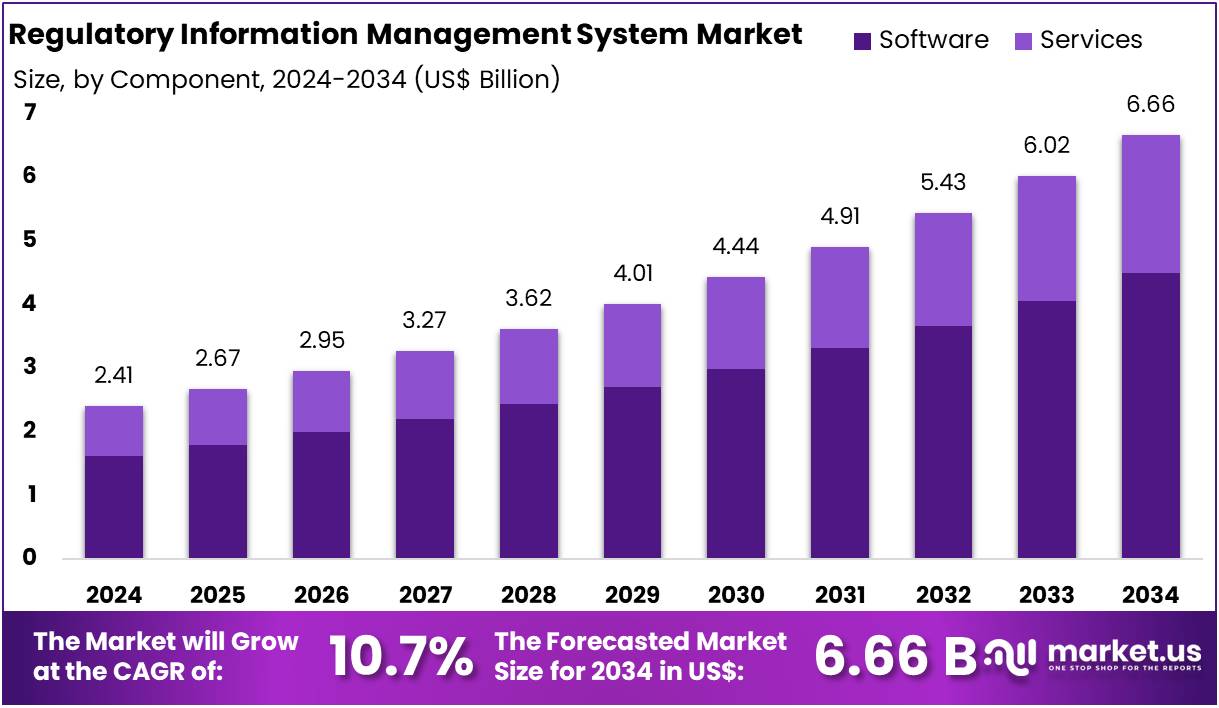
Key Takeaways
- The global Regulatory Information Management System (RIMS) Market is expected to grow from US$ 2.41 billion in 2024 to US$ 6.66 billion by 2034, registering a CAGR of 10.7% during the forecast period.
- In 2024, the Software segment emerged as the leading component, capturing over 67.5% of the total market share.
- The Registration segment held the dominant position by application in 2024, accounting for more than 26.9% of the overall market share.
- Large Enterprises led the market by enterprise size in 2024, representing over 62.4% of the total market.
- By end user, the Pharmaceutical & Biotechnology segment accounted for the highest share in 2024, contributing more than 42.1% of the global market.
- North America remained the leading regional market in 2024, holding over 36.2% of the global share, with a market value of US$ 872.4 million.
Statistical Information
- Electronic Regulatory Submissions Are Becoming the Global Standard: The U.S. FDA reported that 94% of all submissions to the Center for Drug Evaluation and Research (CDER) during FY2023 were submitted in the electronic Common Technical Document (eCTD) format, while only 5% were non-eCTD and 1% remained paper submissions. This demonstrates the industry’s strong shift toward digital regulatory submission platforms, increasing demand for Regulatory Information Management Systems (RIMS).
- FDA Electronic Gateway Continues to Process Growing Submission Volumes: According to the FDA Electronic Submission Gateway (ESG), CDER processed 310,433 electronic submissions in 2024, increasing to 319,828 submissions in 2025, highlighting continuous growth in electronic regulatory activities and the need for centralized regulatory information management.
- Artificial Intelligence Is Increasingly Used in Regulatory Drug Development: The FDA reported receiving more than 500 drug application submissions incorporating Artificial Intelligence (AI) between 2016 and 2023. The agency also issued draft guidance promoting the responsible use of AI in drug development, reflecting increasing regulatory complexity and greater need for digital regulatory management systems.
- Global ICD-11 Adoption Is Accelerating Digital Regulatory Requirements: The World Health Organization (WHO) reported that, as of May 2024, 132 Member States were at different stages of implementing ICD-11, with 72 countries already actively implementing the new classification system. WHO also provides APIs and digital implementation tools to support adoption, increasing demand for structured regulatory information systems.
- Healthcare Cybersecurity Is Driving Compliance Investments: The U.S. Department of Health and Human Services (HHS) reported 717 healthcare data breaches affecting 500 or more individuals during 2022, demonstrating increasing pressure on healthcare organizations to strengthen regulatory compliance, document management, audit readiness, and secure information governance through digital platforms.
- FDA Receives Thousands of Regulatory Applications Annually: The FDA CDER manages a large volume of regulatory activities, including Investigational New Drug (IND) applications, New Drug Applications (NDAs), Abbreviated New Drug Applications (ANDAs), and supplements. In FY2023, CDER received more than 6,000 original and supplemental applications, creating a significant need for automated regulatory information management and workflow solutions.
- Global Pharmaceutical R&D Investment Increases Regulatory Data Requirements: According to the Pharmaceutical Research and Manufacturers of America (PhRMA), biopharmaceutical companies invested approximately US$ 96 billion in research and development in 2023. Higher R&D investment generates larger volumes of clinical, regulatory, and safety data, increasing the need for integrated regulatory information systems.
- Clinical Trial Growth Creates More Regulatory Documentation Needs: The World Health Organization (WHO) International Clinical Trials Registry Platform (ICTRP) contains more than 800,000 registered clinical trials from over 220 countries. The continuous growth of clinical research increases the complexity of regulatory submissions, compliance tracking, and documentation management, supporting adoption of advanced RIMS solutions.
- Medical Product Approvals Require Extensive Regulatory Lifecycle Management: The FDA reported that CDER regulates products representing approximately $1 trillion in annual U.S. prescription drug sales, including thousands of approved medicines. Managing post-approval changes, safety updates, labeling revisions, and compliance activities requires robust regulatory information management systems.
Regional Analysis
North America held the largest regional market share in 2024, commanding over 36.2%.
North America remains a leading region for the Regulatory Information Management System (RIMS) market, supported by strong pharmaceutical, biotechnology, and healthcare industries. The United States has a highly regulated healthcare environment, where organizations increasingly adopt digital regulatory solutions to manage complex submissions, compliance requirements, and changing regulatory standards.
The U.S. FDA’s continued focus on electronic submissions, data standards, and digital transformation has accelerated the adoption of advanced regulatory platforms. The region also benefits from strong investments in cloud computing, artificial intelligence (AI), and life science technologies. Pharmaceutical companies are using automated regulatory systems to improve submission accuracy, enhance data governance, and reduce compliance timelines.
Additionally, increasing clinical research activities, growing regulatory data volumes, and rising mergers and acquisitions among life science companies are creating greater demand for centralized regulatory information management solutions. The presence of major technology and healthcare organizations further supports the expansion of RIMS adoption across North America.
Emerging Trends
- Artificial Intelligence (AI) Integration in Regulatory Management: AI is transforming regulatory operations by automating document classification, compliance checks, and submission reviews. The FDA reported more than 500 drug application submissions containing AI components between 2016 and 2023, increasing demand for intelligent RIMS platforms that support AI-driven regulatory workflows.
- Growth of Electronic Common Technical Document (eCTD) Adoption: Regulatory agencies are shifting toward digital submissions, with the FDA reporting that 94% of CDER submissions in FY2022 were completed using the eCTD format. RIMS platforms help organizations manage electronic submissions, improve tracking, and maintain regulatory compliance.
- Cloud-Based Regulatory Information Management Solutions: Cloud-based RIMS adoption is increasing as pharmaceutical and biotechnology companies require secure access to regulatory information across global teams. These solutions improve collaboration, data availability, and compliance management while supporting remote regulatory operations.
- Increasing Use of Real-World Evidence (RWE): Real-World Evidence is becoming more important in regulatory decision-making. The FDA’s RWE program under the 21st Century Cures Act encourages the use of healthcare data, creating demand for RIMS solutions capable of managing complex real-world regulatory information.
- Regulatory Data Standardization and Global Harmonization: Regulatory authorities are focusing on standardized data exchange to improve approval processes. The International Council for Harmonisation (ICH) develops guidelines adopted by regulators such as FDA and EMA, encouraging companies to use RIMS for consistent global compliance management.
Use Cases
- Electronic Regulatory Submission Management: RIMS platforms help pharmaceutical and biotechnology companies prepare, validate, track, and submit regulatory documents electronically. With the FDA reporting that 94% of CDER submissions in FY2022 used eCTD format, organizations increasingly rely on RIMS to manage digital submission workflows and regulatory timelines.
- Drug Approval and Registration Management: RIMS is widely used for managing product registrations, marketing applications, renewals, and regulatory approvals across multiple countries. The FDA approved 50 novel drugs in 2024, creating a growing need for systems that organize regulatory information throughout the approval process.
- Regulatory Document Lifecycle Management: Companies use RIMS to store, update, and control regulatory documents, including submissions, safety reports, labeling information, and compliance records. These systems help maintain data accuracy and ensure regulatory teams can access updated information throughout a product’s lifecycle.
- Real-World Evidence (RWE) Data Management: RIMS platforms support the collection and organization of real-world data used in regulatory decisions. The FDA’s Real-World Evidence Program promotes the use of healthcare data under the 21st Century Cures Act, increasing the requirement for structured regulatory data management.
- Regulatory Compliance Tracking and Monitoring: Organizations use RIMS to monitor regulatory changes, compliance deadlines, and submission requirements across different regions. As global regulations become more complex, automated tracking capabilities help companies reduce compliance risks and improve regulatory readiness.
Frequently Asked Questions on
- What factors are driving the growth of the RIMS Market?
The RIMS Market is growing due to increasing regulatory complexity, rising electronic submissions, demand for compliance automation, and adoption of cloud-based solutions. Pharmaceutical and biotechnology companies are investing in RIMS to improve regulatory efficiency, reduce manual processes, and manage global compliance requirements. - Why are pharmaceutical companies adopting RIMS solutions?
Pharmaceutical companies use RIMS to manage drug submissions, regulatory documents, product registrations, and compliance requirements. The increasing number of clinical trials, drug approvals, and global regulatory standards has created demand for centralized systems that improve regulatory tracking and lifecycle management. - How does Artificial Intelligence impact the RIMS Market?
Artificial Intelligence is enhancing RIMS capabilities by automating document review, regulatory intelligence, data analysis, and compliance monitoring. The FDA reported more than 500 drug application submissions containing AI components between 2016 and 2023, supporting the adoption of AI-enabled regulatory solutions. - What role does cloud technology play in RIMS adoption?
Cloud-based RIMS solutions provide secure access to regulatory information, improve collaboration among global teams, and reduce infrastructure requirements. These platforms support remote operations, real-time updates, and scalable regulatory management for organizations handling complex compliance processes across multiple regions. - How does RIMS support electronic regulatory submissions?
RIMS helps organizations prepare, validate, track, and submit regulatory documents through electronic formats such as eCTD. The FDA reported that 94% of CDER submissions in FY2022 used eCTD, increasing demand for efficient electronic regulatory management systems. - Which industries are the major users of RIMS solutions?
The pharmaceutical and biotechnology industries are the largest users of RIMS due to strict regulatory requirements and extensive documentation needs. Medical device, healthcare, and food industries also adopt these systems to improve compliance management and streamline regulatory processes. - What are the key applications of RIMS platforms?
Major applications of RIMS include regulatory submission management, product registration, document lifecycle management, compliance tracking, labeling management, and regulatory reporting. These applications help companies efficiently manage product information from development stages through post-market monitoring activities. - What is the future outlook of the RIMS Market?
The future of the RIMS Market is expected to be influenced by digital transformation, AI integration, regulatory data standardization, and increasing demand for automation. Growing healthcare regulations and expanding global pharmaceutical activities will continue supporting the adoption of advanced RIMS solutions.
Conclusion
The Regulatory Information Management System (RIMS) market is experiencing significant growth due to increasing regulatory complexity, digital transformation, and the rising need for efficient compliance management. Growing adoption of electronic submissions, AI-driven regulatory processes, cloud-based platforms, and real-world evidence applications is reshaping regulatory operations across pharmaceutical and biotechnology industries.
Government initiatives supporting data standardization and digital regulatory frameworks are further accelerating adoption. As companies face expanding global compliance requirements, RIMS solutions provide improved data governance, workflow automation, and regulatory visibility. The market is expected to continue expanding as organizations prioritize faster approvals, accuracy, and streamlined regulatory lifecycle management.
Discuss your needs with our analyst
Please share your requirements with more details so our analyst can check if they can solve your problem(s)




