


Overview
New York, NY – July 24, 2026 – The Global Laboratory mixer market size is expected to be worth around US$ 29.6 Billion by 2034 from US$ 2.5 Billion in 2024, growing at a CAGR of 3.5% during the forecast period 2025 to 2034. In 2024, North America led the market, achieving over 47.5% share with a revenue of US$ 1.2 Billion.
The laboratory mixer market is witnessing steady growth as research institutions, pharmaceutical companies, biotechnology firms, and chemical laboratories increasingly adopt advanced mixing solutions to improve accuracy, efficiency, and reproducibility. Laboratory mixers play a critical role in applications such as drug formulation, vaccine research, sample preparation, chemical analysis, and biotechnology experiments, where precise and consistent mixing performance is essential.
The market is being shaped by the growing adoption of automated and high-performance laboratory equipment. Modern laboratory mixers are increasingly integrated with programmable controls, digital monitoring systems, data recording capabilities, and connectivity features that support efficient workflows and improved process control. The shift toward high-throughput research activities is further increasing demand for mixers capable of handling multiple samples with enhanced speed and reliability.
Technological advancements, including the integration of Internet of Things (IoT), artificial intelligence (AI), and smart laboratory solutions, are transforming laboratory operations by enabling remote monitoring, predictive maintenance, and optimized equipment utilization. These innovations are helping researchers achieve greater productivity while reducing operational challenges.
Increasing investments in scientific research and development are also supporting market expansion. Funding from organizations such as the National Institutes of Health (NIH) and the National Science Foundation (NSF) continues to strengthen laboratory infrastructure and drive demand for advanced research equipment. Additionally, rising pharmaceutical and biotechnology R&D activities, including drug discovery and vaccine development programs, are creating sustained opportunities for laboratory mixer manufacturers. As laboratories continue to prioritize automation, precision, and efficiency, the adoption of advanced laboratory mixers is expected to increase across research and industrial applications.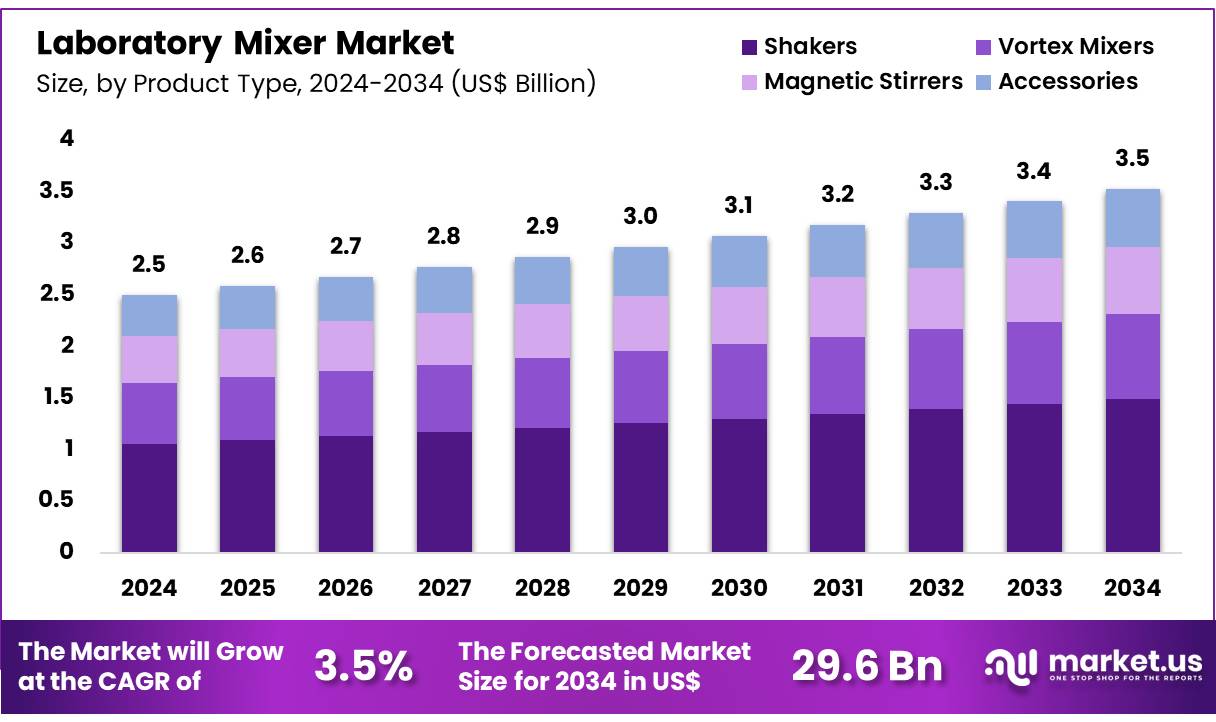
Key Takeaways
- In 2024, the laboratory mixer market generated revenue of US$ 2.5 billion and is projected to grow at a CAGR of 3.5%, reaching US$ 29.6 billion by 2034.
- Based on product type, the laboratory mixer market is segmented into shakers, vortex mixers, magnetic stirrers, and accessories. Among these, shakers dominated the market in 2023, accounting for a 42.3% share.
- By application, the market is categorized into pharmaceutical & biotechnology companies, research laboratories & institutes, and others. Research laboratories & institutes held a significant market share of 58.4%.
- North America emerged as the leading region in the laboratory mixer market, capturing a 47.5% share in 2023.
Statistical Information
- Growth in Biomedical Research Funding Supports Laboratory Equipment Demand: The National Institutes of Health (NIH) operates with a budget of nearly US$48 billion, with approximately 82% of funding distributed through extramural research programs supporting universities, medical schools, and research institutions. This continuous investment supports demand for laboratory infrastructure and research equipment used in biomedical studies.
- Expansion of Laboratory Automation and Digital Connectivity: The FDA recognizes laboratory automation and connectivity standards that support communication between laboratory instruments and information systems. Standards covering laboratory automation, instrument communication, and laboratory information system integration highlight the increasing importance of connected laboratory workflows.
- Public Health Laboratory Programs Increase Demand for Advanced Laboratory Equipment: The CDC’s Epidemiology and Laboratory Capacity (ELC) program provides financial assistance to 65 state, large local, and U.S. territory health departments to strengthen laboratory capacity, health information systems, and infectious disease response capabilities.
- Research Infrastructure Investment Supports High-Throughput Laboratory Operations: According to NSF data, U.S. R&D spending reached US$937 billion in 2023, with an estimated increase to US$993 billion in 2024, demonstrating continued expansion of scientific research activities requiring advanced laboratory infrastructure
- Increasing Need for Reproducible Research Equipment: NIH-supported research programs emphasize reproducibility, standardized methodologies, and reliable experimental workflows. Laboratory equipment that provides controlled mixing, repeatable conditions, and accurate sample preparation supports these requirements across biomedical research activities
- Biotechnology and Drug Development Activities Support Laboratory Equipment Adoption: NIH-funded research infrastructure supports studies across areas such as disease biology, therapeutics development, and clinical research. These activities depend on laboratory processes requiring precise preparation, mixing, and handling of biological and chemical samples.
Regional Analysis
North America emerged as the leading region in the laboratory mixer market, capturing a 47.5% share in 2023.
North America remains a major region for laboratory mixer adoption due to its strong pharmaceutical, biotechnology, and academic research infrastructure. The region benefits from significant investments in biomedical research and laboratory modernization. The National Institutes of Health (NIH) allocated approximately US$47.7 billion in FY 2023 to support biomedical research activities, strengthening demand for advanced laboratory equipment.
The National Science Foundation (NSF) reported that U.S. research and development spending exceeded US$ 886 billion in 2021, reflecting strong scientific investment. The presence of advanced research institutions, pharmaceutical companies, and automation-focused laboratories continues to support demand for high-performance laboratory mixers. Asia Pacific is experiencing increased demand for laboratory mixers due to expanding biotechnology, pharmaceutical research, and government-supported R&D programs.
China’s R&D expenditure exceeded 3.6 trillion yuan in 2024, highlighting its focus on scientific innovation. Japan and South Korea are also increasing investments in research infrastructure, supporting laboratory development and adoption of advanced equipment. Growing pharmaceutical manufacturing and academic research activities across the region are expected to drive laboratory mixer usage.
Emerging Trends
- Increasing Adoption of Automated Laboratory Mixers: Laboratories are shifting toward automated mixers with programmable controls, digital interfaces, and monitoring features to improve accuracy, reduce manual errors, and support standardized workflows. FDA laboratory automation initiatives highlight the growing importance of connected and efficient laboratory operations.
- Integration of IoT and Smart Laboratory Technologies: Laboratory mixers are increasingly incorporating digital connectivity, remote monitoring, and data tracking capabilities. These technologies help researchers monitor equipment performance, improve workflow efficiency, and maintain better control over laboratory processes.
- Growing Demand for High-Throughput Research Equipment: Pharmaceutical and biotechnology laboratories require advanced mixers to process multiple samples efficiently. NIH supports more than 50,000 competitive research grants, increasing the need for reliable laboratory infrastructure across universities, research centers, and biomedical facilities.
- Expansion of Biotechnology and Drug Development Applications: Laboratory mixers are increasingly used in biotechnology research, including protein studies, vaccine development, and therapeutic formulation. The National Science Foundation reported U.S. R&D investment reached approximately US$892 billion in 2022, supporting advanced laboratory technology adoption.
- Development of Energy-Efficient Laboratory Equipment: Research facilities are focusing on sustainable laboratory operations by adopting equipment with improved energy efficiency and longer operational life. Energy-efficient designs help reduce operating costs while maintaining performance in pharmaceutical and scientific laboratories.
- Focus on Research Reproducibility and Precision: Scientific organizations are emphasizing accurate and repeatable experimental procedures. NIH research quality initiatives encourage standardized laboratory practices, increasing demand for mixers that provide precise speed control, consistent results, and reliable performance.
Use Cases
- Drug Discovery and Pharmaceutical Formulation: Laboratory mixers are widely used in pharmaceutical research for preparing drug formulations, combining active pharmaceutical ingredients (APIs) with excipients, and optimizing formulations during development. Precise mixing helps researchers maintain consistency and improve the quality of experimental drug candidates.
- Biotechnology and Biologics Research: Laboratory mixers support biotechnology applications such as protein preparation, cell culture studies, and biologics development. NIH-funded research programs support thousands of biomedical projects that require controlled laboratory processes and reliable equipment for advanced biological experiments.
- Vaccine Development and Infectious Disease Research: Mixers are used in vaccine research for preparing biological samples, reagents, and formulations under controlled conditions. CDC-supported laboratory programs strengthen infectious disease testing capabilities across public health laboratories requiring accurate sample preparation tools.
- Chemical Research and Material Testing: Chemical laboratories use mixers for blending compounds, preparing solutions, and conducting reaction studies. The National Science Foundation reported U.S. R&D spending reached approximately US$892 billion in 2022, supporting continued research activities requiring advanced laboratory equipment.
- Academic and Research Institute Applications: Universities and research institutes use laboratory mixers for experiments in molecular biology, chemistry, microbiology, and life sciences. NIH provides research support through more than 50,000 competitive grants, increasing demand for laboratory instruments used in scientific investigations.
- Quality Control and Testing Laboratories: Laboratory mixers are used in quality control processes for pharmaceuticals, food, chemicals, and healthcare products to ensure uniform sample preparation and accurate testing results. FDA quality systems emphasize reliable laboratory processes to maintain product safety and compliance.
Frequently Asked Questions on Laboratory Mixer
- What are the major types of laboratory mixers?
The major types of laboratory mixers include shakers, vortex mixers, magnetic stirrers, and specialized mixing systems. Each type is designed for specific applications, such as sample preparation, chemical reactions, cell culture processes, and pharmaceutical formulation development. - Why is automation becoming important in the laboratory mixer market?
Automation is becoming important because laboratories require faster, more accurate, and reproducible processes. Automated laboratory mixers with programmable controls, digital monitoring, and data management features help researchers improve efficiency, reduce manual errors, and support high-throughput experimental workflows. - Which industries use laboratory mixers?
Laboratory mixers are mainly used by pharmaceutical companies, biotechnology firms, research institutes, universities, chemical laboratories, and diagnostic facilities. These instruments support applications including drug discovery, vaccine research, sample preparation, quality testing, and advanced scientific investigations. - How does technology impact the laboratory mixer market?
Technological advancements such as IoT connectivity, digital controls, and smart monitoring systems are improving laboratory mixer performance. These innovations allow remote operation, equipment tracking, predictive maintenance, and better process management, helping laboratories achieve higher productivity and operational efficiency. - Why are pharmaceutical and biotechnology companies adopting advanced laboratory mixers?
Pharmaceutical and biotechnology companies are adopting advanced mixers due to increasing research activities in drug discovery, biologics, and vaccine development. High-precision mixing systems help maintain product consistency, improve formulation processes, and support complex laboratory procedures requiring accurate sample handling. - What factors are driving the growth of the laboratory mixer market?
The laboratory mixer market is driven by increasing research investments, rising pharmaceutical and biotechnology activities, laboratory automation adoption, and demand for precise experimental equipment. Government-funded scientific programs and expanding R&D activities continue to support the need for advanced laboratory instruments.
Conclusion
The laboratory mixer market is witnessing continuous development due to increasing demand for precision, automation, and efficiency across pharmaceutical, biotechnology, chemical, and research laboratories. Advancements in digital technologies, IoT integration, and automated mixing solutions are improving workflow accuracy and productivity.
Growing investments in scientific research, drug discovery, vaccine development, and biotechnology applications are creating sustained demand for advanced laboratory equipment. North America remains a strong region due to its established research infrastructure, while Asia Pacific shows significant growth potential through expanding R&D activities. Overall, technological innovation and rising laboratory requirements will continue to shape the future growth of the laboratory mixer market.
Discuss your needs with our analyst
Please share your requirements with more details so our analyst can check if they can solve your problem(s)




