


Overview
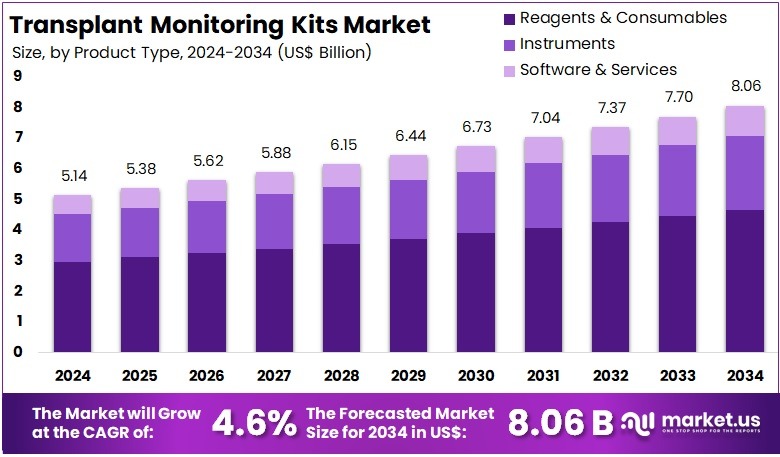
New York, NY – Sep 03, 2026 – The Transplant Monitoring Kits Market size is expected to be worth around US$ 8.06 Billion by 2034 from US$ 5.14 Billion in 2024, growing at a CAGR of 4.6% during the forecast period 2025 to 2034. North America held a dominant market position, capturing more than a 37.4% share and holds US$ 1.92 Billion market value for the year.
The global Transplant Monitoring Kits market is gaining momentum as organ transplantation procedures increase worldwide and healthcare providers focus on improving long-term graft survival. These kits are widely used to monitor immune responses, detect organ rejection at an early stage, and guide personalized immunosuppressive therapy for kidney, liver, heart, lung, and bone marrow transplant recipients. Advances in molecular diagnostics, biomarker testing, and next-generation sequencing are enhancing the accuracy and speed of transplant monitoring.
According to the Global Observatory on Donation and Transplantation (GODT), more than 170,000 organ transplants are performed each year globally, while the World Health Organization (WHO) estimates that only about 10% of the global demand for organ transplantation is currently met.
The growing transplant gap highlights the need for reliable monitoring technologies to improve patient outcomes and maximize graft longevity. In the United States, the Organ Procurement and Transplantation Network (OPTN) reported over 48,000 organ transplants in 2024, marking another record year for transplant procedures.
Increasing adoption of non-invasive monitoring methods, including donor-derived cell-free DNA (dd-cfDNA) assays and gene expression profiling, is supporting market expansion. Hospitals, transplant centers, and diagnostic laboratories remain the primary end users due to the need for routine post-transplant surveillance.
North America leads the market because of its advanced transplant infrastructure, while Asia-Pacific is expected to witness strong growth driven by improving healthcare facilities, rising awareness, and expanding organ donation programs. Continuous innovation in precision diagnostics is expected to create new opportunities for the Transplant Monitoring Kits market over the coming years.
Key Takeaways
- In 2024, the global Transplant Monitoring Kits market generated US$ 14.0 billion in revenue and is projected to reach US$ 8.06 billion by 2034, expanding at a CAGR of 4.6% during the forecast period.
- By Product Type, the market is segmented into Reagents & Consumables, Instruments, and Software & Services. Among these, Reagents & Consumables dominated the market in 2024, accounting for 57.8% of the total share.
- By Technology, the market is categorized into Molecular Assay Technologies and Non-Molecular Assay Technologies. Molecular Assay Technologies held the largest market share of 69.4% in 2024.
- By Transplant Type, the market is segmented into Solid Organ, Stem Cell, and Soft Tissue. Solid Organ transplantation emerged as the leading segment, capturing 65.5% of the market share in 2024.
- By End User, the market is divided into Independent Reference Laboratories, Hospitals & Transplant Centres, and Research Laboratories & Academic Institutes. Hospitals & Transplant Centres led the segment with a 52.4% market share in 2024.
- North America dominated the global Transplant Monitoring Kits market in 2024, accounting for 37.4% of the overall market share.
Market segmentation
- Product Type Analysis: Reagents & Consumables dominated the Transplant Monitoring Kits market with a 57.8% share in 2024 because every transplant test requires recurring consumables. Frequent patient monitoring after transplantation, combined with growing adoption of advanced molecular diagnostic kits, continues to drive strong and consistent demand.
- Technology Analysis: Molecular Assay Technologies held the largest 69.4% market share in 2024 due to their superior accuracy in detecting transplant rejection. Technologies such as PCR, next-generation sequencing, and donor-derived cell-free DNA testing enable earlier, non-invasive diagnosis and improve long-term graft monitoring outcomes.
- Transplant Type Analysis: Solid Organ transplantation accounted for 65.5% of the market in 2024, supported by the high number of kidney, liver, heart, and lung transplants. Continuous monitoring for rejection, infection, and graft function creates sustained demand for advanced transplant monitoring kits.
- End-User Analysis: Hospitals & Transplant Centres captured 52.4% of the market in 2024 as they perform transplant surgeries and provide routine follow-up care. Their need for rapid, accurate molecular testing and continuous patient monitoring supports the widespread adoption of transplant monitoring kits.
Statistical Information
- A 149% increase in donor-derived cell-free DNA (dd-cfDNA) improved the sensitivity for detecting subclinical kidney allograft injury during transplant surveillance, according to the 2025 STAR working group review.
- In lung transplant monitoring, a >73% increase in dd-cfDNA improved the sensitivity for detecting acute lung allograft dysfunction in prospective surveillance studies summarized in the 2025 STAR report.
- Stable kidney transplant recipients generally maintain dd-cfDNA levels below 0.5%–1.0% during the first year after transplantation, providing an important quantitative baseline for transplant monitoring assays.
- A 2025 liver transplant study reported that a 9.88% dd-cfDNA cutoff achieved an AUROC of 0.812, 100% sensitivity, 66.7% specificity, 17.5% positive predictive value, and 100% negative predictive value for detecting acute rejection.
- The same 2025 study found that acute liver graft rejection produced a 3.9-fold increase in dd-cfDNA compared with stable transplant recipients, demonstrating the biomarker’s ability to detect graft injury.
- A 2025 heart transplant study using a two-threshold dd-cfDNA algorithm achieved 86.5% sensitivity, 83.6% specificity, and an AUC of 0.881 for acute rejection detection.
- The same 2025 heart transplant study reduced false-positive results by 37.3% compared with the previously used 0.15% dd-cfDNA cutoff, improving diagnostic efficiency.
- In pediatric kidney transplant monitoring (2025), a ≥1% dd-cfDNA threshold delivered 52% sensitivity, 83% specificity, 61% positive predictive value, and 93% negative predictive value for detecting allograft rejection.
- A 2025 commercial assay review reported that the AlloSure Heart transplant monitoring assay analyzes 405 SNPs, while the Prospera Heart assay evaluates more than 13,000 SNPs, demonstrating the increasing analytical resolution of molecular transplant monitoring technologies.
Regional Analysis
North America dominates the transplant monitoring kits market due to its advanced transplant care infrastructure, high organ transplant volumes, and widespread adoption of precision molecular diagnostics. The region has rapidly integrated donor-derived cell-free DNA (dd-cfDNA) assays into routine post-transplant surveillance, particularly for kidney, heart, and lung transplant recipients.
Strong reimbursement systems, well-established transplant centers, and continuous investments in genomic diagnostics further strengthen market growth. Research published during 2025 and 2026 also highlights increasing clinical use of dd-cfDNA as a non-invasive alternative to repeated biopsies, improving graft monitoring and patient management.
In addition, collaborations among hospitals, diagnostic laboratories, and biotechnology companies continue to accelerate innovation and commercialization of transplant monitoring technologies.
The Asia Pacific region is projected to register the fastest growth during the forecast period, supported by expanding healthcare expenditure, increasing organ transplantation procedures, and rapid adoption of molecular diagnostic technologies across China, India, Japan, South Korea, and Australia. Governments are investing in transplant infrastructure, while major hospitals are enhancing genomic testing capabilities to improve graft survival and early rejection detection.
Rising awareness of personalized transplant care, improved laboratory capacity, and broader access to non-invasive monitoring assays are driving demand. Growing digital health integration and collaborations with international diagnostic companies are also expected to accelerate the adoption of advanced transplant monitoring kits across the region.
Business opportunities
The transplant monitoring kits market offers significant business opportunities as healthcare providers increasingly adopt non-invasive molecular diagnostics to improve long-term graft survival. Rising global organ transplant procedures are creating sustained demand for donor-derived cell-free DNA (dd-cfDNA) assays, gene expression profiling kits, and biomarker-based monitoring solutions that enable earlier detection of transplant rejection.
Emerging economies such as India, China, Brazil, and Southeast Asian countries present attractive growth opportunities due to expanding transplant programs, improving molecular laboratory infrastructure, and increasing healthcare investments. Companies can strengthen their market position by introducing cost-effective, easy-to-use monitoring kits tailored to regional healthcare systems and reimbursement environments.
There is also growing demand for multiplex testing platforms that combine multiple biomarkers into a single assay, reducing testing time and improving clinical decision-making. Integrating artificial intelligence, digital pathology, cloud-based data management, and remote patient monitoring with transplant diagnostics creates additional value for hospitals and transplant centers.
Strategic collaborations between diagnostic manufacturers, transplant hospitals, academic institutions, and biotechnology companies are accelerating product development and clinical validation. Furthermore, expanding regulatory approvals, broader reimbursement coverage, and increasing use of precision medicine are expected to create new commercialization opportunities for innovative transplant monitoring technologies across both developed and emerging healthcare markets.
Emerging Trends
- Growing adoption of donor-derived cell-free DNA (dd-cfDNA) testing: Healthcare providers are increasingly using non-invasive dd-cfDNA blood tests to monitor transplanted organs and reduce dependence on biopsies. Recent 2025 clinical reviews highlight expanding routine use in heart and lung transplantation for earlier rejection detection and personalized patient management.
- Standardization of molecular testing methods: Industry and clinical experts are working to standardize dd-cfDNA analytical methods because different testing platforms produce varying results. A 2025 international working group emphasized harmonized laboratory validation to improve clinical reliability and broader adoption across transplant centers.
- Advanced multi-marker monitoring approaches: Researchers are combining dd-cfDNA fraction with additional quantitative biomarkers to improve transplant rejection detection. A 2025 heart transplant study introduced a two-threshold algorithm that enhanced diagnostic performance compared with using a single biomarker measurement alone.
- Expansion of digital transplant data systems: Healthcare organizations are investing in centralized transplant databases and digital monitoring infrastructure. During 2025, the U.S. Health Resources and Services Administration (HRSA) accelerated modernization of OPTN data systems to improve transplant monitoring, transparency, and patient safety nationwide.
- Increasing transplant activity driving diagnostic demand: According to the OPTN/SRTR Annual Data Report, the United States performed more than 45,000 organ transplants in 2024, while a new patient joins the transplant waiting list approximately every 10 minutes, supporting continued demand for advanced monitoring kits.
Use Cases
- Routine kidney transplant surveillance: Hospitals increasingly use transplant monitoring kits to detect early graft injury before symptoms appear. Regular dd-cfDNA testing helps physicians identify rejection sooner, allowing timely treatment adjustments and reducing unnecessary invasive biopsy procedures in kidney transplant recipients.
- Heart transplant rejection monitoring: Molecular monitoring kits are increasingly used after heart transplantation to measure donor-derived DNA in blood. New clinical algorithms developed in 2025 improve rejection assessment and support faster treatment decisions while minimizing reliance on repeated endomyocardial biopsies.
- Lung transplant follow-up programs: Multicenter clinical studies showed dd-cfDNA monitoring achieved 77.8% sensitivity, 84.6% specificity, and 96.8% negative predictive value for detecting acute rejection after single-lung transplantation, supporting its routine use in post-transplant surveillance.
- Personalized immunosuppressive therapy management: Transplant specialists use molecular monitoring results alongside clinical findings to optimize immunosuppressive drug therapy. This approach reduces the risk of over-treatment while helping maintain long-term graft function and improving patient-specific transplant care.
- National transplant quality improvement: Government agencies and transplant networks use transplant monitoring data to evaluate outcomes, improve patient safety, and strengthen clinical oversight. Modernized national data systems support evidence-based policy decisions and continuous improvement across transplant programs.
Recent development
- In March 2026, Hoffmann-La Roche Ltd. launched the cobas MPX-E assay, a new multiplex donor-screening molecular test that simultaneously detects HIV, HBV, HCV, and HEV, supporting safer organ and blood donor screening workflows relevant to transplantation.
- In April 2026, Natera Inc. continued expanding clinical adoption of its Prospera™ donor-derived cell-free DNA (dd-cfDNA) transplant monitoring test through additional clinical evidence and healthcare provider implementation across kidney, heart, and lung transplantation programs.
- In July 2026, Natera Inc. announced that the finalized MolDx Local Coverage Determination (LCD) expanded Medicare coverage for its Prospera™ molecular transplant surveillance test across kidney, heart, and lung transplant monitoring, increasing patient access to non-invasive rejection testing.
Frequently Asked Questions on Transplant Monitoring Kits
- What is the purpose of the transplant monitoring kits market?
The transplant monitoring kits market focuses on developing and supplying advanced diagnostic solutions that help hospitals and laboratories monitor transplant recipients. These kits improve graft survival, reduce complications, and enable clinicians to make informed treatment decisions through regular patient monitoring. - Which technologies are commonly used in transplant monitoring kits?
Modern transplant monitoring kits use technologies including polymerase chain reaction (PCR), next-generation sequencing (NGS), donor-derived cell-free DNA analysis, enzyme-linked immunosorbent assays (ELISA), and gene expression profiling to evaluate transplant health with greater accuracy and speed. - Why is the demand for transplant monitoring kits increasing?
Demand is increasing because organ transplantation procedures are rising worldwide, while healthcare providers are adopting non-invasive monitoring methods. Growing awareness of early rejection detection, personalized medicine, and improved long-term graft survival further supports market expansion. - Which end users are the primary buyers of transplant monitoring kits?
Hospitals, transplant centers, diagnostic laboratories, academic research institutes, and specialty clinics are the primary users of transplant monitoring kits. These organizations require reliable testing solutions to monitor patients before and after transplantation and improve clinical outcomes. - Which region currently leads the transplant monitoring kits market?
North America leads the transplant monitoring kits market due to its advanced transplant infrastructure, high transplant procedure volume, widespread adoption of molecular diagnostics, strong reimbursement systems, and continuous investment in precision medicine and clinical research. - Which region is expected to grow the fastest in this market?
Asia Pacific is expected to record the fastest market growth because of expanding transplant programs, improving healthcare infrastructure, rising molecular diagnostic adoption, increasing healthcare expenditure, and greater awareness of long-term transplant monitoring across developing countries. - What factors are driving innovation in the transplant monitoring kits market?
Innovation is driven by advances in molecular diagnostics, artificial intelligence, digital pathology, automation, biomarker discovery, and next-generation sequencing. These technologies improve testing accuracy, reduce invasive procedures, and support personalized monitoring for transplant recipients.
Conclusion
The transplant monitoring kits market is poised for steady growth as transplant centers increasingly adopt molecular diagnostics to improve graft survival and patient outcomes. Rising organ transplant procedures, greater use of donor-derived cell-free DNA (dd-cfDNA) testing, and advances in PCR and next-generation sequencing technologies are transforming post-transplant care.
Hospitals and transplant centers remain the largest end users due to the need for continuous monitoring of rejection and infection risks. North America continues to lead the market with its advanced healthcare infrastructure, while Asia Pacific is expected to witness the fastest expansion because of growing transplant programs and healthcare investments.
Continuous product innovation, automation, and integration of precision medicine are expected to strengthen market adoption. Despite challenges such as high testing costs and reimbursement limitations, ongoing technological advancements and increasing clinical acceptance are likely to create significant opportunities for manufacturers and healthcare providers over the coming decade.
Discuss your needs with our analyst
Please share your requirements with more details so our analyst can check if they can solve your problem(s)




