


Overview
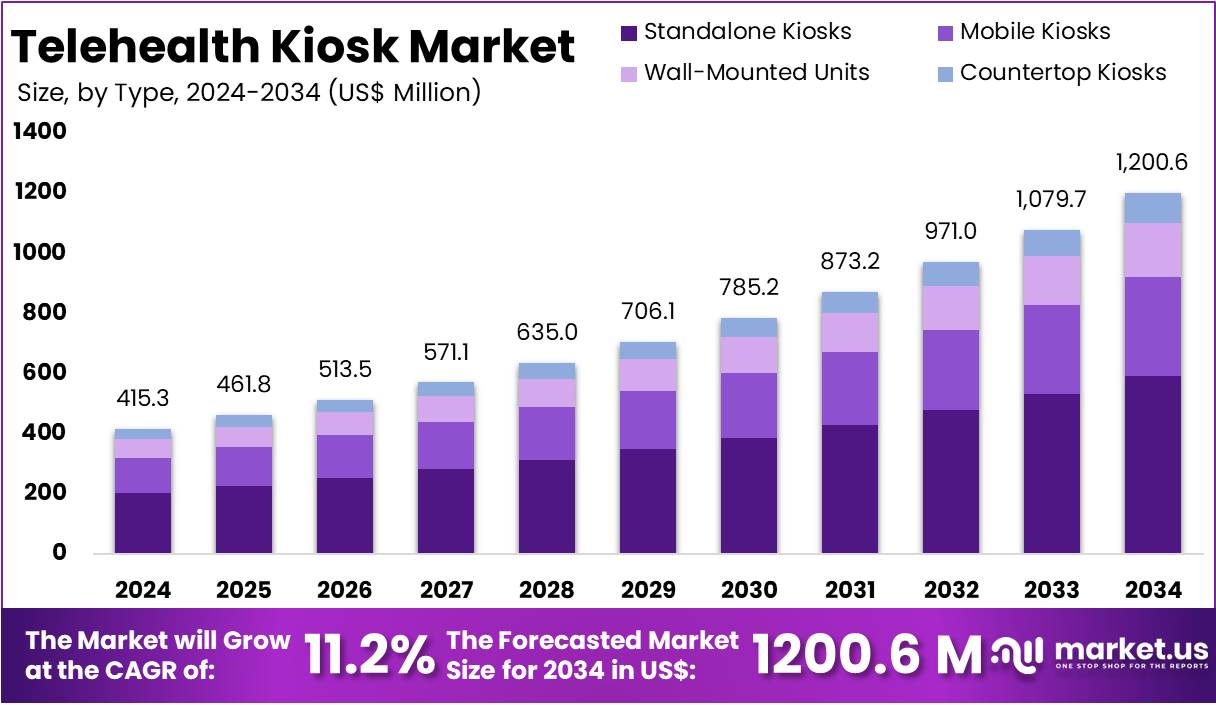
New York, NY – Aug 04, 2026 – The Global Telehealth Kiosk Market Size is expected to be worth around US$ 1200.6 Million by 2034, from US$ 415.3 Million in 2024, growing at a CAGR of 11.2% during the forecast period from 2025 to 2034. North America held a dominant market position, capturing more than a 48.5% share and holding US$201.4 Million market value for the year.
The increasing demand for convenient healthcare access, expanding broadband connectivity, and wider adoption of digital health technologies are driving market growth. In 2024, standalone kiosks accounted for more than 49.3% of the market by type, while hardware components represented over 44.0% of total market revenue.
Hospitals, pharmacies, workplaces, educational institutions, and community health centers are using telehealth kiosks to reduce patient travel, improve healthcare accessibility, and support routine consultations, chronic disease management, prescription renewals, and preventive health screenings.
Technological advancements in artificial intelligence, cloud computing, remote patient monitoring, and secure electronic health record integration continue to improve kiosk performance and clinical efficiency. Growing government support for telehealth services and investments in digital healthcare are expected to further accelerate deployment, making telehealth kiosks an essential part of modern healthcare systems and improving access to quality medical care in both urban and rural communities.
Continuous improvements in cloud computing, artificial intelligence, remote patient monitoring, and secure electronic health record integration are enhancing the capabilities of modern telehealth kiosks. Governments and healthcare organizations are increasingly promoting digital healthcare initiatives to improve service delivery, particularly in underserved and rural communities.
As healthcare providers continue to prioritize accessible, cost-effective, and patient-centered care, telehealth kiosks are expected to become an important part of modern healthcare infrastructure, supporting better health outcomes while expanding access to quality medical services worldwide.
Key Takeaways
- The global telehealth kiosk market is expected to grow from US$ 415.3 million in 2024 to approximately US$ 1,200.6 million by 2034, registering a CAGR of 11.2% during the forecast period.
- Standalone kiosks emerged as the leading type segment in 2024, accounting for more than 49.3% of the global market share.
- Hardware solutions held the largest share of the component segment in 2024, contributing over 44.0% of the total market.
- Teleconsultation led the application segment in 2024, representing more than 47% of overall market demand.
- Hospitals and specialty clinics dominated the end-user segment in 2024, capturing over 43.5% of the global market.
- North America remained the leading regional market in 2024, holding more than 48.5% of the global share and generating approximately US$ 201.4 million in revenue.
Statistical Information
- A 2025 systematic review reported that self-check-in kiosks reduced time to see a physician by 56.8% compared with conventional workflows in one included study.
- The same 2025 systematic review found that digital kiosk implementation reduced the median time to triage by 15 minutes in one emergency department study.
- A 2025 peer-reviewed systematic review found that one emergency department achieved 97% patient uptake of digital self-check-in kiosks among emergency department attendees.
- The same review analyzed evidence from 5 studies, covering 47,778 patients and 310,249 emergency department visits, providing one of the largest evidence bases available for digital check-in and triage kiosks.
- Digital triage kiosks demonstrated up to 88.5% sensitivity for identifying patients with high-acuity outcomes in studies reviewed during 2025.
- The review reported under-triage rates ranging from 8.0% to 10.1%, indicating relatively low rates of missing high-priority patients.
- Agreement between kiosk-generated triage scores and nurse-assigned triage scores ranged from 27.0% to 30.7%, highlighting current limitations in automated triage consistency.
- Digital triage kiosks showed over-triage rates between 59.2% and 65.0%, meaning many patients were assigned a higher urgency level than clinicians ultimately determined.
- The same 2025 deployment estimated operational utilization of 5–6 users per day for the airport-based telehealth kiosk during its initial rollout.
Regional Analysis
In 2024, North America accounted for more than 48.5% of the global telehealth kiosk market, representing US$ 201.4 million in market value. The region’s leading position was supported by advanced healthcare infrastructure, broad digital health adoption, and favorable reimbursement policies.
The United States remained the largest contributor, driven by continued demand for remote healthcare services and sustained Medicare telehealth coverage. Strong electronic health record (EHR) integration and improved interoperability enabled telehealth kiosks to connect efficiently with clinical systems, enhancing patient care and workflow efficiency.
Federal and state initiatives also supported digital health expansion by improving broadband access and strengthening telehealth capabilities in underserved communities. The deployment of telehealth kiosks across hospitals, pharmacies, retail clinics, and community healthcare centers further expanded patient access to virtual care.
Canada also contributed to regional growth through continued investment in virtual healthcare services and remote care programs. These combined factors created a well-established ecosystem that supported the ongoing adoption and expansion of telehealth kiosk solutions across North America.
Emerging Trends
- Growing use in primary healthcare and community clinics– Telehealth kiosks are being installed in community health centers, pharmacies, and public facilities to improve healthcare access. In 2024, 95% of HRSA-funded health centers used telehealth for primary care, showing strong digital healthcare adoption that supports wider kiosk deployment in underserved communities.
- Integration with remote patient monitoring (RPM)-Modern telehealth kiosks increasingly connect with RPM devices such as blood pressure monitors, pulse oximeters, and weight scales. According to CMS, Medicare-covered RPM requires connected devices to transmit at least 2 days of patient readings every 30 days, enabling continuous chronic disease management.
- Expansion in rural and underserved regions-Healthcare providers are deploying telehealth kiosks where physician shortages limit care access. In 2025, Webb County, Texas launched a telehealth kiosk in Bruni, a community with fewer than 800 residents and no practicing physicians, reducing long-distance travel for routine healthcare services.
- Advanced diagnostic technology inside kiosks-New telehealth kiosks now include digital stethoscopes, thermal cameras, pulse oximeters, blood pressure monitors, and high-definition imaging. A 2025 airport telehealth kiosk demonstrated the ability to support diagnosis for up to 85% of primary care conditions, improving care quality through virtual consultations.
- Continued government support for digital healthcare-Government reimbursement and telehealth policies continue to encourage adoption. Telehealth.HHS reports that 25% of Medicare fee-for-service users received at least one telehealth service in 2024, while Medicare telehealth visits increased 63-fold during 2020, creating lasting demand for digital care infrastructure, including kiosks.
Use Cases
- Remote management of chronic disease-Telehealth kiosks allow patients with hypertension, diabetes, and heart disease to measure vital signs and securely share results with clinicians. CMS supports RPM using connected medical devices that automatically transmit patient information, improving disease monitoring between in-person visits.
- Virtual consultations in rural healthcare-Rural hospitals and public health centers use telehealth kiosks to connect patients with licensed clinicians without requiring travel. The Bruni telehealth kiosk serves residents of a town with under 800 people, helping improve access where healthcare providers are limited.
- Healthcare access in transportation hubs-Airports are adopting telehealth kiosks to provide immediate medical consultations for travelers. A 2025 installation at Bradley International Airport serves approximately 12,000 passengers and staff daily, offering virtual assessments and basic diagnostic testing before travel continues.
- Preventive health screening and wellness checks-Telehealth kiosks perform routine measurements including blood pressure, body weight, oxygen saturation, and temperature. These preventive screenings help identify health issues early and allow healthcare providers to recommend follow-up treatment without requiring a traditional clinic appointment.
- Public health and emergency response support-Government agencies use telehealth technology to strengthen healthcare delivery during emergencies and routine public health programs. HRSA reports more than 44,000 telehealth encounters through supported telehealth networks, demonstrating the growing role of digital care infrastructure across healthcare systems.
Frequently Asked Questions on Telehealth Kiosk
- How does a telehealth kiosk market support healthcare systems?
The telehealth kiosk market supports healthcare systems by providing technologies that improve patient access, reduce unnecessary hospital visits, and extend medical services to remote areas. Growing digital health investments and demand for convenient care continue to increase adoption across hospitals, pharmacies, and community centers. - Where are telehealth kiosks commonly installed?
Telehealth kiosks are commonly installed in hospitals, clinics, pharmacies, workplaces, schools, retail stores, airports, and rural healthcare centers. These locations help people receive medical consultations without traveling long distances while improving healthcare accessibility and reducing waiting times. - what technologies are integrated into modern telehealth kiosks?
Modern telehealth kiosks combine high-definition video conferencing, electronic health record integration, secure cloud connectivity, biometric monitoring devices, digital diagnostic tools, and artificial intelligence-based patient support. These technologies improve consultation quality, data accuracy, and overall patient experience during virtual healthcare visits. - What factors are driving the growth of the telehealth kiosk market?
The telehealth kiosk market is expanding because of increasing chronic disease cases, aging populations, improved internet connectivity, government support for digital healthcare, and growing acceptance of remote consultations. Healthcare providers also seek cost-effective solutions that enhance patient engagement and operational efficiency. - Which healthcare settings are the largest users of telehealth kiosks?
Hospitals and healthcare clinics remain the largest users of telehealth kiosks because they require efficient patient triage, specialist consultations, and remote monitoring. Pharmacies, retail health centers, and employer wellness facilities are also rapidly adopting these systems to expand healthcare services. - What are the key challenges affecting the telehealth kiosk market?
The market faces challenges including high installation costs, cybersecurity concerns, patient privacy protection, internet connectivity limitations in remote regions, and integration with existing healthcare information systems. Addressing these issues is important for wider market adoption and long-term operational success. - Which regions are leading the telehealth kiosk market?
North America currently leads the telehealth kiosk market due to advanced healthcare infrastructure, strong digital health adoption, supportive reimbursement policies, and widespread telemedicine use. Europe and Asia-Pacific are also experiencing steady growth through healthcare modernization and increased investments in connected care technologies. - What is the future outlook for the telehealth kiosk market?
The telehealth kiosk market is expected to witness sustained growth as healthcare providers increasingly adopt digital care models. Advances in artificial intelligence, remote diagnostics, wearable device integration, and connected healthcare ecosystems are likely to improve kiosk capabilities and expand their use across global healthcare settings.
Conclusion
The telehealth kiosk market is expected to witness steady growth as healthcare providers increasingly adopt digital solutions to improve access, efficiency, and patient outcomes. Rising demand for remote consultations, chronic disease management, and convenient healthcare services is encouraging the deployment of kiosks across hospitals, pharmacies, workplaces, schools, and rural communities.
Advances in connected medical devices, cloud platforms, artificial intelligence, and secure health data systems are further enhancing kiosk capabilities. North America continues to lead adoption due to its advanced healthcare infrastructure and supportive digital health ecosystem.
As governments and healthcare organizations focus on expanding equitable care access and reducing provider shortages, telehealth kiosks are expected to play an increasingly important role in delivering accessible, cost-effective, and patient-centered healthcare services worldwide.
Discuss your needs with our analyst
Please share your requirements with more details so our analyst can check if they can solve your problem(s)




