


Overview
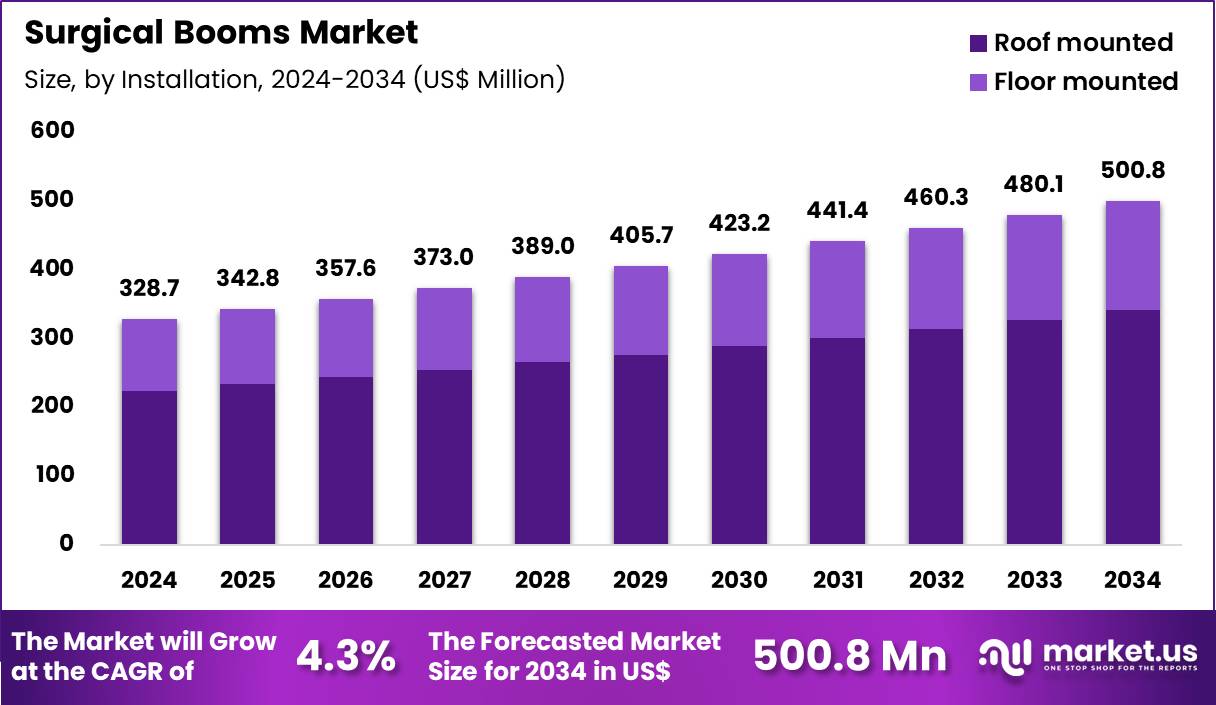
New York, NY – Oct 19, 2026 – The Global Surgical Booms Market size is expected to be worth around US$ 500.8 Million by 2034 from US$ 328.7 Million in 2024, growing at a CAGR of 4.3% during the forecast period 2025 to 2034. In 2024, North America led the market, achieving over 36.6% share with a revenue of US$ 120.3 Million.
Surgical booms are ceiling-mounted medical equipment support systems used in operating rooms, intensive care units, and other critical care environments. These systems are designed to organize and support essential medical equipment, including surgical instruments, monitors, medical gas outlets, electrical power supplies, and communication devices. By providing flexible access to equipment, surgical booms help improve space utilization, support efficient clinical workflows, and maintain organized operating room environments.
The growth of the surgical booms market is driven by the increasing number of surgical procedures, rising healthcare infrastructure investments, and the growing adoption of advanced operating room technologies. The expansion of hospitals, ambulatory surgical centers, and specialty care facilities is further supporting demand for modern surgical equipment management systems.
Technological advancements, including motorized positioning, integrated cable management, and compatibility with digital operating room systems, are improving the functionality of surgical booms. Healthcare providers are increasingly focusing on solutions that enhance operational efficiency, improve equipment accessibility, and support patient safety.
However, high installation costs, maintenance requirements, and the complexity of integrating surgical booms into existing healthcare facilities may limit market adoption. Despite these challenges, continued hospital modernization, increasing investments in advanced surgical infrastructure, and growing demand for efficient operating room layouts are expected to create new growth opportunities for surgical boom manufacturers and healthcare technology providers.
Key Takeaways
- In 2024, the surgical booms market was valued at US$ 328.7 million and is projected to reach US$ 500.8 million by 2034, growing at a CAGR of 4.3% during the forecast period.
- By product type, the market is segmented into anesthesia booms, equipment booms, and others, with the anesthesia boom segment dominating with a market share of 46.7%.
- Based on installation, the market is categorized into roof-mounted and floor-mounted systems, with the roof-mounted segment accounting for the largest share of 68.2%.
- By end user, the market is divided into hospitals, ambulatory surgical centers, dental clinics, and others. The hospitals segment dominated the market, accounting for the largest revenue share of 59.6%.
- Regionally, North America dominated the surgical booms market, accounting for a market share of 36.6%.
Key Market Segments
- Product Type Analysis: The anesthesia boom segment accounted for 46.7% of the surgical booms market, driven by increasing surgical volumes and demand for organized anesthesia equipment. These systems support efficient placement of medical gas outlets, monitors, ventilators, and infusion pumps. Their benefits include improved ergonomics, cable management, infection control, and equipment accessibility, supporting adoption across hospitals and ambulatory surgical centers.
- Installation Analysis: The roof-mounted segment accounted for 68.2% of the surgical booms market, supported by its space-saving design and operational flexibility. Ceiling-mounted systems keep floors clear, improve equipment positioning, and reduce cable-related hazards. Their compatibility with modern operating rooms, advanced surgical equipment, and efficient cleaning practices is encouraging adoption as healthcare facilities expand and upgrade surgical infrastructure.
- End-User Analysis: The hospitals segment accounted for 59.6% of the surgical booms market, driven by high surgical volumes and ongoing operating room modernization. Hospitals use surgical booms to organize medical equipment, improve staff workflows, and support infection control. Increasing investments in advanced surgical facilities, minimally invasive procedures, and integrated medical systems are expected to sustain demand for these solutions.
Regional Analysis
North America Leads the Surgical Booms Market
North America accounted for 36.6% of the surgical booms market in 2024, supported by hospital infrastructure upgrades and operating room modernization. Increasing investments in ceiling-mounted systems, minimally invasive procedures, and advanced surgical technologies are driving regional demand.
The expansion of ambulatory surgical centers and the replacement of traditional equipment further support adoption. Integration with imaging systems, anesthesia equipment, and digital operating room platforms is also strengthening market growth.
Asia Pacific Expected to Record the Highest CAGR
Asia Pacific is expected to register the highest CAGR during the forecast period, driven by hospital expansion, rising surgical volumes, and increasing healthcare investments across China, India, and Southeast Asia. Growing adoption of minimally invasive procedures and advanced operating room technologies is supporting demand for surgical booms.
Investments by private hospital chains, government healthcare initiatives, and regional manufacturing partnerships are improving infrastructure and product accessibility. These developments are expected to create significant growth opportunities for surgical boom manufacturers across the region.
Emerging Trends
- Integration with Digital Operating Rooms: Surgical booms are increasingly being designed to support connected monitors, imaging displays, data connections, and other digital operating room equipment. This integration helps surgical teams access essential information more conveniently and supports the development of coordinated, technology-enabled surgical environments.
- Growing Demand for Motorized and Flexible Systems: Motorized boom systems allow equipment to be repositioned more easily during surgical procedures. Their adoption can improve equipment access and reduce manual handling, particularly in operating rooms where multiple devices must be arranged around the patient.
- Modular Designs for Changing Surgical Requirements: Modular surgical booms allow hospitals to select different arms, shelves, outlets, and equipment supports according to their needs. This flexibility can help healthcare facilities accommodate new medical technologies without replacing the entire system when operating room requirements change.
- Greater Compatibility with Robotic and Image-Guided Surgery: The growing use of robotic-assisted surgery and advanced imaging is increasing the need for well-organized operating rooms. Surgical booms can support monitors, cables, and related equipment while maintaining access around the operating table. Compatibility depends on equipment loads, room design, and manufacturer specifications.
- Increased Focus on Lifecycle Service and Maintenance: Hospitals are placing greater importance on equipment reliability, preventive maintenance, and long-term operating costs. Manufacturers and service providers can respond through maintenance programs, technical support, and replacement components that help reduce equipment downtime and extend system service life.
Use Cases
- Anesthesia Equipment Management: Anesthesia booms provide organized access to anesthesia machines, gas outlets, electrical connections, and monitoring equipment near the anesthesia workstation. This arrangement helps anesthesiologists manage equipment efficiently while maintaining access to the patient during the administration of anesthesia.
- Orthopedic and Trauma Surgery: During orthopedic procedures, surgical booms can support displays, power connections, and other equipment used by the surgical team. They are particularly useful in operating rooms where imaging systems, specialized instruments, and multiple equipment units must be positioned around the operating table.
- Cardiovascular and Hybrid Operating Rooms: Hybrid operating rooms combine surgical procedures with advanced medical imaging. Surgical booms help organize monitors, electrical connections, and related equipment, supporting the coordination of surgical and imaging activities while preserving access for clinical staff.
- Minimally Invasive and Endoscopic Procedures: Minimally invasive procedures often require video monitors, cameras, light sources, and imaging equipment. Surgical booms help position these devices within the clinical team’s field of view, while supporting organized cable routing and access to equipment during procedures.
- Neurosurgery and Complex Image-Guided Procedures: Neurosurgical procedures may require several displays and specialized visualization systems. Surgical booms can position these components according to procedural requirements, helping maintain clear access around the patient and supporting the coordinated use of imaging and monitoring equipment.
Frequently Asked Questions About Surgical Booms
- What are the main types of surgical booms?
The main types include equipment booms, anesthesia booms, utility booms, and combination booms. Equipment booms support monitors and devices, anesthesia booms serve anesthesia workstations, and utility booms provide access to essential operating room services. - What are the benefits of using surgical booms?
Surgical booms help reduce floor clutter, improve equipment positioning, and organize cables and medical connections. These features can support staff movement and operating room workflow, although actual benefits depend on system design, installation quality, and clinical practices. - What is the difference between equipment booms and anesthesia booms?
Equipment booms primarily support monitors, displays, and other surgical devices, whereas anesthesia booms provide organized access to anesthesia equipment, gas outlets, and electrical connections. Both systems are designed to meet different operating room workflow requirements. - What factors should hospitals consider when purchasing surgical booms?
Hospitals should assess equipment weight, arm movement, ceiling load capacity, medical gas requirements, electrical connections, cleaning needs, and compatibility with existing devices. Installation costs, maintenance support, staff training, and future expansion requirements should also be evaluated. - Which end users drive demand in the surgical booms market?
Hospitals are a major source of demand because they operate multiple surgical suites and require specialized equipment infrastructure. Ambulatory surgical centres also offer growth opportunities as outpatient procedures expand and facilities invest in efficient operating room layouts. - Which region offers growth opportunities in the surgical booms market?
Asia-Pacific offers growth opportunities as healthcare facilities invest in operating room modernization and advanced medical equipment. However, growth rates differ across countries and depend on healthcare spending, hospital construction, technology adoption, and access to capital. - What challenges affect the surgical booms market?
High installation costs, ceiling reinforcement requirements, complex utility connections, and compatibility issues can limit adoption. Hospitals may also delay purchases because of budget restrictions, maintenance expenses, and the need to coordinate installation with existing operating room infrastructure. - What is the future outlook for the surgical booms market?
The market outlook is supported by operating room upgrades, demand for flexible equipment management, and investments in advanced surgical environments. Future performance will depend on healthcare capital spending, product innovation, installation costs, and adoption across emerging markets.
Conclusion
The surgical booms market is expected to experience steady growth, supported by increasing surgical procedures, hospital infrastructure investments, and the adoption of advanced operating room technologies. The market, valued at US$ 328.7 million in 2024, is projected to reach US$ 500.8 million by 2034, registering a CAGR of 4.3%. Anesthesia booms, roof-mounted systems, and hospitals represent key market segments.
North America currently leads the market, while Asia Pacific is expected to offer significant growth opportunities. Despite high installation costs and integration challenges, technological advancements and ongoing healthcare modernization are expected to support long-term market development.
Discuss your needs with our analyst
Please share your requirements with more details so our analyst can check if they can solve your problem(s)



