


Overview
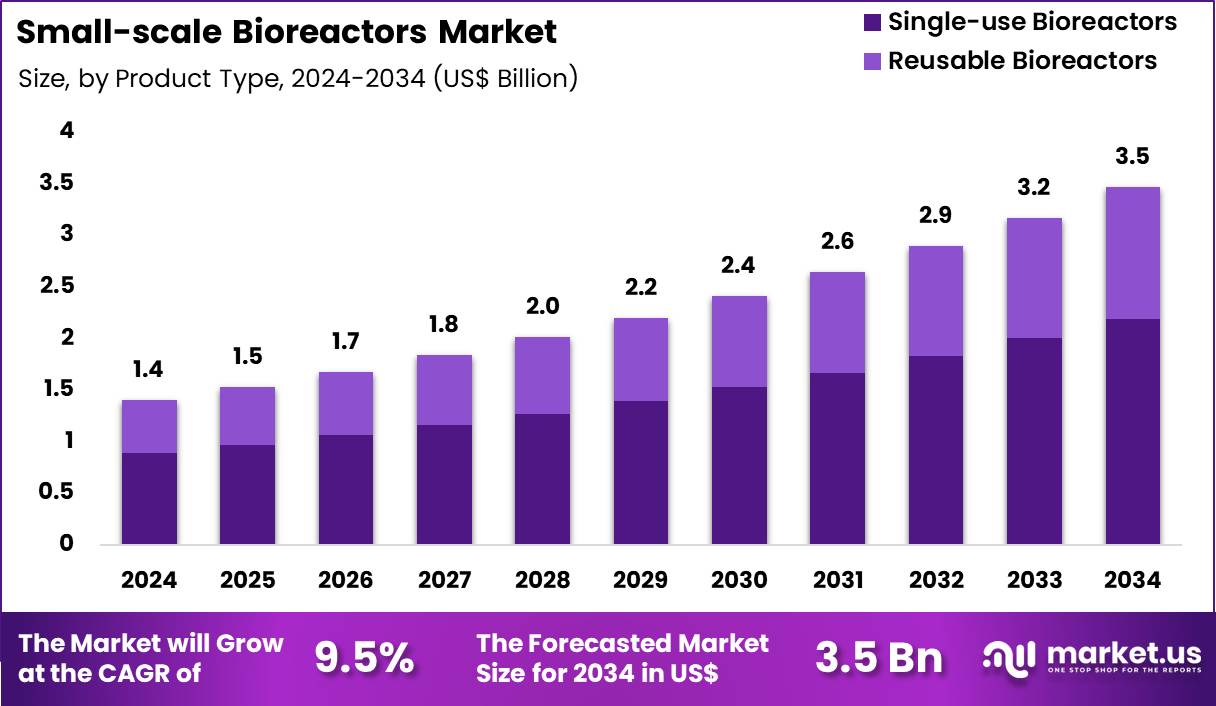
New York, NY – Oct 29, 2026 – Global Small-scale Bioreactors Market size is expected to be worth around US$ 3.5 Billion by 2034 from US$ 1.4 Billion in 2024, growing at a CAGR of 9.5% during the forecast period 2025 to 2034. In 2024, North America led the market, achieving over 44.7% share with a revenue of US$ 0.6 Billion.
Small-scale bioreactors are becoming essential tools in biotechnology, pharmaceutical research, and bioprocess development. These systems are designed to cultivate microorganisms, mammalian cells, and other biological materials under controlled conditions, enabling researchers to study biological processes and optimize production methods on a smaller scale.
The growing adoption of small-scale bioreactors is being supported by the increasing demand for biopharmaceuticals, vaccines, cell and gene therapies, and other biologically derived products. These systems offer advantages such as reduced media consumption, lower operating costs, improved experimental flexibility, and faster process development. They also enable parallel experimentation, allowing researchers to evaluate multiple process conditions simultaneously and identify optimal operating parameters.
Small-scale bioreactors are widely used in academic research institutions, biotechnology companies, pharmaceutical laboratories, and contract research and manufacturing organizations. Technological advancements in automation, real-time monitoring, sensor integration, and data analytics are further improving process control, reproducibility, and operational efficiency.
As the biotechnology industry continues to focus on accelerating research timelines and improving manufacturing productivity, small-scale bioreactors are expected to play an increasingly important role in early-stage development and process optimization. Their ability to generate valuable experimental data while minimizing resource requirements makes them an important component of modern bioprocessing workflows.
Continued investment in biopharmaceutical research and the development of advanced biological products is expected to support further innovation and adoption of small-scale bioreactor technologies across the global biotechnology ecosystem.
Key Takeaways
- In 2024, the small-scale bioreactors market generated US$ 1.4 billion in revenue and is projected to reach US$ 3.5 billion by 2034, expanding at a CAGR of 9.5% during the forecast period.
- By product type, the market is segmented into single-use and reusable bioreactors. Single-use bioreactors dominated the market, accounting for 63.2% of the total market share.
- By capacity, the market is categorized into 1 L to 3 L, 500 mL to 1 L, 5 mL to 100 mL, 3 L to 5 L, 250 mL to 500 mL, and 100 mL to 250 mL. The 1 L to 3 L segment held the largest share at 28.9%.
- By end use, the market is divided into CROs and CMOs, pharmaceutical and biopharmaceutical companies, and academic and research institutes. CROs and CMOs led the market, accounting for 44.6% of total revenue.
- Regionally, North America dominated the small-scale bioreactors market, capturing a 44.7% market share.
Key Market Segments
- Product Type Analysis: Single-use bioreactors held a 63.2% market share, driven by their flexibility, reduced contamination risks, and faster turnaround times. By eliminating cleaning and validation requirements, these systems lower operational complexity and costs. Increasing biologics research, parallel experimentation, and advancements in sensor integration are expected to support continued adoption across bioprocess development laboratories.
- Capacity Analysis: The 1 L to 3 L segment accounted for 28.9% of the market, supported by its suitability for process development and scale-up studies. These systems provide controlled experimental conditions, reliable data, and compatibility with automation. Growing demand for efficient media optimization, clone selection, and reproducible bioprocess workflows is expected to sustain segment growth.
- End-Use Analysis: CROs and CMOs accounted for 44.6% of the market, driven by increasing outsourcing of bioprocess development and manufacturing activities. These organizations use small-scale bioreactors to manage multiple client projects, optimize processes, and accelerate development timelines. Expanding biologics pipelines and demand for flexible research infrastructure are expected to strengthen adoption across service providers.
Regional Analysis
North America Leads the Small-Scale Bioreactors Market
North America accounted for 44.7% of the small-scale bioreactors market in 2024, driven by strong demand from biopharmaceutical companies, contract manufacturers, and research institutions.
Increasing investments in biologics, cell therapies, and vaccine development have supported the adoption of flexible bioprocessing systems. Advanced supplier networks, skilled professionals, and established research infrastructure further strengthen regional growth. Additionally, the United States recorded 55 novel drug approvals through the FDA’s CDER program in 2023, reflecting continued pharmaceutical innovation.
Asia Pacific Expected to Record the Highest CAGR
Asia Pacific is projected to register the highest CAGR during the forecast period, supported by expanding biologics and biosimilar development across China, India, South Korea, and Southeast Asia. Increasing clinical research activities, government funding, and industry-academia collaborations are encouraging the adoption of small-scale bioreactors.
Single-use technologies are gaining traction due to lower capital requirements and operational flexibility. Furthermore, Singapore’s RIE2025 initiative, backed by SGD 25 billion in research and innovation funding, supports regional advancements in biomanufacturing and bioprocess development.
Emerging Trends
- Automation and high-throughput experimentation: Small-scale bioreactors are increasingly being used to test several cell cultures, microorganisms, and operating conditions at the same time. Automated liquid handling and parallel experiments can reduce manual work, limit material use, and help researchers identify suitable production conditions faster.
- Real-time monitoring and advanced sensors: The use of sensors to measure pH, dissolved oxygen, temperature, and other process conditions is becoming more important. New analytical technologies can also help monitor nutrients, metabolites, and product formation, allowing researchers to identify changes early and improve process consistency.
- Digital twins and data-driven process control: Digital models are emerging as tools for understanding bioreactor performance and predicting how process changes may affect production. Linking these models with sensor data can support better decisions, improve process control, and help researchers understand biological production systems before moving to larger equipment.
- Improved scale-up and scale-down studies: Researchers are placing greater emphasis on making laboratory-scale conditions more representative of larger production systems. Small-scale bioreactors help investigate mixing, oxygen supply, pH changes, and nutrient differences, reducing uncertainty when a process is transferred to pilot or commercial production.
- Single-use systems and flexible process development: Single-use bioreactor technologies support flexible laboratory workflows and can reduce the need for equipment cleaning between suitable experiments. Their use in process development can help laboratories evaluate different biological production methods, although material compatibility, operating limits, and experimental requirements must be considered.
Use Cases
- Biopharmaceutical development: Small-scale bioreactors are used to grow cells that produce therapeutic proteins, including monoclonal antibodies. Researchers can compare cell growth, nutrient feeding, and production levels under controlled conditions before selecting suitable processes for further development.
- Cell line and microbial strain screening: Biotechnology laboratories use small vessels to compare different cell lines or microbial strains under multiple growth conditions. This helps identify candidates that deliver better growth, productivity, or process stability while using smaller quantities of culture media and other materials.
- Process optimization and media development: Small-scale systems help researchers test nutrient combinations, feeding schedules, temperature, pH, and agitation settings. Results can be used to identify suitable operating conditions and reduce unnecessary experiments before a process is transferred to larger equipment.
- Cell and gene therapy research: Small-scale bioreactors can support the development of processes involving therapeutic cells and other biological materials used in advanced therapies. They help researchers evaluate cell expansion and culture conditions, although product-specific manufacturing, quality, and regulatory requirements must still be met.
- Fermentation and industrial biotechnology: Small-scale bioreactors are used to study microorganisms that produce enzymes, organic compounds, peptides, and other biological products. Controlled experiments help compare strains and fermentation conditions, supporting the development of processes for biotechnology, food-related applications, and industrial production.
Frequently Asked Questions About Small-scale Bioreactors
- What are the main types of small-scale bioreactors?
Common types include stirred-tank bioreactors, miniature parallel bioreactors, microbioreactors, and single-use systems. The selection depends on the organism, culture volume, oxygen requirements, mixing needs, and level of process control required for the experiment. - What are the key benefits of small-scale bioreactors?
Small-scale bioreactors can reduce material consumption, support faster testing of multiple conditions, and improve control over laboratory experiments. They also help researchers compare biological performance and identify suitable process settings before larger-scale development begins. - Which industries use small-scale bioreactors?
Small-scale bioreactors are used in pharmaceuticals, biotechnology, academic research, industrial fermentation, and cell therapy development. These systems support cell culture studies, microbial growth, protein production, and process optimization across different stages of biological research and development. - What factors should be considered when selecting a small-scale bioreactor?
Selection depends on working volume, culture type, oxygen transfer, mixing performance, sensor availability, automation, sterility requirements, and operating costs. Compatibility with larger production systems is also important when laboratory findings are expected to guide future manufacturing decisions. - What factors are driving the small-scale bioreactors market?
Market demand is supported by increasing biopharmaceutical research, greater use of automated experiments, and the need for efficient process development. Small-scale systems help researchers evaluate production conditions and improve process understanding before investing in larger manufacturing operations. - What role do small-scale bioreactors play in biopharmaceutical manufacturing?
Small-scale bioreactors support early process development, cell culture optimization, and the evaluation of production conditions for biological medicines. Their results can inform larger-scale manufacturing, but scale-up studies and appropriate quality controls remain necessary before commercial production. - What is the future outlook for the small-scale bioreactors market?
The outlook is supported by advances in biotechnology, automation, process analytics, and data-driven manufacturing. Wider adoption will depend on equipment affordability, reliable experimental results, and the ability to transfer laboratory findings effectively into larger biological production systems.
Conclusion
The small-scale bioreactors market is poised for substantial growth, driven by rising demand for biopharmaceuticals, cell and gene therapies, and advanced bioprocessing technologies. Valued at US$ 1.4 billion in 2024, the market is projected to reach US$ 3.5 billion by 2034, expanding at a CAGR of 9.5%. Single-use systems, medium-capacity bioreactors, and CROs and CMOs are expected to remain key market segments.
Technological advancements in automation, real-time monitoring, and data analytics will further improve process efficiency. North America will maintain a strong market position, while Asia Pacific is expected to experience rapid growth.
Discuss your needs with our analyst
Please share your requirements with more details so our analyst can check if they can solve your problem(s)



