
Overview
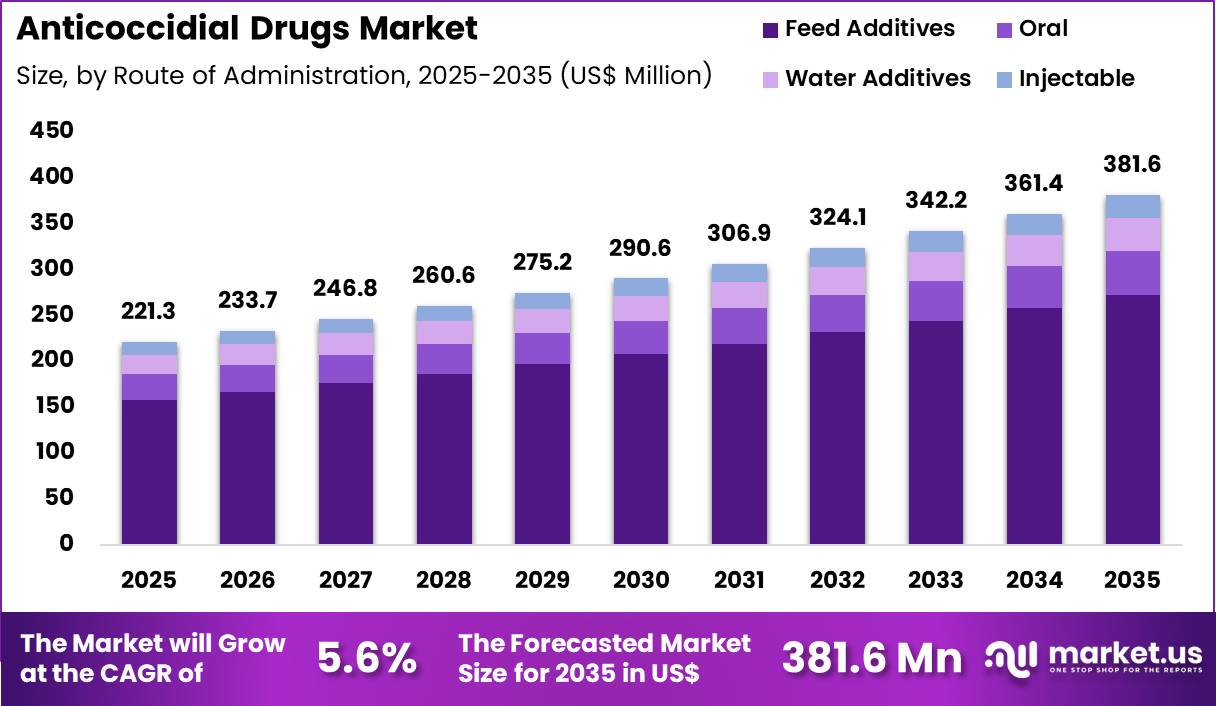
New York, NY – Nov 23 2026 – The Global Anticoccidial Drugs Market size is expected to be worth around US$ 381.6 Million by 2035 from US$ 221.3 Million in 2025, growing at a CAGR of 5.6% during the forecast period 2026-2035. In 2025, North America led the market, achieving over 45.6% share with a revenue of US$ 101.0 Million.
Anticoccidial drugs are pharmaceutical products used to prevent and control coccidiosis, a parasitic disease caused by protozoan parasites belonging to the genus Eimeria. The disease primarily affects poultry, livestock, and other animals, leading to intestinal damage, reduced feed efficiency, poor weight gain, lower productivity, and increased mortality.
These drugs play an important role in animal health management, particularly in the poultry industry, where coccidiosis can cause significant economic losses. Anticoccidial drugs work by targeting different stages of the parasite’s life cycle, thereby preventing parasite multiplication and reducing disease severity.
Major categories of anticoccidial drugs include ionophores, such as monensin, salinomycin, and lasalocid, and chemical anticoccidials, such as amprolium, diclazuril, and toltrazuril. These products are administered through feed, drinking water, or other veterinary formulations, depending on the drug and animal species.
The demand for anticoccidial drugs is supported by the growing global consumption of poultry and meat products, increasing focus on animal health, and the need to improve livestock productivity. However, concerns regarding drug resistance, regulatory restrictions, and antimicrobial stewardship are encouraging the development of safer and more effective alternatives. Continued advancements in veterinary pharmaceuticals are expected to support innovation in the anticoccidial drugs industry.
Key Takeaways
- In 2025, the market was valued at US$ 221.3 Million and is projected to grow at a CAGR of 5.6%, reaching US$ 381.6 Million by 2035.
- Based on drug class, the market is segmented into ionophore antibiotics, chemical derivatives, and combination products. Among these, ionophore antibiotics dominated the market, accounting for a share of 58.6%.
- Based on animal type, the market is categorized into poultry, cattle, sheep, goats, swine, and others, with poultry accounting for the largest market share of 62.7%.
- Based on the route of administration, the market is segmented into oral, feed additives, water additives, and injectable. The feed additives segment dominated the market, capturing a revenue share of 71.5%.
- Based on distribution channel, the market is classified into veterinary hospitals, retail pharmacies, online pharmacies, and veterinary clinics. Veterinary hospitals held the leading position, accounting for a revenue share of 56.9%.
- Regionally, North America dominated the market, accounting for the largest share of 45.6%.
Key Market Segments
- In 2025, the market was valued at US$ 221.3 Million and is projected to grow at a CAGR of 5.6%, reaching US$ 381.6 Million by 2035.
- Based on drug class, the market is segmented into ionophore antibiotics, chemical derivatives, and combination products. Among these, ionophore antibiotics dominated the market with a share of 58.6%.
- Based on animal type, the market is categorized into poultry, cattle, sheep, goats, swine, and others, with poultry accounting for the largest market share of 62.7%.
- Based on the route of administration, the market is classified into oral, feed additives, water additives, and injectable. Among these, feed additives emerged as the leading segment, accounting for 71.5% of the market revenue.
- Based on distribution channel, the market is segmented into veterinary hospitals, retail pharmacies, online pharmacies, and veterinary clinics, with veterinary hospitals holding the dominant revenue share of 56.9%.
- Regionally, North America dominated the market, accounting for the largest share of 45.6%.
Regional Analysis
- Drug Class Analysis: Ionophore antibiotics dominated the drug class segment, accounting for 58.6% of the market share. Their widespread adoption is attributed to their proven effectiveness in controlling coccidiosis by disrupting ion transport in parasites. Their cost efficiency, compatibility with medicated feed, and ability to improve animal health further support their demand across commercial livestock production systems.
- Animal Type Analysis: Poultry dominated the animal type segment, accounting for 62.7% of the market share. The leading position is supported by the high prevalence of coccidiosis in chickens and the expansion of intensive poultry farming. Increasing demand for poultry meat, combined with the need to minimize disease-related losses and maintain flock productivity, continues to drive segment growth.
- Route of Administration Analysis: Feed additives represented the leading route of administration segment, accounting for 71.5% of the market share. Their dominance is primarily attributed to convenient medication delivery through routine feeding practices. This approach enables consistent drug intake across large animal populations, reduces labor requirements, and supports effective disease prevention, making it highly suitable for intensive livestock production systems.
- Distribution Channel Analysis: Veterinary hospitals dominated the distribution channel segment, accounting for 56.9% of the market share. Their leading position is driven by access to qualified veterinary professionals, diagnostic facilities, and prescription-based treatment services. Increasing awareness of animal health, growing demand for professional guidance, and the need for effective disease management further strengthen their role in anticoccidial drug distribution.
Emerging Trends
- Growing Demand for Herbal and Plant-Based Anticoccidials: Increasing concerns about drug resistance and chemical residues are encouraging interest in plant-based anticoccidial solutions. Botanical extracts, essential oils, and phytochemicals are being studied for their ability to control Eimeria infections and support intestinal health in poultry.
- Development of Drug Resistance Management Strategies: Continuous use of the same anticoccidial compounds can reduce their effectiveness against coccidia. Consequently, poultry producers are adopting rotational drug programs and shuttle programs, in which different medicines are used during separate production stages to manage resistance.
- Increasing Adoption of Vaccination-Based Disease Control: Live coccidiosis vaccines are gaining importance as part of integrated disease-control programs. These vaccines expose birds to controlled quantities of Eimeria organisms, helping them develop immunity and potentially reducing dependence on continuous medication.
- Innovation in Microbiome-Based Anticoccidial Solutions: Probiotics, prebiotics, and other beneficial microbial products are receiving attention because of their potential to improve gut health and strengthen natural immune responses. These products are being investigated as complementary solutions to conventional anticoccidial medicines.
- Advancement in Nanotechnology-Based Drug Delivery: Nanoparticles and nano-encapsulation technologies are being explored to improve the stability, absorption, and targeted delivery of anticoccidial compounds. These technologies may help improve treatment performance while reducing unnecessary exposure to active ingredients.
Use Cases
- Prevention of Coccidiosis in Commercial Poultry Farms: Anticoccidial drugs are widely used in broiler and other poultry production systems to prevent infections caused by Eimeria parasites. Preventive medication helps reduce intestinal damage, mortality, and production losses associated with coccidiosis.
- Treatment of Infected Poultry Flocks: Anticoccidial medicines are used to manage active coccidiosis infections in chickens and turkeys. Depending on the product and applicable veterinary guidance, treatments may be administered through drinking water to help control parasite development and disease severity.
- Protection of Poultry Growth and Feed Efficiency: Coccidiosis can damage the intestinal lining and reduce nutrient absorption. Anticoccidial drugs help control parasite activity, supporting normal digestion, body-weight development, feed utilization, and overall production performance in commercial poultry operations.
- Disease Management in Turkey Production: Turkey farms also use anticoccidial medicines to control species of Eimeria responsible for intestinal infections. Preventive disease management helps maintain flock health and reduces the risk of production disruptions during commercial turkey farming.
- Integrated Coccidiosis Control in Livestock Production: Anticoccidial products can be incorporated into broader veterinary disease-control programs alongside vaccination, sanitation, litter management, and nutritional support. Such integrated approaches help reduce parasite exposure and improve animal health management.
Frequently Asked Questions About Anticoccidial Drugs
- What are the commonly used anticoccidial drugs?
Commonly used anticoccidial compounds include amprolium, toltrazuril, diclazuril, monensin, salinomycin, narasin, lasalocid, and maduramicin. Their selection depends on the animal species, disease-control requirements, product approval, and veterinary recommendations. - How do anticoccidial drugs work?
Anticoccidial drugs interfere with different stages of the coccidia parasite’s development. Depending on the active ingredient, they either stop parasite multiplication or kill developing parasites, thereby reducing intestinal damage and the severity of infection. - Which animals require anticoccidial drugs?
Anticoccidial medicines are primarily used in poultry production, particularly in chickens and turkeys. Certain anticoccidial products are also developed for other livestock species, depending on the parasite involved and the approved veterinary application. - What are the major factors responsible for increasing demand for anticoccidial drugs?
Increasing commercial poultry production, the need to prevent parasitic infections, rising awareness of animal health, and efforts to reduce production losses are important factors supporting demand for anticoccidial drugs across livestock farming operations. - What is the difference between coccidiostatic and coccidiocidal drugs?
Coccidiostatic drugs temporarily stop or slow the development of coccidia parasites, whereas coccidiocidal drugs kill the parasites during development. The classification depends on the active ingredient, treatment duration, and exposure conditions. - What are the major product segments in the anticoccidial drugs market?
The market can be segmented into ionophores and chemical anticoccidials based on product type. Common active ingredients include monensin, salinomycin, amprolium, toltrazuril, diclazuril, narasin, and lasalocid. - What are the major factors driving the anticoccidial drugs market?
The need to maintain poultry health, prevent parasitic infections, improve production efficiency, and reduce disease-related financial losses supports market demand. Commercial poultry farming and increasing attention to preventive veterinary healthcare also contribute to product adoption. - What are the key opportunities in the anticoccidial drugs market?
Research into herbal formulations, improved drug delivery systems, microbiome-based products, and new vaccine technologies creates potential commercial opportunities. These developments aim to address drug resistance, improve treatment performance, and support more sustainable poultry disease management.
Conclusion
The anticoccidial drugs market is expected to witness steady growth, driven by increasing poultry production, rising awareness of animal health, and the growing need to prevent coccidiosis-related economic losses. Valued at US$ 221.3 Million in 2025, the market is projected to reach US$ 381.6 Million by 2035, growing at a CAGR of 5.6%.
Ionophore antibiotics, poultry, feed additives, and veterinary hospitals remain the leading segments. North America holds a dominant regional position. Furthermore, advancements in herbal formulations, vaccination, microbiome-based solutions, and innovative drug delivery technologies are expected to create new growth opportunities.
Discuss your needs with our analyst
Please share your requirements with more details so our analyst can check if they can solve your problem(s)