


Overview
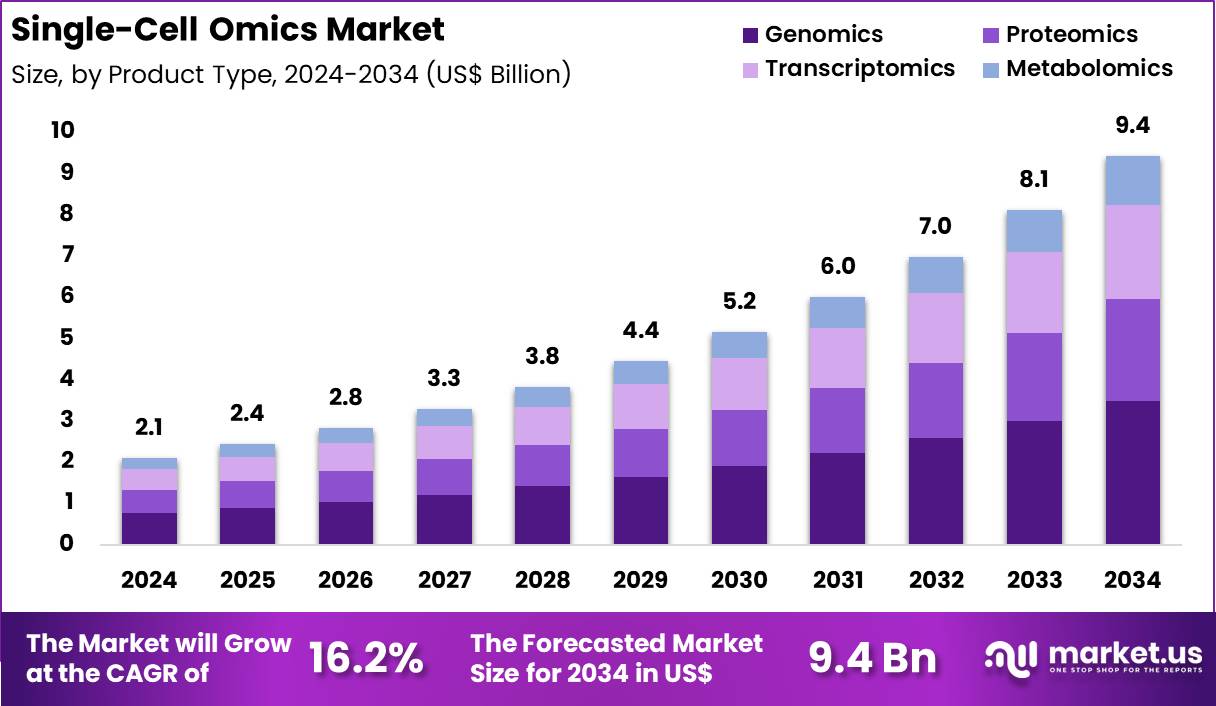
New York, NY – Oct 28, 2026 – Global Single-Cell Omics Market size is expected to be worth around US$ 9.4 Billion by 2034 from US$ 2.1 Billion in 2024, growing at a CAGR of 16.2% during the forecast period 2025 to 2034. In 2024, North America led the market, achieving over 46.1% share with a revenue of US$ 1.0 Billion.
Single-cell omics is an advanced research approach that enables the analysis of individual cells to understand biological systems at a deeper level. Unlike traditional bulk analysis, which measures the average molecular characteristics of large cell populations, single-cell omics reveals cellular diversity, gene expression patterns, and molecular differences between individual cells.
The technology includes several techniques, such as single-cell genomics, transcriptomics, proteomics, and epigenomics. These methods help researchers investigate DNA, RNA, proteins, and epigenetic modifications at the cellular level. By combining these data types, scientists can gain a more comprehensive understanding of cellular functions, disease mechanisms, and biological processes.
Single-cell omics is gaining importance across pharmaceutical research, biotechnology, clinical diagnostics, and academic research. Key applications include cancer research, immunology, neuroscience, stem cell studies, drug discovery, and biomarker identification. The approach also supports the development of targeted therapies and advances in personalized medicine.
Technological advancements in sequencing platforms, microfluidics, automation, and bioinformatics are improving data quality, analytical capabilities, and research efficiency. However, high experimental costs, complex data interpretation, and the need for specialized expertise remain important challenges.
As demand for high-resolution biological insights increases, single-cell omics is expected to play an increasingly significant role in biomedical research and precision healthcare, creating new opportunities for technology developers, research institutions, pharmaceutical companies, and biotechnology organizations.
Key Takeaways
- In 2024, the global single-cell omics market was valued at US$ 2.1 billion and is projected to reach US$ 9.4 billion by 2034, growing at a CAGR of 16.2% during the forecast period.
- By product type, the market is segmented into genomics, proteomics, transcriptomics, and metabolomics. Genomics dominated the market, accounting for a share of 36.9%.
- Based on application, the market is categorized into oncology, neurology, cell biology, and immunology. Oncology held a leading position, capturing 41.7% of the market.
- By end-user, the market is divided into academic and research organizations, pharmaceutical and biotechnology companies, hospital and diagnostic laboratories, and others. Academic and research organizations dominated the segment, accounting for 48.8% of total market revenue.
- Regionally, North America dominated the global single-cell omics market, capturing a share of 46.1%.
Key Market Segments
- Product Type Analysis: Genomics dominated the single-cell omics market, accounting for 36.9% of the product type segment. Its leadership is driven by the growing need to understand genetic variation, cellular heterogeneity, and disease mechanisms. Advancements in next-generation sequencing, improved data quality, and expanding multi-omics research continue to support segment growth.
- Application Analysis: Oncology dominated the application segment, accounting for 41.7% of the single-cell omics market. Growth is driven by increasing demand for tumor profiling, cancer heterogeneity analysis, and treatment resistance research. Rising cancer research funding, precision medicine initiatives, and drug discovery applications further strengthen the adoption of single-cell omics technologies.
- End-User Analysis: Academic and research organizations dominated the end-user segment, accounting for 48.8% of the single-cell omics market. Their leading position is supported by extensive cell atlas projects, fundamental biological research, and government-funded initiatives. Access to advanced technologies, specialized research facilities, and skilled professionals continues to drive adoption across academic institutions and research centers.
Regional Analysis
North America Leads the Single-Cell Omics Market
North America dominated the global single-cell omics market in 2024, accounting for 46.1% of the market share. Regional growth is supported by strong research infrastructure, substantial funding, and increasing applications in oncology, immunology, and neuroscience.
Companies such as 10x Genomics and Fluidigm have contributed to technological advancements in sequencing and microfluidics. Government initiatives, collaborative research programs, and investments in precision medicine further support market expansion. Funding from institutions such as the National Institutes of Health also encourages innovation in single-cell technologies.
Asia Pacific Expected to Record the Highest CAGR
The Asia Pacific single-cell omics market is expected to register the highest CAGR during the forecast period. Growth is driven by increasing investments in biotechnology, expanding healthcare infrastructure, and rising demand for precision diagnostics.
Government support for genomic research, growing cancer research activities, and wider adoption of advanced sequencing technologies are creating new opportunities. Additionally, improvements in laboratory automation, bioinformatics capabilities, and local reagent manufacturing are expected to enhance accessibility and accelerate regional market growth.
Emerging Trends
- Integration of multiple omics technologies: Single-cell analysis is increasingly combining information about genes, RNA, proteins and epigenetic changes within individual cells. This approach provides a broader understanding of cellular activity and disease mechanisms. Integrated analysis is expected to support more detailed biological research and drug development.
- Growth of spatial omics technologies: Spatial transcriptomics and spatial proteomics are gaining attention because they show where molecular activity occurs within tissues. Unlike conventional single-cell analysis, these technologies can help preserve information about the location of cells and their interactions. This is particularly useful in cancer and tissue disease research.
- Increasing use of artificial intelligence: Artificial intelligence and machine learning are being applied to interpret complex single-cell datasets, identify cell populations and discover disease-related patterns. These tools may also help researchers predict treatment responses. However, the reliability of such predictions depends on data quality and further experimental and clinical validation.
- Development of high-throughput and automated workflows: New laboratory methods are making it possible to process and analyse larger numbers of cells more efficiently. Improvements in sample preparation, microfluidics and sequencing workflows can help researchers increase study capacity and improve consistency. Automation may also reduce manual work and support wider use in research laboratories.
- Movement towards clinical and precision medicine applications: Single-cell omics is being investigated for identifying disease-specific cell patterns, developing biomarkers and understanding why patients respond differently to treatments. Research is also exploring its role in personalised medicine. Routine clinical use remains limited, as standardisation, cost, reproducibility and clinical validation need further development.
Use Cases
- Cancer research and tumour profiling: Single-cell omics helps researchers identify different cancer cell populations within the same tumour. It can reveal variations in gene activity, immune cell behaviour and possible treatment resistance. These findings support tumour research, biomarker discovery and the investigation of new cancer treatment strategies.
- Drug discovery and treatment response analysis: Pharmaceutical researchers can use single-cell data to study how different cells respond to a drug candidate. This can help identify resistant cell populations, explore drug mechanisms and improve the selection of potential therapies for further testing.
- Immune system and infectious disease research: Single-cell omics can distinguish immune cell types and examine how their activity changes during infection or immune-related disease. Researchers can use these findings to investigate host–pathogen interactions, immune responses and possible targets for vaccines or treatments.
- Stem cell and developmental biology: The technology can track how cells develop, mature and specialise into different cell types. It supports research into tissue formation, stem cell behaviour and developmental disorders, helping scientists understand the biological changes that occur during growth and cell differentiation.
- Disease biomarker discovery and precision medicine: Single-cell analysis can reveal molecular patterns linked to disease severity, progression or potential treatment response. Researchers can investigate these patterns as possible biomarkers and develop evidence for more targeted healthcare approaches. Clinical use requires validation to confirm that findings are reliable and useful for patient care.
Frequently Asked Questions About Single-Cell Omics
- How does single-cell omics work?
Single-cell omics involves preparing biological samples, isolating or identifying individual cells, measuring selected molecular features and analysing the resulting data using computational tools. Depending on the method, researchers can examine gene expression, DNA changes, proteins or multiple molecular layers. - What are the main types of single-cell omics?
The main types include single-cell genomics, transcriptomics, epigenomics and proteomics. These methods examine DNA, RNA activity, gene regulation and proteins, respectively. Integrated approaches combine multiple measurements to provide a more complete understanding of cellular function and disease. - Why is single-cell omics important in healthcare research?
Single-cell omics helps researchers investigate disease mechanisms, identify potential biomarkers and understand why cells respond differently to treatments. These insights can support drug development and precision medicine research, although clinical applications require appropriate validation and evidence of practical benefit. - What are the key factors driving the single-cell omics market?
Market growth is supported by rising demand for detailed cellular analysis, increasing cancer research, advances in sequencing technologies and wider use of computational tools. Interest in precision medicine and integrated molecular analysis is also creating new research opportunities. - Which applications contribute to demand for single-cell omics technologies?
Major applications include cancer research, immunology, drug discovery, developmental biology, stem cell research and biomarker identification. Pharmaceutical companies, academic institutions, hospitals and biotechnology laboratories use these technologies to investigate cellular differences and develop new scientific insights. - How is artificial intelligence influencing the single-cell omics market?
Artificial intelligence helps researchers process complex datasets, classify cell populations and identify molecular patterns associated with disease. It may also support drug-response prediction. Its effectiveness depends on suitable training data, reliable analytical methods and independent validation of research findings. - Is single-cell omics currently used for routine clinical diagnosis?
Single-cell omics has promising research applications, but routine clinical use remains limited. Before widespread adoption, methods must demonstrate reproducibility, clinical validity and practical value, while addressing testing costs, laboratory standards and requirements for dependable interpretation of patient results.
Conclusion
The single-cell omics market is positioned for significant growth, driven by advances in sequencing technologies, automation, bioinformatics, and precision medicine. The market is projected to increase from US$ 2.1 billion in 2024 to US$ 9.4 billion by 2034, reflecting growing demand for detailed cellular analysis.
Genomics, oncology, and academic research organizations remain important market segments, while North America maintains a leading regional position. Asia Pacific presents promising growth opportunities through rising biotechnology investments and expanding research capabilities. However, high costs, data complexity, and clinical validation requirements remain key challenges. Continued innovation is expected to support wider adoption.
Discuss your needs with our analyst
Please share your requirements with more details so our analyst can check if they can solve your problem(s)



