


Overview
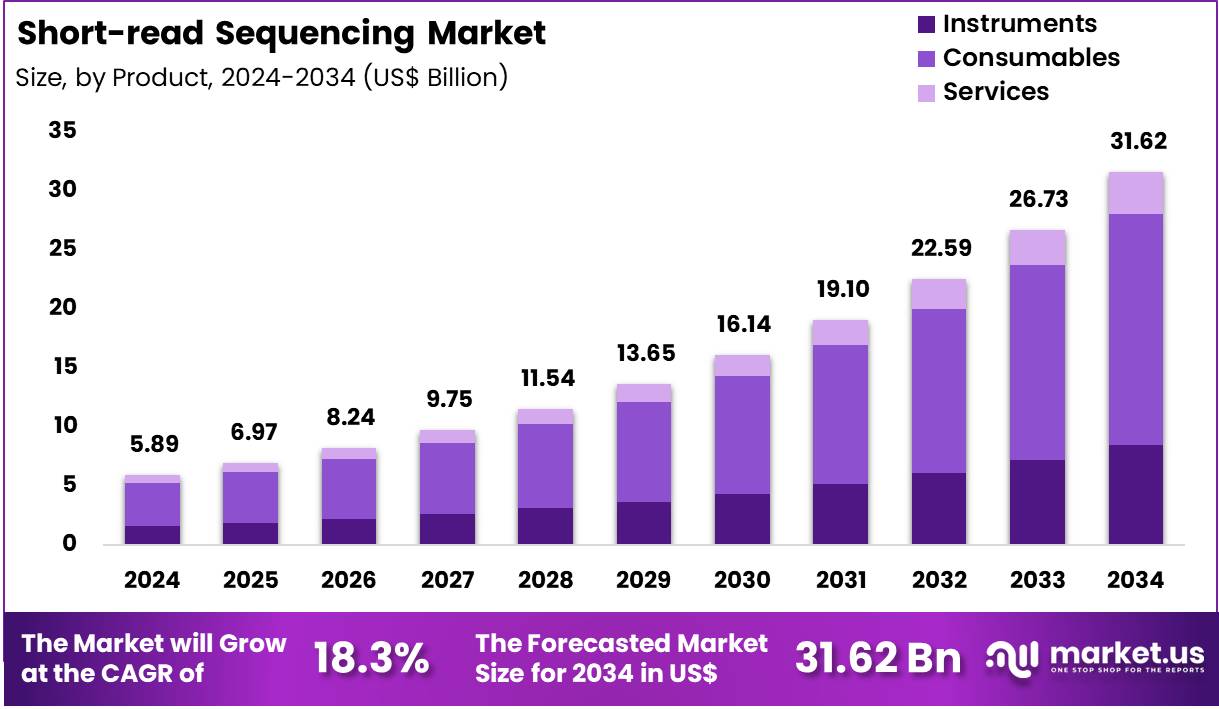
New York, NY – Sep 07, 2026 – The Global Short-Read Sequencing Market size is expected to be worth around US$ 31.62 Billion by 2034 from US$ 5.89 Billion in 2024, growing at a CAGR of 18.3% during the forecast period 2025 to 2034. In 2024, North America led the market, achieving over 46.8% share with a revenue of US$ 2.76 Billion.
The global Short-read Sequencing Market is witnessing strong growth due to increasing adoption of next-generation sequencing (NGS) technologies in genomics research, precision medicine, oncology testing, infectious disease surveillance, and agricultural biotechnology.
Short-read sequencing enables rapid and accurate analysis of DNA and RNA by generating millions of small sequence fragments, typically ranging from 50 to 300 base pairs, which are assembled using advanced bioinformatics tools.
The market is expanding as healthcare organizations increasingly integrate genomic testing into clinical workflows. In 2025, global sequencing platforms are processing billions of sequencing reads daily, supporting applications such as whole genome sequencing, targeted sequencing, exome sequencing, and transcriptome analysis. The rising demand for early disease detection and personalized treatment approaches is driving investments in sequencing infrastructure and data analysis solutions.
Technological advancements have improved sequencing accuracy, throughput, and cost efficiency. Modern short-read platforms can generate over 1 terabase (TB) of sequencing data per run, enabling large-scale population genomics projects and clinical studies.
The declining cost of genome sequencing, which has reduced from millions of dollars during early sequencing efforts to nearly US$600–US$1,000 for many short-read workflows, is further supporting adoption.
Leading companies are focusing on improved sequencing instruments, automation, cloud-based genomic analysis, and integrated diagnostic solutions. Growing research funding, increasing clinical applications, and rising demand for precision healthcare are expected to strengthen the short-read sequencing market as genomics becomes a key component of modern biomedical research and healthcare delivery.
Key Takeaways
- In 2024, the Short-read Sequencing Market generated a revenue of US$5.89 billion and is projected to grow at a CAGR of 18.3%, reaching approximately US$31.62 billion by 2034.
- Based on Product, the market is segmented into Instruments, Consumables, and Services. Among these, Consumables dominated the market in 2024, accounting for a 61.9% market share.
- Based on Workflow, the market is categorized into Pre-Sequencing, Sequencing, and Data Analysis. The Sequencing segment held the leading position in 2024, capturing a 59.8% market share.
- Based on Application, the market is segmented into Whole Genome Sequencing (WGS), Whole Exome Sequencing (WES), Targeted Sequencing & Resequencing, and Others. Whole Exome Sequencing (WES) emerged as the leading segment in 2024, with a 38.1% market share.
- Based on End-User, the market is divided into Academic & Research Institutes, Hospitals & Clinics, Pharmaceutical & Biotechnology Companies, and Others. Academic & Research Institutes dominated the market in 2024, accounting for a 38.9% share.
- Regionally, North America led the Short-read Sequencing Market in 2024, securing the highest market share of 46.8% due to strong genomic research activities, advanced healthcare infrastructure, and increasing adoption of sequencing technologies.
Market segmentation
- Product Analysis: The Consumables segment dominated the Short-read Sequencing Market in 2024 with a 61.9% share, driven by recurring demand for reagents, flow cells, library preparation kits, and sequencing chemicals. Increasing adoption of WGS, WES, oncology testing, and multi-omics research continues to support steady consumables consumption.
- Workflow Analysis: The Sequencing segment accounted for 59.8% of the Short-read Sequencing Market in 2024, supported by rising sequencing volumes, advanced platforms, and frequent sequencing cycles. Growing applications in clinical genomics, oncology profiling, infectious disease monitoring, and population genomics programs are increasing demand for sequencing workflows globally.
- Application Analysis: Whole Exome Sequencing (WES) led the application segment with a 38.1% market share in 2024, due to its ability to identify disease-related genetic variants efficiently. Increasing adoption in rare disease diagnosis, precision medicine, cancer research, and genomic studies is driving WES demand across healthcare and research sectors.
- End-User Analysis: Academic & Research Institutes held the largest end-user share of 38.9% in 2024, driven by extensive genomic research activities, population sequencing projects, and biotechnology studies. Universities and research centers remain major contributors to sequencing data generation through applications including WGS, WES, RNA sequencing, and pathogen analysis.
Statistical Information
- In 2025, Illumina’s NovaSeq X Plus sequencing platform delivered up to 26 billion single reads per run and generated up to 16 terabases (TB) of data in a single run, supporting large-scale human genome and population sequencing projects.
- In 2025, Illumina reported that the NovaSeq X Series achieved a sequencing accuracy of more than 90% of bases at Q30 or higher quality scores, enabling high-confidence variant detection in clinical and research workflows.
- In 2025, the Illumina NovaSeq X Plus platform reduced whole-genome sequencing costs to approximately US$200–US$300 per genome when operating at high throughput, improving accessibility for large genomic studies.
- In 2025, Element Biosciences’ AVITI24 sequencing platform supported up to 50 million paired-end reads per day through automated sequencing workflows, increasing laboratory productivity for short-read applications.
- In 2025, Illumina’s DRAGEN secondary analysis platform accelerated genomic data processing by up to 50× compared with traditional CPU-based analysis pipelines for certain sequencing workflows.
- In 2025, the NovaSeq X Series reduced sequencing turnaround time for high-throughput projects by completing large-scale sequencing runs in less than 48 hours, depending on workflow configuration.
- In 2025, the National Institutes of Health’s All of Us Research Program surpassed sequencing data availability from more than 245,000 whole genome sequences, supporting large-scale genomic research using short-read sequencing technologies.
- In 2025, the UK Biobank genomic resource included approximately 500,000 participant samples with genome-wide sequencing data, creating one of the largest datasets supporting short-read sequencing-based research.
Regional Analysis
North America is leading the Short-read Sequencing Market
North America maintains the largest share of the market with 46.8% due to strong research spending, established clinical genomics infrastructure, and major sequencing manufacturers headquartered in the region. High adoption of NGS in oncology, reproductive health, and hereditary-disease diagnostics strengthens market leadership. Large federal genomics initiatives, robust insurance coverage improvements, and widespread laboratory automation drive continuous demand.
The Asia Pacific region is expected to experience the highest CAGR during the forecast period
Asia Pacific demonstrates rapid adoption driven by expanding research output, increasing cancer burden, government-funded genome programs in China, Japan, South Korea, India, and strong growth in biotech manufacturing. Falling sequencing costs and large populations accelerate genomic medicine adoption across the region.
Europe Shows Strong Clinical Adoption
Europe remains a major market due to well-established healthcare systems, strong rare-disease diagnostic capability, and national genomics efforts such as the UK’s Genomics England program. Increasing investments in precision oncology strengthen regional demand.
Business Opportunities
The Short-read Sequencing Market presents significant business opportunities driven by the rising adoption of genomics in precision medicine, oncology, rare disease diagnostics, and pharmaceutical research. Companies can capitalize on demand for advanced sequencing instruments, high-performance consumables, automated library preparation solutions, and bioinformatics platforms.
The growing need for faster, accurate, and cost-effective genomic analysis is creating opportunities for developing low-cost sequencing technologies and cloud-based data interpretation tools. Expansion of population genomics programs, infectious disease surveillance, and multi-omics research further supports market growth.
Pharmaceutical and biotechnology partnerships for biomarker discovery, clinical trials, and companion diagnostics provide additional opportunities. Emerging healthcare markets also offer potential for sequencing service providers through infrastructure development, training, and affordable genomic solutions.
Additionally, recurring demand for reagents, flow cells, and sequencing kits creates sustainable revenue opportunities for companies focusing on innovative consumables and workflow optimization. AI-driven genomic analysis and integrated sequencing ecosystems are expected to become key areas for future business expansion.
Emerging Trends
- AI-Based Genomic Data Analysis Integration: Artificial intelligence is becoming important in short-read sequencing workflows by improving variant detection and genomic interpretation. In 2025, advanced sequencing analysis platforms supported processing of large datasets, while some systems handled up to 16 terabases (TB) of sequencing output per run, increasing demand for automated bioinformatics solutions.
- Ultra-High Throughput Sequencing Platforms: High-throughput short-read sequencing platforms are advancing to support large population and clinical studies. In 2025, next-generation systems generated approximately 52–70 billion paired-end reads using high-capacity flow cells, enabling faster genome analysis for research institutes and healthcare applications.
- Growth of Population Genomics Research: Population genomics programs are expanding the use of short-read sequencing for studying genetic variation and disease risks. In 2025, large sequencing initiatives continued generating datasets involving hundreds of thousands of participants, creating opportunities for genomic databases and precision healthcare research.
- Expansion of Pathogen Genomic Surveillance: Short-read sequencing is increasingly used for monitoring infectious diseases and tracking genetic changes in pathogens. In 2025, genomic surveillance programs analyzed thousands of samples globally, supporting faster identification of emerging variants and antimicrobial resistance patterns through sequencing-based monitoring.
- Improved Sequencing Accuracy and Faster Workflows: Short-read sequencing platforms are focusing on higher accuracy and reduced turnaround times. In 2025, advanced systems achieved ≥85% of bases above Q30 quality scores for 2×150 bp runs, with sequencing runs completed in approximately 48 hours.
Use Cases
- Precision Oncology and Cancer Profiling: Short-read sequencing is widely applied in cancer research to identify mutations, biomarkers, and treatment targets. In 2025, genomic workflows using high-throughput sequencing supported analysis of thousands of cancer-related samples, helping researchers develop personalized treatment approaches and improve molecular diagnosis.
- Rare Disease Diagnosis and Genetic Testing: Short-read sequencing supports the identification of disease-causing genetic variants in rare disorders. In 2025, clinical and research laboratories used sequencing approaches covering millions of genetic regions, improving diagnostic capabilities for inherited conditions and supporting faster patient evaluations.
- Drug Discovery and Clinical Research Applications: Pharmaceutical and biotechnology researchers use short-read sequencing for biomarker discovery, genomic profiling, and clinical trial support. In 2025, sequencing platforms producing up to 16 TB of data per run enabled large-scale analysis for therapeutic development programs.
- Agricultural and Environmental Genomics: Short-read sequencing is expanding beyond healthcare into crop improvement, biodiversity studies, and microbial analysis. In 2025, the U.S. Department of Energy Joint Genome Institute reported an annual sequencing output of 1,144.186 TB, supporting large genomic research projects across multiple biological fields.
- Infectious Disease and Microbial Identification: Healthcare organizations use short-read sequencing for pathogen identification, outbreak investigation, and surveillance programs. In 2025, genomic monitoring initiatives analyzed pathogen sequence data from multiple regions, helping public health agencies detect and respond to infectious disease threats.
Recent Development
- In May 2025, Roche announced a strategic collaboration with Broad Clinical Labs to evaluate SBX sequencing technology for clinical genomics applications, including newborn genetic disorder research and whole-genome sequencing workflows.
- In March 2026, Agilent Technologies announced the acquisition of Biocare Medical for US$950 million in an all-cash transaction to strengthen its diagnostics portfolio and expand capabilities in cancer and tissue-based testing solutions.
- In June 2026, Roche launched the AXELIOS 1 next-generation sequencing platform based on SBX technology, enabling same-day whole-genome sequencing in research workflows with results generated within hours.
Frequently Asked Questions on Short-read Sequencing
- What are the major applications of short-read sequencing?
Short-read sequencing is used in whole genome sequencing, whole exome sequencing, cancer genomics, infectious disease monitoring, reproductive health testing, and agricultural research. Its accuracy and scalability make it suitable for studying genetic variations and supporting advanced biomedical discoveries. - Why is short-read sequencing important for precision medicine?
Short-read sequencing enables precision medicine by identifying genetic mutations and biomarkers linked to diseases. Healthcare providers use sequencing data to select targeted therapies, improve diagnosis, and develop personalized treatment strategies, particularly in oncology, rare diseases, and inherited genetic disorders. - What factors are driving the Short-read Sequencing Market growth?
The Short-read Sequencing Market is growing due to increasing genomic research, rising demand for personalized medicine, improved sequencing accuracy, and reduced testing costs. Expanding applications in healthcare, biotechnology, pharmaceutical research, and population genomics are also supporting technology adoption worldwide. - Which segment dominates the Short-read Sequencing Market?
The consumables segment leads the Short-read Sequencing Market because sequencing processes require regular use of reagents, flow cells, and library preparation kits. Continuous demand from research laboratories, diagnostic centers, and pharmaceutical companies makes consumables a major revenue-generating component. - Who are the major end users of short-read sequencing technology?
Major end users include academic research institutes, hospitals, biotechnology companies, pharmaceutical organizations, and diagnostic laboratories. Academic centers primarily use sequencing for genomic studies, while healthcare and pharmaceutical sectors apply it for disease diagnosis, drug discovery, and clinical research. - What are the challenges in the Short-read Sequencing Market?
The Short-read Sequencing Market faces challenges such as large genomic data management, computational complexity, skilled workforce requirements, and difficulty analyzing repetitive DNA regions. Companies are developing improved software, automation solutions, and integrated platforms to overcome these limitations.
Conclusion
The Short-read Sequencing Market is experiencing strong expansion due to rising adoption of genomic technologies in precision medicine, oncology, infectious disease monitoring, and pharmaceutical research. Leading companies such as Illumina, Thermo Fisher Scientific, BGI, QIAGEN, Agilent Technologies, PacBio, Roche, and other players are focusing on advanced sequencing platforms, automation, and bioinformatics solutions.
Continuous innovation in sequencing accuracy, throughput, and data analysis capabilities is strengthening market competitiveness. Increasing investments in population genomics, clinical diagnostics, and drug discovery are expected to create new opportunities. The integration of artificial intelligence and improved workflow solutions will further support the adoption of short-read sequencing across healthcare and research applications.
Discuss your needs with our analyst
Please share your requirements with more details so our analyst can check if they can solve your problem(s)




