


Overview
New York, NY – Aug 07, 2026 – Global Proteomics Outsourcing Market size is expected to be worth around US$ 8.6 Billion by 2034 from US$ 3.1 Billion in 2024, growing at a CAGR of 10.8% during the forecast period 2025 to 2034. In 2024, North America led the market, achieving over a 38.8% share with a revenue of US$ 1.2 Billion.
The global proteomics outsourcing market is gaining momentum as pharmaceutical and biotechnology companies increasingly outsource advanced protein analysis services to reduce research costs and accelerate drug development timelines. Proteomics research requires highly sophisticated technologies, including mass spectrometry, liquid chromatography, and artificial intelligence-based bioinformatics platforms. The cost of establishing a complete proteomics laboratory can exceed US$500,000–US$2 million, while annual operational expenses for specialized equipment maintenance, data analysis, and skilled researchers can reach hundreds of thousands of dollars.
Growing investment in biopharmaceutical research is further supporting outsourcing demand. Global pharmaceutical R&D spending reached approximately US$250 billion annually, increasing the need for efficient research models and specialized service providers. Small and mid-sized biotechnology companies, which represent a significant portion of emerging drug developers, are increasingly using contract research organizations (CROs) to access high-throughput proteomic technologies without large capital investments.
Industry consolidation and technology expansion are also accelerating market development. In July 2024, Thermo Fisher Scientific acquired Olink Holding AB for US$3.1 billion, enhancing its next-generation proteomics capabilities. In May 2024, Bruker Corporation inaugurated a new manufacturing facility in Bremen, Germany, to support innovation in mass spectrometry technologies. The rising importance of biomarker discovery is creating new opportunities for proteomics service providers.
The National Institutes of Health supports large-scale cancer proteomics initiatives through its Office of Cancer Clinical Proteomics Research, which focuses on integrating protein analysis into precision oncology. Additionally, the U.S. Food and Drug Administration has approved hundreds of biomarker-supported therapies and diagnostic approaches, highlighting the growing role of molecular profiling in healthcare. Increasing demand for personalized medicine, targeted therapies, and high-throughput protein analysis is expected to strengthen adoption of proteomics outsourcing services worldwide.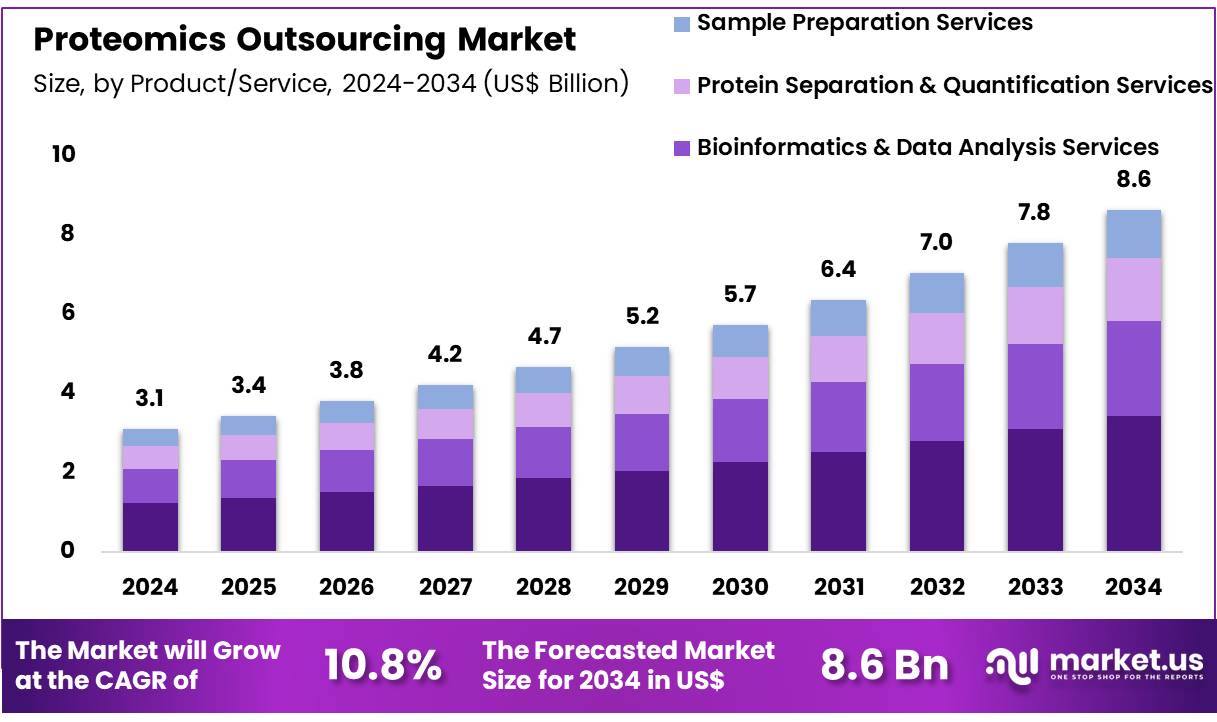
Key Takeaways
- In 2024, the proteomics outsourcing market generated US$ 3.1 billion in revenue and is projected to reach US$ 8.6 billion by 2034, expanding at a CAGR of 10.8% during the forecast period.
- Based on product/service, the market is segmented into protein identification & characterisation services, bioinformatics & data analysis services, protein separation & quantification services, and sample preparation services. Among these, protein identification & characterization services dominated in 2023, accounting for 39.6% market share.
- By application, the proteomics outsourcing market is categorized into drug discovery & development, proteome profiling, biomarker discovery, and others. The drug discovery & development segment held the leading position in 2023, capturing 44.3% of the market share.
- Based on end users, the market is segmented into pharmaceutical & biotechnology companies, academic & research institutes, and contract research organizations (CROs). The pharmaceutical & biotechnology companies segment emerged as the largest contributor, representing 47.8% of total market revenue.
- Regionally, North America dominated the global proteomics outsourcing market in 2023, accounting for 38.8% of the overall market share, driven by strong biotechnology research activities, advanced healthcare infrastructure, and increasing demand for precision medicine solutions.
Statistical Information
- Large-Scale Proteomics Projects Are Increasing Demand for Outsourcing Services: Pharmaceutical companies and research organizations are outsourcing proteomics analysis as large-scale protein profiling requires advanced mass spectrometry platforms, automation, and bioinformatics expertise. The UK Biobank Pharma Proteomics Project (UKB-PPP) is analyzing 56,000 plasma samples and is supported by a consortium of 14 biopharmaceutical companies for drug target discovery and biomarker identification.
- Proteomics Platforms Can Analyze Thousands of Proteins Per Sample: Advancements in proteomic technologies are increasing demand for outsourced laboratory services, as the UK Biobank population proteomics initiative aims to measure up to 5,400 proteins per sample using data from approximately 500,000 participants, including 100,000 repeat samples collected over 15 years for longitudinal analysis.
- Pharmaceutical Companies Are Increasing Proteomics Collaborations: Pharmaceutical companies are partnering with external proteomics organizations to accelerate discovery programs, with the UK Biobank Pharma Proteomics Project involving 14 biopharmaceutical companies, analyzing up to 600,000 blood samples, and measuring up to 5,400 protein markers per sample.
- Proteomics Supports Biomarker Discovery for Drug Development: Proteomic outsourcing is supporting biomarker discovery, as a UK Biobank study analyzed plasma samples from 54,219 participants, evaluated 2,923 proteins, and identified 14,287 genetic associations with protein levels, with approximately 81% of associations previously undescribed.
- Cancer Research Is Driving Demand for Proteomics Testing: Cancer researchers are adopting outsourced proteomics services for biomarker discovery and molecular profiling, with UK Biobank proteomics studies analyzing nearly 3,000 circulating proteins from more than 54,000 participants to identify disease-related protein signatures.
- Increasing Demand for Proteomics Data Analysis and Bioinformatics: Growing proteomics datasets are increasing demand for specialized bioinformatics services, as UK Biobank research generated information on 2,923 proteins and mapped more than 14,000 protein–genetic relationships requiring advanced computational analysis.
- Outsourcing Helps Biotechnology Companies Access Advanced Technologies: Biotechnology companies outsource proteomics workflows because high-resolution mass spectrometry requires specialized infrastructure; large-scale projects such as the UK Biobank plan analysis of up to 600,000 samples with measurements of up to 5,400 proteins per sample.
- Proteomics Is Expanding Pharmaceutical Drug Target Discovery: Pharmaceutical companies are using proteomics datasets for drug target identification, with UK Biobank research identifying 14,287 protein quantitative trait associations from plasma samples of 54,219 individuals, while future expansion includes up to 600,000 samples and 5,400 protein measurements per sample.
Regional Analysis
North America led the market by securing a market share of 38.8% in 2023.
North America remains a major hub for proteomics outsourcing due to strong pharmaceutical R&D activities, advanced biotechnology infrastructure, and extensive academic–industry collaborations. The region benefits from investments by organizations such as the NIH and regulatory support from the FDA, which promotes biomarker qualification and precision medicine research.
The growing adoption of mass spectrometry, artificial intelligence-based data analysis, and high-throughput protein profiling is encouraging pharmaceutical and biotechnology companies to outsource complex proteomics workflows. The U.S. also has a strong ecosystem of contract research organizations and specialized laboratories supporting drug discovery, clinical research, and biomarker validation.
Asia Pacific is experiencing increasing demand for proteomics outsourcing due to expanding biotechnology research, government-funded life science programs, and rising investments in precision medicine. Countries such as China, Japan, Singapore, and South Korea are strengthening proteomics capabilities through research infrastructure development and collaborations between academia and biopharmaceutical companies.
China’s National Natural Science Foundation supports large-scale life science research programs involving proteomics and molecular analysis. Growing research activities in oncology, drug discovery, and biomarker development are increasing demand for external proteomics services across the region.
Emerging Trends
- AI-Based Proteomics Data Analysis Is Expanding: Artificial intelligence is increasingly used in outsourced proteomics workflows to analyze complex protein datasets, improve biomarker discovery, and accelerate drug development. Large-scale initiatives such as UK Biobank analyze data from approximately 500,000 participants and measure up to 5,400 proteins per sample for precision medicine research.
- Growth of High-Throughput Protein Profiling: High-throughput proteomics is becoming a major trend as pharmaceutical companies require external laboratories capable of processing large sample volumes. The UK Biobank Pharma Proteomics Project is analyzing 56,000 plasma samples using advanced protein profiling technologies to support biomarker discovery and drug target identification.
- Increasing Adoption of Proteomics in Precision Medicine: Precision medicine is driving demand for proteomics outsourcing because protein-level information helps identify disease mechanisms and treatment responses. UK Biobank’s research platform contains health data from approximately 500,000 individuals, supporting large-scale protein studies for personalized healthcare applications.
- Rising Focus on Biomarker Discovery and Validation: Pharmaceutical companies are increasingly outsourcing proteomics services for biomarker identification and validation in clinical research. The FDA Biomarker Qualification Program supports development of reliable biomarkers for medical products, helping accelerate drug development and regulatory decision-making.
- Expansion of Multi-Omics Integration in Research: Proteomics is increasingly combined with genomics and other biological data to improve disease understanding and therapeutic discovery. UK Biobank proteomics research identified 14,287 protein–genetic associations from analysis of 54,219 participants, supporting advanced drug target discovery programs.
- Growing Use of Proteomics in Cancer Research: Cancer research is adopting outsourced proteomics services to identify molecular signatures and develop targeted therapies. Large-scale studies analyze thousands of proteins to understand tumor biology, with UK Biobank studies evaluating approximately 3,000 circulating proteins from more than 54,000 participants.
Use Cases
- Drug Target Identification and Validation: Proteomics outsourcing is widely used by pharmaceutical companies to identify and validate new drug targets by analyzing protein interactions, disease pathways, and biological responses. Large-scale projects such as UK Biobank analyze thousands of proteins from human samples to support faster therapeutic discovery.
- Biomarker Discovery for Disease Diagnosis: Outsourced proteomics services help researchers discover protein biomarkers linked with diseases, enabling improved diagnosis, prognosis, and treatment monitoring. The FDA supports biomarker qualification programs to evaluate biomarkers for use in medical product development and clinical research.
- Precision Medicine and Patient Stratification: Proteomics outsourcing supports precision medicine by analyzing patient-specific protein profiles to predict treatment response and identify suitable therapies. UK Biobank’s research platform includes data from approximately 500,000 participants, enabling large-scale protein analysis for personalized healthcare applications.
- Multi-Omics Research Integration: Proteomics outsourcing enables integration of protein data with genomics, transcriptomics, and other biological datasets to improve understanding of complex diseases. UK Biobank studies identified 14,287 protein–genetic associations, supporting advanced disease research and therapeutic discovery.
- Drug Safety and Toxicology Studies: Pharmaceutical companies use outsourced proteomics analysis to identify protein changes linked with drug toxicity and safety risks. Protein profiling helps researchers evaluate biological effects during preclinical and clinical development stages.
- Academic and Biotechnology Research Support: Universities, research institutes, and biotechnology companies outsource proteomics workflows to access advanced mass spectrometry equipment, laboratory expertise, and bioinformatics capabilities without developing expensive internal infrastructure.
Frequently Asked Questions on Proteomics Outsourcing
- Why are pharmaceutical companies outsourcing proteomics services?
Pharmaceutical companies outsource proteomics services to access advanced technologies, specialized expertise, and high-performance analytical platforms without investing in costly internal infrastructure. Outsourcing helps improve research efficiency, reduce development timelines, and support complex drug discovery and biomarker validation activities. - What technologies are used in proteomics outsourcing?
Proteomics outsourcing relies on technologies such as mass spectrometry, liquid chromatography, protein microarrays, and bioinformatics tools. These technologies enable researchers to identify, quantify, and analyze thousands of proteins from biological samples for pharmaceutical, clinical, and academic research applications. - What are the major applications of the Proteomics Outsourcing Market?
Major applications include biomarker discovery, precision medicine, cancer research, clinical trial support, drug target identification, and disease mechanism analysis. Proteomics outsourcing helps researchers understand protein changes associated with diseases and develop improved diagnostic and therapeutic solutions. - How is proteomics used in personalized medicine?
Proteomics supports personalized medicine by analyzing individual protein profiles to predict treatment response, identify disease risks, and develop targeted therapies. Researchers combine proteomics data with genomic information to create more accurate patient-specific treatment approaches. - How does proteomics outsourcing benefit biotechnology companies?
Proteomics outsourcing allows biotechnology companies to access advanced laboratory infrastructure, skilled scientists, and analytical technologies without establishing expensive internal facilities. This approach helps startups and research organizations accelerate projects while improving operational efficiency and resource management. - What is the future outlook of the Proteomics Outsourcing Market?
The future outlook of the Proteomics Outsourcing Market is driven by artificial intelligence, automation, multi-omics integration, and personalized healthcare. Increasing demand for biomarker discovery, targeted therapies, and advanced disease research will continue expanding the use of outsourced proteomics services.
Conclusion
The Proteomics Outsourcing Market is expanding due to increasing demand for advanced protein analysis, biomarker discovery, precision medicine, and pharmaceutical research support. Growing adoption of mass spectrometry, artificial intelligence, automation, and multi-omics technologies is encouraging companies to outsource complex workflows.
Large-scale proteomics initiatives, rising clinical research activities, and collaborations between biotechnology firms and specialized laboratories are further strengthening market opportunities. Outsourcing enables organizations to access advanced infrastructure, reduce research costs, and accelerate drug development timelines. With continuous innovation in protein profiling technologies, proteomics outsourcing will remain an important component of future healthcare and life science research.
Discuss your needs with our analyst
Please share your requirements with more details so our analyst can check if they can solve your problem(s)




