


Overview
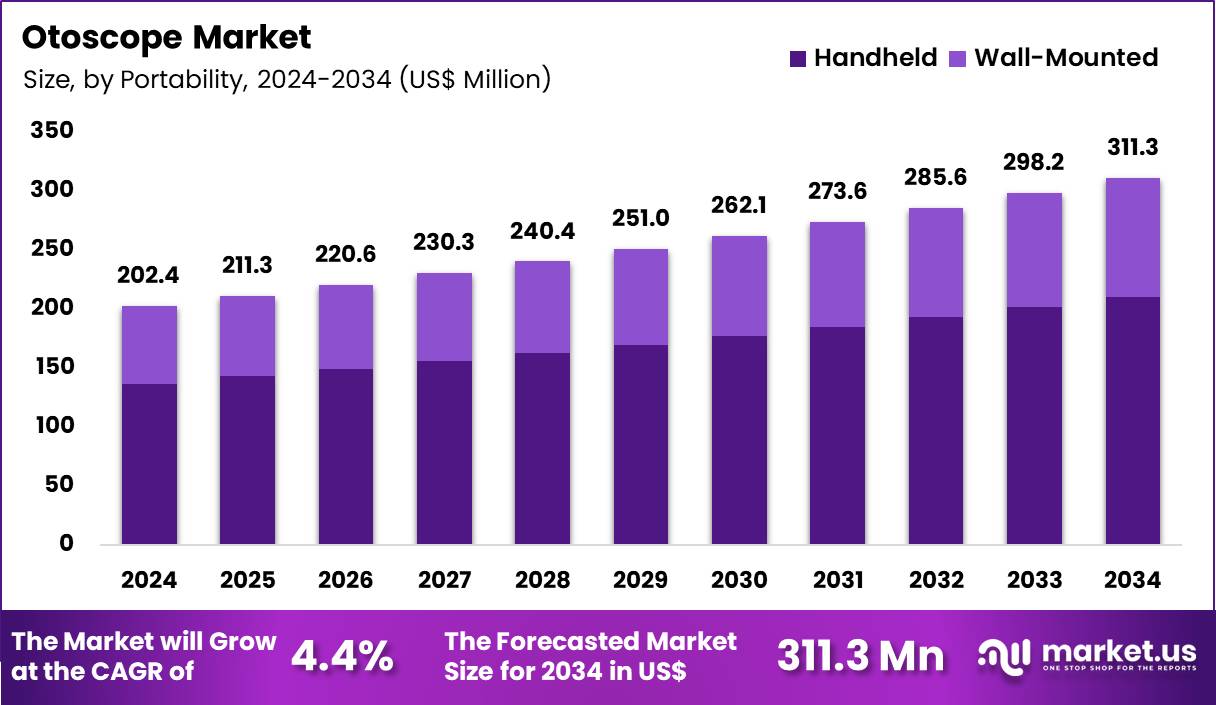
New York, NY – Sep 23, 2026 –The Global Otoscope Market size is expected to be worth around US$ 311.3 Million by 2034 from US$ 202.4 Million in 2024, growing at a CAGR of 4.4% during the forecast period 2025 to 2034. In 2024, North America led the market, achieving over 35.5% share with a revenue of US$ 71.4 Million.
An otoscope is a handheld diagnostic medical device used to examine the external ear canal and tympanic membrane. It provides magnified illumination to help healthcare professionals identify earwax, inflammation, infections, foreign bodies, and abnormalities. The U.S. FDA classifies otoscopes under 21 CFR 874.4770 as Class I medical devices, with the product code ERA.
Modern otoscopes increasingly incorporate LED illumination, wider viewing fields, digital imaging, and smartphone connectivity. For example, the Welch Allyn MacroView Plus provides approximately 5× magnification, a viewing area around 3 times larger than a standard single-lens otoscope, and light output of approximately 5,200 lux. Its LED has a rated life of more than 60 years under typical use.
Digital otoscopes enable clinicians to capture and share ear images for documentation, remote consultation, and patient education. These capabilities are particularly useful in primary care, pediatric assessment, emergency departments, ENT clinics, and telemedicine. The development of compact imaging systems is also supporting easier examination in decentralized healthcare settings.
Otoscope technology continues to evolve from conventional optical instruments toward connected diagnostic platforms. Manufacturers are focusing on brighter illumination, improved magnification, ergonomic designs, rechargeable power systems, and digital image capture. These developments are expanding the role of otoscopes from basic visual examination toward documented, shareable, and technology-assisted ear assessment.
Key Takeaways
- In 2024, the Otoscope market generated US$ 202.4 million in revenue, registering a 4.4% CAGR, and is projected to reach US$ 311.3 million by 2034.
- By type, the market is segmented into halogen otoscopes, LED otoscopes, fiber optic otoscopes, and video otoscopes. LED otoscopes dominated in 2024, accounting for a 41.5% market share.
- Based on portability, the market is categorized into handheld and wall-mounted otoscopes. Handheld otoscopes held the leading position in 2024, representing 67.6% of the market share.
- By modality, the market is divided into wired digital and wireless otoscopes. Wired digital otoscopes dominated the segment, capturing the largest revenue share of 63.2%.
- Based on application, the market is segmented into diagnostic and surgical/interventional uses. Diagnostic applications led the market in 2024, accounting for a 76.5% revenue share.
- By end user, the market is categorized into hospitals, ENT clinics, and others. Hospitals held the dominant position, accounting for the largest revenue share of 54.8%.
- Regionally, North America led the Otoscope market in 2024, securing a 35.3% market share, supported by advanced healthcare infrastructure and widespread adoption of diagnostic technologies.
Market Segmentation
- Type Analysis: LED otoscopes, accounting for 41.5%, are expected to maintain segment leadership due to brighter, consistent illumination and lower heat generation than halogen models. Longer LED lifespan, reduced maintenance requirements, improved color visibility, and lower power consumption support frequent clinical use. Compact designs and technological improvements further strengthen adoption among primary-care physicians and ENT specialists.
- Portability Analysis: Handheld otoscopes, holding 67.6%, are projected to dominate because they provide flexibility, portability, and convenient examination across different healthcare environments. Their lightweight design supports repeated use in outpatient clinics, emergency departments, pediatric practices, and bedside care. Battery-powered operation, lower equipment costs, and compatibility with digital accessories further increase their clinical usefulness.
- Modality Analysis: Wired digital otoscopes, representing 63.2%, are expected to lead because they provide stable connectivity and reliable image transmission during examinations. Digital imaging enables documentation, image sharing, and integration with electronic medical records. Hospitals also value uninterrupted operation without wireless signal limitations, while real-time visualization supports clinical training, patient education, and diagnostic decision-making.
- Application Analysis: Diagnostic applications, accounting for 76.5%, are projected to remain dominant because otoscopes are essential for routine ear examinations. They help clinicians identify infections, earwax accumulation, inflammation, and tympanic membrane abnormalities. Increasing pediatric examinations, preventive healthcare visits, and early detection efforts support frequent diagnostic use. Improved digital imaging further enhances examination and documentation.
- End-User Analysis: Hospitals, holding 54.8%, are expected to remain the leading end-user segment because they handle substantial patient volumes and require otoscopes across emergency, pediatric, primary-care, and ENT departments. Hospitals increasingly prioritize durable diagnostic equipment, digital documentation, and standardized procurement. Teaching facilities also use digital otoscopes for clinical training, supervision, and patient assessment.
Statistical Information
- In 2025, patient self-recorded digital otoscopy produced a 48.4% correct-diagnosis rate, compared with 63.5% when digital otoscopy was performed by an ENT resident, showing the effect of operator experience on remote otoscopic assessment.
- In 2025, patient-recorded digital otoscopy received an average image-quality score of 5.2 ± 2.5 on a 1–10 scale, while recordings made by an ENT resident scored 6.6 ± 2.3, demonstrating a measurable difference in image quality between users.
- A 2025 systematic review and meta-analysis reported that telemedicine-enabled otoscopes achieved 82% sensitivity and 95% specificity for diagnosing ear disease, demonstrating measurable diagnostic performance compared with conventional examination methods.
- In the same meta-analysis, physicians using telemedicine-enabled otoscopes achieved 84% sensitivity and 91% specificity, while community health workers achieved 80% sensitivity and 97% specificity, indicating useful performance across different operator groups.
- A 2025 rural pediatric study compared digital and conventional otoscopes across 3 diagnostic groups: general-practitioner standard otoscopy, ENT video otoscopy, and general-practitioner video otoscopy, evaluating tympanic membranes using the OM-grade scale.
- A 2025 otoscopic-AI study found that the Türkiye dataset’s AUC decreased from 0.86 to 0.65 when clinically relevant image information was progressively masked, demonstrating how strongly diagnostic performance can depend on meaningful visual features.
Regional Analysis
North America remains a major region for otoscope adoption, supported by strong pediatric and primary-care demand and advanced diagnostic infrastructure. The NIDCD reports that 5 out of 6 children experience at least one ear infection by age three, reinforcing the importance of routine otoscopic examination and early diagnosis.
Asia Pacific presents substantial opportunities as governments strengthen primary ear and hearing care. WHO reports that the Western Pacific Region has more than 546 million people living with hearing loss, including 430 million with disabling hearing loss.
Additionally, 60% of childhood hearing-loss cases in the region are attributed to preventable causes, increasing the importance of accessible ear examination technologies. WHO’s 2025 consultation on its Package of Ear and Hearing Care Interventions further emphasized essential equipment and technologies for expanding services.
Business opportunities
The Otoscope Market offers opportunities in digital, portable, and smartphone-connected devices. Manufacturers can develop otoscopes with image capture, video recording, and remote consultation capabilities for primary-care and ENT settings. WHO supports digital technologies and telehealth for expanding ear and hearing care services. (who.int)
AI-assisted otoscopy provides another opportunity by helping clinicians analyze ear images and identify abnormalities. Companies can also develop affordable devices for rural clinics, pediatric services, and community screening programs. Tele-otoscopy platforms can connect primary-care providers with specialists, improving access to expert assessment. WHO identifies otoscopes and smartphone-compatible diagnostic technologies as useful tools for strengthening ear-care services. (who.int)
Additional opportunities include rechargeable handheld models, wireless connectivity, wide-angle imaging, electronic medical-record integration, and specialized training platforms. Manufacturers can also create accessories such as reusable examination heads, disposable specula, smartphone adapters, and image-management software. These developments can support broader adoption across hospitals, ENT clinics, pediatric practices, emergency departments, and underserved healthcare settings.
Emerging Trends
- Digital Otoscopy: Digital otoscopes are gaining attention because they capture and share ear images. WHO notes that some devices connect with computers or mobile phones for pictures and videos, supporting documentation, remote review, and better communication between primary-care providers and specialists.
- AI-Assisted Diagnosis: Artificial intelligence is becoming an emerging trend in otoscopy. A 2025 study evaluated deep-learning analysis of tympanostomy-tube images captured using smartphone otoscopes, supporting automated assessment and potentially reducing the time and travel burden associated with routine follow-up visits.
- 3D Ear Imaging: Three-dimensional otoscopy is moving beyond conventional two-dimensional images. Research published in 2026 described a digital otoscope designed to measure the 3D shape of the tympanic membrane, creating opportunities for more detailed middle-ear assessment and quantitative clinical measurements.
- Remote Diagnostic Support: Tele-otoscopy is becoming more important in underserved areas where ENT specialists may be limited. A 2025 rural pediatric study compared 3 diagnostic groups, including general-practitioner standard otoscopy, ENT video otoscopy, and general-practitioner video otoscopy.
- Mobile Healthcare Integration: Smartphone and tablet-based healthcare tools are expanding ear-care technology. In 2026, WHO launched WHOears for community screening among people aged 5 years and older, reinforcing the broader movement toward portable, digitally supported ear and hearing services.
Use Cases
- Pediatric Ear Examination: Pediatric otoscopy remains an important use case for identifying middle-ear conditions. A 2025 study specifically evaluated digital versus traditional otoscopy for diagnosing acute otitis media in a pediatric primary-care clinic, demonstrating the role of digital imaging in routine child healthcare.
- Rural Primary Care: Digital otoscopes can support ear examinations in rural healthcare centers where specialist access is limited. The 2025 rural study evaluated general-practitioner examinations alongside remote ENT video assessment, demonstrating the potential use of digital devices for specialist-supported diagnosis.
- Tympanostomy-Tube Monitoring: Smartphone otoscopes can support follow-up of children with tympanostomy tubes. A 2025 study included children aged 10 months to 10 years and evaluated AI assessment of tube status from images captured by non-physicians using an over-the-counter digital otoscope.
- Primary Ear and Hearing Care: Otoscopes are used to examine the ear canal and eardrum for signs of disease. WHO’s primary-care guidance recommends examining both ears, even when symptoms occur on only one side, supporting routine otoscopy across community and primary-care settings.
- Telehealth and Specialist Consultation: Digital otoscopes can enable specialists to review remotely captured ear images and videos. WHO’s 2026 digital-health initiatives emphasize validated mobile technologies and clinical trials for expanding ear and hearing services, supporting connected diagnostic workflows in underserved communities.
Recent Development
- In September 2025, Baxter launched the Welch Allyn Connex 360 Vital Signs Monitor, expanding its connected clinical-diagnostics portfolio. While the announcement is not an otoscope launch, Baxter’s Welch Allyn business continues to provide physical-examination diagnostic equipment, including otoscopy-related solutions.
- In 2025, Luxamed GmbH & Co. KG showcased its LuxaScope Auris CCT LED 2.5 V otoscope at MEDICA 2025. The product uses CCT illumination technology and was presented as part of Luxamed’s diagnostic-device portfolio.
- In 2026, Inventis S.r.l. continued promoting its Harmonica HD video otoscope, featuring a high-definition chip-on-tip camera and LED illumination for detailed visualization of the eardrum. The product was originally launched in March 2024, so it should not be described as a new 2025–2026 launch.
Frequently Asked Questions About Otoscope
- What are the main types of otoscopes?
The main types include halogen, LED, fiber-optic, and video otoscopes. LED models provide efficient illumination, while video otoscopes capture images and videos for documentation, remote consultations, clinical training, and improved communication between healthcare professionals and patients. - What are the major applications of otoscopes?
Otoscope applications include diagnosing ear infections, examining the tympanic membrane, identifying cerumen buildup, detecting foreign objects, and supporting ENT examinations. Digital models additionally enable image capture, documentation, remote consultations, and monitoring of ear-related conditions. - Who are the major end users of otoscopes?
Major end users include hospitals, ENT clinics, primary-care practices, pediatric clinics, emergency departments, and community healthcare facilities. Hospitals frequently use otoscopes because they manage large patient volumes and require equipment for routine, emergency, pediatric, and specialist examinations. - What factors are driving the Otoscope Market?
Market growth is supported by increasing ear-related consultations, pediatric examinations, adoption of digital diagnostic equipment, telemedicine expansion, and demand for portable devices. Growing healthcare infrastructure and technological improvements in imaging and connectivity are also encouraging broader clinical adoption. - What role does telemedicine play in the Otoscope Market?
Telemedicine enables healthcare professionals to capture ear images using digital otoscopes and share them with specialists remotely. This approach can improve access to ENT expertise, particularly for rural communities, primary-care facilities, pediatric services, and geographically underserved populations. - What are the advantages of handheld otoscopes?
Handheld otoscopes provide portability and flexibility for examinations across hospitals, clinics, emergency departments, and bedside settings. Their compact design and battery-powered operation allow healthcare professionals to perform rapid assessments without depending on permanently installed examination equipment. - What is the future outlook for the Otoscope Market?
The future of the Otoscope Market is expected to focus on digital imaging, wireless connectivity, smartphone integration, artificial intelligence, portable designs, and tele-otoscopy. These technologies can support improved documentation, remote assessment, clinical education, and more accessible ear-care services.
Conclusion
The Otoscope Market is evolving with increasing adoption of LED, digital, video, handheld, and connected diagnostic devices. Growing demand for accurate ear examinations, particularly in pediatric and primary-care settings, is supporting technological advancement. Digital imaging and tele-otoscopy are improving documentation, remote consultations, and specialist collaboration.
WHO highlights the importance of accessible ear and hearing care, with 430 million people requiring rehabilitation for disabling hearing loss globally. Continued development of portable, smartphone-compatible, and AI-assisted otoscopy solutions is creating new opportunities across hospitals, ENT clinics, primary-care facilities, and underserved communities.
Overall, innovation in visualization, connectivity, portability, and diagnostic support is expected to strengthen the clinical importance of otoscopes.
Discuss your needs with our analyst
Please share your requirements with more details so our analyst can check if they can solve your problem(s)




