


Overview
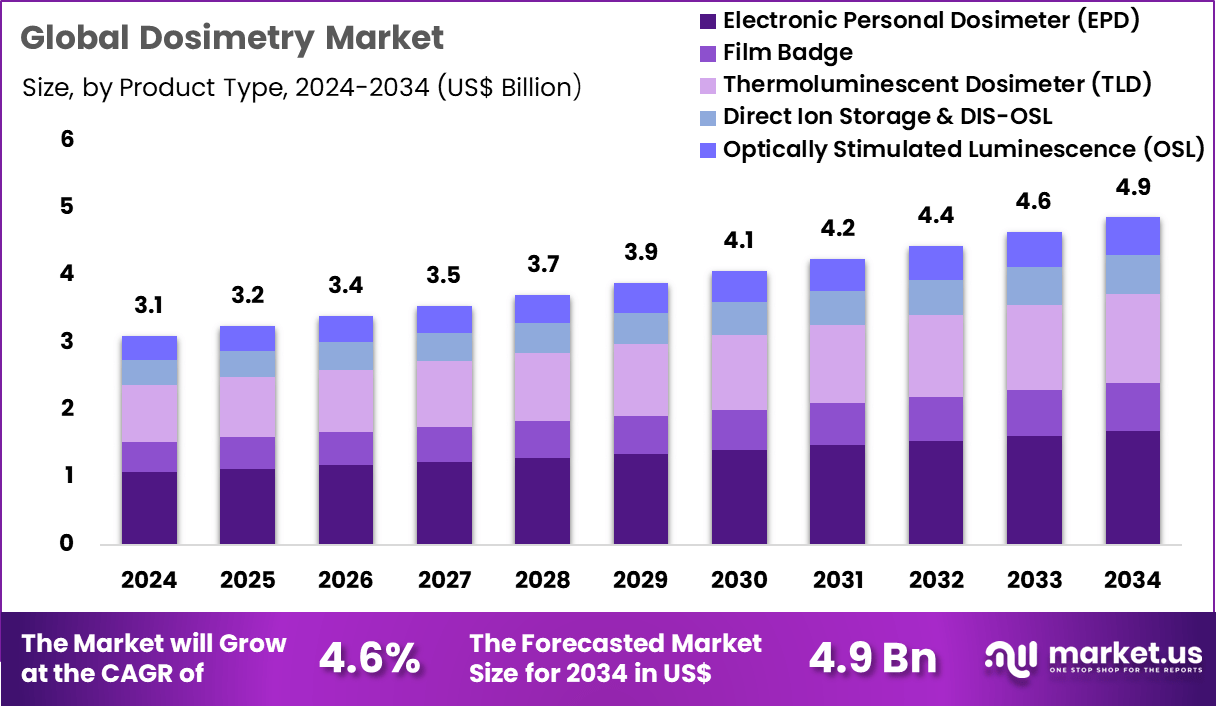
New York, NY – Oct 22, 2026 – Global Dosimetry Market size is expected to be worth around US$ 4.9 Billion by 2034 from US$ 3.1 Billion in 2024, growing at a CAGR of 4.6% during the forecast period 2025 to 2034. In 2024, North America led the market, achieving over 39.3% share with a revenue of US$ 1.2 Billion.
Dosimetry is the scientific measurement, calculation, and assessment of radiation doses absorbed by the human body, materials, or other objects. It plays a vital role in healthcare, medical imaging, cancer treatment, nuclear energy, radiation protection, and industrial applications.
In healthcare, medical dosimetry is particularly important in radiation therapy, where precise radiation doses are delivered to cancerous tissues while minimizing exposure to surrounding healthy organs. Advanced dosimetry techniques help healthcare professionals improve treatment planning, enhance patient safety, and support better clinical outcomes.
Dosimetry also supports radiation monitoring in diagnostic imaging procedures, nuclear facilities, research laboratories, and industrial environments. Common dosimetry technologies include personal dosimeters, thermoluminescent dosimeters, electronic personal dosimeters, and advanced radiation measurement systems. These devices help measure radiation exposure and ensure compliance with applicable safety standards.
The growing adoption of advanced radiation-based technologies, increasing demand for cancer care, and greater emphasis on occupational radiation safety are strengthening the importance of reliable dosimetry solutions. Technological developments, including digital monitoring systems, automation, and improved dose calculation software, are further supporting accuracy and operational efficiency.
As radiation applications continue to expand across medical and industrial sectors, dosimetry is expected to remain an essential component of radiation safety, quality assurance, and effective treatment delivery. Continued innovation in dosimetry technologies will support more precise dose assessment and safer radiation management.
Key Takeaways
- In 2024, the dosimetry market generated revenue of US$ 3.1 billion and is projected to reach US$ 4.9 billion by 2034, registering a CAGR of 4.6% during the forecast period.
- By product type, the market is segmented into electronic personal dosimeters (EPD), film badges, thermoluminescent dosimeters (TLD), direct ion storage (DIS), DIS-OSL, and optically stimulated luminescence (OSL). Electronic personal dosimeters (EPD) dominated the segment, accounting for 34.8% of the market share.
- Based on technology, the market includes semiconductor, scintillator-based, solid-state passive, gas-filled GM/proportional, and bubble/superheated-drop technologies. The semiconductor segment held a significant market share of 38.5%.
- By application, the market is categorized into active and passive dosimetry. The active dosimetry segment was identified as the dominant category, with a reported revenue share of 9%.
- By end user, the market is segmented into healthcare, oil and gas, nuclear power and fuel cycle, mining and metals, industrial NDT/manufacturing, and defence and security. The healthcare segment led the market, accounting for 41.6% of total revenue.
- Regionally, North America dominated the dosimetry market, accounting for 39.3% of the global market share.
Key Market Segments
- Product Type Analysis: Electronic personal dosimeters (EPDs) held a 34.8% market share, driven by demand for real-time radiation monitoring. Instant dose readings, alerts, wireless connectivity, and automated reporting support occupational safety and regulatory compliance across healthcare, nuclear, and industrial environments.
- Technology Analysis: Semiconductor technology accounted for 38.5% of the market, supported by high sensitivity, rapid response, and compact device designs. Digital integration, portability, and reliable dose measurement are strengthening adoption across healthcare facilities, nuclear installations, and industrial radiation monitoring applications.
- Application Analysis: Active dosimetry accounted for 56.9% of the market, driven by growing demand for continuous exposure monitoring and immediate alerts. Healthcare, industrial, and nuclear facilities increasingly use active systems to improve worker safety, strengthen compliance, and support real-time radiation exposure management.
- End-User Analysis: Healthcare held 41.6% of the market, driven by increasing radiation-based diagnostic imaging and cancer treatment procedures. Hospitals and diagnostic centers require reliable dosimetry solutions to monitor staff exposure, meet safety regulations, and improve radiation protection across clinical environments.
Regional Analysis
North America Dosimetry Market Analysis
North America dominated the dosimetry market in 2024, accounting for 39.3% of the global market share. Regional growth is supported by advancements in radiation therapy, nuclear medicine, and radiation monitoring technologies. Leading companies, including Mirion Technologies and Landauer, are strengthening product capabilities.
Increasing emphasis on occupational safety, rising cancer treatment requirements, government research funding, and stringent radiation protection regulations are further supporting demand. Investments in low-dose radiation research by the U.S. Department of Energy also demonstrate the region’s commitment to advancing radiation safety and dosimetry technologies.
Asia Pacific Dosimetry Market Outlook
The Asia Pacific region is projected to register the highest CAGR during the forecast period, driven by healthcare modernization, expanding nuclear power infrastructure, and growing industrial safety requirements. China and India are increasing investments in medical facilities and nuclear energy, supporting demand for advanced dosimetry solutions.
Government initiatives, international technical assistance, workforce training, and collaborations between research institutions and industry players are further strengthening regional capabilities. Additionally, investments in cost-effective wearable monitoring devices and radiation medicine quality improvement are expected to accelerate market expansion across Asia Pacific.
Emerging Trends
- Increasing use of artificial intelligence (AI) in dosimetry: AI-based tools are being explored to estimate radiation doses, improve treatment planning, and support dose monitoring. These tools may help medical teams assess complex dose patterns and develop more personalized treatment plans, although clinical validation remains important.
- Growing demand for personalized patient dosimetry: Radiation dose assessment is increasingly focused on individual patients rather than relying only on standard estimates. This is particularly relevant in nuclear medicine and radiopharmaceutical therapy, where patient-specific dose calculations can support treatment planning and help evaluate how radiation is distributed within the body.
- Development of advanced and three-dimensional dose measurement systems: New detector technologies, including advanced electronic detectors, imaging-based systems, and three-dimensional dosimetry methods, are being developed to measure complex radiation distributions. These technologies can support the verification of radiation delivery in advanced cancer treatments and improve quality assurance.
- Integration of digital dose monitoring in medical imaging: Hospitals are increasingly using recorded radiation dose information to review imaging practices and identify procedures with unusually high or low dose indicators. Digital dose reports and dose management systems can support protocol reviews, improve consistency, and help maintain suitable image quality while avoiding unnecessary radiation exposure.
- Advancement of miniaturized and high-resolution dosimeters: Research into chip-based and highly sensitive dosimeters is supporting more detailed radiation measurement. NIST is developing photonic dosimetry technologies for medical and industrial applications, including radiation therapy and medical device sterilization. These systems may enable dose measurements at very small spatial scales.
Use Cases
- Cancer radiotherapy dose verification: Dosimetry systems are used to measure and verify radiation doses delivered by cancer treatment equipment. Medical physicists use these measurements to check treatment accuracy, confirm equipment performance, and ensure that planned radiation doses are delivered correctly to support effective tumor treatment.
- Radiation dose assessment in diagnostic imaging: Dosimetry is applied in computed tomography (CT), X-ray imaging, and fluoroscopy to assess radiation dose indicators. Healthcare providers can review these measurements to identify unusually high exposures, improve scanning protocols, and maintain sufficient image quality for accurate diagnosis.
- Personal radiation monitoring for healthcare workers: Personal dosimeters are used by radiologists, radiographers, nuclear medicine staff, and other workers who may be exposed to ionizing radiation. The devices help monitor occupational exposure, maintain radiation safety records, and support compliance with applicable workplace radiation protection requirements.
- Nuclear medicine and radiopharmaceutical therapy: Dosimetry supports the assessment of radiation absorbed by organs and tissues during diagnostic nuclear medicine procedures and targeted radionuclide treatments. These measurements can help clinicians evaluate treatment delivery and improve patient-specific dose assessment, particularly as new radiopharmaceutical treatments become available.
- Radiation sterilization of medical devices: Dosimetry is used to verify radiation exposure during the sterilization of medical devices and surgical instruments. Manufacturers rely on suitable dose measurements and validation procedures to confirm that the required radiation treatment has been delivered consistently while maintaining the quality of the processed products.
Frequently Asked Questions About Dosimetry
- Why is dosimetry important in healthcare?
Dosimetry helps healthcare professionals understand radiation exposure and verify that radiation equipment is working as intended. Appropriate dose assessment supports treatment accuracy, patient safety, and better control of exposure during diagnostic imaging, radiotherapy, and nuclear medicine procedures. - What are the main types of dosimeters?
Common dosimeters include thermoluminescent dosimeters (TLDs), optically stimulated luminescence dosimeters (OSLDs), electronic personal dosimeters, ionization chambers, and semiconductor detectors. Each type serves different purposes, including personal monitoring, equipment calibration, radiation measurement, and verification of medical treatment doses. - How does dosimetry improve cancer treatment?
Dosimetry helps medical physicists verify radiation beam output, evaluate dose distribution, and check treatment plans before or during radiotherapy. These measurements support accurate dose delivery to tumors while helping treatment teams assess and limit exposure to nearby healthy tissues. - Which technologies are shaping the dosimetry market?
The market is being influenced by electronic detectors, advanced imaging systems, AI-assisted dose calculations, computational modeling, and miniaturized sensors. These technologies aim to improve measurement accuracy, support complex treatment verification, and enable more detailed assessment of radiation dose distribution. - What role do government agencies play in the dosimetry market?
Government agencies and international organizations establish measurement standards, provide technical guidance, and support radiation safety programs. For example, NIST maintains radiation measurement standards, while the IAEA supports dosimetry audits and promotes consistent measurement practices in medical radiation applications. - What opportunities exist for dosimetry market participants?
Opportunities include developing patient-specific dose assessment software, advanced radiation detectors, digital monitoring platforms, and calibration services. Solutions designed for nuclear medicine, precision radiotherapy, and industrial sterilization may address specialized measurement needs as these applications adopt increasingly advanced radiation technologies. - What is the future outlook for the dosimetry market?
The outlook is supported by continued advances in radiation-based diagnosis, cancer treatment, and industrial processing. Wider adoption of digital tools, personalized dosimetry, and advanced detectors may create new opportunities, although market growth will depend on costs, training, and clinical validation.
Conclusion
The dosimetry market is expected to experience steady growth, supported by increasing demand for cancer treatment, medical imaging, radiation monitoring, and industrial safety. The market is projected to grow from US$ 3.1 billion in 2024 to US$ 4.9 billion by 2034, at a CAGR of 4.6%. Electronic personal dosimeters, semiconductor technologies, and healthcare applications remain important market segments.
North America currently leads the market, while Asia Pacific offers strong growth opportunities due to healthcare modernization and nuclear infrastructure investments. Continued technological advancements, digital monitoring, and personalized dose assessment are expected to strengthen market development and improve radiation safety.
Discuss your needs with our analyst
Please share your requirements with more details so our analyst can check if they can solve your problem(s)



