


Overview
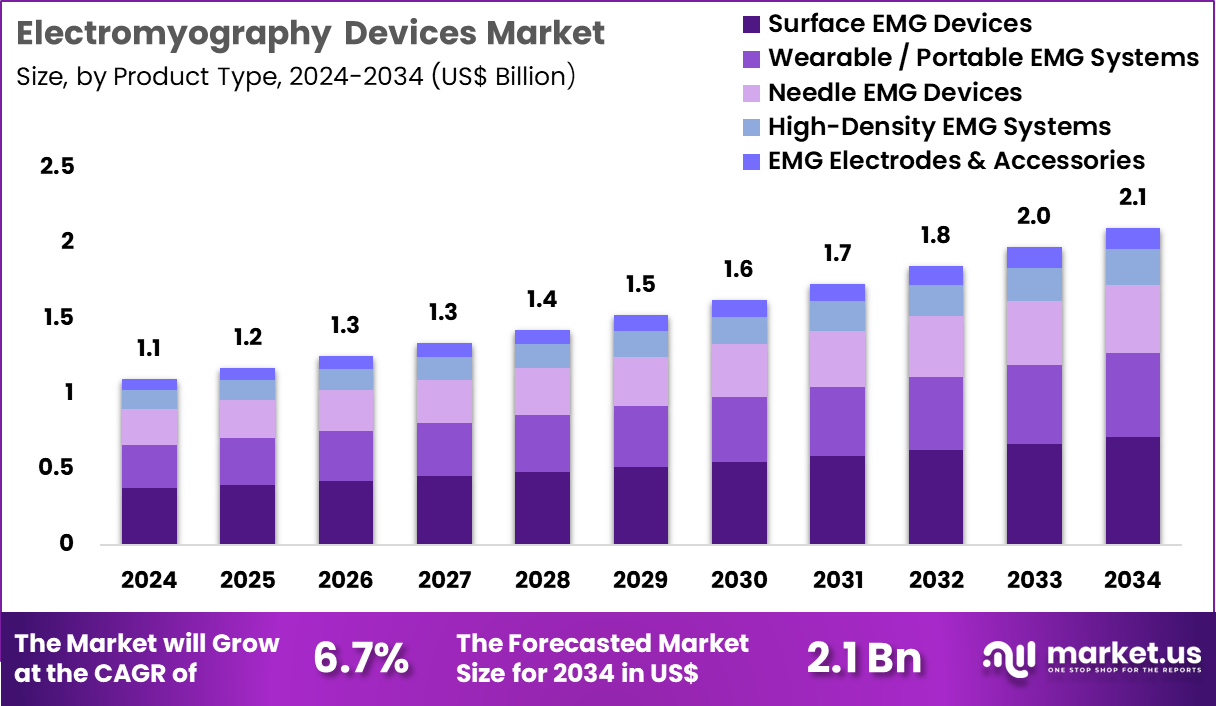
New York, NY – Oct 22, 2026 – Global Electromyography Devices Market size is expected to be worth around US$ 2.1 Billion by 2034 from US$ 1.1 Billion in 2024, growing at a CAGR of 6.7% during the forecast period 2025 to 2034. In 2024, North America led the market, achieving over 43.1% share with a revenue of US$ 0.5 Billion.
Electromyography (EMG) devices are medical diagnostic instruments used to measure and record the electrical activity produced by skeletal muscles and the nerves controlling them. These devices play an important role in identifying neuromuscular disorders, assessing muscle function, and supporting clinical decision-making. They are widely used in hospitals, diagnostic laboratories, rehabilitation centers, and specialized neurology clinics.
The market includes needle electromyography systems, surface EMG devices, and integrated electrodiagnostic systems that combine EMG with nerve conduction studies. Technological advancements, including portable devices, wireless connectivity, digital signal processing, and artificial intelligence-based analysis, are improving diagnostic efficiency and supporting wider clinical adoption.
The growing prevalence of neurological conditions, such as peripheral neuropathy, muscular dystrophy, and amyotrophic lateral sclerosis, is contributing to demand for advanced electrodiagnostic solutions. Additionally, the rising geriatric population, increasing awareness of early disease diagnosis, and expanding access to specialized healthcare services are supporting market development.
North America and Europe represent established markets, supported by advanced healthcare infrastructure and the availability of specialized diagnostic services. Meanwhile, Asia-Pacific is expected to offer growth opportunities due to improving healthcare facilities, rising healthcare expenditure, and increasing access to neurological diagnostics.
However, high equipment costs, the need for skilled professionals, and reimbursement limitations may restrict adoption in certain regions. Continued innovation and expanding clinical applications are expected to shape the future development of the electromyography devices market.
Key Takeaways
- In 2024, the electromyography devices market was valued at US$ 1.1 billion and is projected to grow at a CAGR of 6.7%, reaching US$ 2.1 billion by 2034.
- By product type, the market is segmented into surface EMG devices, wearable/portable EMG systems, needle EMG devices, high-density EMG systems, and EMG electrodes and accessories. Surface EMG devices dominated the segment, accounting for 33.9% of the market share.
- Based on modality, the market is categorized into stand-alone and integrated systems, with stand-alone systems accounting for a significant share of 58.6%.
- By application, the market is segmented into neuromuscular disorder diagnosis, research and academia, pain management and rehabilitation, orthopedics and sports medicine, and intraoperative monitoring. Neuromuscular disorder diagnosis led the segment, capturing 37.8% of the market revenue.
- By end user, the market comprises hospitals, sports rehabilitation centers, specialty clinics, ambulatory surgical centers, and academic and research institutes. Hospitals held the leading position, accounting for 42.3% of the market revenue.
- Regionally, North America dominated the electromyography devices market, accounting for 43.1% of the total market share.
Key Market Segments
- Product Type Analysis: Surface EMG devices dominated the product type segment with a 33.9% market share, driven by their non-invasive nature, patient comfort, and broad clinical acceptance. Increasing demand for neuromuscular assessments and rehabilitation monitoring supports adoption. Technological advancements in signal processing, electrode design, and biofeedback further enhance clinical applications.
- Modality Analysis: Stand-alone systems accounted for 58.6% of the market, supported by their operational flexibility, ease of installation, and lower dependence on integrated hospital platforms. Their suitability for smaller clinics and diagnostic centers, combined with portable designs and improved data management, strengthens demand.
- Application Analysis: Neuromuscular disorder diagnosis held 37.8% of the market, driven by rising neurological conditions and increasing demand for accurate diagnostic assessments. EMG supports the identification of neuropathies, myopathies, and motor neuron diseases, enabling treatment planning and disease monitoring.
- End-User Analysis: Hospitals led the end-user segment with 42.3% of the market, supported by high patient volumes, advanced diagnostic infrastructure, and specialized neurology departments. Increasing integration of EMG testing across inpatient, outpatient, and rehabilitation services further supports adoption.
Regional Analysis
North America Market Analysis
North America dominated the electromyography devices market in 2024, accounting for 43.1% of the global market share. This leadership is supported by advanced healthcare infrastructure, increasing demand for neurological diagnostics, and widespread adoption of innovative medical technologies. Hospitals and specialized clinics increasingly utilize EMG systems for neuromuscular diagnosis, rehabilitation, and geriatric care.
Technological advancements, including portable devices, wireless monitoring, and improved signal processing, further support regional market development. Research investments and collaborations between manufacturers and academic institutions also contribute to product innovation and clinical adoption.
Asia-Pacific Market Analysis
The Asia-Pacific region is expected to register the highest CAGR during the forecast period, driven by improving healthcare infrastructure, rising awareness of neurological disorders, and expanding access to diagnostic services. Investments in medical technology across China, Japan, and other emerging economies are supporting market growth.
Partnerships between domestic manufacturers and international companies are improving product affordability and availability. Furthermore, increasing cases of diabetic neuropathy, growing research activities, and rising demand for portable diagnostic systems are expected to create significant opportunities for electromyography devices across the region.
Emerging Trends
- Growing adoption of wearable and portable EMG devices: EMG technology is moving towards compact, wireless, and wearable systems that can measure muscle activity outside traditional clinical settings. These devices may support home-based rehabilitation, movement tracking, and repeated muscle assessments, increasing the need for convenient monitoring solutions.
- Integration of artificial intelligence and machine learning: AI-based software is being developed to identify patterns in EMG signals, distinguish muscle movements, and support the interpretation of complex data. This may improve movement classification and help personalize rehabilitation, although clinical accuracy and reliability require appropriate validation.
- Development of high-density EMG systems: High-density EMG systems use multiple electrodes to capture muscle activity from different locations. The additional information can help researchers examine muscle coordination and movement patterns in greater detail, supporting advanced neuromuscular research and more detailed rehabilitation assessments.
- Greater use of EMG biofeedback in rehabilitation: EMG biofeedback systems provide visual or other feedback about muscle activity during exercises. Their use in rehabilitation can help patients and therapists observe muscle activation and adjust exercise techniques. Digital and mobile-based systems are expanding the available ways to deliver this feedback.
- Increased focus on device safety and standardized performance: Medical-device manufacturers are placing greater emphasis on electrical safety, reliable signal acquisition, and compliance with recognized technical standards. The US FDA recognizes IEC 60601-2-40:2024 for electromyographs and evoked-response equipment, supporting a clearer framework for device safety and performance.
Use Cases
- Diagnosis of nerve and muscle disorders: EMG devices help clinicians investigate muscle weakness, abnormal muscle activity, and possible nerve damage. When combined with nerve conduction studies, they support the assessment of conditions affecting peripheral nerves, muscles, and the communication between them.
- Physical rehabilitation and muscle retraining: Physiotherapists can use EMG biofeedback to observe whether targeted muscles are activating during exercise. This information supports muscle retraining, movement correction, and rehabilitation planning following injury, surgery, or neurological impairment.
- Control of prosthetic limbs and assistive devices: EMG sensors can detect electrical signals generated by residual muscles and translate them into control commands. This technology supports myoelectric prosthetic hands and is also being studied for exoskeletons and other assistive systems that help users perform movements.
- Intraoperative nerve and muscle monitoring: EMG monitoring can be used during selected surgical procedures to observe muscle responses and help assess nerve function. It can provide additional information to the surgical team, although monitoring methods and clinical protocols depend on the procedure and patient.
- Sports science and movement research: Researchers and sports professionals use surface EMG to study muscle activation during exercise and movement. The recorded signals can support biomechanical analysis, comparisons of muscle recruitment, and research into fatigue, exercise techniques, and physical performance.
Frequently Asked Questions About Electromyography Devices
- How do electromyography devices work?
EMG devices detect electrical signals generated when muscles activate. Surface electrodes record signals through the skin, while needle electrodes measure activity within a muscle. The recorded signals are displayed and interpreted by trained healthcare professionals to assess muscle function. - What are the different types of electromyography devices?
Electromyography devices include needle EMG systems, surface EMG systems, portable EMG monitors, and multi-channel diagnostic systems. They differ in electrode design, recording methods, portability, and intended use across clinical diagnosis, rehabilitation, research, and muscle activity monitoring. - What conditions can electromyography devices help diagnose?
EMG examinations can help investigate peripheral nerve injuries, nerve compression, muscle disorders, and certain neuromuscular conditions. They are often combined with nerve conduction studies to provide additional information about nerve function and help clinicians determine the possible cause of muscle weakness. - Are electromyography devices used for home-based monitoring?
Some wearable and portable surface EMG devices can record muscle activity outside hospitals. Depending on their design and intended purpose, they may support rehabilitation exercises, movement tracking, and remote assessments, but they do not replace every clinical diagnostic EMG examination. - What is the electromyography devices market?
The electromyography devices market includes equipment and related systems used to record muscle electrical activity for diagnosis, monitoring, rehabilitation, and research. It covers diagnostic EMG systems, electrodes, portable devices, and related technologies serving healthcare and research institutions. - What are the major challenges facing the electromyography devices market?
Market challenges include the cost of advanced equipment, the need for trained professionals, and variations in signal quality caused by electrode placement or movement. Manufacturers must also address device safety, regulatory requirements, and the reliability of software-based analysis. - Which technological developments are creating opportunities in this market?
Wearable sensors, high-density electrode arrays, AI-based signal analysis, and mobile biofeedback systems are creating new development opportunities. These technologies may improve muscle activity assessment, support personalized rehabilitation, and expand applications beyond traditional diagnostic laboratories. - What is the future outlook for the electromyography devices market?
The market outlook is supported by continued advances in neurological diagnostics, rehabilitation, wearable monitoring, and assistive technologies. Future adoption will depend on clinical evidence, affordability, regulatory compliance, and the ability to demonstrate reliable performance across different healthcare settings.
Conclusion
The electromyography devices market is expected to experience steady growth, supported by the rising demand for neurological diagnostics, rehabilitation services, and advanced muscle monitoring solutions. Technological developments in wearable devices, artificial intelligence, wireless connectivity, and high-density EMG systems are expanding clinical applications and improving diagnostic capabilities.
Surface EMG devices, stand-alone systems, neuromuscular disorder diagnosis, and hospitals remain important market segments. North America continues to lead the market, while Asia-Pacific offers promising growth opportunities due to improving healthcare infrastructure and increasing access to diagnostic services. However, equipment costs, skilled workforce requirements, and regulatory challenges may influence future market expansion.
Discuss your needs with our analyst
Please share your requirements with more details so our analyst can check if they can solve your problem(s)



