
Overview
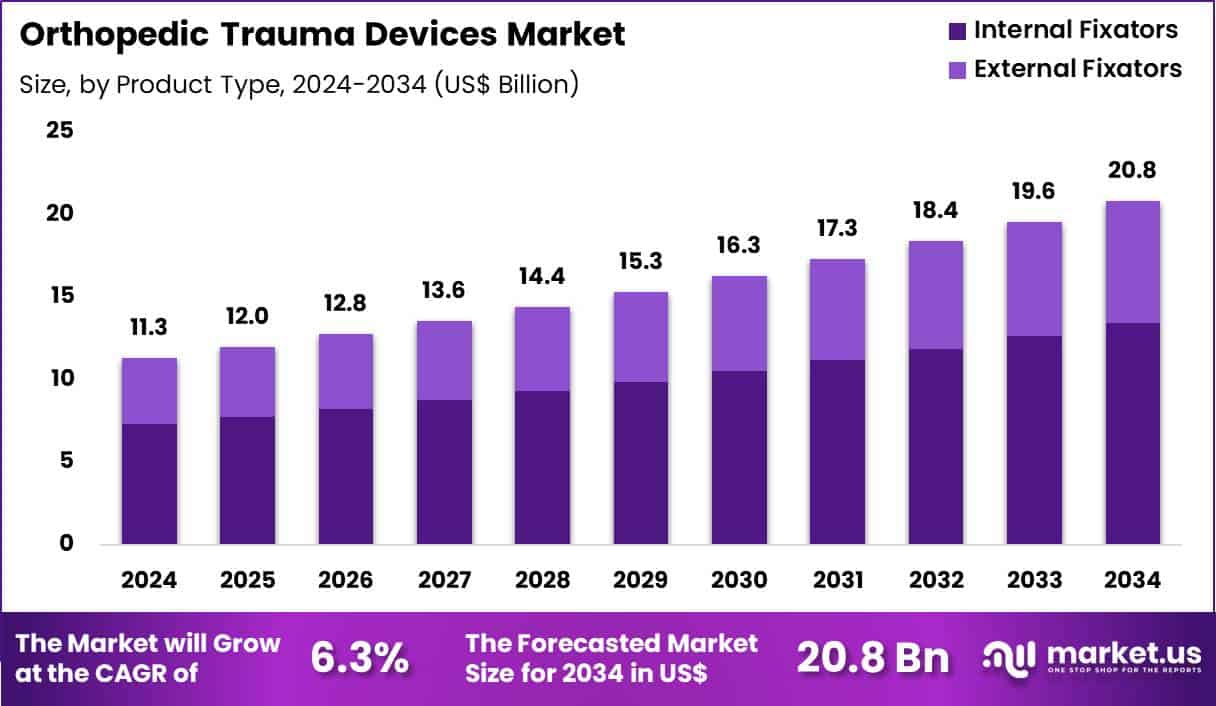
New York, NY – Oct 28, 2026 – Global Orthopedic Trauma Devices Market size is expected to be worth around US$ 20.8 Billion by 2034 from US$ 11.3 Billion in 2024, growing at a CAGR of 6.3% during the forecast period 2025 to 2034. In 2024, North America led the market, achieving over 42.9% share with a revenue of US$ 4.8 Billion.
The orthopedic trauma devices market comprises medical devices used to treat bone fractures, joint injuries, and other musculoskeletal trauma caused by accidents, falls, sports injuries, and other incidents. These devices play a critical role in restoring bone stability, supporting healing, and improving patient mobility.
Key product categories include internal fixation devices, such as plates, screws, intramedullary nails, and wires, as well as external fixation systems and other fracture management solutions. These products are widely used in hospitals, trauma centers, ambulatory surgical centers, and specialized orthopedic facilities.
The growth of the market is supported by the rising incidence of road accidents, increasing sports-related injuries, a growing geriatric population, and the rising prevalence of osteoporosis-related fractures. In addition, technological advancements in implant materials, minimally invasive surgical techniques, and patient-specific orthopedic solutions are contributing to the development of more effective treatment options.
North America and Europe represent established markets, supported by advanced healthcare infrastructure and access to specialized surgical care. Meanwhile, Asia-Pacific is expected to offer significant growth opportunities due to improving healthcare facilities, increasing healthcare expenditure, and greater access to trauma treatment services.
Manufacturers are increasingly focusing on product innovation, biocompatible materials, and advanced fixation technologies to strengthen their market position. Overall, the orthopedic trauma devices market is expected to benefit from continued advancements in orthopedic care and the growing demand for effective fracture management solutions.
Key Takeaways
- In 2024, the orthopedic trauma devices market was valued at US$ 11.3 billion and is projected to grow at a CAGR of 6.3%, reaching US$ 20.8 billion by 2034.
- By product type, the market is segmented into internal fixators and external fixators, with internal fixators accounting for the largest share of 64.5%.
- By end-user, the market includes hospitals, ambulatory surgical centers, and orthopedic and trauma centers, with hospitals holding the dominant share of 58.9%.
- Regionally, North America dominated the orthopedic trauma devices market, accounting for a market share of 42.9%.
Key Market Segments
- Product Type Analysis: Internal fixators held a dominant share of 64.5% in the orthopedic trauma devices market, supported by their effectiveness in stabilizing complex fractures. Plates, screws, rods, and nails provide rigid fixation and anatomical alignment. Rising trauma cases, minimally invasive surgical techniques, and advancements in implant materials continue to support segment growth.
- End-User Analysis: Hospitals accounted for 58.9% of the orthopedic trauma devices market, driven by their capacity to manage complex fractures and emergency trauma cases. Access to advanced imaging, surgical teams, and postoperative care supports device utilization. Expanding trauma services, improved operating facilities, and established referral networks are expected to sustain hospital segment dominance.
Regional Analysis
North America Orthopedic Trauma Devices Market
North America dominated the orthopedic trauma devices market in 2024, accounting for 42.9% of the global market share. Growth has been supported by rising fracture cases resulting from road accidents, sports injuries, and age-related bone conditions. The presence of established manufacturers, including Zimmer Biomet and DePuy Synthes, has encouraged innovation in fracture fixation implants and surgical technologies.
Advanced trauma care infrastructure, favorable reimbursement policies, and access to specialized orthopedic treatment have further strengthened regional market growth. Increasing adoption of minimally invasive procedures and improved implant designs is also supporting demand.
Asia-Pacific Orthopedic Trauma Devices Market
The Asia-Pacific orthopedic trauma devices market is expected to register the highest CAGR during the forecast period. Growth is driven by increasing road accidents, expanding healthcare infrastructure, rising healthcare expenditure, and improved access to emergency trauma services.
Growing investments in hospitals and surgical facilities are supporting the adoption of internal and external fixation devices. In addition, local manufacturing capabilities, technological advancements, and government initiatives to improve healthcare access are expected to create significant growth opportunities across the region.
Emerging Trends
- Increasing adoption of patient-specific implants: The use of customized orthopedic implants and surgical guides is gaining attention because patients have different bone structures and injury patterns. The US Food and Drug Administration (FDA) recognizes that 3D printing can produce devices based on individual patient anatomy, supporting more tailored fracture reconstruction.
- Development of minimally invasive fracture fixation techniques: Orthopedic treatment is increasingly focused on techniques that stabilize fractures while limiting unnecessary damage to surrounding soft tissues. Improvements in plate systems, screws, and intramedullary nails support different surgical approaches. Device selection depends on fracture type, bone condition, and the surgeon’s treatment plan.
- Growing focus on implants for older patients: Population ageing is increasing the importance of devices designed for fractures in weaker bones. WHO reports that fractures are more common among older adults, particularly older women. This is encouraging attention toward fixation systems that provide suitable stability in patients with fragile bones.
- Research into absorbable bone fixation materials: Absorbable fixation devices are attracting research and regulatory attention because selected materials may gradually break down after supporting bone healing. In June 2026, the FDA classified absorbable metallic bone fixation fasteners as Class II medical devices with special controls, reflecting the development of this product category.
- Stronger focus on device safety and performance testing: Manufacturers are placing importance on implant strength, durability, and reliable fixation to meet regulatory and clinical requirements. FDA guidance provides performance criteria for orthopedic fracture fixation plates, while recognized ASTM and ISO standards support the evaluation of orthopedic implants and fixation devices.
Use Cases
- Treatment of arm, wrist, and ankle fractures: Plates and screws are used to hold broken bone fragments in position, particularly when a fracture requires surgical stabilization. These devices are commonly applied to injuries involving the wrist, forearm, ankle, and other smaller bones.
- Treatment of thigh and shin bone fractures: Intramedullary nails are inserted into the central channel of long bones, such as the femur and tibia. They provide internal support and help maintain alignment during healing after serious injuries, including fractures caused by road accidents.
- Management of severe open fractures: External fixation systems stabilize bones using pins connected to a frame outside the body. They can be useful when severe injuries involve extensive soft-tissue damage, swelling, or contaminated wounds that require careful surgical management.
- Stabilization of pelvic and complex joint fractures: Specialized plates, screws, and external fixation systems are used for selected pelvic, acetabular, and joint fractures. Their purpose is to restore bone alignment and provide stability in anatomically complex injuries that may require detailed surgical planning.
- Management of fragility fractures in older adults: Screws, plates, and selected hip fracture fixation systems are used to stabilize fractures associated with weakened bones. Treatment planning considers bone quality, fracture location, mobility needs, and the patient’s overall health to support recovery.
Frequently Asked Questions About Orthopedic Trauma Devices
- What are the main types of orthopedic trauma devices?
The main types include bone plates, screws, intramedullary nails, wires, pins, and external fixation systems. Each device provides a different form of support, depending on the fracture location, bone structure, injury severity, and required stability during healing. - How do orthopedic trauma devices help broken bones heal?
These devices hold fractured bone fragments in an appropriate position and provide stability during healing. Depending on the injury, fixation may allow limited movement at the fracture site or maintain tighter alignment. Successful healing also depends on blood supply and patient health.
eduevents. - Are orthopedic trauma implants permanent?
Some orthopedic trauma implants remain in the body permanently, while others may be removed after healing if clinically necessary. Removal depends on implant type, symptoms, complications, and medical assessment. Absorbable devices are designed to break down under specified conditions. - What factors are driving the orthopedic trauma devices market?
Market growth is supported by rising fracture cases, road traffic injuries, falls, and an ageing population. Demand is also influenced by improvements in fracture surgery, wider access to trauma care, and the development of advanced orthopedic implants. - Which regions offer opportunities in the orthopedic trauma devices market?
Opportunities may arise in regions where access to trauma treatment is improving and the need for fracture care is increasing. Population ageing, road injury prevention and treatment needs, hospital infrastructure, and availability of trained orthopedic surgeons influence regional demand. - How is technology influencing the orthopedic trauma devices market?
Technological progress is supporting patient-specific implants, 3D-printed surgical guides, and improvements in fixation design. These developments may help address complex fractures and individual anatomical needs. However, adoption depends on clinical evidence, regulatory clearance, manufacturing costs, and hospital capabilities. - What is the future outlook for the orthopedic trauma devices market?
The market outlook is supported by continuing fracture treatment needs, demographic ageing, and ongoing implant development. Customized devices and improved fixation systems may create further opportunities, although future performance will depend on clinical adoption, reimbursement, regulatory requirements, and healthcare spending. - What should companies evaluate when entering the orthopedic trauma devices market?
Companies should assess unmet clinical needs, product safety requirements, competing implant designs, pricing, hospital purchasing practices, and distribution networks. Clinical evidence, surgeon training, manufacturing quality, and regulatory compliance are also important when planning product launches and market expansion.
Conclusion
The orthopedic trauma devices market is expected to experience steady growth, supported by rising fracture cases, an ageing population, increasing road accidents, and advancements in orthopedic treatment. The market, valued at US$ 11.3 billion in 2024, is projected to reach US$ 20.8 billion by 2034, at a CAGR of 6.3%.
Internal fixation devices and hospitals are expected to remain important market segments due to their role in fracture management. North America currently leads the market, while Asia-Pacific offers promising growth opportunities. Continued product innovation, improved implant materials, and wider access to trauma care are expected to support future market development.
Discuss your needs with our analyst
Please share your requirements with more details so our analyst can check if they can solve your problem(s)