


Overview
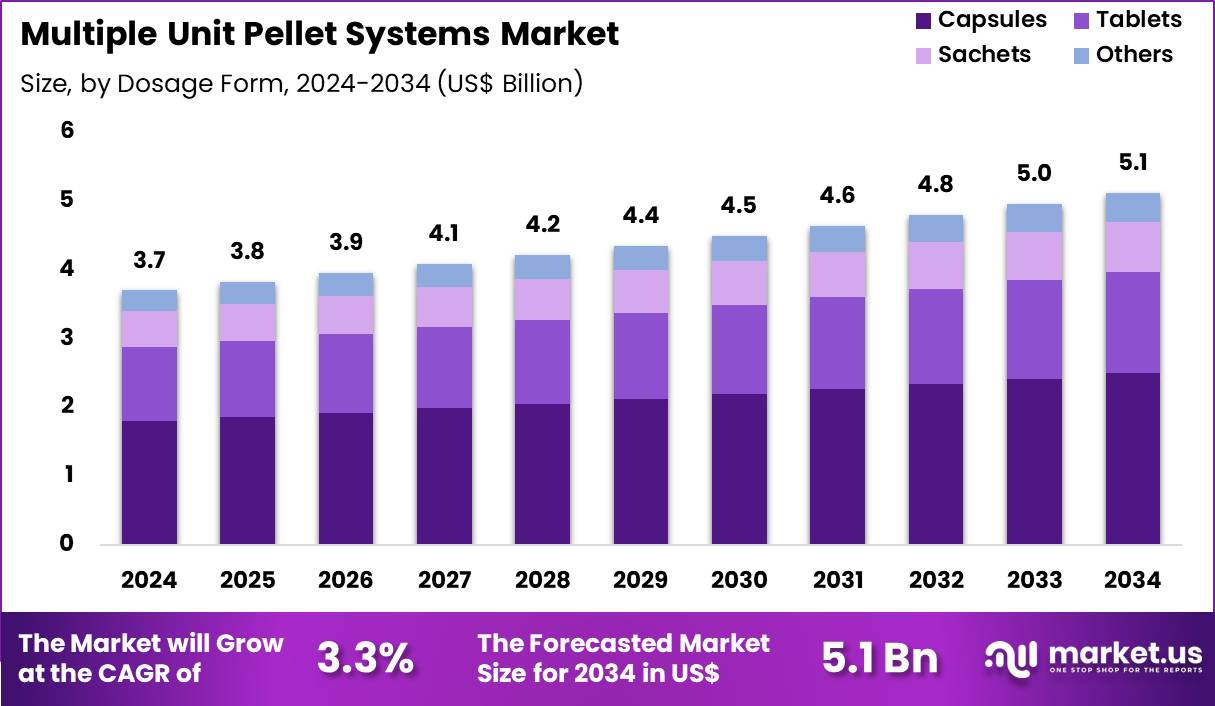
New York, NY – Oct 08, 2026 – The Global Multiple Unit Pellet Systems Market size is expected to be worth around US$ 5.1 Billion by 2034 from US$ 3.7 Billion in 2024, growing at a CAGR of 3.3% during the forecast period 2025 to 2034. In 2024, North America led the market, achieving over 36.9% share with a revenue of US$ 1.4 Billion.
The Multiple Unit Pellet Systems (MUPS) Market is gaining attention in the pharmaceutical industry due to the growing demand for advanced drug delivery technologies. MUPS formulations consist of multiple small pellets enclosed within a single dosage form, such as capsules or tablets. These systems offer advantages including controlled drug release, improved dose flexibility, and more uniform distribution of active pharmaceutical ingredients throughout the gastrointestinal tract.
Market growth is supported by the increasing prevalence of chronic diseases, rising demand for modified-release formulations, and continued advancements in pharmaceutical manufacturing technologies. MUPS technology is widely used in the development of oral solid dosage forms, particularly for medicines requiring specific drug-release profiles. Its flexibility also supports the formulation of drugs with different release characteristics within a single dosage unit.
Pharmaceutical companies are increasingly focusing on patient compliance, product performance, and formulation innovation, creating opportunities for the adoption of multiple-unit pellet technologies. In addition, ongoing research and development activities are expected to support improvements in pellet coating, manufacturing efficiency, and drug delivery performance.
However, formulation complexity, manufacturing costs, and stringent regulatory requirements may influence market development. As pharmaceutical manufacturers continue to invest in advanced oral drug delivery solutions, the MUPS market is expected to present opportunities for technology providers, contract manufacturers, and pharmaceutical companies worldwide.
Key Takeaways
- In 2024, the Multiple Unit Pellet Systems Market was valued at US$ 3.7 billion and is projected to reach US$ 5.1 billion by 2034, registering a CAGR of 3.3% during the forecast period.
- By dosage form, the market is segmented into capsules, tablets, sachets, and others. Capsules dominated the segment in 2024, accounting for a market share of 48.7%.
- Based on formulation, the market is categorized into extended-release dosage forms, delayed-release orodispersible dosage forms, delayed-release dosage forms, and others. Extended-release dosage forms held a significant market share of 44.6%.
- By drug class, the market is segmented into proton pump inhibitors, antihypertensives, antibiotics, analgesics, and others. Proton pump inhibitors emerged as the leading segment, accounting for the largest revenue share of 41.9%.
- By distribution channel, the market is divided into hospital pharmacies, drug stores, retail pharmacies, and online pharmacies. Hospital pharmacies led the segment in 2024, capturing a revenue share of 46.3%.
- Regionally, North America dominated the Multiple Unit Pellet Systems Market in 2024, accounting for 36.9% of the global market share.
Key Market Segments
- Dosage Form Analysis: Capsules dominated the dosage form segment with a 48.7% share, supported by their compatibility with pellet-filling technologies, accurate dosing, ease of swallowing, and ability to accommodate multiple pellet populations. Their suitability for modified-release products and efficient manufacturing is expected to sustain segment leadership.
- Formulation Analysis: Extended-release dosage forms led the formulation segment with a 44.6% share. Rising demand for sustained drug delivery, reduced dosing frequency, improved patient adherence, and stable plasma drug concentrations is supporting adoption. MUPS technology enables precise control of drug-release profiles, making extended-release formulations suitable for chronic disease management.
- Drug Class Analysis: Proton pump inhibitors accounted for 41.9% of the drug class segment. Their dominance is supported by the high prevalence of acid-related disorders and the need for enteric protection. MUPS technology enables effective delivery and controlled release of PPIs.
- Distribution Channel Analysis: Hospital pharmacies held the leading position with a 46.3% share. Strong procurement capabilities, clinical oversight, patient counseling, and growing use of modified-release therapies support their dominance.
Regional Analysis
North America dominated the Multiple Unit Pellet Systems Market in 2024, accounting for 36.9% of the global market. Growth was supported by rising demand for sustained-release drug delivery systems for chronic conditions, including hypertension and gastrointestinal disorders.
Increasing adoption of multiparticulate formulations for pediatric and geriatric patients, along with demand for complex generics and improved pharmacokinetic profiles, further supported regional expansion.
Pharmaceutical companies also focused on advanced pellet manufacturing technologies, including extrusion-spheronization and specialized coating techniques, to improve dose uniformity and drug-release performance. Regulatory support for complex generic development contributed to market opportunities.
Asia Pacific is expected to register the highest CAGR during the forecast period. Market expansion is being driven by increasing chronic disease prevalence, growing pharmaceutical manufacturing capabilities, and rising demand for affordable sustained-release generics.
Investments in pelletization technologies, bioequivalence studies, and advanced coating systems are supporting product development. Government initiatives to strengthen local pharmaceutical production and increasing https://market.us/reports/healthcare/
needs across emerging economies are expected to further accelerate adoption of multiple unit pellet technologies in the region.
Emerging Trends
- Growing focus on modified and extended drug release: The development of MUPS is increasingly linked with controlled, delayed, and extended drug release. By changing the pellet coating and formulation, drug release can be adjusted over time. This supports lower dosing frequency and more stable drug exposure in suitable medicines.
- Greater use of patient-friendly dosage forms: Small pellets can improve swallowing and provide greater flexibility than conventional large tablets. This is particularly relevant for patients who have difficulty swallowing, including children and older adults. Multiparticulate systems can also support flexible dosing and taste masking.
- Increasing interest in advanced pellet coating technologies: Functional coatings are becoming an important area of formulation development because they can control where and when the drug is released. Enteric and extended-release coatings can help protect the drug in the stomach or prolong release after administration.
- Development of more patient-centric and flexible products: MUPS can contain pellets with different drug loads or release characteristics within the same dosage form. This creates opportunities for flexible dosing, combination products, and different release patterns. Recent research also highlights patient-specific formulation and newer technologies such as 3D printing.
- Stronger focus on manufacturing quality and regulatory control: Commercial development is placing greater attention on pellet coating strength, content uniformity, dissolution, and tablet compression. FDA guidance requires appropriate quality and performance evaluation when modified-release products are changed or scaled up.
Use Cases
- Extended-release medicines: MUPS can be used when a medicine needs to be released slowly over an extended period. This approach can potentially reduce dosing frequency and reduce fluctuations in drug concentrations compared with immediate-release formulations.
- Delayed-release and enteric drug delivery: Coated pellets can be designed to resist the acidic environment of the stomach and release the active ingredient later in the gastrointestinal tract. This makes MUPS useful for medicines where stomach protection or delayed release is required.
- Pediatric medicines: Small multiparticulate pellets can provide an easier-to-administer alternative to large tablets for children. They may also be combined with suitable foods or vehicles, while taste masking can improve acceptability and support adherence.
- Medicines for patients with swallowing difficulties: MUPS can be formulated as tablets that rapidly separate into individual pellets after administration. Their small individual size can support easier swallowing and may provide an alternative to conventional large tablets or capsules.
- Targeted gastrointestinal drug delivery: Because individual pellets can be given different coatings and release characteristics, MUPS can be designed to distribute drug more evenly through the gastrointestinal tract. This provides opportunities for site-specific and controlled gastrointestinal drug delivery.
Frequently Asked Questions About Multiple Unit Pellet Systems
- How do Multiple Unit Pellet Systems work?
MUPS divide the drug dose into multiple individual pellets rather than placing the entire dose in one unit. Different coatings can control how quickly each pellet releases its drug, allowing the final dosage form to produce a planned release pattern. - What types of drugs can use MUPS technology?
MUPS can be considered for medicines requiring modified, delayed, sustained, or extended release. The technology is particularly relevant when drug release needs to be controlled through coatings or multiple pellet populations. Suitability depends on the drug’s properties and formulation requirements. - Can MUPS help reduce dose dumping?
MUPS can reduce the risk associated with release failure of a single large unit because the total dose is divided among many pellets. However, the actual safety benefit depends on formulation design, coating integrity, manufacturing quality, and the drug product’s release characteristics. - Why is patient-centric drug delivery important for the MUPS market?
Patient-centric formulation focuses on making medicines easier and more convenient to use. MUPS can support smaller units, flexible dosing, taste masking, and controlled release, making the technology relevant to populations such as children, older adults, and patients with swallowing difficulties. - Which application areas are important for the MUPS market?
Important application areas include extended-release medicines, delayed-release products, gastrointestinal drug delivery, pediatric formulations, and swallowing-friendly oral medicines. The technology is especially useful where drug release needs to be controlled through pellet design and functional coating systems. - What factors can influence MUPS market growth?
Growth can be influenced by pharmaceutical companies’ adoption of modified-release formulations, demand for patient-friendly medicines, advances in coating technologies, manufacturing capabilities, and regulatory requirements. Product development costs and technical challenges associated with pellet compression can also affect adoption. - What technologies are shaping the MUPS market?
Pelletization, drug layering, functional film coating, controlled-release polymers, and advanced compression methods are important technologies. Recent research is also examining flexible multiparticulate designs and newer manufacturing approaches, including the possible use of 3D printing for specialized drug-delivery systems. - What is the future direction of the MUPS market?
Future development is expected to focus on more flexible release profiles, patient-specific dosing, pediatric and geriatric applications, improved manufacturing control, and advanced multiparticulate technologies. Research is increasingly connecting MUPS with broader goals of safer, more convenient, and controlled oral drug delivery.
Conclusion
The Multiple Unit Pellet Systems (MUPS) Market is expected to experience steady growth as pharmaceutical companies increasingly adopt advanced oral drug delivery technologies. Rising demand for extended-release formulations, patient-friendly dosage forms, and flexible drug delivery is supporting market expansion.
Capsules, extended-release formulations, proton pump inhibitors, and hospital pharmacies currently represent key market segments. North America maintains a leading position, while Asia Pacific is expected to witness strong growth due to expanding pharmaceutical manufacturing and healthcare demand.
Despite challenges related to formulation complexity, manufacturing costs, and regulatory requirements, continued innovation in pellet coating, pelletization, and controlled-release technologies is expected to create new opportunities worldwide.
Discuss your needs with our analyst
Please share your requirements with more details so our analyst can check if they can solve your problem(s)




