


Overview
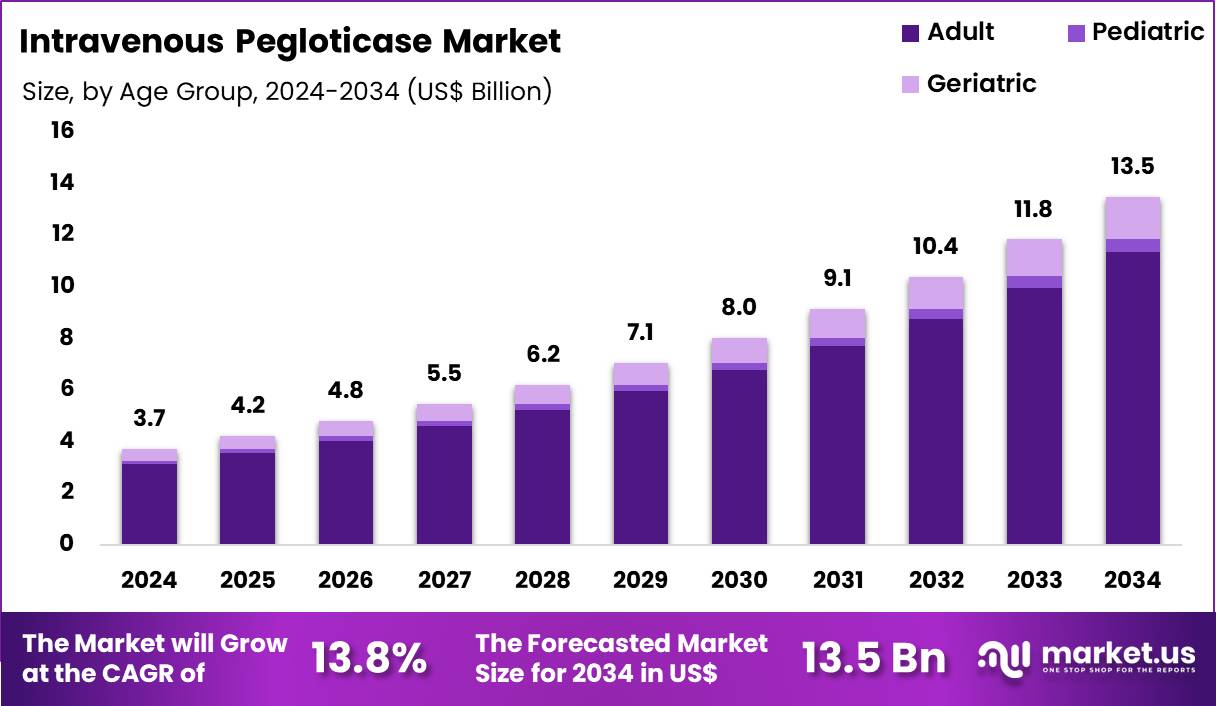
New York, NY – Oct 08, 2026 – The Global Intravenous Pegloticase Market size is expected to be worth around US$ 13.5 Billion by 2034 from US$ 3.7 Billion in 2024, growing at a CAGR of 13.8% during the forecast period 2025 to 2034. In 2024, North America led the market, achieving over 39.9% share with a revenue of US$ 1.5 Billion.
The global Intravenous Pegloticase Market is witnessing growing demand, driven by the increasing prevalence of chronic gout and the need for effective treatment options among patients who do not respond adequately to conventional urate-lowering therapies. Intravenous pegloticase is a recombinant uricase enzyme administered through intravenous infusion and is primarily used for the management of chronic gout that remains uncontrolled despite standard treatments.
Market growth is being supported by the rising burden of gout worldwide, increasing awareness of advanced therapies, and continued improvements in healthcare infrastructure. The growing geriatric population and the increasing incidence of lifestyle-related risk factors are also contributing to the demand for specialized gout treatments.
Pharmaceutical companies are focusing on improving treatment outcomes, expanding patient access, and strengthening distribution networks for biologic therapies. Ongoing clinical research and developments in combination therapies are expected to create additional opportunities for market expansion.
North America is expected to maintain a significant position in the market, supported by advanced healthcare facilities, higher treatment adoption, and the presence of established pharmaceutical companies. Meanwhile, opportunities in Europe and Asia-Pacific are expected to increase as awareness of advanced gout therapies improves.
Overall, the Intravenous Pegloticase Market is expected to experience steady growth as healthcare providers increasingly adopt targeted therapies for patients with uncontrolled chronic gout.
Key Takeaways
- In 2024, the market generated revenue of US$ 13.7 billion and is projected to grow at a CAGR of 13.8% through the forecast period, reaching US$ 13.5 billion by 2034.
- By age group, the market is segmented into adult, pediatric, and geriatric. The adult segment dominated in 2024, accounting for a market share of 84.2%.
- Based on application, the market is segmented into chronic and refractory. The chronic segment held the dominant position, accounting for 71.6% of the market share.
- By distribution channel, the market is categorized into hospital pharmacies, retail pharmacies, and others. Hospital pharmacies dominated the segment, accounting for the largest revenue share of 63.5%.
- North America dominated the global market in 2024, accounting for a market share of 39.9%.
Key Market Segments
- Age Group Analysis: The adult segment accounted for 84.2% of the age group category in 2024, supported by the high prevalence of chronic and refractory gout among adults. Rising comorbidities, including obesity, diabetes, cardiovascular disorders, and renal impairment, continue to increase demand for intravenous pegloticase therapy.
- Application Analysis: The chronic segment represented 71.6% of the application category in 2024, driven by persistent hyperuricemia, recurrent gout flares, and progressive joint damage. Increasing treatment escalation, specialist care, and the need for sustained urate reduction continue to support intravenous pegloticase adoption among chronic patients.
- Distribution Channel Analysis: Hospital pharmacies accounted for 63.5% of the distribution channel category in 2024, primarily due to the requirement for controlled infusion environments, biologic storage, and patient monitoring. Integrated laboratory services, specialist supervision, and emergency response capabilities further strengthen hospital pharmacies as the leading channel.
Regional Analysis
North America dominated the Intravenous Pegloticase Market in 2024, accounting for 39.9% of global revenue. Market leadership was supported by the rising prevalence of gout and hyperuricemia, increasing treatment needs among patients unresponsive to conventional urate-lowering therapies, and growing adoption of pegloticase among patients with refractory and tophaceous gout.
Strong clinical evidence, regulatory support, reimbursement availability, and established outpatient infusion infrastructure further facilitated market expansion. The region also benefits from an aging population and high prevalence of metabolic and cardiovascular comorbidities, which increase the burden of severe gout.
Asia Pacific is projected to register the highest CAGR during the forecast period, supported by increasing hyperuricemia prevalence, changing dietary patterns, metabolic disorders, and expanding healthcare infrastructure.
Growing awareness of advanced gout therapies, improving specialist access, government-supported healthcare programs, and increasing investments in biologic manufacturing are expected to strengthen adoption. Rising diagnostic rates and multicenter clinical research are also anticipated to improve treatment accessibility and support long-term market growth across major regional economies.
Emerging Trends
- Growing Use of Immunomodulator Combination Therapy: A major trend is the increasing use of methotrexate or other immunomodulators alongside pegloticase. FDA-approved labeling permits co-administration with weekly methotrexate when appropriate. Real-world evidence has also shown that immunomodulator use can improve treatment persistence and response.
- Greater Focus on Uncontrolled and Refractory Gout: Market demand is being supported by greater identification of patients with uncontrolled or treatment-resistant gout. Research shows that disease burden, gout flares, healthcare use, and complications can increase before patients begin pegloticase therapy, creating a need for earlier identification of suitable patients.
- Increasing Attention to Patients With Kidney Disease: Patients with gout frequently have other health problems, including chronic kidney disease. Real-world studies indicate that pegloticase with methotrexate can be effective in selected patients with and without chronic kidney disease, supporting continued interest in this high-need patient group.
- Stronger Monitoring and Infusion-Center Requirements: Because pegloticase can cause serious infusion reactions and anaphylaxis, treatment requires healthcare supervision, premedication, and monitoring. Serum uric acid is also checked before infusions, with treatment discontinuation recommended when levels rise above specified thresholds. These requirements influence market delivery and service models.
- Expansion of Real-World Evidence for Treatment Selection: Real-world databases and rheumatology registries are increasingly being used to evaluate pegloticase persistence, safety, response, and treatment patterns. A 2024 registry analysis involving 700 pegloticase recipients found that concomitant immunomodulator treatment was associated with lower discontinuation risk.
Use Cases
- Treatment of Chronic Refractory Gout: The primary use case is the treatment of chronic gout in adults who do not respond adequately to conventional therapy. FDA records identify this as the approved indication, making refractory gout the core application for intravenous pegloticase.
- Rapid Reduction of High Serum Uric Acid: Pegloticase is used when substantial urate reduction is required in patients with uncontrolled gout. Its enzyme-based mechanism converts uric acid into allantoin, which can support rapid lowering of serum urate compared with conventional oral therapies.
- Management of Severe Tophaceous Gout: Patients with longstanding gout may develop tophi, which are deposits of urate crystals around joints and other tissues. Pegloticase is particularly relevant for severe disease where conventional treatment has failed and substantial urate reduction is clinically required.
- Treatment of Patients Failing Conventional Urate-Lowering Therapy: Pegloticase provides an intravenous treatment option for patients who remain uncontrolled despite medicines such as allopurinol or febuxostat. Research has shown that many patients with chronic refractory gout continue to have serum urate above target despite conventional treatments.
- Treatment Within Specialist Rheumatology and Infusion Settings: Because administration requires intravenous infusion and monitoring for potentially serious reactions, pegloticase is commonly positioned within specialist rheumatology and supervised infusion-care pathways. FDA labeling specifies administration by intravenous infusion rather than intravenous push or bolus.
Frequently Asked Questions About Intravenous Pegloticase
- What is intravenous pegloticase used for?
Intravenous pegloticase is used for adults with chronic gout that remains uncontrolled despite conventional treatment. It is not intended for ordinary asymptomatic high uric acid levels and is mainly reserved for patients with significant treatment needs. - How is pegloticase administered?
Pegloticase is administered as an intravenous infusion, generally at a dose of 8 mg every two weeks under the approved U.S. regimen. The infusion must be given in a healthcare setting and should not be administered as an intravenous push or bolus. - Why is methotrexate used with pegloticase?
Methotrexate may be used with pegloticase to improve treatment persistence and response. FDA labeling allows weekly methotrexate when clinically appropriate, while real-world registry evidence has associated immunomodulator use with lower rates of pegloticase discontinuation. - What is driving the intravenous pegloticase market?
Market growth is supported by the increasing clinical focus on uncontrolled gout, severe disease, treatment failure, and patients with substantial comorbidities. Real-world studies indicate that healthcare utilization and disease burden can increase before patients receive pegloticase. - How does immunomodulator use affect the market?
Immunomodulator co-therapy is becoming an important market trend because it can improve the durability of pegloticase treatment. A 700-patient real-world registry study found lower discontinuation among patients receiving concomitant immunomodulatory therapy, supporting broader clinical adoption. - What role do specialty infusion centers play in the market?
Specialty infusion centers can support pegloticase administration by providing trained healthcare staff, intravenous treatment facilities, premedication, and monitoring for adverse reactions. FDA requirements for supervised administration make infusion infrastructure an important part of market delivery. - What is the future outlook for the intravenous pegloticase market?
The market outlook is supported by continued unmet needs in refractory gout, greater use of combination therapy, growing real-world evidence, and improved identification of suitable patients. However, safety monitoring, treatment cost, and specialist administration will remain important market constraints.
Conclusion
The global Intravenous Pegloticase Market is expected to maintain steady growth, supported by the rising burden of chronic and refractory gout and increasing demand for advanced urate-lowering therapies. Growing adoption among adults, greater use of immunomodulator combination therapy, and improved specialist infusion infrastructure are strengthening market opportunities.
North America currently leads the market due to established healthcare systems, treatment access, and regulatory support, while Asia Pacific is expected to record strong growth as awareness and healthcare infrastructure improve.
Continued clinical research, real-world evidence, and better patient identification are likely to support future adoption. However, treatment costs, safety monitoring, and specialized administration remain key market challenges.
Discuss your needs with our analyst
Please share your requirements with more details so our analyst can check if they can solve your problem(s)




