


Overview
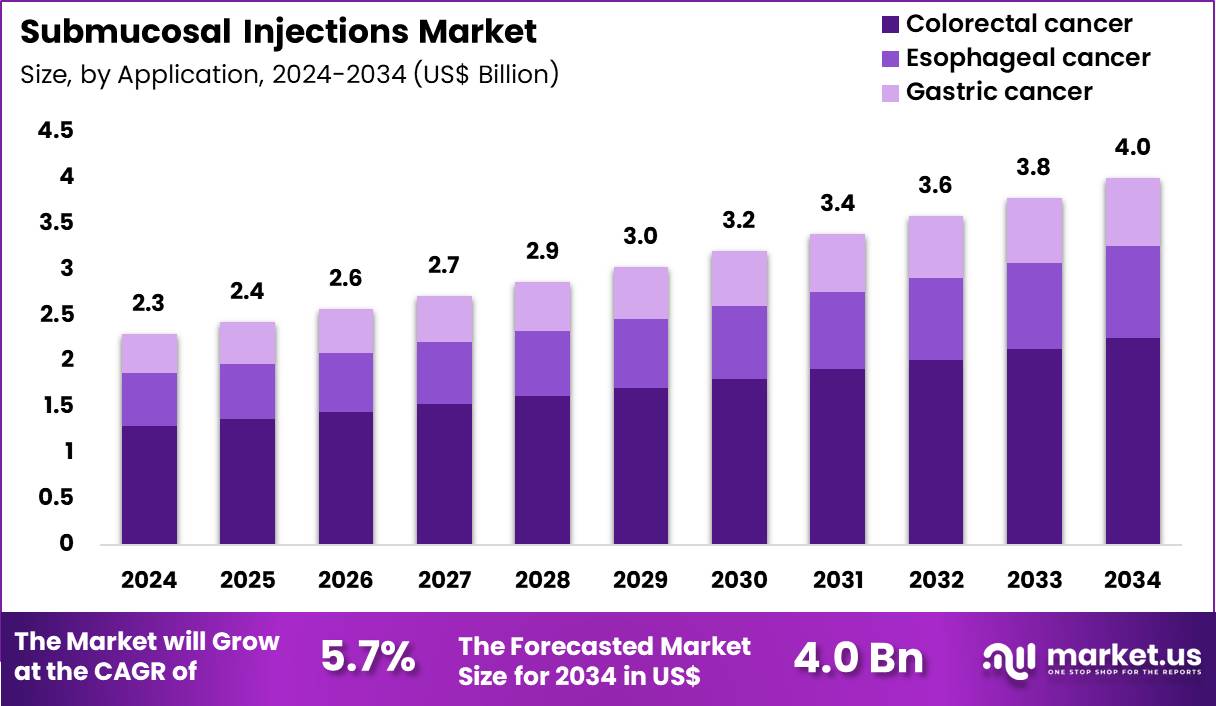
New York, NY – Oct 08, 2026 – The Global Submucosal Injections Market size is expected to be worth around US$ 4.0 Billion by 2034 from US$ 2.3 Billion in 2024, growing at a CAGR of 5.7% during the forecast period 2025 to 2034. In 2024, North America led the market, achieving over 38.4% share with a revenue of US$ 0.9 Billion.
The global Submucosal Injections Market is gaining importance due to the increasing adoption of minimally invasive gastrointestinal (GI) procedures and the growing prevalence of colorectal and gastrointestinal disorders.
Submucosal injections are used during endoscopic procedures to elevate lesions from the underlying tissue, supporting safer and more effective removal of polyps, tumors, and other abnormalities. The rising number of diagnostic and therapeutic endoscopy procedures is expected to support market expansion.
Technological advancements in endoscopic injection solutions, increasing awareness of early disease detection, and the growing use of advanced endoscopic mucosal resection techniques are further contributing to demand. Hospitals, specialty clinics, and ambulatory surgical centers represent key end users of these products.
North America is expected to maintain a significant position in the market, supported by advanced healthcare infrastructure, high adoption of endoscopic procedures, and favorable reimbursement conditions.
Meanwhile, Asia-Pacific is projected to offer substantial growth opportunities due to improving healthcare facilities, increasing healthcare expenditure, and a rising patient population.
Key Takeaways
- In 2024, the market generated US$ 2.3 billion in revenue and is projected to grow at a CAGR of 5.7%, reaching US$ 4.0 billion by 2034.
- By type of agent, the market is segmented into Eleview and Orise Gel, succinylated gelatin, normal saline, hydroxypropyl methylcellulose, hydroxyethyl starch, hyaluronic acid, fibrinogen mixture, and dextrose water. Eleview and Orise Gel dominated the segment in 2024, accounting for 42.8% of the market.
- Based on application, the market is categorized into colorectal cancer, esophageal cancer, and gastric cancer. Colorectal cancer held the leading position, with a market share of 56.4%.
- By end user, the market is segmented into hospitals, surgical centers, and others. Hospitals represented the dominant end-user segment in 2024, holding the largest revenue share.
- North America dominated the global market in 2024, accounting for a market share of 38.4%.
Key Market Segments
- Type of Agent Analysis: Eleview and Orise Gel held a 42.8% share in 2024, supported by growing preference for ready-to-use viscous lifting agents. Their durable submucosal cushions improve lesion elevation, procedural precision, and safety during complex endoscopic resections, supporting continued clinical adoption.
- Application Analysis: Colorectal cancer accounted for 56.4% of the application segment in 2024, driven by expanding screening programs and rising detection of early lesions. Submucosal injections facilitate safer endoscopic resections, improve margin control, and support minimally invasive treatment, sustaining demand across colorectal procedures.
- End-User Analysis: Hospitals accounted for 61.3% of the end-user segment in 2024 and remained the leading end-user category. Their advanced endoscopy infrastructure, specialized gastroenterologists, multidisciplinary teams, and high procedural volumes support greater adoption of submucosal injection products for complex gastrointestinal interventions.
Regional Analysis
North America led the global Submucosal Injections Market in 2024, accounting for 38.4% of the market. Growth was supported by the increasing adoption of advanced endoscopic procedures for early detection and removal of gastrointestinal lesions.
Rising use of hyaluronic acid and saline-based lifting agents in colorectal and esophageal procedures further supported demand. Regulatory approvals for advanced formulations, investments in pre-filled injection systems, and expanded training programs also strengthened regional adoption. In 2022, approximately 23.5 million GI endoscopies were performed, highlighting the region’s substantial procedural base.
Asia Pacific is projected to register the highest CAGR during the forecast period. Market growth is being driven by expanding colorectal screening programs, rising gastrointestinal cancer incidence, improving healthcare infrastructure, and increasing adoption of minimally invasive endoscopic procedures.
Government investments in public healthcare facilities and product innovation are further supporting market development. In 2022, Asia accounted for 50.2% of global colorectal cancer cases, representing approximately 966.4 thousand new cases.
Emerging Trends
- Development of longer-lasting lifting agents: A major trend is the development and adoption of viscous, longer-lasting injection solutions. These materials can maintain tissue elevation for longer periods than normal saline, which is useful during technically difficult EMR and ESD procedures. Research is increasingly focused on improving lifting duration, handling, and safety.
- Growing use in minimally invasive cancer treatment: Submucosal injections are increasingly important as endoscopic treatment is used for early gastrointestinal cancers and precancerous lesions. EMR and ESD can remove selected lesions without open surgery, supporting organ preservation and less invasive treatment. ASGE guidelines recognize ESD as an important option for selected early esophageal and gastric cancers.
- Shift toward ready-to-use commercial products: The market is moving toward commercially prepared injection agents rather than relying only on basic solutions such as saline. Commercial products can offer consistent viscosity, predictable lifting performance, and easier preparation. ASGE’s technology review identifies both commercially prepared and readily available materials as options for submucosal lifting.
- Increasing focus on procedural safety: Safety is becoming a key product-development priority. Injection creates a cushion between the lesion and deeper bowel-wall layers, helping reduce mechanical and thermal injury. New materials are therefore being evaluated for their ability to support complete removal while limiting bleeding and perforation risks.
- Development of advanced materials for complex procedures: Research is increasingly examining new formulations and materials that can provide better tissue elevation, longer-lasting cushions, and easier visualization. This is particularly relevant to ESD, where procedures can take longer and stable tissue separation is important. However, current evidence does not establish one injection material as universally superior.
Use Cases
- Endoscopic Mucosal Resection (EMR): Submucosal injection is widely used during EMR to raise a gastrointestinal lesion away from the deeper muscle layer. This creates a safer working space for snare removal and can make lesion resection technically easier. It is particularly relevant for larger or flat colorectal lesions.
- Endoscopic Submucosal Dissection (ESD): In ESD, injection provides a cushion that helps separate the lesion from deeper tissue during dissection. The technique is particularly useful for selected larger or complex superficial gastrointestinal lesions where en-bloc removal and accurate pathological assessment are important.
- Colorectal polyp removal: Injection can be used for large or difficult colorectal polyps, particularly when additional lifting is needed before snare removal. It can also provide a protective cushion between the lesion and deeper bowel layers, supporting safer resection.
- Early gastrointestinal cancer treatment: Submucosal injection supports endoscopic treatment of selected early esophageal, gastric, and colorectal cancers. By creating tissue separation, it facilitates EMR or ESD and can support minimally invasive removal in appropriately selected patients.
- Bleeding-risk management during lesion removal: Injection solutions may also be used as part of strategies to manage bleeding risk, including the use of agents such as epinephrine in selected procedures. However, injection is not a replacement for other bleeding-control methods, and the appropriate technique depends on the lesion and procedure.
Frequently Asked Questions About Submucosal Injections
- Why are submucosal injections used during endoscopy?
Submucosal injections are mainly used to lift gastrointestinal lesions before removal. The raised tissue provides additional working space and can reduce contact with deeper muscle layers during cutting or electrocautery, helping improve procedural safety and technical ease. - Which procedures commonly use submucosal injections?
Submucosal injections are commonly associated with endoscopic mucosal resection and endoscopic submucosal dissection. They can also be used during selected polypectomy procedures, particularly when large lesions or bleeding risks make additional tissue lifting beneficial. - What materials are used for submucosal injection?
Normal saline is widely used, while other options include sodium hyaluronate, dextrose, gelatin-based materials, hydroxypropyl methylcellulose, and commercially prepared lifting agents. The choice depends on the procedure, lesion characteristics, desired lifting duration, availability, and clinician preference. - What are the benefits of submucosal injections?
The main benefits include lifting the lesion, creating a protective cushion, improving access for resection, and potentially reducing injury to deeper tissue. These advantages can make EMR and ESD technically easier and support more controlled removal of gastrointestinal lesions. - Can submucosal injection reduce perforation risk?
Submucosal injection can help reduce the risk of deeper tissue injury by creating a cushion between the mucosal lesion and the muscle layer. However, it does not eliminate procedural risks, and outcomes depend on lesion characteristics, technique, equipment, and operator experience. - What is driving the submucosal injections market?
Market growth is supported by increasing use of therapeutic gastrointestinal endoscopy, wider application of EMR and ESD, treatment of early gastrointestinal cancers, and demand for minimally invasive procedures. Development of improved lifting materials is also supporting product innovation. - What is the outlook for the submucosal injections market
The outlook is supported by continued development of therapeutic endoscopy and minimally invasive treatment for gastrointestinal lesions. Future growth is likely to be influenced by better lifting materials, commercial ready-to-use products, expanding ESD expertise, and improvements in procedural safety and efficiency.
Conclusion
The global Submucosal Injections Market is expected to witness steady growth, supported by the increasing adoption of minimally invasive gastrointestinal procedures, rising gastrointestinal cancer burden, and expanding use of EMR and ESD techniques.The demand for longer-lasting, ready-to-use, and safer lifting agents is expected to encourage product innovation and clinical adoption.
North America is likely to remain a major market due to advanced healthcare infrastructure and high endoscopy volumes, while Asia-Pacific is expected to provide significant growth opportunities through improving healthcare access and increasing screening activities. Overall, technological advancements, growing procedural volumes, and increasing preference for minimally invasive treatment are expected to support sustained market expansion.
Discuss your needs with our analyst
Please share your requirements with more details so our analyst can check if they can solve your problem(s)




