


Overview
New York, NY – Aug 11, 2026 – The Global Nurse Call Systems Market size is expected to be worth around US$ 8.18 Billion by 2034 from US$ 2.78 Billion in 2024, growing at a CAGR of 11.4% during the forecast period from 2025 to 2034. In 2024, North America led the market, achieving over 42.3% share with a revenue of US$ 1.17 Billion.
The global healthcare sector is rapidly adopting advanced nurse call systems to enhance patient safety, improve caregiver communication, and optimize hospital workflows. These systems allow patients to instantly connect with nursing staff through bedside terminals, wireless devices, mobile applications, and smart communication platforms. Modern nurse call solutions are evolving into integrated healthcare hubs with real-time alerts, analytics, automated escalation, and connectivity with medical devices.
Growing elderly populations, increasing chronic disease prevalence, and healthcare workforce shortages are key factors supporting market expansion. According to the United Nations, the global population aged 65 years and above reached approximately 761 million in 2021 and is projected to exceed 1.6 billion by 2050. The World Health Organization (WHO) reports that noncommunicable diseases account for nearly 41 million deaths annually, representing about 74% of global deaths, increasing demand for faster patient monitoring and emergency response solutions.
The rising adoption of smart hospitals is further accelerating demand for wireless nurse call systems. Healthcare facilities are integrating these platforms with electronic health records (EHRs), real-time location systems (RTLS), and connected medical devices to improve response efficiency. The WHO also estimates a global nursing workforce shortage of approximately 4.5 million nurses by 2030, creating the need for automation-driven communication technologies.
North America remains a major adoption market due to advanced healthcare infrastructure and digital transformation initiatives. Meanwhile, Asia-Pacific is expected to witness strong growth supported by hospital modernization projects and increasing healthcare investments. Despite opportunities, challenges such as high installation costs, interoperability issues, and staff training requirements continue to impact adoption.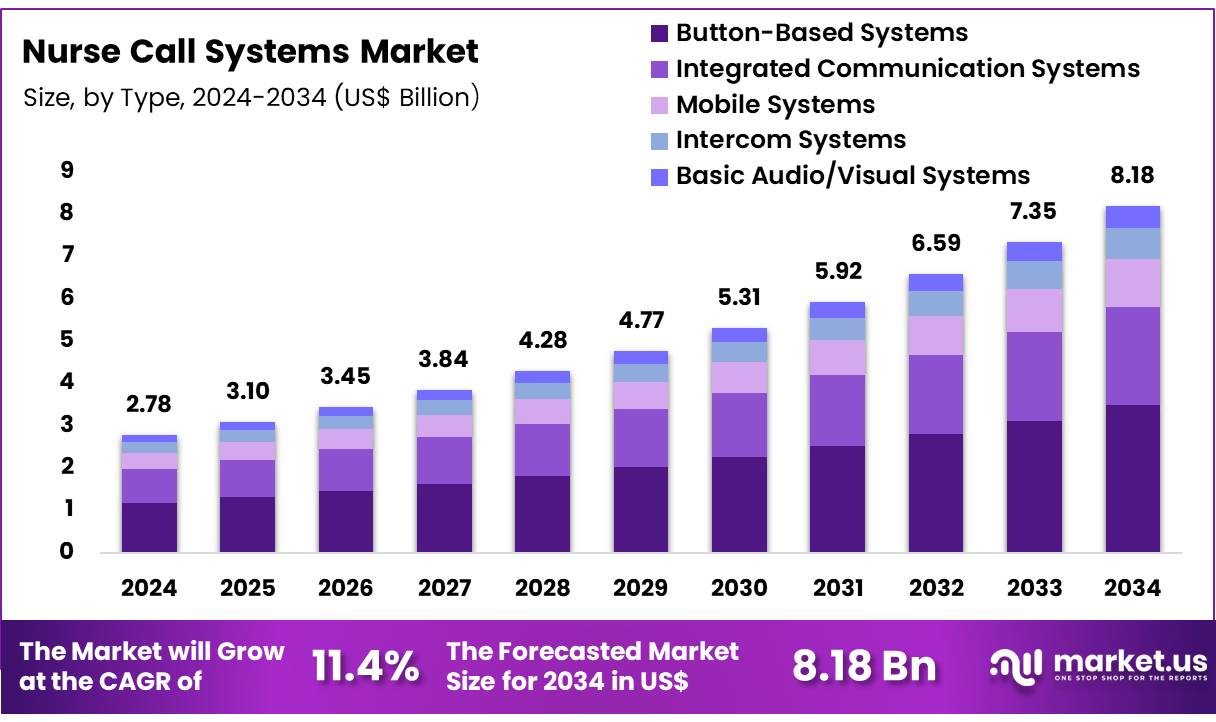
Key Takeaways
- Market Size: The global nurse call systems market is projected to reach approximately US$ 8.18 billion by 2034, rising from US$ 2.78 billion in 2024.
- Market Growth: The market is expected to expand at a CAGR of 11.4% during the forecast period from 2025 to 2034.
- Type Analysis: Button-based systems dominated the market in 2024, accounting for 42.5% of the total market share.
- Technology Analysis: Wired communication systems held the leading position in 2024, capturing 55.12% of the market share.
- Application Analysis: The alarms & communications segment represented the largest application category in 2024, with a 38.8% market share.
- End-Use Analysis: Hospitals emerged as the dominant end-user segment in 2024, accounting for 38.9% of the overall market share.
- Regional Analysis: North America led the global nurse call systems market in 2024, capturing more than 42.3% market share with a market value of approximately US$ 1.17 billion.
Statistical Information
- Rising Elderly Population Driving Need for Nurse Call Solutions: The increasing elderly population is creating higher demand for assisted care, long-term care facilities, and patient monitoring technologies. According to the United Nations, the global population aged 65 years and older is projected to reach approximately 1.6 billion by 2050, compared with 761 million in 2021.
- Nursing Workforce Shortage Increasing Need for Automated Communication: Healthcare workforce shortages are encouraging hospitals to implement technologies that improve nurse efficiency and workload management. The World Health Organization (WHO) reports that the global nursing workforce includes approximately 29 million nurses, while a shortage of 4.5 million nurses is expected by 2030.
- Increasing Number of Hospitals Supporting Adoption of Nurse Call Systems: The growing healthcare facility base is expanding opportunities for patient communication technologies. The American Hospital Association (AHA) reported that the United States had approximately 6,093 hospitals in 2023, including 5,157 community hospitals, 625 federal government hospitals, and other specialty facilities.
- Elderly Population Growth Creating Higher Demand for Assisted Care Technologies: Aging demographics are increasing demand for monitoring and safety technologies in hospitals and residential care facilities. According to the United Nations, the global population aged 65 years and older reached around 761 million people in 2021 and is expected to increase to 1.6 billion by 2050.
- Chronic Disease Burden Increasing Demand for Continuous Patient Monitoring: The rising prevalence of chronic diseases is increasing hospitalization and long-term care requirements. The World Health Organization (WHO) reports that noncommunicable diseases cause approximately 41 million deaths annually, representing nearly 74% of deaths worldwide.
- Nursing Workforce Shortage Driving Healthcare Automation: Healthcare organizations are adopting communication automation technologies to improve efficiency amid workforce shortages. According to the World Health Organization (WHO), the global nursing workforce consists of approximately 29 million professionals, but the world could face a shortage of 4.5 million nurses by 2030.
- Healthcare Spending Growth Supporting Digital Hospital Investments: Increasing healthcare expenditure is enabling hospitals to invest in advanced communication infrastructure. The Centers for Medicare & Medicaid Services (CMS) reported that U.S. national healthcare expenditure reached approximately $4.9 trillion in 2023, accounting for nearly 17.6% of U.S. GDP.
- Long-Term Care Expansion Increasing Need for Wireless Nurse Call Systems: Demand for residential care communication systems is increasing due to growth in older populations requiring assisted living support. According to the U.S. Administration for Community Living (ACL), the U.S. population aged 60 years and older exceeded 75 million people in 2020 and continues expanding.
Regional Analysis
North America held a dominant market position, capturing more than a 42.3% share
North America remains a leading region for nurse call system adoption due to its advanced healthcare infrastructure, increasing focus on patient safety, and rapid integration of digital healthcare technologies. The region has a strong network of hospitals, skilled nursing facilities, and long-term care centers requiring efficient patient-to-caregiver communication solutions. According to the American Hospital Association (AHA), the United States had approximately 6,093 hospitals in 2023, creating significant demand for healthcare communication technologies. The growing elderly population and rising chronic disease burden are further supporting adoption.
The U.S. Census Bureau reported that the population aged 65 years and older reached 55.8 million in 2020, representing 16.8% of the total U.S. population, increasing the need for monitoring and assisted care solutions. Healthcare digitalization initiatives, electronic health record adoption, and investments in smart hospital infrastructure are accelerating the deployment of wireless nurse call systems, integrated alarms, and real-time communication platforms. With continued emphasis on reducing response times, improving workflow efficiency, and enhancing patient outcomes, North America is expected to maintain a strong position in the global nurse call systems market.
Emerging Trends
- Integration of AI and Smart Communication Technologies: Artificial intelligence and automation are transforming nurse call systems into intelligent communication platforms. Hospitals are adopting AI-based alert prioritization, predictive analytics, and automated workflows to reduce response delays. According to ONC, more than 96% of U.S. acute care hospitals adopted certified EHR systems by 2021, supporting connected healthcare environments.
- Growth of Wireless Nurse Call Systems in Healthcare Facilities: Wireless nurse call systems are gaining adoption due to easier installation, mobility, and integration with smartphones and wearable devices. These systems support faster caregiver responses in hospitals and senior care centers. The U.S. Census Bureau reported that adults aged 65 years and older reached 55.8 million in 2020, increasing demand for monitoring solutions.
- Integration with Real-Time Location Systems (RTLS) and Mobile Devices: Healthcare providers are increasingly connecting nurse call platforms with RTLS, mobile communication devices, and hospital information systems. These integrations help track caregiver availability and improve workflow efficiency. The National Institute of Standards and Technology (NIST) highlights interoperability as a key requirement for effective healthcare technology adoption.
- Advanced Alarm Management to Reduce Alarm Fatigue: Hospitals are implementing intelligent alarm management features to reduce unnecessary alerts and improve patient safety. The Joint Commission identified alarm safety as a National Patient Safety Goal due to risks associated with excessive clinical alarms. Healthcare facilities are adopting systems that prioritize critical alerts and improve response accuracy.
- Expansion of Nurse Call Systems in Long-Term Care Facilities: The increasing need for elderly care is expanding the use of nurse call technologies in nursing homes and assisted living centers. According to the Administration for Community Living (ACL), the U.S. population aged 60 years and older exceeded 75 million in 2020, increasing demand for emergency communication and fall detection solutions.
Use Cases
- Fall Detection and Emergency Response Applications: Nurse call systems are increasingly used with fall detection sensors to provide immediate alerts when patients experience accidents. The CDC reports that more than 14 million older adults fall annually in the United States, creating demand for technologies that improve emergency response in hospitals and senior care facilities.
- Smart Hospital Workflow Optimization: Hospitals are using nurse call platforms to optimize staff allocation, monitor response times, and improve operational efficiency. With U.S. healthcare spending reaching approximately $4.9 trillion in 2023, healthcare organizations are investing in digital solutions that improve quality and resource utilization.
- Patient-Centered Communication Solutions: Modern nurse call systems improve patient engagement by enabling direct communication between patients and caregivers. The Agency for Healthcare Research and Quality (AHRQ) emphasizes effective communication as an important factor in improving patient safety and healthcare outcomes.
- Integration with Electronic Health Records (EHRs): Healthcare facilities are connecting nurse call systems with EHR platforms to improve documentation and information sharing. According to ONC, certified EHR adoption exceeded 96% among U.S. acute care hospitals, creating opportunities for connected communication workflows.
- Use in Aging Care and Assisted Living Environments: Nurse call technologies are becoming essential in assisted living and residential care settings for emergency alerts, remote monitoring, and caregiver coordination. The United Nations projects the global population aged 65+ will reach 1.6 billion by 2050, increasing demand for elderly care communication solutions.
Frequently Asked Questions on Nurse Call Systems
- What are the major types of nurse call systems?
Major types of nurse call systems include button-based systems, integrated communication systems, mobile nurse call solutions, and emergency alert systems. Button-based solutions remain widely used, while wireless and smart systems are gaining popularity due to improved flexibility and advanced monitoring capabilities. - How are wireless nurse call systems improving healthcare operations?
Wireless nurse call systems improve healthcare operations by enabling mobile communication, automated alerts, and faster caregiver responses. These systems reduce dependency on fixed nurse stations, support real-time notifications, and allow healthcare staff to manage patient requests more efficiently across hospital departments. - Which technology segment dominates the nurse call systems market?
Wired communication systems currently represent a significant technology segment due to their reliability, established infrastructure, and widespread hospital adoption. However, wireless communication technologies are gaining traction because they offer easier installation, scalability, mobility, and integration with modern healthcare platforms. - What are the major applications of nurse call systems?
Nurse call systems are mainly used for patient communication, emergency alerts, staff assistance, fall detection, and workflow management. Hospitals, nursing homes, and assisted living facilities use these solutions to improve patient monitoring, reduce response delays, and enhance overall healthcare service quality. - Why are hospitals the largest end users of nurse call systems?
Hospitals are major end users because they require continuous patient monitoring, emergency communication, and efficient nursing workflows. High patient volumes, increasing safety requirements, and the adoption of smart hospital technologies are encouraging hospitals to invest in advanced nurse call communication solutions. - Which region dominates the nurse call systems market?
North America holds a leading position in the nurse call systems market due to advanced healthcare infrastructure, high healthcare technology adoption, and strong investment in digital hospital solutions. The region’s large network of hospitals and long-term care facilities supports continued demand for advanced communication systems. - What are the future trends in the nurse call systems market?
Future trends include artificial intelligence-based alert management, wireless communication, cloud-based healthcare platforms, predictive analytics, and integration with smart hospital technologies. These innovations are expected to improve response times, reduce alarm fatigue, optimize staffing, and enhance patient-centered healthcare delivery.
Conclusion
The nurse call systems market is experiencing significant growth as healthcare providers increasingly prioritize patient safety, faster response times, and operational efficiency. Rising elderly populations, increasing chronic diseases, nursing workforce shortages, and the expansion of smart hospitals are driving adoption of advanced communication solutions.
Technologies such as wireless systems, AI-based alerts, real-time monitoring, and healthcare platform integration are transforming traditional nurse call solutions into intelligent care management tools. Although challenges such as high costs and interoperability remain, continuous healthcare modernization and digital transformation initiatives are expected to support sustained market expansion globally.
Discuss your needs with our analyst
Please share your requirements with more details so our analyst can check if they can solve your problem(s)




