
Overview
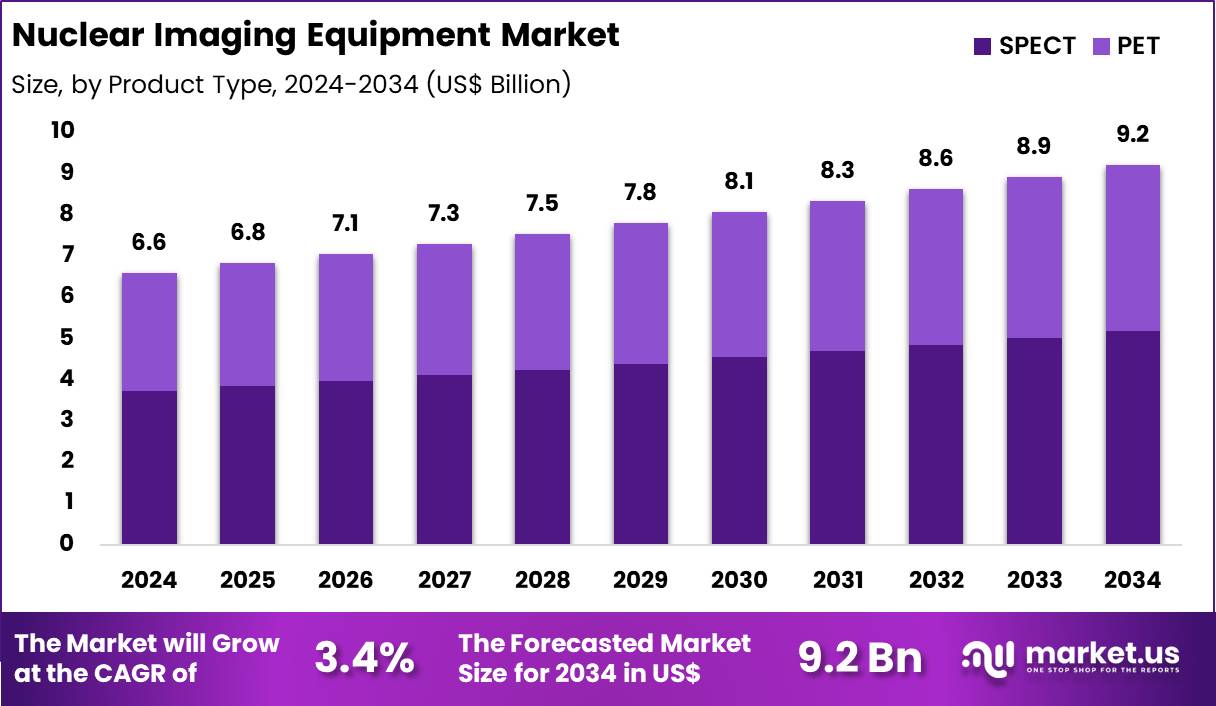
New York, NY – Oct 27, 2026 – Global Nuclear Imaging Equipment Market size is expected to be worth around US$ 9.2 Billion by 2034 from US$ 6.6 Billion in 2024, growing at a CAGR of 3.4% during the forecast period 2025 to 2034. In 2024, North America led the market, achieving over 43.3% share with a revenue of US$ 2.9 Billion.
Nuclear imaging equipment plays a vital role in modern healthcare by enabling the diagnosis, monitoring, and evaluation of various diseases through the use of radioactive tracers. These systems help healthcare professionals examine organ function, detect abnormalities, and support clinical decision-making, particularly in oncology, cardiology, and neurology.
The nuclear imaging equipment market includes technologies such as Positron Emission Tomography (PET), Single Photon Emission Computed Tomography (SPECT), and hybrid imaging systems, including PET/CT and SPECT/CT. These technologies provide detailed functional and anatomical information, supporting early disease detection and more accurate diagnosis.
Market growth is being supported by the increasing prevalence of cancer and cardiovascular diseases, rising demand for advanced diagnostic imaging, and continuous technological advancements. Improvements in image resolution, system sensitivity, workflow efficiency, and artificial intelligence integration are further enhancing the clinical value of nuclear imaging solutions.
In addition, growing investments in healthcare infrastructure, expanding access to diagnostic services, and increasing adoption of personalized medicine are creating new opportunities for market participants. However, high equipment costs, regulatory requirements, and the limited availability of radiopharmaceuticals and specialized professionals may present challenges.
As healthcare systems increasingly emphasize early diagnosis and precision medicine, nuclear imaging equipment is expected to remain an important component of advanced diagnostic care. Continued innovation and investment are likely to shape the market’s future development.
Key Takeaways
- In 2024, the nuclear imaging equipment market was valued at US$ 6.6 billion and is projected to reach US$ 9.2 billion by 2034, growing at a CAGR of 3.4%.
- By product type, the market is segmented into SPECT and PET, with SPECT accounting for the largest share of 56.3%.
- By application, the market is categorized into oncology, cardiology, neurology, and others, with oncology dominating with a share of 48.9%.
- By end user, the market is segmented into hospitals, diagnostic imaging centers, and others, with hospitals holding the leading revenue share of 61.4%.
- Regionally, North America dominated the nuclear imaging equipment market, accounting for a market share of 43.3%.
Key Market Segments
- Product Type Analysis: SPECT accounted for 56.3% of the nuclear imaging equipment market, supported by its affordability, widespread clinical availability, and established use in cardiology, oncology, and neurology. Improved detectors, hybrid imaging systems, and advanced reconstruction software are supporting adoption. Its compatibility with existing infrastructure and cost-effectiveness continue to strengthen demand across healthcare facilities.
- Application Analysis: Oncology accounted for 48.9% of the nuclear imaging equipment market, driven by rising cancer incidence and growing demand for functional imaging. Nuclear imaging supports tumor detection, disease staging, and treatment monitoring. Increasing adoption of personalized medicine, targeted therapies, and advanced diagnostic procedures is expected to sustain demand for nuclear imaging equipment across cancer care facilities.
- End-User Analysis: Hospitals accounted for 61.4% of the nuclear imaging equipment market, supported by high patient volumes, advanced diagnostic infrastructure, and access to specialized medical professionals. Growing investments in oncology and cardiology services are strengthening adoption. Additionally, integrated healthcare facilities, research activities, and established referral networks continue to support hospitals’ demand for nuclear imaging systems.
Regional Analysis
North America Dominates the Nuclear Imaging Equipment Market
North America accounted for 43.3% of the global nuclear imaging equipment market in 2024, supported by advanced healthcare infrastructure and increasing adoption of hybrid imaging technologies, including PET/CT. Leading manufacturers, such as GE HealthCare and Siemens Healthineers, are advancing digital detectors and AI-based image reconstruction to improve diagnostic accuracy and reduce scan times.
Favorable reimbursement policies, rising chronic disease prevalence, and investments in radiopharmaceutical production are further supporting regional market growth. Additionally, research initiatives and advancements in theranostics are expanding the clinical applications of nuclear imaging.
Asia Pacific Expected to Record the Highest CAGR
Asia Pacific is expected to register the highest CAGR during the forecast period, driven by increasing healthcare expenditure, rising cancer and cardiovascular disease cases, and expanding diagnostic infrastructure. Countries including China, India, Japan, and South Korea are investing in advanced imaging technologies and cost-effective equipment.
Improvements in local manufacturing, radiopharmaceutical availability, and healthcare professional training are expected to enhance accessibility. Furthermore, technological advancements, government initiatives, and growing demand for early disease detection will support regional market expansion.
Emerging Trends
- Integration of artificial intelligence into imaging systems: Artificial intelligence (AI) is increasingly being explored to improve image reconstruction, image analysis, and quantitative measurements. These tools may help reduce image processing time, support consistent interpretation, and improve clinical workflows. Wider adoption will depend on clinical validation, regulatory requirements, and integration into hospital systems.
- Growing adoption of theranostics: Theranostics combines diagnostic imaging with targeted treatment using related radioactive medicines. This approach is gaining attention in cancer care, particularly for prostate cancer and neuroendocrine tumors. Demand for compatible PET and SPECT equipment may increase as hospitals expand services for patient selection, treatment planning, and response monitoring.
- Development of faster and more sensitive scanners: Manufacturers and researchers are working on detector materials, time-of-flight PET technology, improved image reconstruction, and better signal detection. These developments aim to produce clearer images or shorten scanning times. Improvements in equipment performance may help hospitals manage patient volumes and improve the quality of diagnostic information.
- Expansion of hybrid imaging technologies: PET/CT and SPECT/CT combine functional information from nuclear imaging with anatomical images from CT. PET/MRI is also being investigated and used in selected clinical settings. These combined systems can help clinicians locate abnormal activity more accurately, supporting complex diagnostic assessments and treatment decisions.
- Greater focus on personalized imaging and radiation-dose management: Research is increasingly focused on patient-specific imaging protocols, accurate measurement of radiotracer distribution, and improved radiation-dose estimation. These developments are important for repeat examinations and radiopharmaceutical treatment planning. Equipment that supports reliable quantitative imaging may become more valuable to advanced hospitals and specialist cancer centers.
Use Cases
- Cancer detection and disease staging: PET/CT scanners help identify cancerous areas, assess the spread of cancer, and support treatment planning. They are also used to monitor changes during treatment. This makes nuclear imaging equipment important for oncology departments, cancer hospitals, and specialized diagnostic centers.
- Cardiac disease diagnosis: PET and SPECT systems are used to examine blood flow to the heart and assess heart muscle function. These scans can help identify areas receiving insufficient blood supply and evaluate heart muscle viability, supporting clinical decisions for patients with suspected or established heart disease.
- Brain and neurological disorder assessment: Nuclear imaging equipment supports the evaluation of brain activity and selected neurological conditions. PET scans can assist in assessing Alzheimer’s disease, while specialized SPECT studies can help evaluate Parkinson’s disease and related movement disorders. These applications support demand from neurology and specialist imaging departments.
- Organ function and bone imaging: Gamma cameras and SPECT systems are used to examine the thyroid, kidneys, lungs, gallbladder, and skeletal system. These scans can help identify changes in organ function, bone abnormalities, and certain infections. Their broad clinical use supports equipment demand beyond oncology and
- Treatment selection and response monitoring: Nuclear imaging helps doctors determine whether specific targeted radiopharmaceutical treatments may be suitable and assess how patients respond to therapy. In theranostics, diagnostic scans can identify target-bearing tumors before related radioactive medicines are used for treatment, supporting more personalized cancer management.
Frequently Asked Questions About Nuclear Imaging Equipment
- What are the main types of nuclear imaging equipment?
The main types include positron emission tomography (PET) scanners, single-photon emission computed tomography (SPECT) systems, gamma cameras, and hybrid PET/CT and SPECT/CT scanners. PET/MRI systems are also used in selected clinical applications. - How does nuclear imaging equipment work?
Nuclear imaging equipment detects radiation emitted by a radiotracer administered to a patient. Specialized detectors collect these signals, and computer software processes them into images that reveal how organs, tissues, or specific biological processes are functioning. - Is nuclear imaging equipment safe for patients?
Nuclear imaging procedures use controlled amounts of radioactive material, but radiation exposure can carry some risk. Healthcare professionals select suitable procedures and doses based on clinical needs, while pregnancy, breastfeeding, and individual circumstances may require additional precautions. - What factors are driving the nuclear imaging equipment market?
Market growth is supported by rising demand for cancer diagnosis, increasing use of molecular imaging, advances in scanner technology, and expanding applications in cardiology and neurology. Greater adoption of targeted radiopharmaceutical treatments is also creating new equipment requirements. - Which equipment segment is important in the nuclear imaging equipment market?
PET, SPECT, and hybrid imaging systems represent important equipment segments. Their adoption depends on clinical applications, image quality, operating costs, and hospital requirements. Market research reports may classify these segments differently according to product scope and revenue measurement methods. - How is artificial intelligence expected to influence this market?
Artificial intelligence is expected to support faster image reconstruction, automated image analysis, and more consistent quantitative measurements. Its commercial impact will depend on clinical validation, regulatory approval where required, integration with existing equipment, and evidence that the technology improves clinical workflows. - What is the future outlook for the nuclear imaging equipment market?
The market outlook is supported by technological innovation, broader clinical applications, and growing interest in precision medicine. Future expansion will depend on affordable equipment, dependable isotope supply, trained professionals, and healthcare systems’ ability to fund advanced imaging services.
Conclusion
The nuclear imaging equipment market is expected to witness steady growth, supported by the rising prevalence of cancer and cardiovascular diseases, increasing demand for early diagnosis, and continuous technological advancements. SPECT remains a leading product segment, while oncology represents the largest application area.
Hospitals continue to drive demand due to their advanced diagnostic infrastructure and high patient volumes. North America dominates the market, whereas Asia Pacific is anticipated to experience the fastest growth. Advancements in artificial intelligence, hybrid imaging, and theranostics are expected to create new opportunities. However, equipment costs, radiopharmaceutical availability, and skilled workforce shortages remain key challenges.
Discuss your needs with our analyst
Please share your requirements with more details so our analyst can check if they can solve your problem(s)