


Overview
New York, NY – Aug 17, 2026 – The Global NGS Sample Preparation Market size is expected to reach around US$ 17.48 Billion by 2034, up from US$ 4.21 Billion in 2024, growing at a CAGR of 15.3% during the forecast period from 2025 to 2034. North America held a dominant market position, capturing more than a 41.5% share and a US$ 1.75 Billion market value for the year.
The global NGS sample preparation market is witnessing steady growth as next-generation sequencing (NGS) becomes an essential tool in cancer research, precision medicine, infectious disease surveillance, and clinical diagnostics. NGS sample preparation includes DNA and RNA extraction, fragmentation, end repair, library preparation, and quality assessment, ensuring high-quality sequencing results.
According to the World Health Organization (WHO), nearly 20 million new cancer cases were reported worldwide in 2022, and this figure is projected to exceed 35 million by 2050, representing a 77% increase. The rising disease burden is driving demand for reliable and automated sample preparation technologies.
The increasing use of genomics in healthcare is further supporting market expansion. England’s NHS Genomic Medicine Service performs approximately 680,000 genomic tests annually, with around 10% involving whole-genome sequencing, highlighting the growing need for standardized sample preparation workflows.
Additionally, the NIH All of Us Research Program has enrolled more than 830,000 participants, generating large volumes of biospecimens for genomic analysis. Declining sequencing costs, supported by the U.S. National Human Genome Research Institute, are encouraging laboratories to invest in automation-ready reagents and high-throughput library preparation systems.
Growing adoption of liquid biopsy, circulating free DNA (cfDNA) testing, and pathogen genomics, alongside supportive regulatory guidance from the U.S. FDA and public health initiatives led by WHO and CDC, is expected to strengthen demand for advanced NGS sample preparation solutions across research and clinical laboratories worldwide.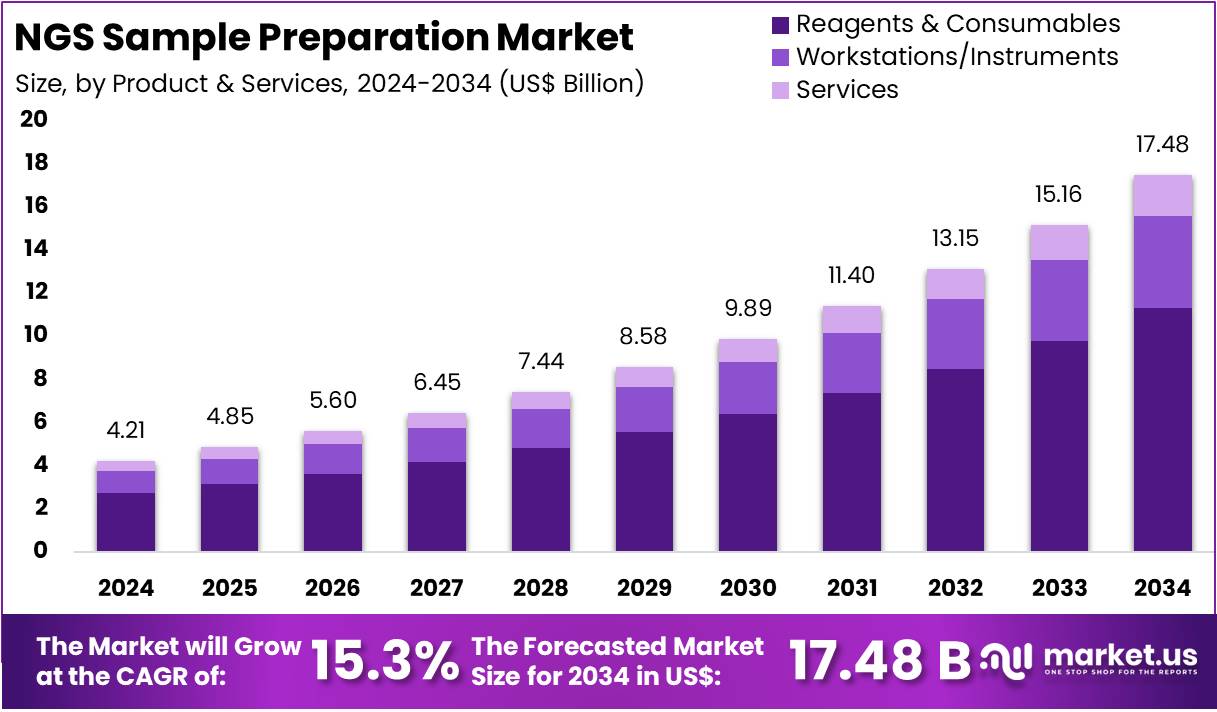
Key Takeaways
- The global NGS sample preparation market is projected to reach US$ 17.48 billion by 2034, expanding at a CAGR of 15.3% during the forecast period.
- In 2024, the Reagents & Consumables segment led the product & services category, accounting for more than 64.7% of the global market share.
- The DNA Fragmentation & Library Preparation segment dominated the workflow category in 2024, capturing over 55.6% of the market.
- By sample type, the DNA-based segment held the largest share in 2024, representing more than 69.7% of the total market.
- Within the method category, manual sample preparation remained the leading approach in 2024, securing a 32.9% market share.
- The diagnostics segment emerged as the leading application in 2024, contributing over 53.8% of the overall market.
- Among end users, hospitals and clinics accounted for the highest market share in 2024, representing 37.7% of the total.
- North America dominated the global market in 2024, capturing 41.5% of the market and reaching an estimated value of US$ 1.75 billion.
Statistical Information
- Rising Global Cancer Burden is Increasing Demand for NGS Sample Preparation: Cancer remains one of the largest drivers of genomic sequencing worldwide. According to the World Health Organization (WHO), there were nearly 20 million new cancer cases and 9.7 million cancer deaths globally in 2022. WHO projects that new cancer cases will exceed 35 million annually by 2050, representing a 77% increase compared with 2022. This increasing testing volume requires greater use of DNA/RNA extraction, library preparation, and sequencing-ready sample preparation kits.
- Large National Genomics Programs are Expanding Sample Processing Volumes: The U.S. NIH All of Us Research Program has enrolled more than 883,000 participants. NIH reports that researchers now have access to over 535,000 whole-genome sequences, 482,000 linked electronic health records, and more than 1.3 billion genetic variants. Every biospecimen collected requires standardized NGS sample preparation before sequencing.
- Genomic Research Includes Highly Diverse Patient Populations: NIH reports that 86% (over 645,000 participants) in the All of Us program come from communities historically underrepresented in biomedical research. Participants represent all 50 U.S. states and territories and cover more than 98% of U.S. three-digit ZIP codes, increasing the diversity of biospecimens processed for sequencing.
- Whole-Genome Sequencing Data Continues to Expand: The NIH dataset now includes nearly 9,000 RNA sequencing datasets, 14,500 long-read whole-genome sequences, and 96,000 structural variant records. The inclusion of multi-omics datasets increases the need for high-quality RNA extraction, DNA fragmentation, and library preparation technologies.
- DNA Sequencing Costs Have Fallen Dramatically: According to the National Human Genome Research Institute (NHGRI), the cost of sequencing one human genome has fallen from approximately US$95 million in 2001 to around US$600 or less using modern high-throughput sequencing technologies. Lower sequencing costs are increasing the number of laboratories adopting NGS, while shifting investment toward sample preparation reagents, consumables, and automation.
- Researchers Worldwide are Using the All of Us Dataset: More than 23,000 registered researchers have utilized the NIH All of Us dataset, producing over 1,400 peer-reviewed scientific publications. Growing research activity increases the processing of blood, saliva, and tissue samples that require standardized NGS sample preparation.
- NHS England Continues to Expand Clinical Genomics: The NHS Genomic Medicine Service performs approximately 680,000 genomic tests every year, with approximately 10% involving whole-genome sequencing for cancer and rare diseases. This expanding testing volume continues to increase the demand for automated extraction, fragmentation, and library preparation kits before sequencing.
- Large-Scale Whole Genome Sequencing is Becoming Routine: NIH’s initial All of Us genomic release contained nearly 100,000 whole-genome sequences, while program laboratories process approximately 5,000 participant samples every week, demonstrating the growing throughput requirements for automated sample preparation systems.
Regional Analysis
North America retained its dominant position in 2024, contributing 41.5% market share
In 2024, North America accounted for the largest share of the NGS sample preparation market, supported by strong investments in genomic research, clinical sequencing, and public health surveillance.
According to the U.S. Centers for Disease Control and Prevention (CDC), more than 1.46 million SARS-CoV-2 genome sequences had been incorporated into national genomic surveillance by January 2022, demonstrating the region’s large-scale sequencing capabilities.
The NIH All of Us Research Program has enrolled over 883,000 participants and provides researchers access to more than 535,000 whole-genome sequences, creating sustained demand for DNA extraction, library preparation, and quality control reagents.
Additionally, Medicare’s National Coverage Determination (NCD) for NGS testing in oncology has expanded reimbursement for eligible cancer patients, encouraging broader clinical adoption.
Canada has also strengthened regional capacity through the Canadian COVID-19 Genomics Network (CanCOGeN), backed by CA$40 million in federal funding, followed by an additional CA$53 million to enhance genomic surveillance. These government-supported initiatives continue to reinforce North America’s leadership in standardized and high-throughput NGS sample preparation workflows.
Emerging Trends
- Automation is becoming the standard in NGS laboratories: The U.S. CDC’s NGS Quality Initiative now provides more than 100 quality management documents, SOPs, and laboratory tools to improve workflow consistency. Automated sample preparation reduces manual errors while increasing throughput for clinical and public health sequencing laboratories.
- Large-scale genomic databases are increasing sample preparation volumes: The NIH All of Us Research Program now includes data from over 747,000 participants and more than 535,000 whole-genome sequences, driving demand for high-throughput DNA extraction, library preparation, and quality-control reagents across research laboratories.
- Lower sequencing costs are shifting investment toward upstream workflows: According to the CDC, modern NGS instruments can sequence over 8 billion DNA base pairs per day, compared with about 2.1 million base pairs using conventional sequencing, increasing the need for efficient sample preparation technologies.
- Quality management systems are becoming essential for clinical sequencing: The CDC and APHL are promoting standardized NGS quality systems based on 12 Quality System Essentials, helping laboratories improve sample preparation, validation, and reproducibility while supporting reliable genomic testing in healthcare and disease surveillance.
- Advanced library preparation is supporting precision medicine: The FDA highlights that optimized mRNA library preparation improves sequencing consistency and enables accurate transcript analysis for cancer research and personalized medicine, encouraging wider adoption of specialized sample preparation chemistries in clinical laboratories.
Use Cases
- Cancer genomics and precision oncology: WHO estimates 20 million new cancer cases occurred globally in 2022, with cases projected to exceed 35 million by 2050. Every sequencing workflow begins with high-quality DNA or RNA extraction and library preparation, making sample preparation essential for genomic cancer testing.
- Public health pathogen surveillance: CDC uses NGS for monitoring infectious diseases, antimicrobial resistance, and outbreak investigations. High-quality extraction and library preparation enable laboratories to rapidly sequence pathogens and generate accurate genomic data for disease surveillance and response.
- Population-scale genomics research: NIH’s All of Us program provides researchers access to more than 535,000 whole-genome sequences linked with 482,000 electronic health records, requiring standardized sample preparation workflows to process large numbers of biospecimens consistently.
- Clinical diagnostic testing: WHO guidance identifies sample preparation, library preparation, sequencing, and data analysis as the four major stages of NGS testing. Reliable extraction and library construction are critical for obtaining accurate diagnostic results in clinical laboratories.
- National biobank and biospecimen research: The CDC’s NHANES Biospecimen Program stores DNA, serum, plasma, and urine specimens for health research. These collections require standardized nucleic acid preparation workflows before genomic analysis, supporting studies in chronic disease, environmental health, and precision medicine.
Frequently Asked Questions on NGS Sample Preparation
- What factors are driving the growth of the NGS Sample Preparation Market?
Rising cancer incidence, expanding precision medicine, declining sequencing costs, and increasing genomic testing are key growth drivers. Government-supported genomics initiatives and growing adoption of next-generation sequencing in healthcare are further boosting demand for sample preparation products. - Why are reagents and consumables important in the NGS Sample Preparation Market?
Reagents and consumables are required for every sequencing workflow, including nucleic acid extraction, library preparation, amplification, and quality control. Their continuous use across research institutes, hospitals, and diagnostic laboratories makes them the largest product segment. - Which applications are driving demand for NGS sample preparation solutions?
Cancer diagnostics, rare disease testing, infectious disease surveillance, reproductive health screening, pharmacogenomics, and population genomics are major applications. The increasing use of whole-genome sequencing and liquid biopsy continues to expand the demand for advanced sample preparation technologies. - Why is automation becoming a major trend in NGS sample preparation?
Automated sample preparation reduces manual errors, improves reproducibility, increases laboratory throughput, and shortens turnaround time. It also enables laboratories to process large sample volumes efficiently while maintaining high sequencing quality and standardized workflows. - Which region dominates the NGS Sample Preparation Market?
North America holds the leading market position due to advanced healthcare infrastructure, extensive genomic research, favorable reimbursement policies, and government-funded sequencing programs. Continuous investments in precision medicine and public health genomics further strengthen regional market growth. - What are the key challenges in the NGS Sample Preparation Market?
High instrument costs, complex workflow validation, stringent regulatory requirements, and the need for skilled laboratory personnel remain key challenges. Laboratories also focus on reducing contamination risks while ensuring consistent sample quality for reliable sequencing outcomes. - How does NGS sample preparation support cancer research?
NGS sample preparation enables researchers to identify cancer-related genetic mutations by producing high-quality sequencing libraries. It supports precision oncology, biomarker discovery, treatment selection, and disease monitoring, helping clinicians deliver more personalized therapies for cancer patients. - How is NGS sample preparation used in infectious disease surveillance?
Public health laboratories use NGS sample preparation to process pathogen samples before sequencing. This enables rapid identification of viruses, bacteria, and emerging variants, supporting outbreak investigations, antimicrobial resistance monitoring, and national genomic surveillance programs.
Conclusion
The NGS sample preparation market is experiencing strong growth, driven by the expanding use of next-generation sequencing in cancer diagnostics, precision medicine, infectious disease surveillance, and genomic research. Rising global cancer incidence, increasing government-supported genomics programs, and declining sequencing costs are accelerating the adoption of advanced sample preparation technologies.
Continuous innovations in automation, library preparation, and quality control are improving laboratory efficiency and sequencing accuracy. Strong investments from organizations such as the NIH, CDC, WHO, NHS, and Health Canada are further supporting market expansion. As genomic testing becomes more integrated into routine healthcare, demand for reliable, standardized, and high-throughput NGS sample preparation solutions is expected to remain robust.
Discuss your needs with our analyst
Please share your requirements with more details so our analyst can check if they can solve your problem(s)




