


Overview
New York, NY – Aug 17, 2026 – The Global Neurological Biomarkers Market size is expected to be worth around US$ 29.84 Billion by 2034 from US$ 9.65 Billion in 2024, growing at a CAGR of 11.9% during the forecast period from 2025 to 2034. In 2024, North America led the market, achieving over 36.5% share with a revenue of US$ 3.52 Billion.
The global neurological biomarkers market is witnessing strong growth, driven by the increasing prevalence of neurological disorders, ageing populations, and expanding clinical research. Biomarkers are becoming essential tools for the early diagnosis, prognosis, treatment monitoring, and drug development of diseases such as Alzheimer’s disease, Parkinson’s disease, multiple sclerosis, stroke, and traumatic brain injury (TBI).
According to the World Health Organization (WHO), around 57 million people were living with dementia in 2021, with nearly 10 million new cases diagnosed each year. The number of dementia cases is projected to reach 78 million by 2030 and 139 million by 2050, highlighting the growing demand for reliable neurological biomarkers. The rising elderly population further supports market expansion. The OECD estimates that people aged 65 years and above will account for 27% of the population by 2050, compared with 18% in 2021, significantly increasing the risk of age-related neurological diseases.
Stroke and traumatic brain injuries also contribute to market demand. According to the U.S. CDC, more than 214,000 TBI-related hospitalizations occurred in 2020, while over 69,000 TBI-related deaths were reported in 2021. Regulatory support from agencies such as the U.S. FDA and the European Medicines Agency is accelerating biomarker validation and commercialization.
Additionally, the U.S. National Institute on Aging supported 495 Alzheimer’s disease and related dementia clinical trials by the end of FY2024, strengthening biomarker research and innovation.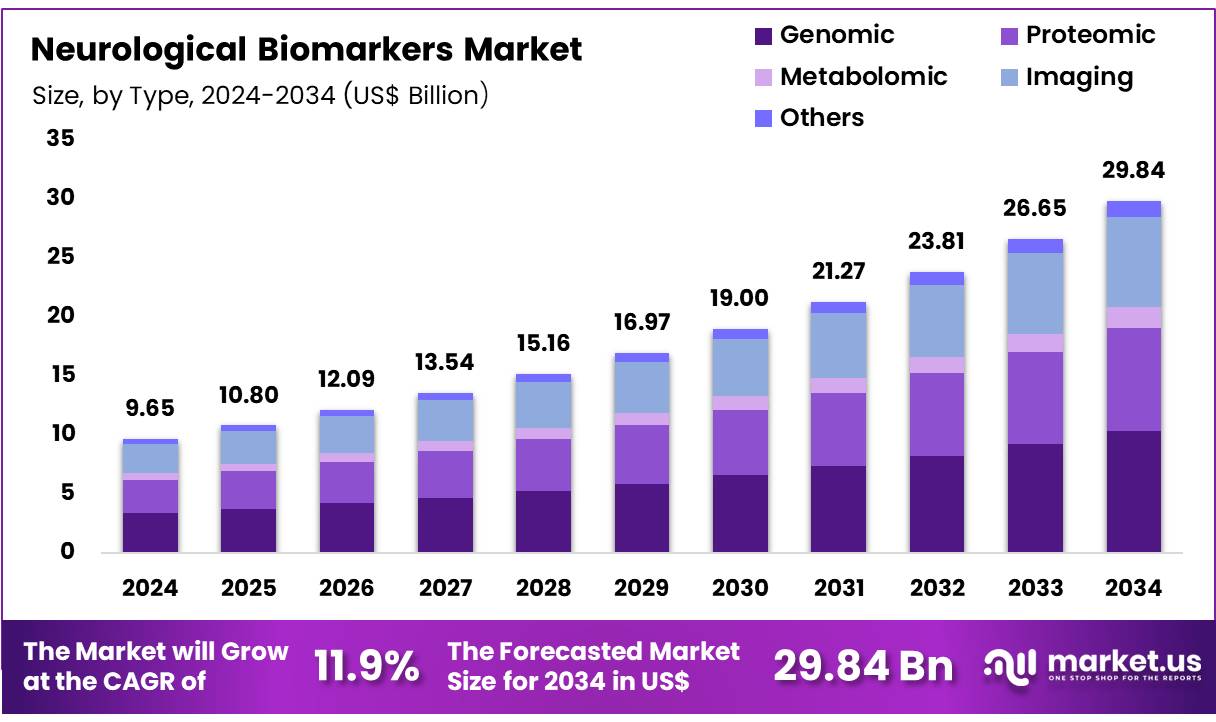
Key Takeaways
- Market Size: The global neurological biomarkers market is projected to grow from US$ 9.65 billion in 2024 to approximately US$ 29.84 billion by 2034.
- Market Growth: The market is anticipated to expand at a CAGR of 11.9% during the forecast period from 2025 to 2034.
- Type Analysis: The genomic biomarkers segment is expected to lead the market, accounting for 34.6% of the total market share.
- Application Analysis: The Alzheimer’s disease segment is projected to hold the largest share, representing 35.1% of the market in 2024.
- End-Use Analysis: Research organizations are expected to dominate the market in 2024, capturing a 40.8% share.
- Regional Analysis: North America led the market, achieving over a 3.52% share with a revenue of US$ 3.52 Billion.
Statistical Information
- Rising Global Burden of Dementia is Increasing the Need for Neurological Biomarkers: Neurological biomarkers are becoming increasingly important because dementia cases continue to rise globally. According to the World Health Organization (WHO), 57 million people were living with dementia in 2021, and nearly 10 million new cases are diagnosed every year. WHO also projects dementia cases will increase to 78 million by 2030 and 139 million by 2050. Alzheimer’s disease accounts for approximately 60–70% of all dementia cases, creating strong demand for blood, CSF, imaging, and genetic biomarkers for early diagnosis and disease monitoring.
- Ageing Population is Expanding the Neurological Disease Patient Pool: Population ageing remains one of the strongest long-term drivers for neurological biomarker adoption. OECD projects that people aged 65 years and older will increase from approximately 18% of the population in 2021 to around 27% by 2050 across OECD countries. Since age is the largest risk factor for Alzheimer’s disease and other neurodegenerative disorders, healthcare systems are increasingly investing in early diagnostic technologies and biomarker-based screening.
- Traumatic Brain Injury Creates Strong Demand for Objective Biomarkers: Traumatic brain injury (TBI) remains a major neurological health challenge. According to the U.S. Centers for Disease Control and Prevention (CDC), there were more than 214,000 TBI-related hospitalizations in 2020 and over 69,000 TBI-related deaths in 2021, averaging about 190 deaths every day. These figures support growing adoption of neurological biomarkers for emergency diagnosis, prognosis, and patient monitoring after brain injury.
- NIH Real-World Study Included More Than 1,200 Patients: An NIH-supported clinical study evaluated blood biomarkers in more than 1,200 patients, including 500+ participants from primary care clinics and nearly 700 from specialty memory clinics. The findings demonstrated that blood biomarker testing can accurately support Alzheimer’s diagnosis in real-world healthcare settings.
- Roche Reports That Around 75% of Dementia Cases Remain Undiagnosed Worldwide: According to Roche, approximately 75% of people living with dementia remain undiagnosed globally, while the average diagnostic journey takes about 3.5 years. Roche’s Elecsys pTau217 blood test aims to improve access to earlier diagnosis using a simple blood sample rather than invasive procedures.
- Blood Biomarkers are Used in Most Alzheimer’s Drug Trials: A 2025 peer-reviewed analysis of Alzheimer’s disease therapeutic clinical trials found that 84% of disease-targeted trials included at least one biomarker. Biomarkers were used in 91% of Phase II trials, 83% of Phase III trials, and 72% of Phase I trials, demonstrating their growing importance in neurological drug development.
- Midlife Study Evaluated 1,350 Adults for Alzheimer’s Blood Biomarkers: An NIH-funded CARDIA study analyzed blood samples from 1,350 adults aged in their 50s and 60s. Researchers found that 4% to 15% of participants had Alzheimer’s-related biomarker levels high enough to indicate amyloid plaques or tau tangles before dementia diagnosis, supporting earlier risk assessment.
- Blood Biomarker Test Achieved Up to 92% Diagnostic Accuracy: An NIH-supported study involving more than 1,200 patients found that the PrecivityAD2 blood test predicted Alzheimer’s disease with 88%–92% accuracy. In comparison, standard clinical evaluations achieved 73% accuracy in specialty memory clinics and 61% accuracy in primary care settings.
Regional Analysis
North America led the market, achieving over 3.52% share.
North America dominated the neurological biomarkers market in 2024, supported by its advanced healthcare infrastructure, strong research ecosystem, and rapid adoption of precision medicine. The United States remains the primary contributor due to significant investments by the National Institutes of Health (NIH) and widespread availability of specialized neurology centers. According to the NIH, more than 7.1 million Americans are currently living with Alzheimer’s disease, and this number is projected to exceed 13.9 million by 2060, increasing the demand for early diagnostic biomarkers.
NIH and the National Institute on Aging (NIA) continue to fund extensive biomarker research, including blood-based, imaging, and cerebrospinal fluid biomarkers for dementia and other neurological disorders. Additionally, the U.S. FDA has accelerated innovation by clearing the first blood-based Alzheimer’s diagnostic test, supporting broader clinical adoption.
Strong collaboration among academic institutions, biotechnology companies, and healthcare providers further strengthens biomarker validation and commercialization, reinforcing North America’s leadership in neurological biomarker research, clinical implementation, and market revenue generation.
Emerging Trends
- Rapid Adoption of Blood-Based Alzheimer’s Biomarkers: Blood-based biomarkers are replacing more invasive diagnostic methods such as PET scans and spinal fluid tests. In 2025, the U.S. FDA cleared the first blood test for Alzheimer’s diagnosis, while NIH reported that more than 7.1 million Americans are living with Alzheimer’s disease, increasing demand for accessible diagnostic tools.
- Growing Use of Biomarkers in Precision Medicine: Healthcare providers are increasingly using neurological biomarkers to personalize treatment decisions. NIH reported that at least 25 NIH-funded Alzheimer’s drug candidates had advanced to human clinical trials by March 2025, with biomarkers helping identify patients most likely to benefit from targeted therapies.
- AI and Digital Biomarkers are Supporting Earlier Detection: Researchers are combining artificial intelligence with electronic health records and biomarker data to identify undiagnosed dementia earlier. The NIH-developed eRADAR tool analyzes routine healthcare data to detect patients at risk, improving referrals for diagnosis and clinical trial enrollment.
- Next-Generation Biomarkers for Multiple Neurological Disorders: Research is expanding beyond Alzheimer’s disease to develop biomarkers for disorders such as frontotemporal dementia, Lewy body dementia, ALS, and vascular dementia. NIH is investing in next-generation blood and spinal fluid biomarkers to improve diagnosis before symptoms appear and support earlier intervention.
- Regulatory Support is Accelerating Biomarker Commercialization: The U.S. FDA continues to expand its Biomarker Qualification Program, encouraging companies to validate biomarkers for clinical use. Standardized regulatory pathways are reducing development uncertainty and improving confidence in biomarker-based diagnostics for neurological diseases.
Use Cases
- Early Diagnosis of Alzheimer’s Disease: Blood biomarkers such as p-tau217 and amyloid-beta are increasingly used to identify Alzheimer’s disease before severe symptoms develop. NIH reported that commercially available blood tests achieved 88%–92% diagnostic accuracy, making early diagnosis faster and less invasive than traditional methods.
- Selecting Patients for Clinical Trials: Neurological biomarkers help researchers identify suitable participants for Alzheimer’s clinical trials. According to NIH, PrecivityAD2 blood testing is already being used to screen patients for anti-amyloid therapy studies, improving trial efficiency and reducing recruitment time.
- Monitoring Disease Progression: Researchers use blood, cerebrospinal fluid, and imaging biomarkers to monitor cognitive decline and treatment response over time. NIH identified a new protein biomarker capable of tracking cognitive decline more accurately, supporting long-term management of Alzheimer’s disease.
- Supporting Clinical Decision-Making: Neurologists increasingly combine biomarker testing with cognitive assessments and imaging to improve diagnostic confidence. The FDA states biomarkers help evaluate disease severity, monitor treatment response, and improve the safety and effectiveness of new neurological therapies.
- Expanding Community-Based Dementia Care: Blood-based biomarker testing enables earlier diagnosis in primary care settings where PET imaging or spinal fluid testing may not be available. NIH estimates more than 13.9 million Americans could be living with Alzheimer’s disease by 2060, highlighting the importance of scalable biomarker testing for routine clinical care.
Frequently Asked Questions on Neurological Biomarkers
- Why are neurological biomarkers important?
Neurological biomarkers enable earlier and more accurate diagnosis, monitor disease progression, assess treatment effectiveness, and support personalized medicine. They also improve patient selection for clinical trials, helping researchers develop safer and more effective neurological therapies. - Which diseases commonly use neurological biomarkers?
Neurological biomarkers are widely used for Alzheimer’s disease, Parkinson’s disease, multiple sclerosis, amyotrophic lateral sclerosis (ALS), stroke, Huntington’s disease, traumatic brain injury, and other neurodegenerative or neurological disorders requiring accurate diagnosis and monitoring. - What types of neurological biomarkers are available?
Common neurological biomarkers include genomic, proteomic, metabolomic, imaging, and fluid biomarkers. Blood-based biomarkers, cerebrospinal fluid biomarkers, MRI, PET imaging, and genetic markers are increasingly used for diagnosis, prognosis, and treatment monitoring. - What factors are driving innovation in neurological biomarkers?
Innovation is driven by increasing neurological disease prevalence, advances in precision medicine, government research funding, AI-assisted biomarker discovery, expanding clinical trials, and growing demand for minimally invasive blood-based diagnostic technologies. - What is driving the neurological biomarkers market?
The market is driven by rising cases of Alzheimer’s disease, Parkinson’s disease, stroke, and other neurological disorders, increasing elderly populations, greater investment in neuroscience research, and expanding adoption of precision medicine and blood-based diagnostic technologies. - Which biomarker type leads the neurological biomarkers market?
Genomic biomarkers currently hold the largest market share because they support disease risk assessment, personalized treatment, targeted drug development, and precision medicine applications across neurological disease diagnosis and pharmaceutical research. - Which region dominates the neurological biomarkers market?
North America dominates the market due to advanced healthcare infrastructure, substantial government funding for neuroscience research, strong biotechnology and pharmaceutical industries, favorable regulatory support, and extensive clinical trial activities supporting biomarker development.
Conclusion
The neurological biomarkers market is poised for strong growth, supported by the rising prevalence of neurological disorders, increasing aging populations, and continuous advancements in precision medicine. Growing adoption of blood-based biomarkers, expanding clinical research, and favorable regulatory initiatives are improving early diagnosis and treatment monitoring for diseases such as Alzheimer’s and Parkinson’s.
Significant investments from government agencies, healthcare organizations, and biotechnology companies continue to accelerate biomarker discovery and commercialization. As healthcare systems increasingly emphasize personalized care and early intervention, neurological biomarkers are expected to play a critical role in improving patient outcomes, enhancing clinical trial efficiency, and driving innovation in neurological disease management worldwide.
Discuss your needs with our analyst
Please share your requirements with more details so our analyst can check if they can solve your problem(s)




