


Overview
New York, NY – Sep 08, 2026 – The Global Neuro Immunoassay Market size is expected to be worth around US$ 5.6 Billion by 2034 from US$ 2.8 Billion in 2024, growing at a CAGR of 7.2% during the forecast period 2025 to 2034. In 2024, North America led the market, achieving over 39.6% share with a revenue of US$ 1.1 Billion.
The Neuro Immunoassay Market is witnessing robust growth due to the rising global burden of neurological diseases and the increasing need for accurate biomarker-based diagnostics. Neuro immunoassays are widely used to detect proteins, antibodies, and biomarkers linked to disorders such as Alzheimer’s disease, Parkinson’s disease, multiple sclerosis, epilepsy, and autoimmune neurological conditions. These tests play a vital role in early diagnosis, treatment monitoring, and drug development.
According to the World Health Organization (WHO), neurological conditions affect more than 3 billion people worldwide and are responsible for approximately 11 million deaths each year, accounting for a significant share of global disability. Furthermore, Alzheimer’s Disease International estimates that over 55 million people are living with dementia globally, with nearly 10 million new cases diagnosed every year.
Continuous advancements in immunoassay technologies, including ELISA, chemiluminescent immunoassays (CLIA), multiplex immunoassays, and automated analyzers, are improving test sensitivity, specificity, and laboratory efficiency. Growing investments in neuroscience research are also driving innovation.
According to the U.S. National Institutes of Health (NIH), annual funding for neuroscience-related research exceeds US$ 10 billion, supporting biomarker discovery and next-generation diagnostic platforms. In addition, healthcare spending continues to rise globally, reaching approximately US$ 9.8 trillion, representing around 9.9% of global GDP, according to the WHO.
The Neuro Immunoassay Market generated US$ 4.1 billion in revenue in 2024 and is projected to reach US$ 8.9 billion by 2034, expanding at a CAGR of 8.1% during the forecast period. North America accounted for over 39% of global market revenue in 2024, supported by advanced diagnostic laboratories, favorable reimbursement policies, and strong R&D investments.
Meanwhile, the Asia-Pacific region is expected to register the fastest growth, driven by increasing neurological disease prevalence, expanding healthcare infrastructure, and rising adoption of advanced diagnostic technologies.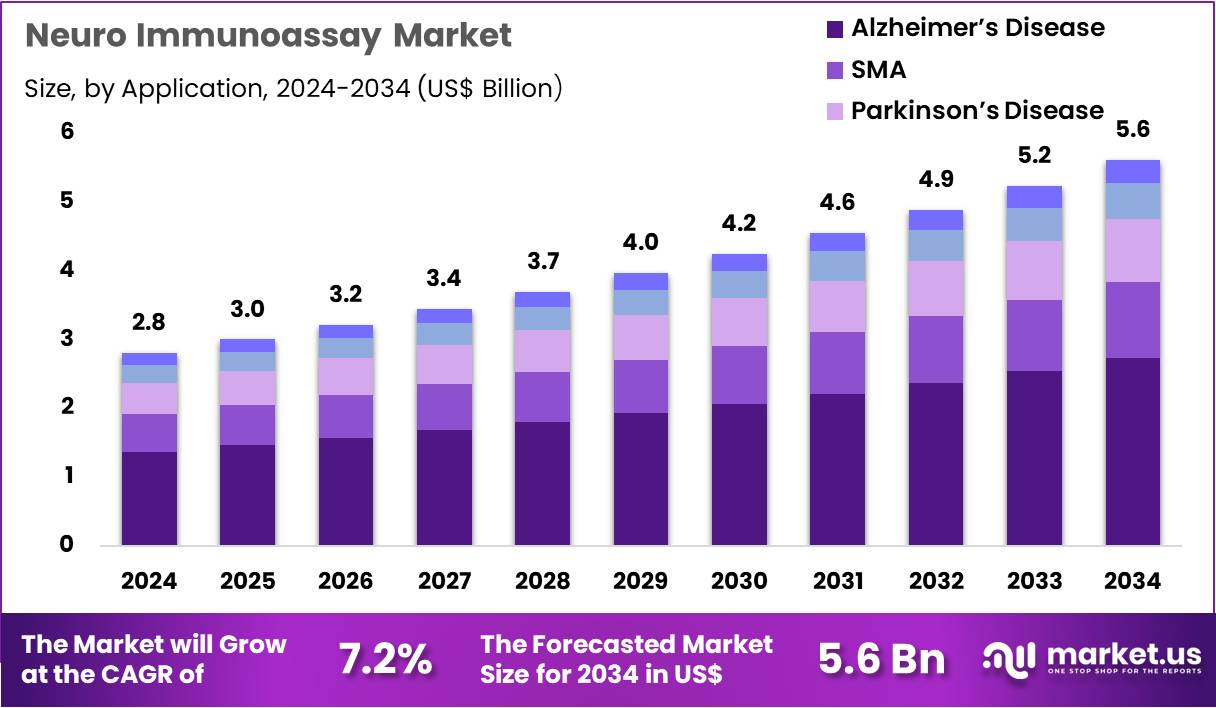
Key Takeaways
- In 2024, the Neuro Immunoassay Market was valued at US$ 2.8 billion and is projected to reach US$ 5.6 billion by 2034, growing at a CAGR of 7.2% during the forecast period.
- By product type, the market is segmented into reagents & kits and analysers. Among these, reagents & kits dominated the market in 2024, accounting for 59.4% of the total revenue share.
- Based on technology, the market includes ELISA, Western Blot, Rapid Tests, RIA, PCR, and ELISPOT. ELISA emerged as the leading technology, capturing 42.7% of the market share in 2024.
- In terms of application, the market is categorized into Alzheimer’s disease, SMA, Parkinson’s disease, Huntington’s disease, and ALS. The Alzheimer’s disease segment held the largest share, contributing 48.6% of the overall market revenue in 2024.
- By end user, the market is segmented into hospitals & clinics, pharmaceutical companies, biopharmaceutical companies, academic organizations, and others. Hospitals & clinics remained the largest end-user segment, representing 46.8% of the market revenue.
- North America dominated the global Neuro Immunoassay Market in 2024, holding the largest regional market share of 39.6%.
Statistical Information
- Global Burden of Neurological Disorders is Increasing: Neurological disorders have become one of the world’s largest health challenges. In 2021, approximately 3.4 billion people (43% of the global population) were living with a neurological condition. These disorders resulted in 11.1 million deaths and 443 million disability-adjusted life years (DALYs), making neurological diseases the leading cause of disability worldwide. This growing patient population continues to increase the demand for neuro immunoassay testing for early diagnosis and disease monitoring.
- Alzheimer’s Disease Represents the Largest Diagnostic Opportunity: According to the World Health Organization, around 57 million people were living with dementia worldwide in 2021, with nearly 10 million new cases every year. Alzheimer’s disease accounts for 60%–70% of all dementia cases, making it the largest application area for neuro immunoassays used to detect amyloid and tau biomarkers.
- U.S. Alzheimer’s Patient Population Continues to Grow: The National Institute on Aging (NIA) estimates that more than 6 million Americans aged 65 years and older are living with Alzheimer’s disease. The disease is currently the 7th leading cause of death in the United States, increasing demand for highly sensitive immunoassay-based diagnostic tests.
- Most Dementia Cases Remain Undiagnosed: WHO reports that only about 25% of people with dementia receive a diagnosis worldwide, meaning nearly 3 out of every 4 patients remain undiagnosed. This significant diagnostic gap is encouraging healthcare providers to adopt blood-based neuro immunoassays and other biomarker tests that enable earlier and more accessible diagnosis.
- Neurological Disorders Cause Massive Economic Burden: According to the WHO, dementia alone generated an estimated US$1.3 trillion in global economic costs in 2019. Approximately 50% of these costs were related to unpaid care provided by family members and caregivers, highlighting the importance of earlier diagnosis and disease management using advanced neuro immunoassays.
- Neurological Disease Burden Has Increased Significantly Since 1990: WHO reports that the overall burden of neurological disorders, measured in disability, illness, and premature death, has increased by 18% since 1990. Meanwhile, diabetic neuropathy cases have more than tripled, reaching approximately 206 million cases globally in 2021, demonstrating the growing need for neurological diagnostic testing.
- Neurological Disorders Are Responsible for More Than 11 Million Deaths Every Year: The WHO’s latest Global Status Report states that neurological disorders now affect more than 3 billion people and are responsible for over 11 million deaths annually. Despite this burden, fewer than one-third of countries have a national neurological health policy, creating opportunities for expanded diagnostic infrastructure.
- More Than 70% of Dementia Cases Are Alzheimer’s Disease: The World Health Organization states that Alzheimer’s disease accounts for 60%–70% of all dementia cases worldwide. With 57 million people living with dementia globally, an estimated 34–40 million individuals are affected by Alzheimer’s disease, creating significant demand for amyloid and tau immunoassays.
- CDC Reports Stroke Remains a Leading Cause of Disability: The U.S. Centers for Disease Control and Prevention (CDC) reports that approximately 795,000 people experience a stroke each year in the United States, with nearly 610,000 first-time strokes. Biomarker research is expanding to improve rapid neurological assessment and post-stroke management.
- Neurological Disorders Account for Nearly One in Five Global Deaths: The Global Burden of Disease study found that neurological disorders were responsible for approximately 11.1 million deaths in 2021, representing about 18% of all global deaths. This rising mortality emphasizes the importance of early diagnostic technologies, including neuro immunoassays.
Regional Analysis
North America led the market by securing a market share of 39.6% in 2024.
North America accounted for 39.6% of the global Neuro Immunoassay Market in 2024, driven by the growing burden of neurological diseases, advanced healthcare infrastructure, and widespread adoption of biomarker-based diagnostics.
According to the Alzheimer’s Association, nearly 7.2 million Americans aged 65 and older were living with Alzheimer’s disease in 2025, while the Centers for Disease Control and Prevention (CDC) reports approximately 795,000 stroke cases occur annually in the U.S. Rising demand for early diagnosis has increased the use of immunoassays for biomarkers such as phosphorylated tau (p-tau), amyloid-beta, neurofilament light chain (NfL), and GFAP.
Strong research funding from the U.S. National Institutes of Health (NIH) continues to accelerate biomarker discovery and diagnostic innovation. Meanwhile, Asia-Pacific is expected to register the fastest growth due to rapidly aging populations, increasing dementia prevalence, expanding diagnostic laboratories, government support for neurological care, and rising adoption of automated immunoassay technologies across major healthcare systems.
Emerging Trends
- Blood-Based Biomarkers Are Replacing Invasive Testing: Blood-based neuro immunoassays are gaining popularity because they are less invasive than cerebrospinal fluid (CSF) testing. The NIH is advancing blood tests for p-tau181, p-tau217, amyloid-beta, and neurofilament light chain (NfL) to support earlier diagnosis of Alzheimer’s and other neurodegenerative diseases, reducing dependence on lumbar punctures.
- Neurofilament Light Chain (NfL) Is Becoming a Key Biomarker: NfL has become one of the fastest-growing neurological biomarkers. An FDA-supported review identified 50 drug development programs using NfL between 2005 and 2024, with 94% using it as a pharmacodynamic biomarker and 52% for patient stratification in neurological clinical trials.
- Precision Medicine Is Increasing Demand for Multiplex Immunoassays: Hospitals and research centers are adopting multiplex immunoassays that measure several neurological biomarkers simultaneously, including GFAP, NfL, tau, and amyloid-beta. The FDA highlights biomarkers as essential tools for precision medicine, improving diagnosis, patient selection, and treatment monitoring.
- Ultra-Sensitive Immunoassays Are Expanding Clinical Applications: New high-sensitivity immunoassay platforms can detect neurological biomarkers in blood at extremely low concentrations. These technologies are enabling routine monitoring of diseases such as multiple sclerosis, Alzheimer’s disease, ALS, and Parkinson’s disease through simple blood samples instead of invasive procedures.
- Biomarkers Are Accelerating Neurology Drug Development: Regulatory agencies increasingly support biomarker use in clinical trials. FDA research shows biomarkers help improve patient selection, evaluate treatment response, and shorten clinical development timelines, increasing the use of neuro immunoassays in pharmaceutical and biotechnology research.
Use Cases
- Early Detection of Alzheimer’s Disease: Neuro immunoassays are widely used to measure p-tau181, p-tau217, and amyloid-beta biomarkers for early Alzheimer’s diagnosis. The WHO estimates 57 million people live with dementia worldwide, with 60–70% of cases caused by Alzheimer’s disease, increasing demand for biomarker-based testing.
- Monitoring Multiple Sclerosis Progression: Blood-based NfL immunoassays help neurologists monitor disease activity, evaluate treatment response, and predict relapse risk in multiple sclerosis patients. Recent studies show NfL correlates closely with neuroaxonal injury, making it valuable for long-term disease management.
- Supporting ALS Diagnosis and Clinical Trials: NIH-supported researchers identified blood protein biomarkers capable of predicting ALS symptom onset around 18 months before clinical symptoms appear. These neuro immunoassays are improving patient enrollment for preventive clinical trials and supporting earlier therapeutic intervention.
- Assessment of Traumatic Brain Injury (TBI): Immunoassays measuring GFAP and other neurological proteins are increasingly used to evaluate traumatic brain injury. FDA-authorized biomarker testing helps clinicians identify brain injury severity, reduce unnecessary imaging, and improve emergency department decision-making.
- Biomarker-Based Patient Selection in Clinical Research: Pharmaceutical companies and academic institutions use neuro immunoassays to identify appropriate participants for neurological clinical trials. FDA analysis found 26 of 50 NfL-based drug development programs used the biomarker for patient stratification, improving trial efficiency and treatment evaluation.
Frequently Asked Questions on Neuro Immunoassay
- How do Neuro Immunoassays work?
Neuro immunoassays use antigen-antibody reactions to measure specific neurological biomarkers in blood, cerebrospinal fluid (CSF), or other biological samples. Technologies such as ELISA, chemiluminescent immunoassays, and multiplex assays provide highly sensitive and accurate results for clinical decision-making. - Which biomarkers are commonly measured in Neuro Immunoassays?
Common neurological biomarkers include amyloid-beta, phosphorylated tau (p-tau181 and p-tau217), neurofilament light chain (NfL), glial fibrillary acidic protein (GFAP), alpha-synuclein, and various autoantibodies that help identify neurodegenerative and autoimmune disorders. - What technologies are used in Neuro Immunoassays?
The market uses technologies including ELISA, chemiluminescent immunoassays (CLIA), Western blot, radioimmunoassay (RIA), ELISPOT, PCR-based assays, and multiplex immunoassays. These platforms provide high sensitivity, automation, and faster turnaround times for neurological testing. - Which product segment dominates the Neuro Immunoassay Market?
Reagents and kits represent the largest product segment because they are consumed repeatedly during routine diagnostic testing and research. Their continuous demand across hospitals, diagnostic laboratories, and pharmaceutical companies supports strong market growth. - Which technology leads the Neuro Immunoassay Market?
ELISA remains the leading technology due to its high accuracy, cost-effectiveness, ease of use, and widespread adoption in clinical laboratories. It is extensively used for detecting neurological biomarkers in both research and routine diagnostic applications. - Which region is expected to grow the fastest?
Asia-Pacific is expected to witness the fastest growth due to rapidly aging populations, increasing neurological disease burden, expanding healthcare infrastructure, greater investment in diagnostic laboratories, and improving access to advanced neurological testing technologies. - What are the future opportunities in the Neuro Immunoassay Market?
Future opportunities include the commercialization of blood-based neurological biomarkers, development of multiplex and ultra-sensitive immunoassays, expansion of precision medicine, increasing clinical trial activity, and greater adoption of AI-supported diagnostic platforms for neurological disorders.
Conclusion
The Neuro Immunoassay Market is poised for steady growth as healthcare systems increasingly prioritize the early diagnosis and effective management of neurological disorders. Rising cases of Alzheimer’s disease, Parkinson’s disease, multiple sclerosis, and other neurodegenerative conditions are driving demand for accurate biomarker-based testing.
Continuous advancements in ELISA, chemiluminescent immunoassays, multiplex platforms, and blood-based biomarkers are improving diagnostic accuracy while supporting precision medicine. Strong government research funding, expanding clinical applications, and increasing adoption across hospitals, diagnostic laboratories, and pharmaceutical companies will continue to strengthen market growth, creating significant opportunities for innovation and improved neurological patient care worldwide.
Discuss your needs with our analyst
Please share your requirements with more details so our analyst can check if they can solve your problem(s)




