


Overview
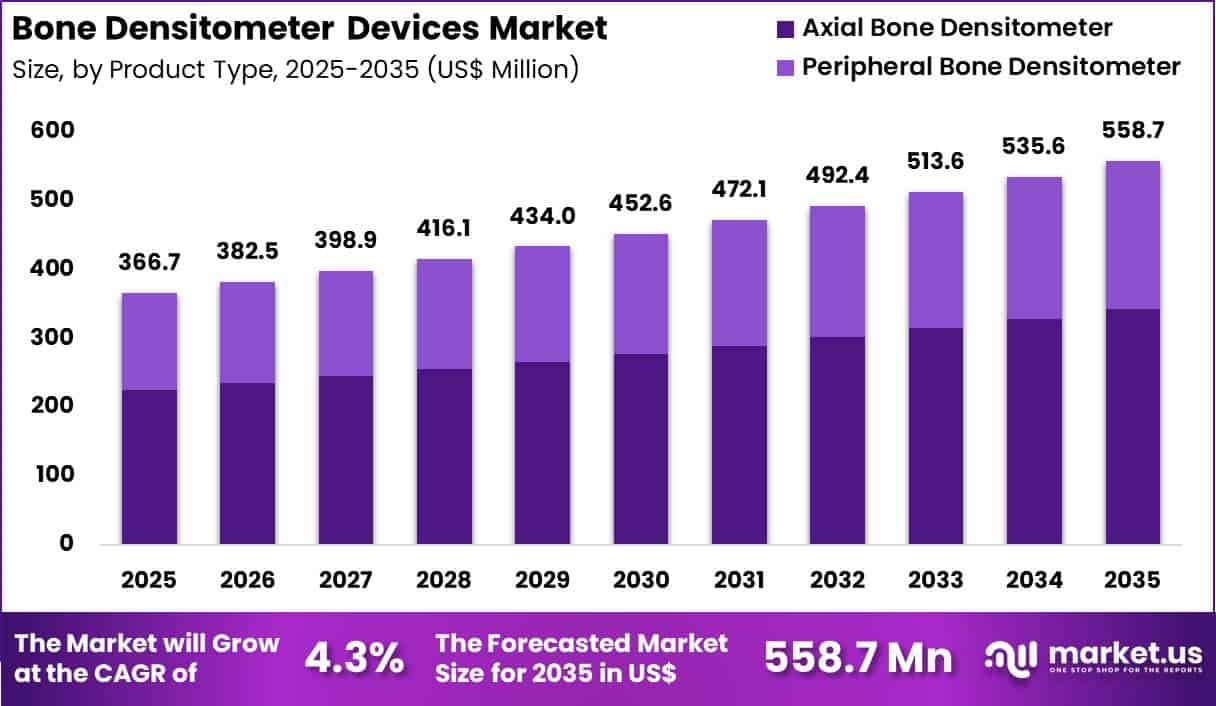
New York, NY – Nov 03 2026 – The Global Bone Densitometer Devices Market size is expected to be worth around US$ 558.7 Million by 2035 from US$ 366.7 Million in 2025, growing at a CAGR of 4.3% during the forecast period 2026-2035. In 2025, North America led the market, achieving over 36.3% share with a revenue of US$ 133.1 Million.
Bone densitometer devices are medical imaging systems used to measure bone mineral density (BMD) and assess bone strength. These devices play an important role in diagnosing osteoporosis, identifying low bone mass, and evaluating the risk of fractures.
Dual-energy X-ray absorptiometry (DXA or DEXA) is the most widely used technology for bone density measurement due to its accuracy, speed, and low radiation exposure. Other technologies include quantitative ultrasound (QUS) and quantitative computed tomography (QCT).
Bone densitometers are commonly used in hospitals, diagnostic imaging centers, specialty clinics, and research institutions. They help healthcare professionals detect bone loss at an early stage, monitor changes in bone density, and evaluate the effectiveness of osteoporosis treatments. The growing prevalence of osteoporosis, increasing geriatric population, and rising awareness of preventive bone health screening are supporting demand for these devices.
Technological advancements, including improved imaging quality, automated analysis, portable systems, and faster scanning procedures, are further improving clinical efficiency. Additionally, increasing healthcare investments and expanding access to diagnostic services are creating new opportunities for market growth. As the need for early osteoporosis detection and fracture risk assessment increases, bone densitometer devices are becoming an essential part of modern diagnostic healthcare.
Key Takeaways
- In 2025, the Bone Densitometer Devices Market recorded revenue of US$ 366.7 Million and is projected to reach US$ 558.7 Million by 2035, expanding at a CAGR of 4.3% during the forecast period.
- Based on product type, the market is segmented into axial bone densitometers and peripheral bone densitometers. The axial bone densitometer segment dominated the market with a 61.4% share.
- By technology, the market is categorized into dual-energy X-ray absorptiometry (DXA), absorptiometry (pDXA), peripheral dual-energy X-ray, quantitative ultrasound (QUS), and others. Among these, dual-energy X-ray absorptiometry (DXA) accounted for the largest share of 54.7%.
- Based on end users, the market is segmented into hospitals, diagnostic centers, and orthopedic clinics. The hospitals segment emerged as the leading end-user category, capturing a 52.8% revenue share.
- Regionally, North America dominated the Bone Densitometer Devices Market, accounting for a 36.3% market share.
Key Market Segments
- Product Type Analysis: The axial bone densitometer segment dominated the market with a 61.4% share, driven by its ability to measure bone mineral density at critical sites such as the hip and spine. Rising osteoporosis cases, increasing geriatric populations, and growing demand for accurate fracture risk assessment support segment growth.
- Technology Analysis: Dual-energy X-ray absorptiometry (DXA) dominated the technology segment with a 54.7% share, supported by its high accuracy, reliability, and low radiation exposure. Increasing osteoporosis screening, technological advancements, faster scanning procedures, and widespread clinical acceptance continue to strengthen DXA adoption across healthcare facilities.
- End-User Analysis: The hospitals segment dominated the end-user category with a 52.8% share, driven by advanced diagnostic infrastructure and high patient volumes. Rising osteoporosis cases, expanding geriatric care services, increasing preventive screening, and growing demand for accurate bone health assessment support the adoption of bone densitometer devices in hospitals.
Regional Analysis
North America is leading the Bone Densitometer Devices Market
North America held a 36.3% market share in 2024, driven by increasing osteoporosis screening and preventive healthcare initiatives. Growing adoption of dual-energy X-ray absorptiometry (DXA), rising awareness of bone health, and advanced healthcare infrastructure support regional growth. Hospitals and specialty clinics are upgrading imaging systems to improve diagnostic accuracy.
Reimbursement coverage in the US and Canada further improves access to bone density testing. According to the CDC, approximately 12.6% of US adults aged 50 and older had osteoporosis at the femur neck or lumbar spine in 2023, highlighting the need for early diagnosis.
Asia Pacific is expected to register the highest CAGR during the forecast period
Asia Pacific is projected to witness the fastest growth, supported by rapidly aging populations, increasing osteoporosis awareness, and expanding healthcare infrastructure. Government initiatives promoting early diagnosis and preventive screening are encouraging demand.
Rising healthcare investments and growing adoption of advanced diagnostic imaging technologies across countries such as China, Japan, and India are further strengthening regional market opportunities.
Emerging Trends
- Growing Adoption of Advanced DXA Technology: Dual-energy X-ray absorptiometry (DXA) systems are becoming increasingly important for measuring bone mineral density. Healthcare facilities are adopting advanced DXA equipment to improve bone assessment, identify osteoporosis, and support better treatment decisions. These systems commonly examine the hip and spine.
- Integration of Trabecular Bone Score Technology: Trabecular Bone Score (TBS) is gaining attention as an additional tool for evaluating bone quality. It uses information from lumbar spine DXA images to provide insights into bone structure, helping healthcare professionals improve fracture risk assessment beyond bone density measurements alone.
- Increasing Focus on Vertebral Fracture Assessment: Healthcare providers are showing greater interest in vertebral fracture assessment (VFA) through bone densitometry systems. This technology helps identify spinal fractures, including fractures that may not have been previously diagnosed, supporting improved osteoporosis evaluation and clinical management.
- Development of Specialized Pediatric Bone Assessment: Manufacturers and healthcare providers are focusing on bone densitometry applications for children and adolescents. DXA systems help assess bone development and identify low bone mineral density in young patients with conditions that may affect skeletal growth and strength.
- Growing Interest in Artificial Intelligence and Advanced Image Analysis: Artificial intelligence and improved image analysis are emerging areas in bone assessment. These technologies may help healthcare professionals interpret imaging information, improve measurement consistency, and support more efficient clinical workflows. AI-enhanced imaging is also receiving attention in professional densitometry research.
Use Cases
- Osteoporosis Diagnosis and Screening: Bone densitometer devices help doctors measure bone mineral density and identify people with weak or thinning bones. These systems are particularly useful for evaluating postmenopausal women, older adults, and individuals with risk factors associated with osteoporosis.
- Fracture Risk Assessment: Healthcare professionals use bone density measurements to evaluate the likelihood of fractures, particularly in the hip and spine. The results help doctors understand bone strength, assess patient risk, and make informed decisions about preventive care and treatment.
- Monitoring Osteoporosis Treatment: Bone densitometer devices are used to monitor changes in bone mineral density during osteoporosis treatment. Doctors compare follow-up scan results with earlier measurements to understand treatment response and determine whether further clinical evaluation or treatment adjustments are required.
- Bone Health Assessment in Children: DXA devices support bone health evaluations in children and adolescents who have conditions affecting normal skeletal development. They are used to assess bone mineral content and density, particularly in patients with chronic diseases or increased fracture risk.
- Clinical Research and Skeletal Health Studies: Research institutions use bone densitometer devices to study bone loss, mineral density changes, and skeletal health. These systems support clinical investigations involving osteoporosis, aging, metabolic bone disorders, and the effectiveness of different bone health interventions.
Frequently Asked Questions About Bone Densitometer Devices
- How do bone densitometer devices work?
Bone densitometer devices commonly use two different X-ray energy levels to measure mineral content in bones. The system calculates bone mineral density, helping doctors assess bone strength and identify possible bone loss. - What is DXA technology in bone densitometry?
DXA stands for dual-energy X-ray absorptiometry. It is a commonly used technology that measures bone mineral density, particularly in the hip and spine, to support osteoporosis diagnosis and fracture risk evaluation. - Who needs bone densitometry testing?
Bone densitometry testing is commonly recommended for older adults, postmenopausal women, and individuals with increased osteoporosis risk. Doctors may also recommend testing for patients with certain medical conditions or previous fragility fractures. - What are the major types of bone densitometer devices?
Major bone densitometer technologies include central DXA, peripheral DXA, quantitative computed tomography, and quantitative ultrasound. These technologies differ in measurement methods, scanning locations, clinical applications, and their suitability for specific bone health assessments. - What factors are driving the Bone Densitometer Devices Market?
The market is driven by increasing osteoporosis cases, an aging population, growing awareness of preventive healthcare, and rising demand for early fracture detection. Healthcare providers are also investing in advanced diagnostic imaging technologies. - Which technology dominates the Bone Densitometer Devices Market?
Dual-energy X-ray absorptiometry (DXA) is a leading technology in clinical bone density assessment. Its ability to measure bone mineral density at important skeletal sites makes it widely used for osteoporosis diagnosis and treatment monitoring. - Who are the major end users of bone densitometer devices?
Major end users include hospitals, diagnostic imaging centers, orthopedic clinics, endocrinology centers, and research institutions. These facilities use bone densitometry systems for osteoporosis screening, fracture risk assessment, treatment monitoring, and skeletal health research.
Conclusion
The Bone Densitometer Devices Market is expected to experience steady growth, increasing from US$ 366.7 Million in 2025 to US$ 558.7 Million by 2035, at a CAGR of 4.3%. Rising osteoporosis prevalence, an aging population, and growing awareness of preventive bone health screening are key growth drivers.
Axial bone densitometers, DXA technology, and hospitals remain the leading market segments. North America currently dominates the market, while Asia Pacific offers strong growth opportunities. Furthermore, advancements in imaging technology, AI-based analysis, and improved diagnostic capabilities are expected to strengthen market adoption and support long-term industry expansion.
Discuss your needs with our analyst
Please share your requirements with more details so our analyst can check if they can solve your problem(s)



