


Overview
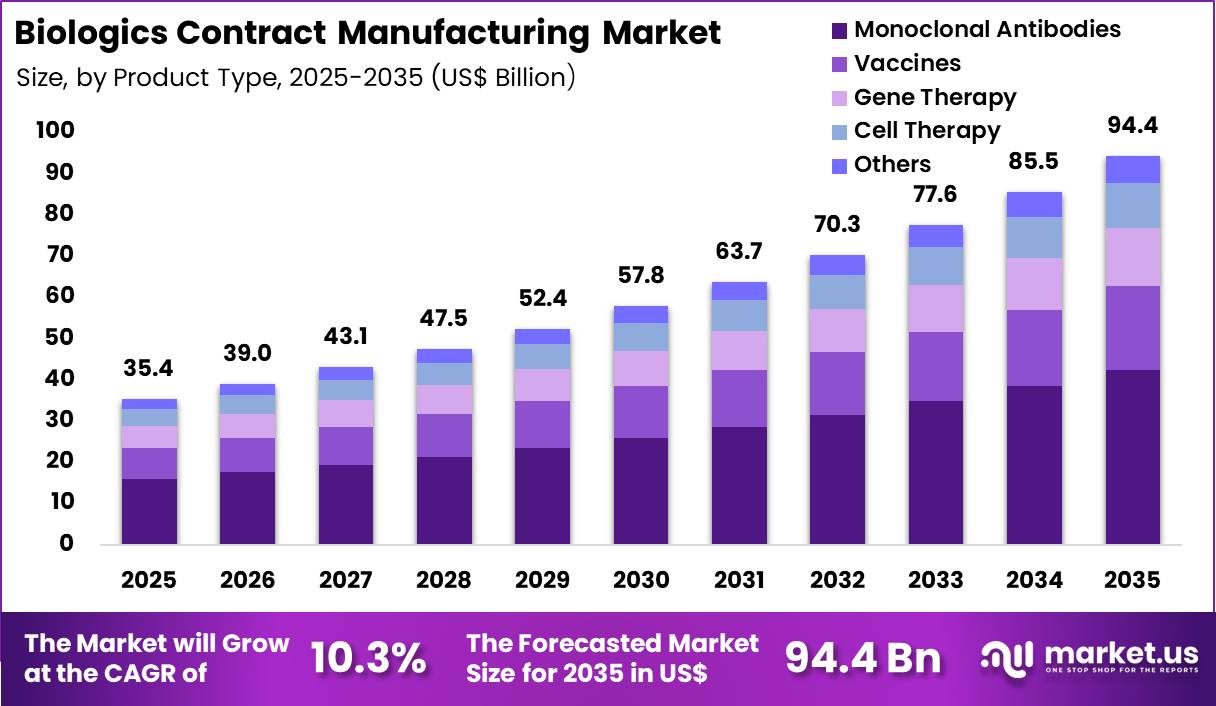
New York, NY – Nov 03 2026 – The Global Biologics Contract Manufacturing Market size is expected to be worth around US$ 94.4 Billion by 2035 from US$ 35.4 Billion in 2025, growing at a CAGR of 10.3% during the forecast period 2026-2035. In 2025, North America led the market, achieving over 36.7% share with a revenue of US$ 13.0 Billion.
Biologics Contract Manufacturing refers to outsourcing the development, production, testing, and packaging of biological medicines to specialized contract manufacturing organizations (CMOs) and contract development and manufacturing organizations (CDMOs). These services support pharmaceutical and biotechnology companies in manufacturing complex biologic products, including monoclonal antibodies, vaccines, recombinant proteins, cell and gene therapies, and other advanced biologics.
The market is gaining momentum due to the rising demand for targeted therapies, increasing prevalence of chronic diseases, and growing investments in biotechnology research. Pharmaceutical companies are increasingly partnering with contract manufacturers to reduce production costs, access advanced manufacturing technologies, and accelerate drug development timelines.
Technological advancements in single-use bioreactors, continuous bioprocessing, automation, and quality control systems are improving production efficiency and scalability. Additionally, growing demand for personalized medicines and biosimilars is creating new opportunities for contract manufacturing providers.
North America and Europe remain important markets due to their established pharmaceutical industries, advanced manufacturing infrastructure, and strong research capabilities. Meanwhile, Asia-Pacific is emerging as a promising region because of expanding biotechnology investments, lower manufacturing costs, and increasing pharmaceutical production capacity.
Overall, the Biologics Contract Manufacturing market is expected to experience steady growth as pharmaceutical companies continue to outsource complex biologics production and focus on innovation, research, and commercialization.
Key Takeaways
- In 2025, the Biologics Contract Manufacturing Market generated revenue of US$ 35.4 Billion and is projected to grow at a CAGR of 10.3%, reaching US$ 94.4 Billion by 2035.
- By product type, the market is segmented into monoclonal antibodies, vaccines, gene therapy, cell therapy, and others. Among these, monoclonal antibodies dominated with a 44.9% market share.
- Based on indication, the market is categorized into oncology, autoimmune diseases, cardiovascular diseases, infectious diseases, and others. Oncology accounted for the largest share at 46.3%.
- Regionally, North America dominated the Biologics Contract Manufacturing Market with a 36.7% market share.
Key Market Segments
- Product Type Analysis: Monoclonal antibodies dominated the biologics contract manufacturing market, accounting for 44.9% of the product type segment. Their strong presence in pharmaceutical pipelines drives outsourcing demand. Drug developers increasingly partner with contract manufacturers to access advanced bioreactor facilities, specialized production technologies, regulatory expertise, and scalable manufacturing capabilities for commercial biologics production.
- Indication Analysis: Oncology dominated the indication segment, capturing 46.3% of the biologics contract manufacturing market. Rising demand for targeted cancer treatments, monoclonal antibodies, antibody-drug conjugates, and immunotherapies supports segment growth. Expanding clinical trials, increasing cancer research investments, and the development of innovative biologic therapies further strengthen outsourcing demand for specialized manufacturing services.
Regional Analysis
North America is leading the Biologics Contract Manufacturing Market
North America held a 36.7% share of the Biologics Contract Manufacturing market in 2024, driven by strong outsourcing demand from pharmaceutical and biotechnology companies. Growing investments in monoclonal antibodies, cell and gene therapies, and recombinant proteins increased the need for specialized manufacturing facilities.
Advanced bioprocessing technologies, skilled professionals, established regulatory frameworks, and strategic industry partnerships further strengthened the region’s market position. Rising investments in single-use systems and continuous manufacturing also improved production efficiency and supply reliability.
Asia Pacific is expected to register the highest CAGR
Asia Pacific is projected to witness the fastest growth during the forecast period, supported by expanding biopharmaceutical manufacturing infrastructure in China, India, South Korea, and Singapore. Competitive production costs, government investments, skilled workforces, and growing biosimilar development are attracting international pharmaceutical companies.
Additionally, global partnerships, improved regulatory standards, and investments in advanced bioprocessing technologies are strengthening the region’s position as an emerging biologics manufacturing hub.
Emerging Trends
- Growing Demand for Single-Use Manufacturing Technologies: Biologics manufacturers are increasingly adopting single-use bioreactors, disposable tubing, and filtration systems. These technologies reduce cleaning requirements, lower contamination risks, and allow manufacturing facilities to switch between different biological products more easily.
- Expansion of Cell and Gene Therapy Manufacturing: Increasing development of advanced therapies is creating demand for specialized contract manufacturing facilities. CDMOs are investing in viral vector production, cell processing, and specialized quality testing to support the development and commercial production of these treatments.
- Increasing Adoption of Continuous Manufacturing: Manufacturers are exploring continuous processing technologies to improve production efficiency and maintain consistent product quality. These systems can reduce processing time, improve resource utilization, and support more flexible manufacturing operations compared with traditional batch production.
- Greater Focus on Manufacturing Automation and Digitalization: Contract manufacturers are adopting automated production systems, digital monitoring, and advanced data management tools. These technologies help monitor critical manufacturing conditions, reduce manual errors, improve batch consistency, and support regulatory documentation.
- Expansion of Biologics Manufacturing Capacity: CDMOs are expanding production facilities and upgrading existing infrastructure to meet increasing demand for monoclonal antibodies, recombinant proteins, and other biological medicines. Investments in large-scale bioreactors and specialized fill-and-finish facilities are strengthening manufacturing capabilities.
- Increasing Use of Advanced Analytical Testing: Contract manufacturing companies are strengthening analytical testing capabilities to evaluate product purity, potency, stability, and safety. Advanced testing methods help identify product variations and ensure that biological medicines meet established quality requirements before release.
Use Cases
- Monoclonal Antibody Production: Pharmaceutical companies use contract manufacturing services to produce monoclonal antibodies used in cancer treatment, autoimmune disease management, and inflammatory conditions. External manufacturers provide cell culture, purification, and formulation facilities to support production from clinical development through commercial supply.
- Vaccine Manufacturing: Vaccine developers partner with contract manufacturers for antigen production, formulation, filling, packaging, and quality testing. These partnerships help increase production capacity and support the supply of vaccines for infectious diseases, including influenza and other emerging public health threats.
- Recombinant Protein Production: Biotechnology companies outsource recombinant protein manufacturing to produce therapeutic proteins, enzymes, and hormones. Contract manufacturers provide specialized expression systems, fermentation equipment, purification technologies, and testing services to support consistent production for medical applications.
- Biosimilar Manufacturing: Companies developing biosimilars use contract manufacturing partners to support cell line development, process optimization, large-scale production, and analytical characterization. These services help manufacturers demonstrate product similarity and maintain consistent quality throughout development and commercial manufacturing.
- Cell and Gene Therapy Production: Contract manufacturers support the production of advanced therapies through cell processing, viral vector manufacturing, genetic modification, and specialized testing. These capabilities are important for developing treatments such as CAR-T cell therapies and other gene-based medicines.
Frequently Asked Questions About Biologics Contract Manufacturing
- What is biologics contract manufacturing?
Biologics contract manufacturing is a service in which pharmaceutical and biotechnology companies hire specialized external manufacturers to produce biological medicines. These services may include development, cell culture, purification, formulation, filling, packaging, and quality testing. - Why do pharmaceutical companies outsource biologics manufacturing?
Companies outsource biologics manufacturing to reduce infrastructure investments, access specialized production technologies, and improve manufacturing flexibility. External partners also provide technical expertise, qualified facilities, and production capacity without requiring companies to build their own facilities. - What products are manufactured through biologics contract manufacturing?
Contract manufacturers produce several biological products, including monoclonal antibodies, vaccines, recombinant proteins, biosimilars, hormones, and cell and gene therapies. These products are used in treating cancer, infectious diseases, autoimmune conditions, and other medical disorders. - What is the difference between a CMO and a CDMO?
A contract manufacturing organization (CMO) primarily provides manufacturing services, while a contract development and manufacturing organization (CDMO) also supports product and process development. CDMOs can assist companies from early development through commercial-scale production. - What role does quality control play in biologics manufacturing?
Quality control ensures that biological products meet required standards for purity, safety, potency, and consistency. Manufacturers conduct testing throughout production, including raw material inspection, process monitoring, contamination testing, and final product evaluation before release. - What is driving the growth of the biologics contract manufacturing market?
Market growth is driven by increasing demand for biological medicines, rising biotechnology research, growing outsourcing activities, and investments in advanced manufacturing facilities. Pharmaceutical companies increasingly depend on external partners for specialized production capabilities and cost-efficient operations. - What role do CDMOs play in the biologics contract manufacturing market?
CDMOs support biological drug development and production by providing process development, analytical testing, manufacturing, and packaging services. Their integrated capabilities help pharmaceutical companies move products from laboratory research and clinical trials toward commercial-scale manufacturing. - How does technology influence the biologics contract manufacturing market?
Advanced bioreactors, automation, single-use systems, and digital monitoring improve production efficiency and process control. These technologies help contract manufacturers manage complex biological processes, reduce contamination risks, improve consistency, and respond to changing customer requirements.
Conclusion
The Biologics Contract Manufacturing Market is poised for significant growth, driven by increasing demand for biological medicines, rising pharmaceutical outsourcing, and advancements in bioprocessing technologies. Valued at US$ 35.4 Billion in 2025, the market is projected to reach US$ 94.4 Billion by 2035, growing at a CAGR of 10.3%.
Monoclonal antibodies and oncology applications remain key growth segments, while North America maintains its leading position. Meanwhile, Asia Pacific offers strong expansion opportunities through increasing biotechnology investments and manufacturing capacity. Growing adoption of automation, single-use systems, and advanced therapies will further strengthen market growth.
Discuss your needs with our analyst
Please share your requirements with more details so our analyst can check if they can solve your problem(s)



