


Overview
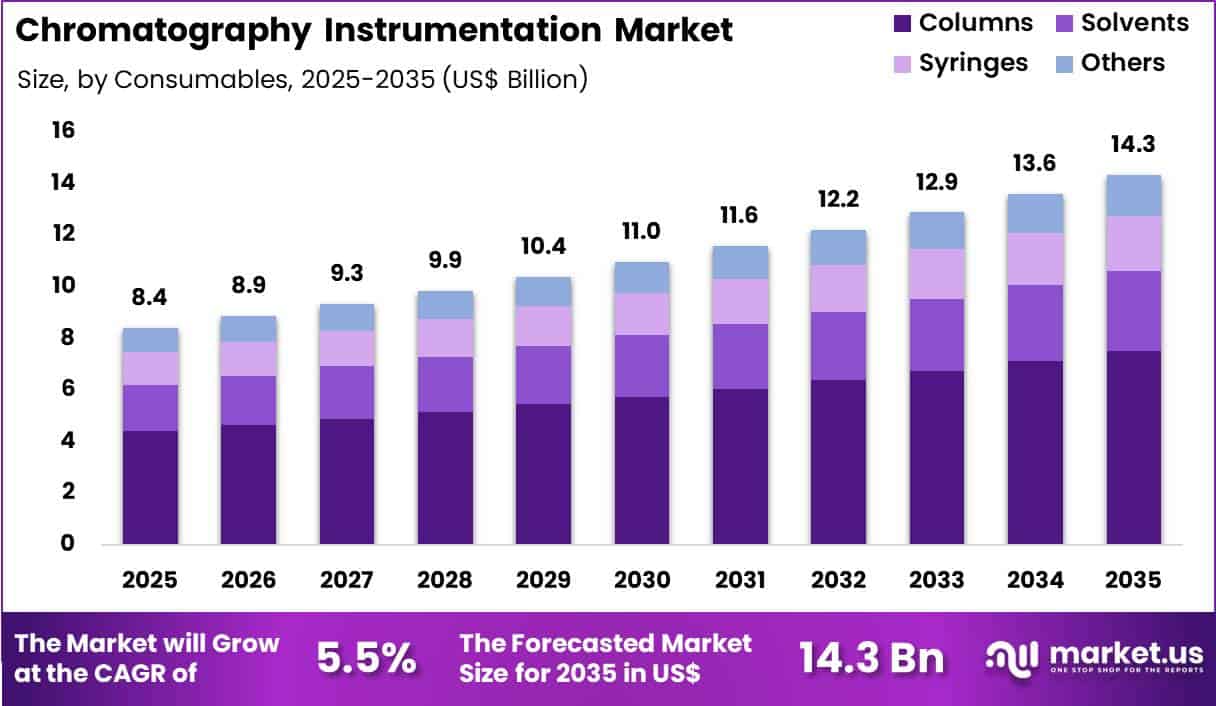
New York, NY – Nov 03 2026 – The Global Chromatography Instrumentation Market size is expected to be worth around US$ 14.3 Billion by 2035 from US$ 8.4 Billion in 2025, growing at a CAGR of 5.5% during the forecast period 2026-2035. In 2025, North America led the market, achieving over 41.1% share with a revenue of US$ 3.5 Billion.
Chromatography instrumentation refers to analytical instruments used to separate, identify, and measure individual components present in complex mixtures. These instruments play an important role in laboratories by supporting accurate chemical analysis, quality testing, and product development.
Common types include gas chromatography (GC), liquid chromatography (LC), high-performance liquid chromatography (HPLC), ultra-high-performance liquid chromatography (UHPLC), and ion chromatography systems.
The market is gaining momentum due to increasing demand for advanced analytical testing across pharmaceutical, biotechnology, food and beverage, environmental testing, and chemical industries.
Pharmaceutical companies widely use chromatography instruments for drug development, impurity detection, stability testing, and quality control. Similarly, food manufacturers rely on these systems to detect contaminants, additives, pesticides, and other unwanted substances.
Technological advancements, including automation, improved detection systems, enhanced sensitivity, and integration with advanced data analysis software, are supporting market development. Growing investments in research and development, stricter regulatory requirements, and increasing demand for reliable laboratory testing are further contributing to adoption.
Additionally, the expansion of pharmaceutical manufacturing, biotechnology research, and environmental monitoring is creating new growth opportunities. Overall, the chromatography instrumentation market is expected to witness steady growth as industries increasingly prioritize product safety, testing accuracy, and efficient analytical processes.
Key Takeaways
- In 2025, the Chromatography Instrumentation Market recorded revenue of US$ 8.4 Billion and is projected to reach US$ 14.3 Billion by 2035, expanding at a CAGR of 5.5% during the forecast period.
- By chromatography system, the market is segmented into liquid chromatography, thin-layer chromatography, gas chromatography, and supercritical fluid chromatography. Liquid chromatography dominated the segment with a 46.8% market share.
- Based on consumables, the market is categorized into columns, solvents, syringes, and others. Columns emerged as the leading segment, accounting for a 52.3% market share.
- By accessories, the market is divided into column accessories, pumps, auto-sampler accessories, and others. Column accessories held the largest share, contributing 38.6% of the total market revenue.
- In terms of application, the market covers pharmaceutical firms, agriculture, clinical research organizations, and environmental testing. Pharmaceutical firms dominated the segment with a 44.5% revenue share.
- Regionally, North America dominated the Chromatography Instrumentation Market, accounting for a leading 41.1% market share.
Key Market Segments
- Chromatography Systems Analysis: Liquid chromatography dominated the chromatography systems segment with a 46.8% market share, driven by its ability to separate complex chemical and biological compounds. Pharmaceutical companies widely use this technology for drug purity testing, impurity detection, and biomolecule analysis. Rising biologics research, advanced analytical requirements, and increasing adoption of high-performance systems continue to support segment growth.
- Consumables Analysis: Columns held the leading position in the consumables segment, accounting for a 52.3% market share. Their essential role in separating chemical compounds creates consistent demand across analytical laboratories. Pharmaceutical testing, research activities, and quality control procedures drive recurring purchases. Advancements in column materials and separation technologies further strengthen adoption across industries.
- Accessories Analysis: Column accessories dominated the accessories segment with a 38.6% market share, supported by their importance in maintaining chromatography system efficiency. Components such as guard columns, connectors, and fittings help improve separation reliability and protect analytical columns. Increasing laboratory automation, routine equipment maintenance, and growing demand for uninterrupted testing operations continue to drive segment expansion.
- Application Analysis: Pharmaceutical firms accounted for the largest application share of 44.5%, driven by increasing drug development activities and strict quality control requirements. Chromatography instruments support drug discovery, purity assessment, impurity profiling, and stability testing. Growing biopharmaceutical research, generic drug manufacturing, and regulatory compliance requirements further increase adoption across pharmaceutical production and research facilities.
Regional Analysis
North America is leading the Chromatography Instrumentation Market
North America accounted for a 41.1% share of the Chromatography Instrumentation market in 2024, driven by strong pharmaceutical R&D investments and growing demand for advanced analytical testing. Pharmaceutical companies increasingly adopted liquid and gas chromatography systems for drug development, purity testing, and quality control.
Expanding biologics research, regulatory requirements, and increasing use of advanced instruments across academic and contract research laboratories further supported regional growth. Additionally, the US FDA reported 55 novel drug approvals through its CDER program in 2023, highlighting strong pharmaceutical development activity.
Asia Pacific is expected to register the highest CAGR during the forecast period
Asia Pacific is projected to experience the fastest growth, supported by expanding pharmaceutical manufacturing and increasing investments in laboratory infrastructure. Countries such as India, China, and South Korea are strengthening generic and biosimilar production, increasing demand for chromatography testing.
Growing research activities, stricter drug safety regulations, and rising food and environmental testing requirements further support adoption. India’s strong position in global generic medicine supply also creates opportunities for chromatography instrumentation providers.
Emerging Trends
- Growing Adoption of Ultra-High-Performance Liquid Chromatography (UHPLC): Laboratories are increasingly adopting UHPLC systems to achieve faster separation, better resolution, and accurate analysis of complex samples. These instruments help pharmaceutical and biotechnology companies reduce testing time while improving laboratory productivity. The NIH’s NIEHS research facility uses UHPLC-based systems for advanced protein, lipid, and metabolite analysis.
- Increasing Integration of Chromatography with Mass Spectrometry: The combination of liquid chromatography and mass spectrometry (LC-MS) and gas chromatography and mass spectrometry (GC-MS) is gaining importance. These integrated systems help laboratories identify and measure very small amounts of chemical compounds, supporting drug research, biomarker identification, and contaminant detection.
- Rising Demand for Two-Dimensional Chromatography: Two-dimensional liquid chromatography (2D-LC) is emerging as an important technology for analyzing samples containing many closely related compounds. It uses two separation processes to improve compound identification and separation accuracy. This technology is particularly useful in pharmaceutical research, protein characterization, and complex biological sample analysis.
- Development of Miniaturized and Microfluidic Chromatography Systems: Instrument manufacturers and researchers are exploring smaller chromatography systems, including microfluidic and chip-based technologies. These systems aim to reduce sample and solvent consumption while supporting compact laboratory designs. Such developments may improve testing flexibility and make advanced analytical techniques more accessible.
- Increasing Focus on Automated Testing and Data Reliability: Laboratories are placing greater emphasis on automated sample analysis, instrument calibration, electronic data management, and reliable analytical results. Pharmaceutical quality control requirements are encouraging laboratories to maintain accurate chromatograms, validated methods, and properly documented instrument performance.
Use Cases
- Pharmaceutical Quality Control and Drug Development: Chromatography instruments are widely used by pharmaceutical companies to check the purity, strength, and quality of medicines. HPLC and GC systems help identify impurities, measure active pharmaceutical ingredients, and monitor drug stability during development and commercial manufacturing.
- Protein and Metabolite Analysis in Healthcare Research: Research laboratories use chromatography combined with mass spectrometry to separate and measure proteins, peptides, amino acids, and metabolites. These techniques support biological research, biomarker identification, metabolic studies, and investigations into disease-related biochemical changes.
- Environmental Pollution Monitoring: Environmental laboratories use GC-MS and LC-MS instruments to detect chemical pollutants in water, soil, and air samples. These systems help identify volatile organic compounds, industrial chemicals, and other contaminants, supporting environmental assessment and pollution control activities.
- Food Safety and Quality Testing: Food testing laboratories use chromatography instruments to identify chemical residues, unwanted substances, and compounds responsible for food flavor and aroma. GC-MS and liquid chromatography techniques support food quality assessment, contamination screening, and the identification of chemical components in different food products.
- Forensic and Toxicological Investigations: Forensic laboratories use chromatography instruments to identify drugs, toxic substances, and chemical residues in biological and physical samples. GC-MS helps analyze volatile and semi-volatile compounds, supporting forensic investigations, toxicology testing, and the examination of chemical evidence.
Frequently Asked Questions About Chromatography Instrumentation
- What are the main types of chromatography instruments?
The main types include high-performance liquid chromatography (HPLC), gas chromatography (GC), ultra-high-performance liquid chromatography (UHPLC), ion chromatography, and supercritical fluid chromatography. Each instrument uses different separation methods depending on sample properties and analytical requirements. - How does chromatography instrumentation work?
Chromatography instruments separate compounds based on their interactions with a stationary phase and a mobile phase. Different compounds move at different speeds through the system, allowing detectors to identify and measure individual components within samples. - Which industries commonly use chromatography instrumentation?
Pharmaceuticals, biotechnology, healthcare, food and beverages, environmental testing, chemicals, and forensic science are major users. These industries depend on chromatography systems for compound identification, impurity detection, product quality assessment, and research activities. - Why is HPLC important in pharmaceutical manufacturing?
HPLC helps pharmaceutical manufacturers measure active ingredients, identify impurities, and evaluate medicine purity. It supports quality control, stability testing, and regulatory compliance by providing reliable analytical results throughout drug development and commercial production. - Which technologies are creating new opportunities in the Chromatography Instrumentation Market?
UHPLC, two-dimensional liquid chromatography, LC-MS, GC-MS, and microfluidic chromatography are creating new opportunities. These technologies improve separation efficiency, detection capabilities, sample analysis, and laboratory productivity across pharmaceutical and scientific research applications. - How is pharmaceutical research influencing the Chromatography Instrumentation Market?
Growing pharmaceutical research is increasing the need for advanced analytical instruments to evaluate drug purity, identify impurities, measure active ingredients, and monitor product stability. These requirements support chromatography adoption throughout drug discovery and manufacturing. - How is automation influencing the Chromatography Instrumentation Market?
Automation is improving laboratory efficiency through automated sample injection, controlled instrument operations, and electronic data collection. These capabilities help laboratories reduce manual work, maintain consistent testing procedures, improve productivity, and support reliable analytical results. - What is the future outlook for the Chromatography Instrumentation Market?
The market is expected to benefit from continued pharmaceutical innovation, increasing analytical testing requirements, advanced detection technologies, and expanding biological research. Improvements in instrument speed, sensitivity, automation, and miniaturization are likely to create further opportunities.
Conclusion
The Chromatography Instrumentation Market is poised for steady growth, driven by increasing demand for accurate analytical testing across pharmaceutical, biotechnology, food, and environmental industries. The market, valued at US$ 8.4 Billion in 2025, is projected to reach US$ 14.3 Billion by 2035, growing at a CAGR of 5.5%.
Liquid chromatography, columns, and pharmaceutical applications remain key growth contributors. Technological advancements in UHPLC, mass spectrometry integration, automation, and miniaturization are further strengthening market potential. Additionally, expanding pharmaceutical manufacturing, rising research investments, and stricter quality standards will create new opportunities for market growth worldwide.
Discuss your needs with our analyst
Please share your requirements with more details so our analyst can check if they can solve your problem(s)



