
Overview
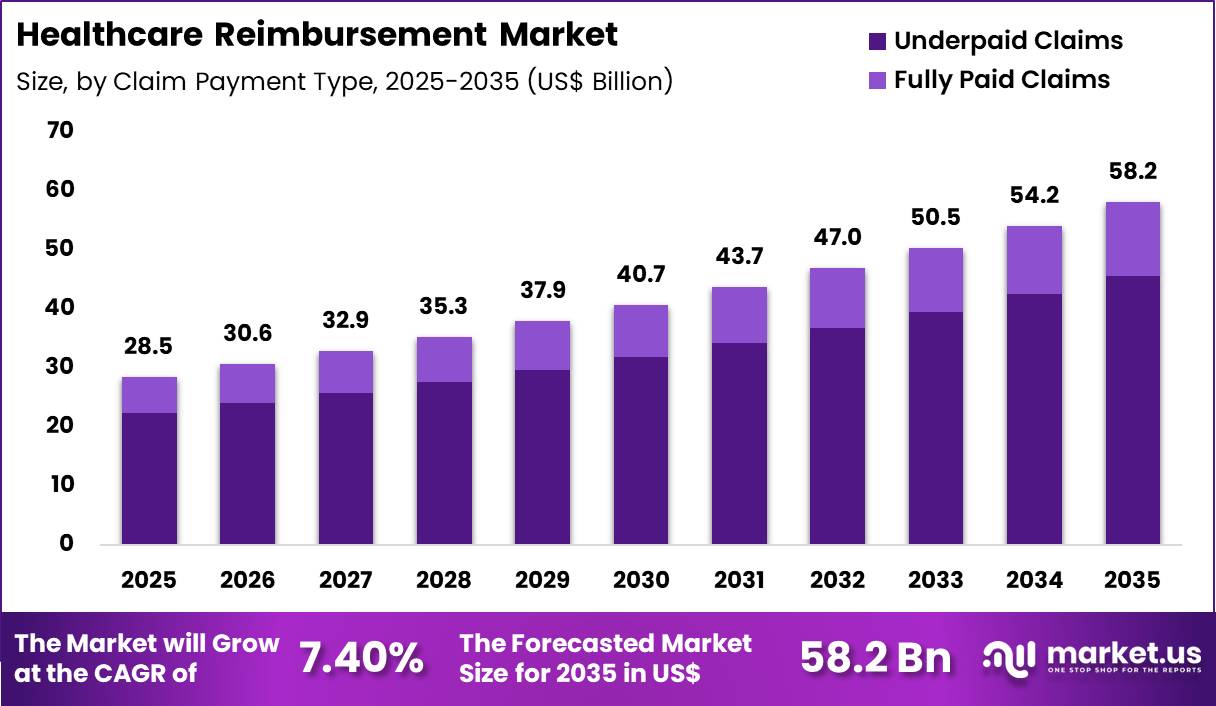
New York, NY – Nov 03 2026 – The Global Healthcare Reimbursement Market size is expected to be worth around US$ 58.2 Billion by 2035 from US$ 28.5 Billion in 2025, growing at a CAGR of 7.40% during the forecast period 2026-2035. In 2025, North America led the market, achieving over 43.1% share with a revenue of US$ 12.3 Billion.
Healthcare reimbursement refers to the process through which healthcare providers, hospitals, clinics, and other medical facilities receive payments for the healthcare services they provide to patients. These payments are generally made by government healthcare programs, private health insurance companies, or patients through out-of-pocket expenses. The reimbursement process covers various medical services, including hospital admissions, diagnostic tests, surgical procedures, consultations, prescription medications, and preventive care.
Healthcare reimbursement plays an important role in maintaining the financial stability of healthcare providers while ensuring patients can access necessary medical treatments. Common reimbursement models include fee-for-service, bundled payments, capitation, and value-based care. These models determine how healthcare providers are compensated based on services delivered, patient outcomes, or agreed payment arrangements.
The healthcare reimbursement landscape is evolving due to rising healthcare expenditures, increasing insurance coverage, growing demand for quality healthcare services, and changes in government healthcare policies. Additionally, digital claims processing, automated billing systems, and advanced healthcare information technology are improving payment accuracy and reducing administrative workloads.
As healthcare systems focus on cost control, transparency, and better patient outcomes, efficient reimbursement solutions are becoming increasingly important. These developments are supporting the adoption of modern reimbursement platforms and creating new opportunities across the global healthcare reimbursement market.
Key Takeaways
- In 2025, the Healthcare Reimbursement Market generated US$ 28.5 Billion in revenue and is projected to reach US$ 58.2 Billion by 2035, expanding at a CAGR of 7.40% during the forecast period.
- Based on claim payment type, the market is segmented into underpaid claims and fully paid claims. Underpaid claims dominated the segment, accounting for a 78.4% market share.
- By reimbursement model, the market is categorized into fee-for-service, capitation, global reimbursement, bundled/episode-based, and cost-based models. Among these, the public payer segment accounted for a significant 54.1% share.
- Based on provider type, the market is segmented into hospitals, physician offices/clinics, diagnostic laboratories, and specialty centers. The fee-for-service model emerged as the leading segment, capturing 46.3% of the market revenue.
- By payer type, the market is divided into public and private payers. The hospitals segment dominated the market, accounting for a revenue share of 47.0%.
- Regionally, North America dominated the Healthcare Reimbursement Market, securing a leading market share of 43.1%.
Key Market Segments
- Claim Payment Type Analysis: Underpaid claims dominated the claim payment type segment, accounting for 78.4% of the market share. Rising billing complexity, coding errors, and differences in payer policies contribute to reimbursement shortfalls. Healthcare providers increasingly adopt claim auditing tools, analytics platforms, and denial management services to identify payment gaps and improve revenue recovery.
- Reimbursement Model Analysis: Public payers held a significant 54.1% share of the healthcare reimbursement market. Their dominance is supported by extensive government-funded healthcare programs, large beneficiary populations, and standardized payment structures. Growing public insurance coverage, policy updates, and digital claims processing systems further strengthen reimbursement activities across hospitals, clinics, and other healthcare facilities.
- Provider Analysis: Fee-for-service emerged as the leading reimbursement model, capturing 46.3% of the market share. Its growth is driven by established billing practices and direct payments for individual medical services. Hospitals, clinics, and specialty providers continue using this model because of its straightforward payment structure, service-based compensation, and compatibility with existing billing systems.
- Payer Analysis: Hospitals dominated the provider segment, accounting for 47.0% of the healthcare reimbursement market. Their leading position reflects high patient volumes, complex medical procedures, inpatient admissions, and emergency care services. Increasing investments in revenue cycle management, automated billing platforms, and claims processing solutions further support hospital reimbursement activities and financial management.
Regional Analysis
North America is leading the Healthcare Reimbursement Market
North America dominated the Healthcare Reimbursement Market with a 43.1% share in 2024, driven by expanding insurance coverage, rising healthcare spending, and advanced claims processing systems. Increasing demand for chronic disease management, specialty drugs, and outpatient procedures boosted reimbursement activities across public and private insurance programs.
Digital billing platforms, value-based care models, and regulatory compliance requirements further strengthened market adoption. According to CMS, U.S. national health expenditures reached US$ 4.5 trillion in 2022, highlighting the region’s substantial healthcare spending.
Asia Pacific is expected to register the highest CAGR
Asia Pacific is projected to experience the highest CAGR during the forecast period, supported by expanding universal health coverage, insurance reforms, and healthcare digitalization. Growing hospital networks, rising private insurance enrollment, and electronic billing solutions are increasing reimbursement activities.
According to China’s National Healthcare Security Administration, medical insurance coverage exceeded 1.3 billion people in 2023, demonstrating the region’s significant healthcare reimbursement potential.
Emerging Trends
- Growth of Digital Claims Processing: Healthcare providers and insurance companies are increasingly using digital platforms to submit, review, and process claims. Automation reduces paperwork, minimizes manual errors, and helps hospitals receive payments faster.
- Increasing Adoption of Value-Based Reimbursement: Healthcare reimbursement is gradually shifting from paying providers for every service to rewarding better patient outcomes. This approach encourages hospitals and physicians to focus on treatment quality, preventive care, and cost efficiency.
- Integration of Artificial Intelligence in Claims Management: Insurance companies are adopting AI and automation to identify incorrect claims, detect unusual billing patterns, and speed up claim reviews. These technologies help reduce administrative workloads and improve payment accuracy.
- Expansion of Healthcare Data Interoperability: Healthcare organizations are adopting standardized digital systems to exchange patient and insurance information. Better data sharing helps providers verify coverage, submit accurate claims, and reduce delays caused by missing documentation.
- Growing Focus on Prior Authorization Automation: Health insurers are improving electronic prior authorization systems to simplify approval processes before treatments and procedures. Automated information exchange helps providers understand coverage requirements and reduces delays in patient care.
- Greater Use of Electronic Funds Transfer: Hospitals and healthcare providers are increasingly adopting electronic funds transfer (EFT) and electronic remittance advice (ERA). These systems simplify payment reconciliation, reduce manual banking work, and improve visibility into reimbursement transactions.
Use Cases
- Hospital and Clinic Billing: Hospitals use reimbursement systems to prepare patient bills, submit insurance claims, track approvals, and receive payments. These platforms help billing departments manage large claim volumes and reduce errors in payment records.
- Medicare and Medicaid Claims Management: Government healthcare programs use reimbursement processes to pay eligible hospitals, physicians, and other providers for covered medical services. These systems support claim verification, payment calculation, and monitoring of healthcare spending.
- Pharmacy and Prescription Reimbursement: Pharmacies use reimbursement platforms to submit prescription claims to insurance providers and pharmacy benefit managers. These systems verify patient coverage, check medication benefits, and calculate the amount payable by insurers and patients.
- Outpatient and Diagnostic Service Payments: Diagnostic laboratories, imaging centers, and outpatient facilities use reimbursement systems to bill insurers for tests and procedures. Accurate coding and electronic claim submission help these organizations receive payments and manage service-related expenses.
- Value-Based Care Payment Management: Healthcare providers use reimbursement platforms to track quality measures, patient outcomes, and healthcare costs under value-based contracts. These systems help organizations calculate performance-based payments and monitor whether care delivery meets payer requirements.
Frequently Asked Questions About Healthcare Reimbursement
- How does the healthcare reimbursement process work?
The reimbursement process begins when a healthcare provider submits a claim to an insurer or government payer. The payer checks patient eligibility, medical records, billing codes, and coverage rules before approving or denying payment. - What are the main types of healthcare reimbursement?
The major types include fee-for-service, value-based reimbursement, bundled payments, capitation, and prospective payment systems. Each method uses different payment arrangements to compensate healthcare providers for medical services, patient outcomes, or defined care periods. - What factors influence healthcare reimbursement rates?
Reimbursement rates depend on treatment complexity, medical service type, provider contracts, geographic location, insurance coverage, billing codes, and government payment policies. Changes in healthcare regulations and treatment costs can also affect provider payments. - Why are healthcare reimbursement claims denied?
Claims may be denied because of incorrect medical codes, missing documentation, expired insurance coverage, duplicate submissions, or services that are not covered. Providers can review denial reasons, correct errors, and submit appeals when appropriate. - What is driving the growth of the healthcare reimbursement market?
Market growth is supported by rising healthcare expenditure, increasing insurance coverage, growing patient volumes, and demand for efficient claims processing. Digital healthcare adoption and government initiatives to improve payment transparency are also supporting market expansion. - Which organizations are the major end users of healthcare reimbursement solutions?
Hospitals, specialty clinics, diagnostic laboratories, pharmacies, ambulatory surgical centers, and physician practices are major end users. These organizations use reimbursement solutions to manage insurance claims, verify coverage, track payments, and improve revenue collection. - How is digital transformation changing the healthcare reimbursement market?
Digital transformation is improving reimbursement through electronic claims, automated billing, cloud platforms, and real-time data exchange. These technologies help healthcare organizations reduce administrative costs, improve payment accuracy, and manage insurance transactions more efficiently.
Conclusion
The global Healthcare Reimbursement Market is witnessing steady growth, driven by rising healthcare expenditures, expanding insurance coverage, and increasing demand for efficient claims management. Valued at US$ 28.5 Billion in 2025, the market is projected to reach US$ 58.2 Billion by 2035, growing at a CAGR of 7.40%.
Growing adoption of digital claims processing, AI-based automation, and value-based payment models is transforming reimbursement operations. North America continues to lead the market, while Asia Pacific offers significant growth opportunities. Increasing focus on payment accuracy, cost control, and improved patient outcomes will further support market expansion.
Discuss your needs with our analyst
Please share your requirements with more details so our analyst can check if they can solve your problem(s)