


Overview
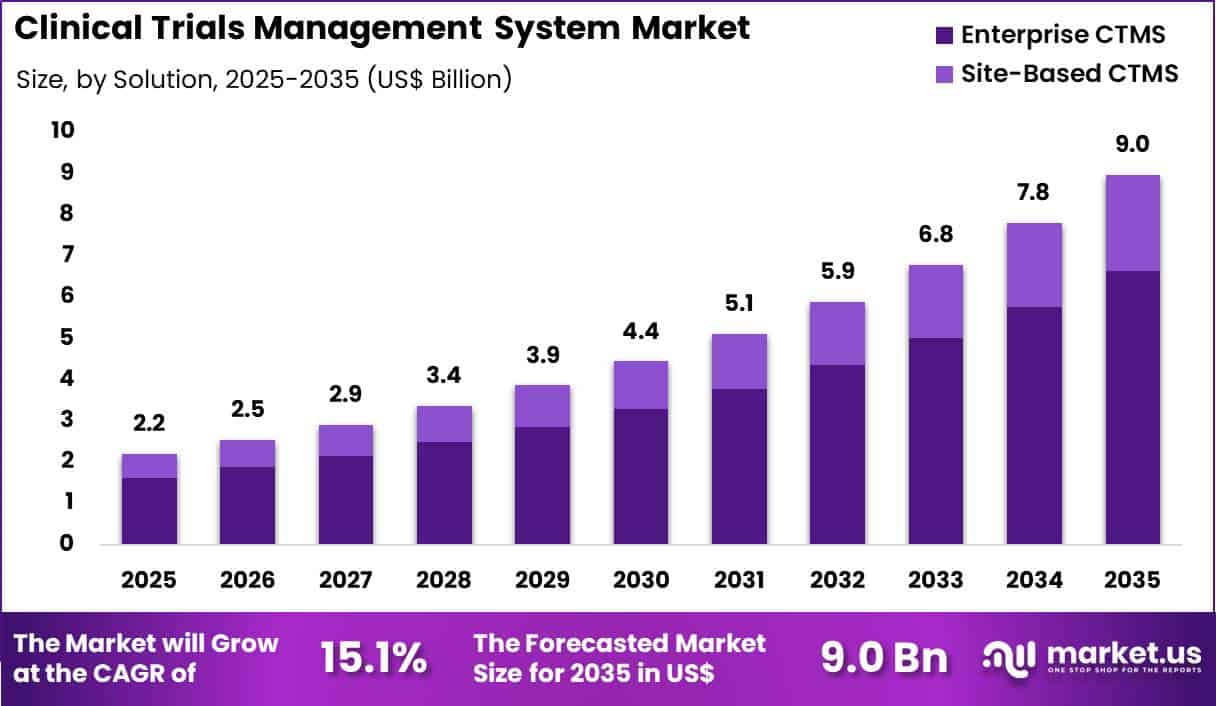
New York, NY – Nov 03 2026 – Global Clinical Trials Management System Market size is expected to be worth around US$ 9.0 Billion by 2035 from US$ 2.2 Billion in 2025, growing at a CAGR of 15.1 during the forecast period 2026-2035. In 2025, North America led the market, achieving over 46.3% share with a revenue of US$ 1.0 Billion.
A Clinical Trials Management System (CTMS) is a specialized software solution designed to plan, manage, monitor, and streamline clinical research activities. It helps pharmaceutical companies, biotechnology firms, contract research organizations (CROs), and research institutions manage clinical trials efficiently, from study initiation to completion. CTMS platforms support essential activities such as clinical trial planning, patient recruitment, site management, investigator coordination, budget tracking, regulatory documentation, and clinical data management.
The market is gaining momentum due to the growing number of clinical studies, increasing investment in pharmaceutical research and development, and rising demand for advanced digital solutions in clinical research. Growing adoption of decentralized and hybrid clinical trials is further encouraging organizations to implement centralized platforms for managing trial operations across multiple locations.
Additionally, increasing regulatory requirements, the need for accurate clinical data, and growing pressure to reduce trial timelines are driving demand for automated trial management solutions. Integration of artificial intelligence (AI), cloud computing, data analytics, and electronic data capture (EDC) technologies is improving operational efficiency, data visibility, and decision-making.
Overall, CTMS solutions are becoming essential tools for improving clinical trial coordination, reducing administrative workloads, controlling costs, and accelerating the development of new drugs and therapies.
Key Takeaways
- In 2025, the Clinical Trials Management System Market generated revenue of US$ 2.2 Billion and is projected to reach US$ 9.0 Billion by 2035, registering a CAGR of 15.1% during the forecast period.
- Based on solution, the market is segmented into enterprise CTMS and site-based CTMS, with enterprise CTMS dominating the market with a 74.0% share.
- By component, the market is categorized into software and services, with the software segment accounting for the largest share of 53.6%.
- Based on deployment mode, the market is classified into cloud-based, web-based, and on-premises solutions, with the web-based segment leading with a 44.1% revenue share.
- By end user, the market is segmented into pharmaceutical & biotech companies, contract research organizations (CROs), medical device manufacturers, and academic & research institutions, with pharmaceutical & biotech companies holding the leading share of 31.7%.
- Regionally, North America dominated the Clinical Trials Management System Market, accounting for a 46.3% market share.
Key Market Segments
- Solution Analysis: Enterprise CTMS dominated the solution segment with a 74.0% market share, driven by the growing need for centralized management of complex clinical trials across multiple countries. These platforms streamline budgeting, site monitoring, regulatory tracking, and reporting. Increasing global trial activities and demand for real-time oversight further support segment growth.
- Component Analysis: Software led the component segment with a 53.6% market share, supported by increasing digitalization of clinical research operations. Clinical trial software helps automate site management, document tracking, budgeting, and reporting. Growing adoption of artificial intelligence, advanced analytics, and integrated digital platforms further strengthens demand for software solutions.
- Deployment Mode Analysis: Web-based deployment dominated the segment with a 44.1% market share, driven by easy accessibility, simplified implementation, and remote collaboration capabilities. These platforms enable research teams to monitor trial progress and coordinate activities across multiple locations. Growing adoption of hybrid work models and reduced IT maintenance requirements further support segment expansion.
- End-User Analysis: Pharmaceutical and biotech companies led the end-user segment with a 31.7% market share, driven by expanding drug development pipelines and increasing clinical research activities. These organizations require efficient platforms to manage multiple trials, regulatory documentation, and patient recruitment. Growing investments in biologics and personalized medicine further strengthen adoption.
Regional Analysis
North America is leading the Clinical Trials Management System Market
North America dominated the Clinical Trials Management System market with a 46.3% share in 2024, driven by increasing digitalization across pharmaceutical companies, CROs, and research institutions. Growing adoption of centralized platforms supports patient enrollment, site monitoring, regulatory documentation, and financial management.
Rising clinical trial complexity and investment in oncology, rare diseases, and advanced therapies further strengthen regional demand. Strong clinical research funding and established healthcare infrastructure also support market expansion.
Asia Pacific is expected to register the highest CAGR during the forecast period
Asia Pacific is projected to witness the fastest growth, supported by expanding clinical research activities and improving regulatory frameworks.
Countries such as China, India, South Korea, and Australia are attracting multinational clinical trials due to large patient populations and growing research capabilities. Increasing investments in digital healthcare infrastructure, rising clinical trial registrations, and demand for efficient patient recruitment are encouraging pharmaceutical companies and CROs to adopt advanced clinical trials management systems.
Emerging Trends
- Growing Adoption of Cloud-Based CTMS Platforms: Pharmaceutical companies and CROs are increasingly adopting cloud-based CTMS platforms to manage clinical trial activities from a centralized location. These systems help teams access study information, coordinate research sites, monitor progress, and share updates more efficiently. Cloud deployment also supports collaboration between geographically distributed research teams.
- Increasing Use of Decentralized and Hybrid Clinical Trials: The growing adoption of decentralized and hybrid clinical trials is increasing the need for flexible CTMS solutions. These platforms help coordinate remote visits, home-based patient activities, telehealth appointments, and traditional site visits. The FDA’s September 2024 guidance supports the use of decentralized elements in clinical research.
- Integration of Digital Health Technologies and Wearable Devices: Clinical trial teams are increasingly using wearable devices, mobile applications, and digital health technologies to collect patient information remotely. CTMS platforms can support coordination of these activities by connecting study workflows with data collection processes. The FDA highlights the potential of these technologies for frequent and remote clinical measurements.
- Greater Focus on Risk-Based Trial Monitoring: Clinical research organizations are placing greater emphasis on risk-based monitoring to identify trial problems early and improve participant safety. CTMS platforms help teams track site performance, study milestones, deviations, and monitoring activities. This approach allows sponsors to focus resources on important risks and critical trial processes.
- Improved Electronic Records and Regulatory Compliance: The demand for reliable electronic records, digital signatures, and audit trails is encouraging organizations to upgrade their clinical trial management systems. Modern CTMS platforms support better documentation, controlled access, and record tracking. The FDA’s October 2024 guidance provides recommendations for electronic systems used in clinical investigations.
Use Cases
- Clinical Trial Planning and Study Management: CTMS software helps pharmaceutical companies and research organizations plan clinical studies by organizing protocols, timelines, budgets, milestones, and research activities. Teams can use these systems to assign responsibilities, manage study schedules, and track progress from trial initiation through completion.
- Patient Recruitment and Enrollment Tracking: Clinical research teams use CTMS platforms to manage patient recruitment activities, monitor enrollment targets, and track participant progress across research sites. These systems help identify enrollment delays, maintain participant records, and coordinate communication between investigators and study coordinators.
- Clinical Research Site Management: CTMS platforms help sponsors and CROs manage multiple clinical research sites through centralized monitoring of site activation, investigator information, staff responsibilities, and operational performance. They also help organizations identify site-related delays and maintain consistent communication throughout the study.
- Regulatory Documentation and Compliance Management: CTMS solutions support the organization and tracking of essential clinical trial documents, approvals, investigator records, and regulatory submissions. They help research teams maintain documentation histories, monitor outstanding requirements, and prepare records for audits and regulatory inspections.
- Clinical Trial Budget and Resource Management: Pharmaceutical companies and CROs use CTMS platforms to manage study budgets, investigator payments, site expenses, and resource allocation. These systems help financial teams monitor spending, track payment schedules, compare actual expenses against planned budgets, and improve financial visibility throughout clinical studies.
Frequently Asked Questions About Clinical Trials Management System
- What are the main functions of a Clinical Trials Management System?
The main functions include clinical study planning, patient enrollment tracking, research site management, investigator coordination, budget monitoring, regulatory documentation, and trial progress reporting. These features help organizations manage clinical research activities more efficiently. - Who uses Clinical Trials Management Systems?
Clinical Trials Management Systems are used by pharmaceutical companies, biotechnology firms, contract research organizations, hospitals, academic research centers, and clinical investigators. These organizations use CTMS platforms to coordinate research activities and manage clinical trial information. - What is the difference between CTMS and EDC systems?
A CTMS manages overall clinical trial operations, including sites, budgets, timelines, and enrollment. Electronic Data Capture (EDC) systems primarily collect and manage clinical data entered through electronic case report forms during clinical studies. - How does CTMS software support regulatory compliance?
CTMS software supports regulatory compliance by maintaining electronic records, tracking document changes, managing user permissions, and providing audit trails. These capabilities help organizations maintain reliable study documentation and meet applicable clinical research recordkeeping requirements. - Which organizations are the major end users of the CTMS market?
Pharmaceutical and biotechnology companies, contract research organizations, hospitals, academic research institutions, and clinical research centers are major end users. These organizations require CTMS solutions to coordinate research sites, monitor trial progress, and manage clinical study operations. - How is digitalization influencing the Clinical Trials Management System Market?
Digitalization is encouraging research organizations to replace manual processes with integrated software platforms. Cloud computing, electronic documentation, remote monitoring, and digital health technologies are improving clinical trial coordination, information accessibility, and operational visibility. - What is the future outlook for the Clinical Trials Management System Market?
The market is expected to benefit from increasing clinical trial digitalization, cloud-based software adoption, decentralized research models, and demand for integrated data management. Continuous improvements in automation and remote monitoring will further support market development.
Conclusion
The Clinical Trials Management System Market is expected to experience strong growth, driven by increasing clinical research activities, rising pharmaceutical R&D investments, and growing demand for digital trial management solutions. The adoption of cloud-based platforms, AI, automation, and decentralized clinical trials is improving operational efficiency, data accuracy, and research coordination.
Pharmaceutical and biotech companies will continue to support market demand through expanding drug development pipelines. Additionally, increasing regulatory requirements and the need to reduce clinical trial timelines are encouraging organizations to invest in advanced CTMS solutions. With North America leading and Asia Pacific emerging as a high-growth region, the market outlook remains promising through 2035.
Discuss your needs with our analyst
Please share your requirements with more details so our analyst can check if they can solve your problem(s)



