


Overview
New York, NY – Sep 16, 2026 – The Global Nephelometry Market size is expected to be worth around US$ 2.4 Billion by 2034 from US$ 1.3 Billion in 2024, growing at a CAGR of 6.4% during the forecast period 2025 to 2034. In 2024, North America led the market, achieving over 40.6% share with a revenue of US$ 0.5 Billion.
Nephelometry is expanding due to increasing demand for advanced immunodiagnostic testing, automated laboratory analyzers, and accurate biomarker detection. Nephelometry is widely used for measuring proteins such as immunoglobulins, complement components, CRP, and other disease-related biomarkers. The growing burden of chronic and autoimmune disorders is increasing the requirement for reliable protein-based diagnostic testing across hospitals, clinical laboratories, and research centers.
According to the World Health Organization (WHO), noncommunicable diseases account for approximately 41 million deaths annually worldwide, representing nearly 74% of all global deaths, increasing the need for continuous disease monitoring and diagnostic testing. Autoimmune disorders impact an estimated 5–8% of the global population, creating significant demand for immunological diagnostic platforms.
The increasing adoption of automated nephelometers is improving laboratory efficiency, with advanced systems capable of performing more than 100–200 tests per hour depending on the instrument configuration. Rising healthcare expenditure is also supporting market growth, with global health spending reaching approximately US$ 9.8 trillion in 2021, according to WHO data, encouraging investments in modern diagnostic infrastructure.
The demand for CRP testing, immunoglobulin analysis, and complement testing is growing due to rising cases of inflammatory diseases, infections, and kidney disorders. Chronic kidney disease affects approximately 850 million people worldwide, increasing the need for protein biomarker monitoring.
North America continues to show strong adoption due to advanced laboratory networks and high diagnostic testing volumes, while Europe benefits from established healthcare systems. Increasing laboratory automation, technological advancements, and rising demand for early disease detection are expected to support the continued expansion of the Nephelometry Market.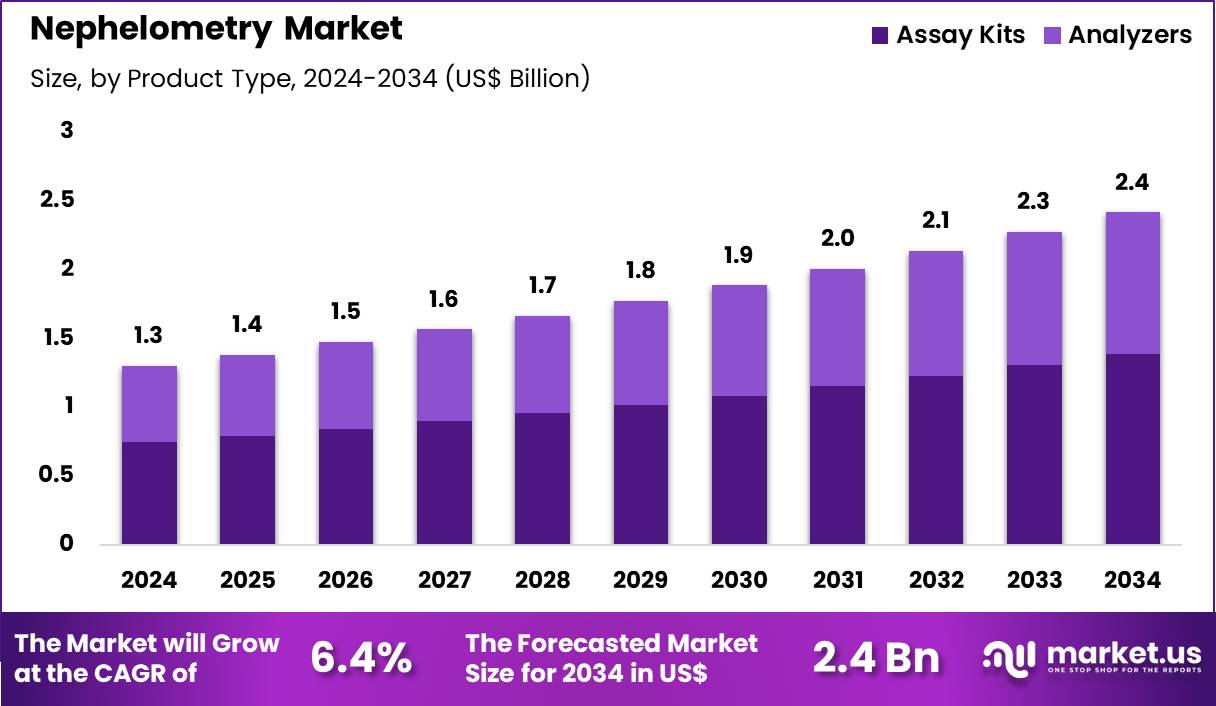
Key Takeaways
- In 2024, the Nephelometry Market generated revenue of US$ 1.3 Billion and is projected to grow at a CAGR of 6.4%, reaching approximately US$ 2.4 Billion by 2034.
- Based on product type, the market is segmented into assay kits and analyzers. The assay kits segment dominated in 2024, accounting for a market share of 57.4%.
- By application, the market is categorized into autoimmune/inflammatory-related, nutritional assessment, kidney disease, cardiovascular, and autoimmune applications. The autoimmune/inflammatory-related segment held the leading position, capturing a significant market share of 46.3%.
- Based on end-user segmentation, the market is divided into hospital-based laboratories, cancer research institutes, and diagnostic laboratories. The hospital-based laboratories segment emerged as the largest contributor, holding the highest revenue share of 49.1%.
- Regionally, North America dominated the Nephelometry Market in 2024, accounting for a market share of 40.6%, supported by advanced healthcare infrastructure and increasing adoption of diagnostic technologies.
Market Segmentation Overview
- Product Type Analysis: Assay kits accounted for 57.4% of the Nephelometry Market in 2024 and are expected to maintain dominance due to their importance in rapid and accurate biomarker testing. These kits enable high-throughput analysis of proteins such as C-reactive protein (CRP), immunoglobulins, and complement factors. Increasing demand for autoimmune and inflammatory disease diagnostics continues to support the adoption of advanced nephelometric assay kits.
- Application Analysis: Autoimmune/inflammatory-related applications held a 46.3% market share in 2024, making them the leading segment. Rising cases of conditions such as rheumatoid arthritis, lupus, and vasculitis are increasing demand for precise inflammation monitoring. Nephelometry supports measurement of key biomarkers, helping hospitals and laboratories improve disease diagnosis, treatment monitoring, and personalized healthcare decisions.
- End-User Analysis: Hospital-based laboratories dominated the Nephelometry Market with a 49.1% share in 2024 due to their high diagnostic testing volume and advanced laboratory infrastructure. Hospitals increasingly use nephelometric systems for autoimmune, inflammatory, and protein analysis testing. Growing demand for early disease detection, faster diagnosis, and accurate patient monitoring continues to strengthen the adoption of nephelometry solutions in hospital laboratories.
Statistical Information
- Chronic Kidney Disease Increasing Protein Testing Requirements: Nephelometry plays an important role in kidney disease diagnostics by measuring abnormal protein levels, immunoglobulins, and related biomarkers. The Centers for Disease Control and Prevention (CDC) reports that approximately 37 million U.S. adults (14%) are affected by chronic kidney disease (CKD). Additionally, CKD prevalence increases significantly among older adults, with approximately 34.2% of adults aged 6b5 years and above affected.
- Increasing Global Aging Population Supporting Diagnostic Testing Demand: The growing elderly population is increasing the need for regular monitoring of chronic diseases, immune disorders, and inflammatory conditions where nephelometric testing is commonly used. According to the United Nations, the global population aged 65 years and older reached 761 million in 2021 and is projected to increase to approximately 1.6 billion by 2050. Older adults have a higher risk of chronic diseases, increasing demand for laboratory-based biomarker testing.
- Increasing Lupus Burden Supporting Immune Biomarker Testing: Systemic lupus erythematosus (SLE) requires long-term monitoring through immune-related biomarkers, including antibody and complement measurements. The Centers for Disease Control and Prevention (CDC) estimates that approximately 204,000 people in the United States have diagnosed lupus, with women representing nearly 90% of lupus patients. Growing awareness and improved diagnosis are increasing the requirement for specialized immunological testing.
- Increasing Healthcare Expenditure Supporting Diagnostic Infrastructure Development: Higher healthcare spending is enabling hospitals and laboratories to invest in advanced diagnostic equipment, automation, and immunological testing platforms. According to the Centers for Medicare & Medicaid Services (CMS), U.S. healthcare spending reached approximately US$ 4.5 trillion in 2022, equal to around US$13,493 per person and representing nearly 17.3% of GDP. Increased healthcare investment supports laboratory modernization.
- Rising Sepsis Cases Increasing Inflammation Marker Monitoring: Inflammatory biomarker testing is increasingly important in severe infections such as sepsis. According to the Centers for Disease Control and Prevention (CDC), at least 1.7 million adults in the United States develop sepsis annually, with approximately 350,000 adults requiring hospital care or dying during hospitalization. Increased use of inflammatory markers for disease severity assessment supports demand for advanced diagnostic testing.
- Growing Cardiovascular Disease Cases Supporting Biomarker-Based Diagnostics: Cardiovascular diseases remain a major contributor to global mortality, increasing the need for early detection and monitoring technologies. According to the World Health Organization (WHO), cardiovascular diseases caused approximately 17.9 million deaths globally each year, representing around 32% of all global deaths. The requirement for inflammatory and protein biomarker analysis supports adoption of diagnostic technologies such as nephelometry.
- Increasing Rheumatoid Arthritis Diagnosis Supporting Inflammation Testing: Rheumatoid arthritis requires regular evaluation of inflammatory activity and immune response markers. According to the Centers for Disease Control and Prevention (CDC), approximately 18 million people worldwide live with rheumatoid arthritis, and arthritis affects around 58.5 million adults in the United States. The need for monitoring disease progression and treatment response increases demand for laboratory-based inflammatory testing.
Regional Analysis
North America led the market by securing a market share of 40.6% in 2024.
North America held a significant position in the Nephelometry Market due to advanced healthcare infrastructure, high adoption of automated diagnostic systems, and increasing demand for immunological testing. The region has a strong presence of clinical laboratories and hospitals using nephelometric technologies for measuring biomarkers such as C-reactive protein (CRP), immunoglobulins, and complement proteins.
According to the National Institutes of Health (NIH), autoimmune diseases affect approximately 5–8% of the U.S. population, creating demand for accurate immune-related diagnostics.
Additionally, the CDC reported that about 37 million U.S. adults have chronic kidney disease, increasing the need for protein-based diagnostic testing. Asia Pacific is projected to experience significant growth due to rising healthcare investments, increasing chronic disease burden, and expanding diagnostic laboratory networks.
The WHO reported that diabetes affected approximately 537 million adults globally in 2021, with a substantial burden across Asia, increasing demand for advanced diagnostic solutions. Government initiatives, laboratory modernization, and growing adoption of automated testing systems are supporting the use of nephelometry across hospitals and diagnostic centers.
Business Opportunities
The Nephelometry Market offers significant business opportunities due to increasing demand for advanced immunodiagnostic solutions, automated laboratory systems, and biomarker-based disease monitoring.
The rising prevalence of autoimmune disorders, cardiovascular diseases, kidney diseases, and chronic inflammatory conditions is creating demand for accurate protein analysis technologies. Companies can focus on developing high-sensitivity assay kits, multiplex testing solutions, and automated nephelometers to improve laboratory efficiency and diagnostic accuracy.
Expansion of healthcare infrastructure in emerging economies, particularly in Asia Pacific and Latin America, provides opportunities for diagnostic companies to strengthen their presence through affordable and scalable solutions. Partnerships with hospitals, reference laboratories, and research institutions can accelerate technology adoption.
Additionally, integrating artificial intelligence, digital laboratory workflows, and cloud-based diagnostic data management with nephelometric systems can create new growth opportunities. Increasing investments in personalized medicine and early disease detection further support innovation and market expansion.
Emerging Trends
- Increasing Adoption of Automated Nephelometry Systems: Hospitals and diagnostic laboratories are shifting toward automated nephelometric analyzers to improve testing speed, accuracy, and workflow efficiency. Rising chronic disease burden is supporting adoption, as WHO reported 43 million deaths from noncommunicable diseases in 2021, increasing the need for advanced diagnostics.
- Growing Demand for Autoimmune Disease Testing: Nephelometry is increasingly used for detecting immune-related biomarkers such as immunoglobulins and complement proteins. NIH estimates autoimmune diseases affect approximately 5–8% of the U.S. population, creating higher demand for accurate immune monitoring and inflammatory disease diagnostics.
- Expansion of Kidney Disease Biomarker Testing: Increasing chronic kidney disease cases are driving demand for protein-based diagnostic testing. CDC data shows around 37 million U.S. adults (14%) are affected by chronic kidney disease, increasing the need for regular monitoring of kidney-related biomarkers through laboratory technologies.
- Integration of Biomarkers in Personalized Medicine: Healthcare is moving toward personalized treatment approaches using patient-specific biomarker information. NIH’s All of Us Research Program aims to collect health data from more than 1 million participants, supporting research and development of precision diagnostic solutions.
- Rising Use of CRP and Inflammatory Marker Testing: Nephelometry is gaining importance for measuring inflammatory biomarkers such as C-reactive protein (CRP). With cardiovascular diseases causing approximately 17.9 million deaths annually worldwide, healthcare providers are increasing the use of biomarker testing for risk assessment and disease monitoring.
Use Cases
- Autoimmune Disease Diagnosis and Monitoring: Nephelometry is widely used to measure immunoglobulins, complement proteins, and inflammatory markers for autoimmune disorders such as lupus and rheumatoid arthritis. NIH estimates autoimmune diseases affect around 5–8% of the U.S. population, increasing the need for accurate immune-related diagnostic testing.
- Inflammatory Disease Assessment: Nephelometric testing supports measurement of biomarkers such as C-reactive protein (CRP) to evaluate inflammation, infection severity, and treatment response. Healthcare providers use these results for monitoring conditions where inflammatory activity influences clinical decisions.
- Kidney Disease Protein Analysis: Nephelometry is used for detecting abnormal protein levels and monitoring kidney-related biomarkers. CDC reports approximately 37 million U.S. adults have chronic kidney disease, creating demand for regular laboratory-based protein testing and disease progression monitoring.
- Immunoglobulin Deficiency Testing: Clinical laboratories use nephelometry to quantify IgG, IgA, and IgM antibodies for diagnosing immune deficiencies and recurrent infection-related conditions. Accurate immunoglobulin measurement helps physicians evaluate immune system function and determine appropriate treatment strategies.
- Cardiovascular Risk Assessment: Nephelometry supports measurement of inflammation-related biomarkers, including high-sensitivity CRP, which assists in cardiovascular risk evaluation. WHO reports cardiovascular diseases cause approximately 17.9 million deaths annually, increasing demand for biomarker-based monitoring solutions.
Recent Development
- In 2026, Siemens Healthineers continued strengthening its laboratory diagnostics portfolio with automation-focused solutions designed to improve testing efficiency and workflow management. The company reported that its Diagnostics segment faced market challenges in 2026, while continuing investments in next-generation laboratory platforms and diagnostic technologies.
- In 2026, F. Hoffmann-La Roche Ltd. expanded its diagnostics innovation strategy by showcasing intelligent laboratory solutions, automation technologies, and AI-enabled diagnostic workflows. The company highlighted integrated solutions across core laboratories, molecular diagnostics, and pathology to improve testing efficiency and clinical decision-making.
- In 2026, Shenzhen Mindray Bio-Medical Electronics Co., Ltd. continued expanding its in-vitro diagnostics and laboratory automation capabilities. The company focused on improving clinical chemistry, immunoassay, and laboratory workflow solutions to support hospitals and diagnostic laboratories requiring faster and more reliable testing processes.
- In 2026, Randox Laboratories Ltd. continued developing clinical diagnostic solutions, quality control systems, and laboratory testing technologies. The company maintained its focus on improving diagnostic accuracy through advanced reagents, analyzer compatibility, and laboratory support solutions for healthcare providers.
- In 2026, Thermo Fisher Scientific, Inc. continued advancing diagnostic development solutions, supporting assay development, validation, and commercialization of clinical testing technologies. The company expanded its diagnostic platform capabilities through instrument systems, reagents, and laboratory workflow solutions for healthcare and research applications.
- In 2026, Beckman Coulter, Inc. continued enhancing automated laboratory diagnostic solutions focused on improving testing productivity and accuracy. The company expanded its clinical diagnostics portfolio with technologies supporting immunoassay, clinical chemistry, and high-throughput laboratory operations.
Frequently Asked Questions On Nephelometry
- What factors are driving the growth of the Nephelometry Market?
The Nephelometry Market is growing due to increasing autoimmune diseases, chronic kidney disorders, inflammatory conditions, and rising demand for accurate biomarker testing. Growing laboratory automation, improved diagnostic accuracy, and increasing adoption of advanced immunodiagnostic systems are further supporting market expansion. - Which product segment dominates the Nephelometry Market?
The assay kits segment dominated the Nephelometry Market in 2024, accounting for approximately 57.4% market share. Assay kits are widely used because they provide accurate biomarker measurement for immunoglobulins, complement proteins, CRP testing, and inflammatory disease diagnosis. - Which region dominates the Nephelometry Market?
North America dominated the Nephelometry Market in 2024, accounting for approximately 40.6% market share. The region’s growth is supported by advanced healthcare infrastructure, increasing adoption of automated diagnostic systems, and rising demand for autoimmune and protein-based testing. - What are the major applications of nephelometry technology?
Nephelometry technology is mainly used for immunoglobulin testing, complement analysis, CRP measurement, autoimmune disease diagnosis, kidney disease monitoring, cardiovascular risk assessment, and infectious disease evaluation. These applications help healthcare providers improve diagnosis accuracy and patient management. - How is automation influencing the Nephelometry Market?
Automation is improving the Nephelometry Market by enabling faster testing, higher sample processing capacity, and reduced manual errors. Automated analyzers help hospitals and diagnostic laboratories manage increasing testing volumes while improving accuracy and workflow efficiency. - What role do autoimmune diseases play in market growth?
Autoimmune diseases significantly contribute to Nephelometry Market growth because nephelometry enables measurement of immune proteins and antibodies. Increasing diagnosis of conditions such as lupus, rheumatoid arthritis, and vasculitis is creating higher demand for advanced immunological testing solutions. - What opportunities exist in the Nephelometry Market?
Growth opportunities include expansion into emerging healthcare markets, development of cost-effective diagnostic solutions, integration of artificial intelligence with laboratory systems, and increasing demand for precision medicine. Rising investments in healthcare infrastructure are creating new opportunities for manufacturers.
Conclusion
The Nephelometry Market is expected to witness steady growth due to increasing demand for accurate protein analysis, autoimmune testing, and advanced immunodiagnostic solutions. Rising cases of chronic diseases, inflammatory disorders, kidney diseases, and cardiovascular conditions are driving the adoption of nephelometric technologies across hospitals and diagnostic laboratories.
Assay kits, autoimmune/inflammatory applications, and hospital-based laboratories remain key market segments, while North America continues to lead adoption. Advancements in automation, high-throughput testing, and personalized medicine are creating new opportunities for market players. Continuous innovation in diagnostic platforms and increasing healthcare investments will further support the long-term expansion of the Nephelometry Market.
Discuss your needs with our analyst
Please share your requirements with more details so our analyst can check if they can solve your problem(s)




