


Overview
New York, NY – July 30, 2026 – Global Mycoplasma Plate Antigens Market size is expected to be worth around US$ 1034.8 Million by 2034 from US$ 572.4 Million in 2024, growing at a CAGR of 6.1% during the forecast period 2025 to 2034. In 2024, North America led the market, achieving over 42.2% share with a revenue of US$ 241.6 Million.
The global Mycoplasma Plate Antigens market is gaining momentum as healthcare systems, research laboratories, and diagnostic manufacturers place greater emphasis on the accurate detection and study of Mycoplasma infections. Mycoplasma plate antigens are widely used in serological assays, diagnostic testing, quality control procedures, and biomedical research to identify immune responses associated with Mycoplasma species. Growing awareness of laboratory contamination, increasing infectious disease surveillance, and expanding clinical diagnostics are supporting market growth.
The market is also benefiting from continuous advancements in immunodiagnostic technologies, standardized antigen preparation methods, and improved assay sensitivity. Pharmaceutical and biotechnology companies increasingly rely on high-quality mycoplasma antigens during research, vaccine development, and biologics manufacturing to ensure product safety and regulatory compliance. Rising investments in life sciences research and laboratory automation are further accelerating demand for reliable testing materials.
North America continues to represent a significant market due to its advanced healthcare infrastructure, strong biotechnology sector, and strict quality standards for laboratory testing. Europe remains an important contributor through active infectious disease monitoring and research initiatives, while Asia-Pacific is expected to witness rapid growth because of expanding diagnostic capabilities, increasing healthcare investments, and growing pharmaceutical manufacturing activities.
Key market participants are focusing on product innovation, quality assurance, strategic collaborations, and expanding distribution networks to strengthen their competitive position. As the demand for rapid, accurate, and standardized diagnostic solutions continues to rise, the Mycoplasma Plate Antigens market is expected to experience steady growth, supported by advancements in clinical diagnostics, microbiology research, and global efforts to improve infectious disease detection and laboratory quality management.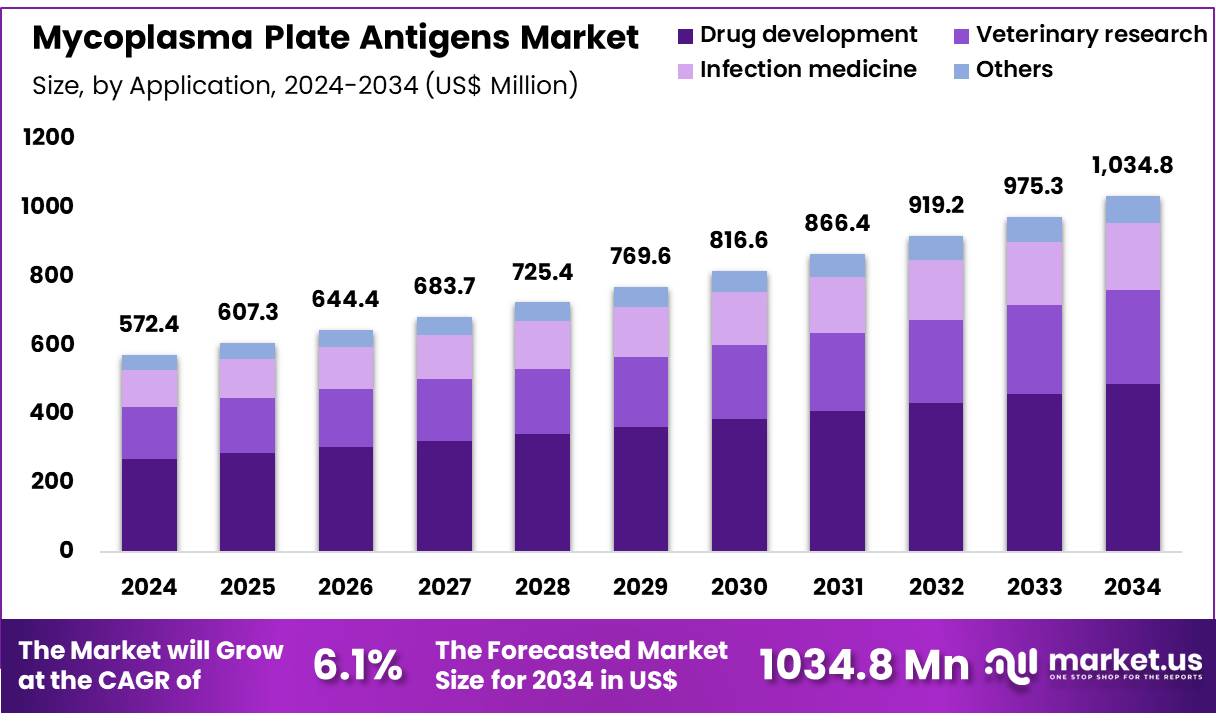
Key Takeaways
- In 2024, the Mycoplasma Plate Antigens market generated US$ 572.4 million in revenue and is projected to reach US$ 1,034.8 million by 2034, expanding at a CAGR of 6.1% during the forecast period.
- Based on product type, the market is categorized into plate agglutination test products and confirmatory testing reagents. Among these, plate agglutination test products dominated the market in 2023, accounting for 53.6% of the total market share.
- By application, the market is segmented into drug development, veterinary research, infection medicine, and others. The drug development segment emerged as the leading application, capturing 47.2% of the market share in 2023.
- In terms of end users, the market comprises veterinary hospitals, poultry veterinary clinics, pharma & biotech companies, and academic & research institutes. Veterinary hospitals held the largest share, contributing 49.5% of the overall market revenue in 2023.
- Regionally, North America maintained its leading position, accounting for 42.2% of the global Mycoplasma Plate Antigens market share in 2023, supported by advanced veterinary diagnostic infrastructure, strong animal healthcare spending, and widespread adoption of mycoplasma screening practices.
Statistical Information
- WOAH’s 2025 standard requires Mycoplasma gallisepticum rapid serum agglutination (RSA) plate antigens to maintain a pH between 6.5 and 7.0 to ensure acceptable diagnostic performance and quality.
- The 2025 WOAH standard specifies that Mycoplasma plate antigens must be stored at 5 ± 3°C before use to preserve antigen stability and diagnostic reliability.
- According to the updated 2025 WOAH manual, serum samples producing a rapid serum agglutination reaction within 2 minutes should be considered reactive and undergo confirmatory testing.
- WOAH’s 2025 diagnostic protocol requires reactive sera to be heated at 56°C for 30 minutes before repeat testing to minimize nonspecific agglutination.
- The 2026 WOAH Biological Standards Commission retained the operational requirement that Mycoplasma plate antigens be stored at 5 ± 3°C and maintain a pH of 6.5–7.0 throughout their declared shelf life.
- The 2025 U.S. regulatory standard for avian Mycoplasma antigens requires completed antigen lots to be centrifuged at 1,000 × g for 90 minutes during density testing before product release.
- The 2025 U.S. regulatory specification requires Mycoplasma gallisepticum plate antigen to have a pH of 6.0 ± 0.2 during release testing.
- The same 2025 regulation specifies that Mycoplasma synoviae plate antigen must have a pH of 7.0 ± 0.2 during quality control testing.
Regional Analysis
North America dominated the global Mycoplasma plate antigens market in 2024, accounting for 42.2% of total revenue. The region’s leadership was driven by the resurgence of Mycoplasma pneumoniae infections after the COVID-19 pandemic, which significantly increased demand for serological testing reagents in hospitals, diagnostic laboratories, and public health surveillance programs. Standardized plate antigens were widely adopted for agglutination and indirect hemagglutination assays to detect antibodies, monitor seroconversion, and support epidemiological investigations.
According to the U.S. Centers for Disease Control and Prevention (CDC), emergency department visits associated with M. pneumoniae pneumonia among children aged 2–4 years increased from 1.0% to 7.2% between March 31 and October 5, 2024, highlighting the growing need for reliable antigen-based diagnostic tools. Increased government-supported respiratory surveillance, expanded testing in pediatric populations, and broader use of serological reagents in outbreak investigations further strengthened North America’s market position. Meanwhile, Asia Pacific is projected to register the fastest growth, supported by expanding surveillance programs and increasing concerns over macrolide-resistant M. pneumoniae infections.
Emerging Trends
- Higher demand following the global resurgence of Mycoplasma infections: The resurgence of Mycoplasma pneumoniae infections since 2023 has increased laboratory demand for serological reagents, including plate antigens. CDC estimates around 2 million infections annually in the United States, while infection levels remained elevated in some regions during 2025–2026, supporting continued diagnostic testing demand.
- Growing use of multiplex molecular testing alongside serology: Healthcare laboratories are increasingly combining plate antigen-based serology with multiplex molecular assays for comprehensive respiratory diagnosis. The CDC notes that multiple FDA-cleared molecular tests are available, with NAATs now preferred for rapid diagnosis, while serological testing remains valuable for epidemiological and confirmatory purposes.
- Greater surveillance of pediatric respiratory infections: Hospitals are expanding diagnostic testing in children because the 2024–2025 outbreak affected younger age groups more than historically observed. CDC reported pneumonia-related emergency visits associated with Mycoplasma pneumoniae increasing from 1.0% to 7.2% among children aged 2–4 years, strengthening demand for laboratory antigen reagents.
- Improved laboratory standardization and quality control: Clinical laboratories are adopting standardized antigen preparations to improve consistency of serological assays. CDC highlights that culture confirmation can require several weeks, encouraging laboratories to maintain validated antigen-based testing workflows where rapid molecular testing is unavailable or used alongside antibody detection.
- Focus on antimicrobial resistance monitoring: Diagnostic laboratories are increasingly supporting antimicrobial stewardship through accurate identification of Mycoplasma pneumoniae. CDC reports that macrolide resistance remains below 10% in the United States, increasing the importance of reliable laboratory testing for appropriate treatment selection and surveillance activities.
Use Cases
- Hospital diagnostic laboratories: Hospitals use mycoplasma plate antigens for serological testing of patients with suspected atypical pneumonia. These assays help detect antibodies during outbreaks, particularly among pediatric patients, complementing molecular methods when paired serum samples or epidemiological investigations are required.
- Public health surveillance programs: Public health laboratories utilize antigen-based serological testing to monitor infection trends during regional outbreaks. CDC reports that Mycoplasma pneumoniae infections typically peak every 3–7 years, making laboratory surveillance important for tracking transmission patterns and supporting outbreak response.
- Academic and clinical research laboratories: Universities and research institutes use standardized plate antigens to study immune responses, antibody persistence, and disease epidemiology. Reliable serological reagents enable comparison of clinical samples across research sites and contribute to understanding post-outbreak immunity.
- Reference laboratory confirmation testing: Reference laboratories apply plate antigen assays alongside PCR and culture to support confirmatory diagnosis in complex or retrospective investigations. CDC notes that culture may require several weeks, making serological testing useful in selected laboratory workflows despite the growing use of NAATs.
- Outbreak investigations in schools and healthcare facilities: During respiratory outbreaks in schools, colleges, and long-term care facilities, laboratories use mycoplasma plate antigens to help identify exposure and support epidemiological assessments. CDC reports that outbreaks commonly occur in crowded settings, reinforcing demand for reliable diagnostic reagents during investigations.
Frequently Asked Questions on Mycoplasma Plate Antigens
- What are Mycoplasma Plate Antigens?
Mycoplasma plate antigens are laboratory reagents used in serological tests to detect antibodies produced against Mycoplasma infections. They support diagnostic procedures by enabling visible antigen-antibody reactions, helping laboratories identify exposure to pathogens such as Mycoplasma pneumoniae for clinical and research purposes. - What factors are driving the growth of the Mycoplasma Plate Antigens Market?
The market is expanding due to rising awareness of respiratory infections, increasing laboratory testing volumes, improved healthcare infrastructure, and greater investment in clinical diagnostics. Government disease surveillance programs and growing research activities also contribute to sustained demand for reliable antigen-based diagnostic products. - Which end users are the primary customers for Mycoplasma Plate Antigens?
Hospitals, diagnostic laboratories, academic research institutions, public health laboratories, biotechnology companies, and pharmaceutical organizations are the major end users. These facilities depend on standardized antigen reagents to support disease diagnosis, epidemiological studies, assay validation, and infectious disease research activities. - What are the key applications of Mycoplasma Plate Antigens?
Mycoplasma plate antigens are mainly used for serological testing, clinical diagnostics, epidemiological surveillance, laboratory research, and validation of diagnostic assays. They assist healthcare professionals in identifying immune responses associated with Mycoplasma infections while supporting disease monitoring and public health investigations. - Which regions are leading the Mycoplasma Plate Antigens Market?
North America currently represents a leading regional market because of advanced diagnostic infrastructure, strong public health surveillance, and widespread laboratory testing capabilities. Europe and the Asia-Pacific are also experiencing steady growth, driven by healthcare investments, expanding research programs, and increasing infectious disease awareness. - How is technological innovation influencing the Mycoplasma Plate Antigens Market?
Advancements in antigen purification, assay standardization, automated laboratory workflows, and quality control are improving diagnostic reliability and efficiency. Integration with modern immunodiagnostic platforms enables laboratories to achieve more consistent testing performance while supporting faster and more accurate clinical decision-making processes. - What opportunities exist for companies in the Mycoplasma Plate Antigens Market?
Manufacturers can benefit from expanding healthcare infrastructure in emerging economies, increasing investment in infectious disease diagnostics, collaborations with research organizations, and the development of improved antigen formulations. Growing emphasis on laboratory quality assurance also creates opportunities for premium diagnostic reagent suppliers.
Conclusion
The global Mycoplasma Plate Antigens market is expected to witness steady growth over the coming years, supported by increasing demand for reliable mycoplasma detection in biopharmaceutical manufacturing, vaccine production, drug development, and clinical diagnostics. Rising concerns about cell culture contamination, stricter regulatory requirements for biologics safety, and the growing adoption of quality assurance protocols across research laboratories continue to strengthen market demand.
Technological advancements, including rapid antigen-based detection methods and improved diagnostic reagents, are further enhancing testing efficiency and laboratory productivity. Additionally, expanding respiratory disease surveillance programs and greater investment in infectious disease research are creating new opportunities for market expansion.
North America remains the leading regional market due to strong healthcare infrastructure, active biologics manufacturing, and increased surveillance of Mycoplasma pneumoniae infections. Meanwhile, Asia-Pacific is emerging as a high-growth region, driven by expanding biotechnology industries, improving laboratory capabilities, and rising government support for disease monitoring. Although molecular diagnostic methods present competitive challenges, plate antigens continue to play an important role because of their affordability, simplicity, and value in serological testing and research applications.
Overall, continued innovation, regulatory compliance, and increasing demand for contamination-free biologics are expected to sustain the long-term growth of the Mycoplasma Plate Antigens market.
Discuss your needs with our analyst
Please share your requirements with more details so our analyst can check if they can solve your problem(s)




