


Overview
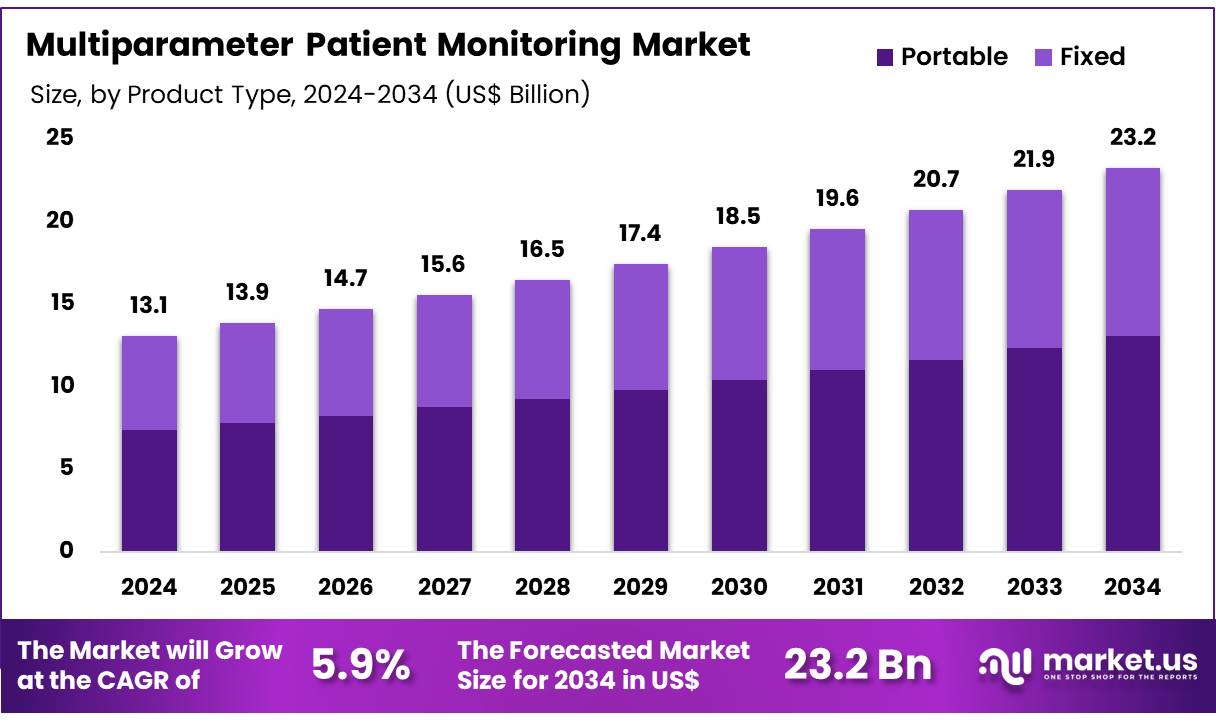
New York, NY – July 28, 2026 – The Global Multiparameter Patient Monitoring Market size is expected to be worth around US$ 23.2 Billion by 2034 from US$ 13.1 Billion in 2024, growing at a CAGR of 5.9% during the forecast period 2025 to 2034. In 2024, North America led the market, achieving over 44.1% share with a revenue of US$ 5.8 Billion.
The global multiparameter patient monitoring market is witnessing robust growth, driven by the rising demand for continuous patient surveillance and early disease detection across healthcare settings. These systems play a critical role in intensive care units (ICUs) and emergency departments, where real-time monitoring of vital parameters significantly improves clinical outcomes.
According to the Centers for Disease Control and Prevention (CDC), the United States records over 130 million emergency department visits annually, with approximately 3.1 million cases requiring admission to critical care units. This highlights the increasing reliance on advanced monitoring technologies in high-acuity environments.
Technological advancements, particularly the integration of wireless systems such as Radio-Frequency Identification (RFID) and Medical Body Area Networks (MBAN), are transforming patient monitoring by enabling continuous, non-invasive data collection. Modern devices can simultaneously track multiple parameters, including heart rate, oxygen saturation, blood pressure, and respiratory rate.
A notable industry development includes the June 2023 FDA approval of integrated monitoring solutions combining Philips IntelliVue systems with Masimo technologies, allowing clinicians to assess brain function, regional oxygenation, and CO2 levels within a single platform.
Furthermore, the shift toward home-based care is expanding market opportunities. The Agency for Healthcare Research and Quality (AHRQ) reports that nearly 60% of U.S. adults live with at least one chronic condition, accelerating adoption of remote monitoring devices. Innovations such as Mindray’s mWear, launched in December 2022, support monitoring of six vital signs, reinforcing the trend toward decentralized healthcare delivery.
Key Takeaways
- The multiparameter patient monitoring market generated revenue of US$ 13.1 billion in 2024 and is projected to reach US$ 23.2 billion by 2034, expanding at a CAGR of 5.9%.
- By product type, the market is segmented into portable and fixed devices, with portable monitors dominating in 2023, accounting for 56.2% of the total share.
- Based on acuity level, the market is categorized into high-acuity and mid- to low-acuity segments, with high-acuity systems holding a leading share of 60.4%.
- In terms of age group, the market is divided into geriatric, adult, and pediatric populations, where the geriatric segment leads with a 45.2% revenue share.
- By end user, the market includes hospitals, homecare settings, and ambulatory surgical centers (ASCs), with hospitals dominating at a 54.8% share.
- Regionally, North America held the largest market share in 2023, accounting for 44.1% of the global market.
Statistical Information
- Emergency Department Visits and Critical Care Admissions: The CDC’s National Hospital Ambulatory Medical Care Survey (NHAMCS) estimated 155.4 million emergency department (ED) visits in the United States in 2022. Of these, about 17.8 million visits resulted in hospital admission and 3.1 million resulted in admission to a critical care unit, indicating substantial demand for continuous, high-acuity monitoring.
- ED Visit Rates by Age: CDC data show that in 2022, the overall ED visit rate was 47 visits per 100 people, but rates were substantially higher for infants younger than 1 year and adults 75 years and older, highlighting heavier ED utilization in high‑risk age groups where multiparameter monitoring is frequently used.
- Burden of Chronic Disease in U.S. Adults: The U.S. Centers for Disease Control and Prevention (CDC) reports that chronic diseases such as heart disease, cancer, and diabetes are the leading causes of death and disability in the United States and major drivers of about 5.3 trillion dollars in annual healthcare costs, which underpins demand for ongoing monitoring and management.
- Geriatric Population and Chronic Conditions: CDC data indicate that among adults 65 years and older in the United States, more than 90% have at least one chronic condition, and this group is therefore highly represented in populations requiring ongoing monitoring in hospitals and home‑based settings.
- Trends in ED Visits Among Adults: A 2024 analysis of emergency department visits in the United States reported about 140 million ED visits in 2021, corresponding to a rate of 43 visits per 100 people, reflecting sustained high demand for acute care services where continuous multiparameter monitoring is frequently used.
- Philips–Masimo Integrated Monitoring: The U.S. FDA 510(k) database lists submissions related to Philips patient monitors incorporating Masimo technologies, demonstrating regulatory clearance pathways supporting integrated multiparameter platforms.
- Multiple Chronic Conditions in U.S. Adults: A 2025 CDC analysis reported that in 2023, 76.4% of U.S. adults had at least one chronic condition, and 51.4% had multiple chronic conditions, indicating extensive need for ongoing management and monitoring in adult and older populations.
- Distribution of Chronic Conditions by Age Group: The same CDC study found that in 2023, 59.5% of young adults, 78.4% of midlife adults, and 93.0% of older adults reported at least one chronic condition, while multiple chronic conditions were present in 27.1% of young adults, 52.7% of midlife adults, and 78.8% of older adults, demonstrating sharply rising disease burden with age and explaining why geriatric patients form a dominant segment for monitoring solutions.
Regional Analysis
North America held the largest market share in 2023, accounting for 44.1% of the global market.
North America dominated the multiparameter patient monitoring market in 2024, supported by advanced healthcare infrastructure, strong adoption of digital health technologies, and high healthcare expenditure. The region’s growing burden of chronic diseases continues to increase demand for continuous monitoring solutions. In the US, around 6 in 10 adults live with at least one chronic condition, creating strong demand for hospital-based and remote monitoring systems.
US healthcare spending reached approximately $5.3 trillion in 2024, reflecting significant investment capacity for advanced medical technologies and connected healthcare solutions. Asia Pacific is projected to witness the fastest growth during the forecast period due to expanding healthcare infrastructure, aging populations, and increasing adoption of digital healthcare solutions.
The rising prevalence of noncommunicable diseases across South-East Asia and Western Pacific regions is driving the need for early diagnosis and continuous patient monitoring. Government initiatives, healthcare modernization programs, and growing use of AI-enabled monitoring platforms are further supporting regional market expansion.
Emerging Trends
- Artificial Intelligence (AI)-Based Predictive Monitoring: AI integration is transforming multiparameter patient monitoring by analyzing real-time vital sign data to predict patient deterioration. Hospitals are using AI algorithms to detect early signs of cardiac, respiratory, and critical conditions. The FDA has authorized more than 1,000 AI-enabled medical devices, highlighting increasing adoption of AI in healthcare.
- Expansion of Remote Patient Monitoring (RPM): Remote patient monitoring is becoming a major trend as healthcare systems focus on home-based care and reducing hospital readmissions. Connected devices continuously track parameters such as blood pressure, oxygen saturation, and heart rate. CMS supports RPM services through Medicare reimbursement pathways, encouraging broader adoption among healthcare providers.
- Growth of Wearable and IoT-Enabled Monitoring Devices: Wearable sensors and IoT technologies are enabling continuous health tracking outside traditional clinical environments. These devices collect multiple health parameters and transmit data to healthcare professionals for real-time analysis. WHO recognizes digital health technologies as important solutions for improving healthcare access, monitoring, and patient outcomes.
- Development of Smart Hospitals and Connected Healthcare Platforms: Smart hospitals are increasingly adopting integrated monitoring systems that connect multiparameter devices with electronic health records (EHRs), cloud platforms, and clinical decision-support tools. These technologies improve patient management, reduce response times, and support efficient healthcare delivery. The U.S. HHS identifies interoperability as a key focus area for healthcare modernization.
- Rising Adoption of Home-Based Patient Monitoring Solutions: Growing elderly populations and increasing chronic disease cases are driving demand for home-based multiparameter monitoring systems. These solutions allow continuous tracking of patients with cardiovascular, respiratory, and metabolic conditions. WHO reported that noncommunicable diseases caused around 43 million deaths globally in 2021, increasing the need for long-term monitoring technologies.
Use Cases
- Critical Care and Intensive Care Unit (ICU) Monitoring: Multiparameter patient monitors are widely used in ICUs to continuously track vital signs such as heart rate, blood pressure, oxygen saturation, respiratory rate, and temperature. These systems help clinicians quickly identify patient deterioration and provide timely treatment for critically ill patients, especially those with cardiac, respiratory, or post-surgical complications.
- Chronic Disease Management and Long-Term Care: Multiparameter monitoring systems support the management of chronic diseases such as cardiovascular disorders, diabetes, and respiratory conditions. Continuous monitoring helps healthcare providers track disease progression and adjust treatments. WHO reports that noncommunicable diseases account for approximately 74% of global deaths, increasing the need for long-term monitoring solutions.
- Remote Patient Monitoring (RPM) for Home Healthcare: Remote multiparameter monitoring enables patients to receive medical supervision from home through connected devices that measure vital health indicators. These solutions are increasingly used for elderly patients and individuals with chronic illnesses. CMS supports remote monitoring services under Medicare, helping expand technology adoption in home-based healthcare.
- Emergency and Ambulance Care Applications: Portable multiparameter monitors are increasingly used in emergency medical services and ambulances to assess patients during transportation. These devices provide real-time information on vital parameters, helping emergency teams make faster clinical decisions. They are especially valuable for trauma cases, stroke patients, and individuals experiencing cardiac emergencies.
- Post-Surgical and Recovery Monitoring: Hospitals use multiparameter monitoring systems after surgeries to observe patient recovery and detect complications early. Continuous tracking of oxygen levels, heart activity, blood pressure, and temperature helps reduce risks during the recovery period. These systems improve patient safety and support efficient postoperative care management.
Frequently Asked Questions on Multiparameter Patient Monitoring
- What factors are driving the growth of the multiparameter patient monitoring market?
The market growth is driven by increasing chronic diseases, rising demand for remote patient monitoring, aging populations, healthcare digitalization, and adoption of AI-enabled medical technologies. Hospitals are increasingly using advanced monitoring systems to improve patient safety and clinical decision-making. - What are the major applications of multiparameter patient monitoring systems?
Multiparameter monitoring systems are widely used in intensive care units, emergency departments, operating rooms, neonatal care, cardiac monitoring, and home healthcare. These devices support continuous observation of patients and help detect early warning signs of health complications. - How is artificial intelligence impacting the multiparameter patient monitoring market?
Artificial intelligence is improving multiparameter monitoring by enabling predictive analysis, automated alerts, and early detection of patient deterioration. AI algorithms analyze real-time health data, helping clinicians make faster decisions and improving outcomes for critically ill and high-risk patients. - Why is remote patient monitoring increasing demand for multiparameter systems?
Remote patient monitoring allows healthcare providers to track patient health outside hospitals using connected monitoring devices. The growing need for home-based care, chronic disease management, and reduced hospital visits is increasing adoption of multiparameter monitoring solutions globally. - Which region dominates the multiparameter patient monitoring market?
North America dominates the multiparameter patient monitoring market due to advanced healthcare infrastructure, high healthcare spending, strong presence of medical device companies, and early adoption of digital health technologies. The region also benefits from increasing demand for remote monitoring solutions. - What role do wearable devices play in multiparameter patient monitoring?
Wearable devices enhance multiparameter monitoring by enabling continuous tracking of health indicators such as heart rate, oxygen levels, and activity patterns. These devices support preventive healthcare, remote monitoring, and personalized treatment approaches by providing real-time patient information. - How are hospitals using multiparameter monitoring systems?
Hospitals use multiparameter monitoring systems in critical care, surgical recovery, emergency departments, and general wards. These devices provide continuous patient information, helping medical teams identify changes in health conditions, improve workflow efficiency, and deliver faster clinical responses. - What is the future outlook for the multiparameter patient monitoring market?
The future of the multiparameter patient monitoring market is expected to focus on AI integration, cloud-based platforms, wearable technologies, and home healthcare solutions. Increasing digital transformation and demand for personalized care will continue supporting market expansion worldwide.
Conclusion
The multiparameter patient monitoring market is experiencing significant growth due to increasing chronic disease prevalence, rising demand for continuous patient observation, and rapid adoption of digital healthcare technologies. North America maintains market leadership because of advanced healthcare infrastructure, strong investment, and widespread use of AI and remote monitoring solutions.
Asia Pacific is expected to witness strong expansion due to healthcare modernization, growing populations, and increased technology adoption. Emerging trends such as AI-based prediction, wearable devices, IoT integration, and home healthcare monitoring are transforming patient care. These advancements are improving early diagnosis, clinical decision-making, and overall healthcare outcomes globally.
Discuss your needs with our analyst
Please share your requirements with more details so our analyst can check if they can solve your problem(s)




