


Overview
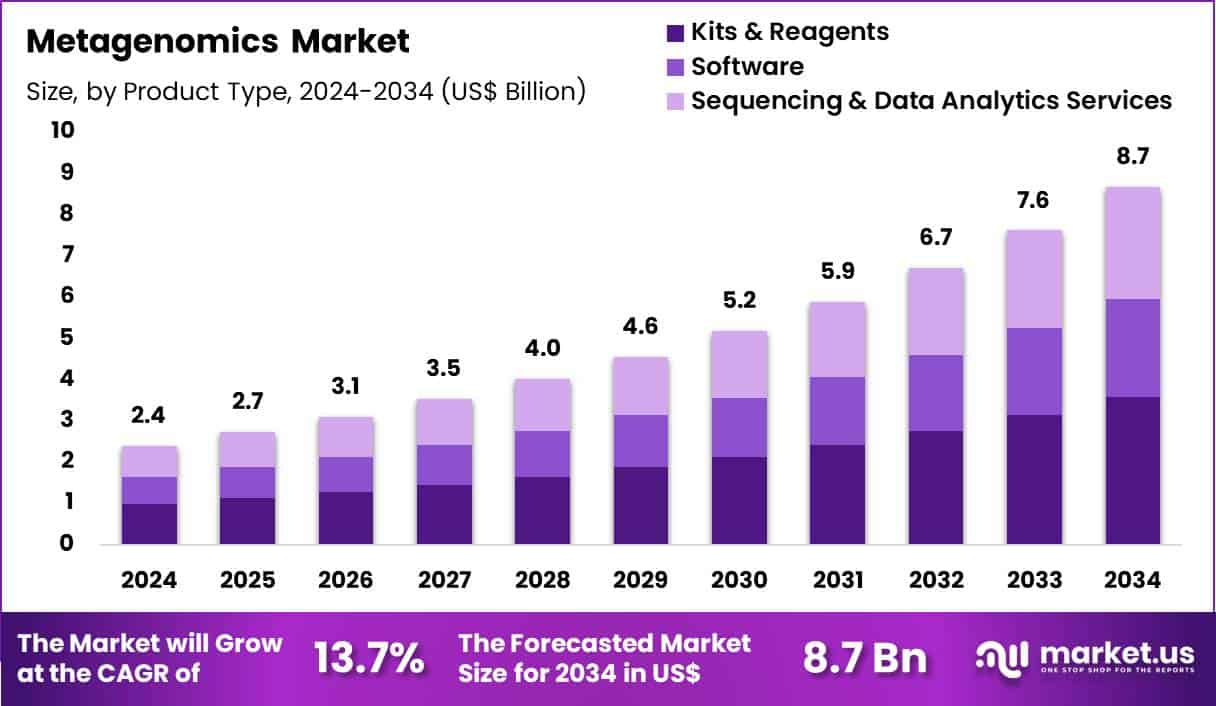
New York, NY – Oct 26, 2026 – Global Metagenomics Market size is expected to be worth around US$ 8.7 Billion by 2034 from US$ 2.4 Billion in 2024, growing at a CAGR of 13.7% during the forecast period 2025 to 2034. In 2024, North America led the market, achieving over 40.9% share with a revenue of US$ 1.0 Billion.
Metagenomics is an advanced molecular biology technique used to study the genetic material of microorganisms directly from environmental, clinical, and biological samples. Unlike traditional methods that require microorganisms to be cultured in laboratories, metagenomics enables the analysis of microbial communities without the need for individual isolation and cultivation.
The technology uses next-generation sequencing (NGS), bioinformatics, and advanced data analysis tools to identify microorganisms and understand their genetic diversity, functional potential, and interactions. It is widely used in healthcare, pharmaceuticals, agriculture, food safety, environmental monitoring, and biotechnology.
In healthcare, metagenomics supports the investigation of infectious diseases, pathogen identification, and antimicrobial resistance research. In agriculture, it helps assess soil microbial diversity and its impact on crop productivity. Environmental applications include monitoring water quality, studying ecosystem health, and evaluating microbial roles in nutrient cycling. The technology also contributes to industrial biotechnology and drug discovery by identifying potentially useful microbial genes and biological pathways.
The growing demand for precision diagnostics, personalized medicine, sustainable agriculture, and environmental protection is increasing interest in metagenomics solutions. Continuous improvements in sequencing technologies, computational tools, and data interpretation are further expanding its applications.
As research capabilities advance, metagenomics is expected to play an increasingly important role in understanding complex microbial ecosystems and supporting data-driven decisions across scientific and industrial sectors.
Key Takeaways
- In 2024, the metagenomics market generated revenue of US$ 2.4 billion and is projected to reach US$ 8.7 billion by 2034, growing at a CAGR of 13.7% during the forecast period.
- By product type, the market is segmented into kits & reagents, software, and sequencing & data analytics services. The kits & reagents segment dominated the market, accounting for 41.2% of the total market share.
- Based on technology, the market is categorized into shotgun sequencing, whole genome sequencing, 16S sequencing, and others. The shotgun sequencing segment held a significant market share of 38.9%.
- By application, the market is segmented into environmental, clinical diagnostics, drug discovery, biotechnology, food & nutrition, and others. The environmental segment led the market, accounting for the largest revenue share of 34.7%.
- Based on workflow, the market is divided into sequencing, pre-sequencing, and data analysis. The sequencing segment dominated the market, capturing a revenue share of 45.8%.
- Regionally, North America dominated the metagenomics market, accounting for 40.9% of the total market share.
Key Market Segments
- Product Type Analysis: The kits and reagents segment accounted for 41.2% of the metagenomics market, driven by its essential role in DNA extraction, sample preparation, and library construction. Increasing research activities, rising sample volumes, and demand for reliable results support adoption. Continued product innovation and standardized laboratory protocols are expected to sustain segment growth.
- Technology Analysis: The shotgun sequencing segment held 38.9% of the metagenomics market, supported by its ability to provide comprehensive microbial and functional analysis. Its applications include environmental monitoring, antimicrobial resistance research, and microbial diversity studies. Improvements in sequencing technologies, data analysis tools, and cost efficiency are expected to strengthen adoption across research and commercial laboratories.
- Application Analysis: The environmental segment accounted for 34.7% of the metagenomics market, driven by increasing demand for biodiversity assessment, ecosystem monitoring, and pollution detection. Applications in soil and water analysis support environmental research and sustainability initiatives. Growing climate change studies, agricultural research, and government monitoring programs are expected to strengthen demand for metagenomics solutions.
- Workflow Analysis: The sequencing segment represented 45.8% of the metagenomics market, reflecting its central role in generating microbial genomic data. Rising sample volumes, technological advancements, and increasing research investments support segment expansion. Improvements in sequencing speed, accuracy, and throughput are enhancing research efficiency. Growing large-scale microbiome studies are expected to sustain demand for sequencing services.
Regional Analysis
North America accounted for 40.9% of the global metagenomics market in 2024, driven by growing applications in microbiome research, drug discovery, clinical diagnostics, and environmental monitoring. The region benefits from advanced sequencing infrastructure, strong biotechnology investment, and established research institutions.
Companies such as QIAGEN and Oxford Nanopore Technologies support market development through innovative sequencing technologies and laboratory solutions. Environmental monitoring initiatives, microbiome research, and federal funding for biomedical studies further contribute to regional growth.
Asia Pacific is expected to register the highest CAGR during the forecast period, supported by increasing investments in genomic research, healthcare infrastructure, and biotechnology development. Growing applications in pathogen surveillance, antimicrobial resistance detection, biodiversity assessment, and agricultural research are creating new opportunities.
Governments and research institutions are expanding sequencing capabilities, while biotechnology companies are developing advanced analytical platforms. In addition, investments in microbial resource discovery and commercial biotechnology are expected to accelerate regional adoption, positioning Asia Pacific as a key growth market for metagenomics solutions.
Emerging Trends
- Artificial intelligence in microbial data analysis: Artificial intelligence (AI) and machine learning are increasingly being applied to large metagenomic datasets. These tools can help researchers identify microbial patterns, compare genetic sequences, and interpret complex results more efficiently, supporting faster scientific analysis and improved decision-making.
- Growth of long-read sequencing technology: Long-read sequencing is gaining attention because it can read longer sections of genetic material in a single sequence. This can help researchers assemble microbial genomes, identify resistance-related genes, and better understand complex microbial communities that may be difficult to study using shorter reads.
- Expansion of clinical metagenomic testing: Healthcare research is increasingly exploring metagenomic sequencing to identify infectious agents in complex patient samples. Unlike tests designed for specific organisms, this approach can examine genetic material from many potential pathogens simultaneously, making it valuable for investigating difficult-to-diagnose infections.
- Increasing use of field-based microbial surveillance: Portable sequencing systems and improved sample-processing methods are creating opportunities to study microorganisms closer to where samples are collected. Applications include wastewater surveillance, environmental sampling, and monitoring infectious threats, potentially reducing delays between sample collection and analysis.
- Greater demand for integrated bioinformatics services: As sequencing generates larger volumes of genetic data, demand is increasing for data processing, microbial identification, secure storage, and interpretation services. Laboratories may use external service providers or cloud-based platforms when they lack the equipment, software, or specialist staff required for in-house analysis.
Use Cases
- Infectious disease diagnosis: Metagenomics can help identify bacteria, viruses, fungi, and other microorganisms in patient samples, including cases where the cause of infection is unclear. It is particularly useful for investigating complex infections and potential pathogens that are not covered by routine targeted tests.
- Wastewater and public health monitoring: Wastewater samples can be examined to detect genetic material from disease-causing microorganisms circulating within communities. Public health teams can use these findings to monitor pathogen activity, identify possible emerging threats, and support wider disease surveillance programmes.
- Agriculture and soil health improvement: Metagenomics can reveal which microorganisms are present in soil and around plant roots. This information can support research into nutrient availability, plant diseases, soil quality, and beneficial microbes, helping agricultural researchers develop more informed approaches to crop production and soil management.
- Food safety and contamination investigation: Food samples and production environments can be studied to identify microbial communities and investigate possible contamination. Metagenomic analysis can support research into food spoilage, foodborne pathogens, and microbial changes during processing, storage, and distribution.
- Drug discovery and industrial biotechnology: Microorganisms contain genes that may produce useful enzymes, antimicrobial compounds, and other biological substances. Metagenomics helps researchers explore these genetic resources, including those found in organisms that are difficult to grow in laboratories, supporting drug discovery and industrial process development.
Frequently Asked Questions About Metagenomics
- What is the difference between metagenomics and genomics?
Genomics generally focuses on the complete genetic material of an organism, while metagenomics examines genetic material from multiple organisms within a sample. This makes metagenomics particularly useful for studying complex microbial communities in patients, soil, water, and other environments. - What are the major applications of metagenomics?
Metagenomics is used in infectious disease research, microbial ecology, food safety, agriculture, environmental monitoring, drug discovery, and biotechnology. It helps researchers understand microbial diversity, investigate potential pathogens, identify useful biological functions, and study how microbial communities change under different conditions. - What are the main limitations of metagenomics?
Metagenomics can be limited by high analysis costs, complex data interpretation, contamination, incomplete reference databases, and differences in sample quality. Detecting microbial genetic material also does not always establish whether an organism is alive or directly responsible for disease. - What factors are driving the growth of the metagenomics market?
Market growth is supported by falling sequencing costs, wider use of genomic technologies, increased interest in infectious disease detection, and expanding microbiome research. Demand for environmental testing, agricultural applications, and advanced data analysis services also contributes to market development. - Which application areas contribute to metagenomics market demand?
Demand comes from clinical diagnostics, environmental monitoring, agricultural research, drug discovery, food safety, and industrial biotechnology. Clinical applications support pathogen investigation, while environmental and agricultural applications help researchers study microbial diversity, ecosystem health, soil conditions, and biological resources. - What challenges affect the metagenomics market?
The market faces challenges related to sequencing costs, limited access to specialised equipment, shortages of skilled bioinformatics professionals, and complex data interpretation. Data privacy, laboratory standardisation, and the need for clinical validation can also affect adoption, particularly in healthcare settings. - What is the future outlook for the metagenomics market?
The market outlook is supported by continued improvements in sequencing technology, computational analysis, and microbial research. Greater adoption in clinical testing, public health surveillance, environmental protection, and agriculture may create additional opportunities, although growth will depend on cost, validation, and practical implementation.
Conclusion
The global metagenomics market is poised for substantial growth, driven by increasing demand for advanced microbial analysis, precision diagnostics, and environmental monitoring. Valued at US$ 2.4 billion in 2024, the market is projected to reach US$ 8.7 billion by 2034, growing at a CAGR of 13.7%. Advancements in next-generation sequencing, artificial intelligence, and bioinformatics are enhancing analytical capabilities and expanding applications across healthcare, agriculture, biotechnology, and food safety.
North America currently leads the market, while Asia Pacific presents significant growth opportunities. Continued technological innovation, research investments, and broader adoption are expected to support long-term market expansion.
Discuss your needs with our analyst
Please share your requirements with more details so our analyst can check if they can solve your problem(s)



