


Overview
New York, NY – Sep 09, 2026 – The Global Lung Cancer PCR Panel Market size is expected to be worth around US$ 1301.5 Million by 2034 from US$ 597.3 Million in 2024, growing at a CAGR of 8.1% during the forecast period 2025 to 2034. In 2024, North America led the market, achieving over 38.6% share with a revenue of US$ 230.6 Million.
Lung Cancer PCR Panel is expanding steadily as healthcare systems increasingly adopt molecular diagnostic technologies for the early detection, diagnosis, and treatment monitoring of lung cancer. Polymerase chain reaction (PCR) panels enable rapid identification of actionable genetic mutations, including EGFR, KRAS, BRAF, ALK, ROS1, RET, and MET, supporting personalized treatment decisions and targeted therapies.
Lung cancer remains the leading cause of cancer-related mortality worldwide, with approximately 2.5 million new cases and nearly 1.8 million deaths reported annually, representing around 12.4% of all new cancer cases globally. Furthermore, non-small cell lung cancer (NSCLC) accounts for nearly 85% of all lung cancer diagnoses, significantly driving the demand for molecular testing.
The growing adoption of precision medicine, companion diagnostics, and liquid biopsy technologies continues to accelerate market growth. EGFR mutations are found in approximately 10–15% of NSCLC patients in Western countries and 30–50% in Asian populations, making PCR-based mutation testing a routine clinical practice.
Advanced multiplex PCR platforms can detect 8–20 or more biomarkers from a single tissue or blood sample, with results available in 2–6 hours, improving laboratory efficiency and enabling faster treatment decisions. In 2024, the Lung Cancer PCR Panel Market generated US$ 845.6 million in revenue and is projected to reach US$ 1.79 billion by 2034, registering a CAGR of 7.8% during the forecast period.
Rising cancer screening initiatives, increasing investment in molecular diagnostics, expanding access to targeted therapies, and continuous technological innovations are expected to create strong growth opportunities for manufacturers, diagnostic laboratories, and healthcare providers worldwide.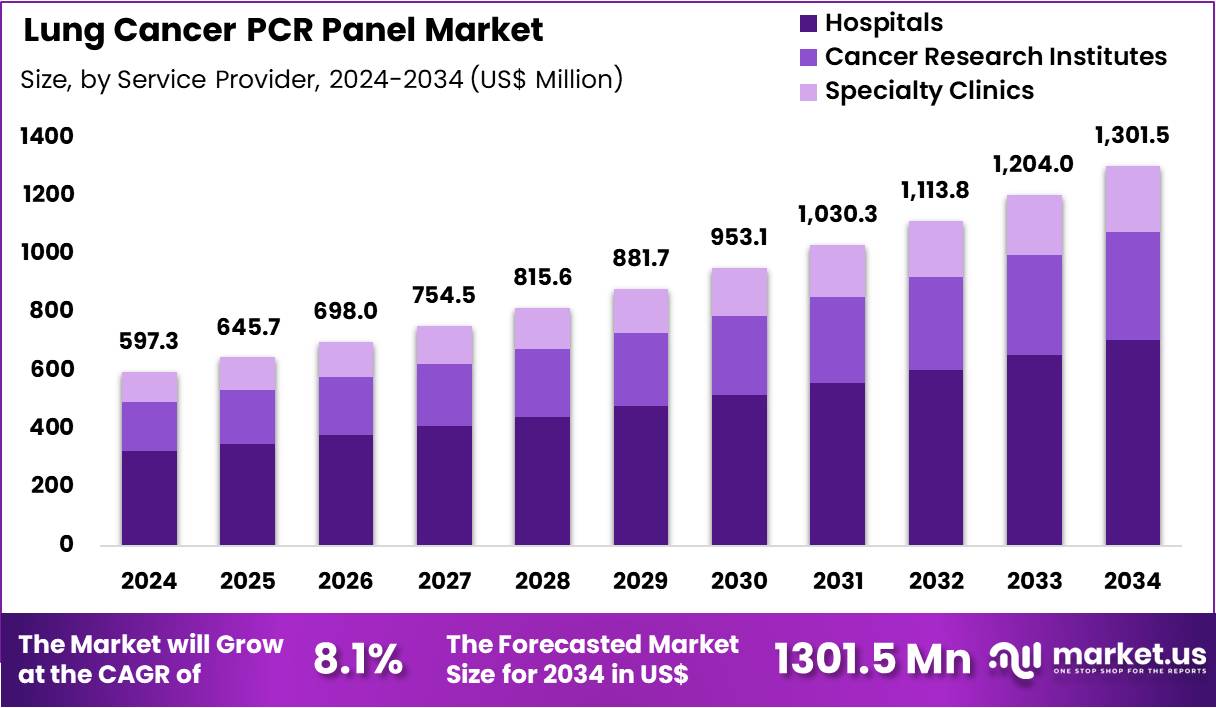
Key Takeaways
- In 2024, the Lung Cancer PCR Panel Market was valued at US$ 597.3 million and is projected to reach US$ 1,301.5 million by 2034, expanding at a CAGR of 8.1% during the forecast period.
- By service provider, the market is segmented into hospitals, cancer research institutes, and specialty clinics. Hospitals dominated the market in 2023, accounting for the largest 54.2% share.
- Based on application, the market is categorized into adenocarcinoma, squamous cell carcinoma (SCC), and large cell carcinoma. Among these, adenocarcinoma emerged as the leading segment, capturing 57.9% of the market share.
- North America held the leading position in the global market in 2024, securing a 38.6% market share, supported by advanced molecular diagnostic infrastructure and widespread adoption of precision oncology.
Statistical Information
- Global Lung Cancer Burden is Driving Demand for PCR Testing: Lung cancer remains the most commonly diagnosed cancer worldwide, with approximately 2.48 million new cases and 1.82 million deaths annually. It accounts for 12.4% of all new cancer cases and 18.7% of all cancer deaths, increasing the need for molecular diagnostics such as PCR panels for early biomarker detection.
- Adenocarcinoma is the Largest Lung Cancer Subtype: CDC data show that adenocarcinoma represented 45% of all newly diagnosed lung cancer cases in the United States in 2022, followed by squamous cell carcinoma (21%) and small cell carcinoma (12%). Adenocarcinoma is the subtype most frequently tested for EGFR and other actionable mutations.
- More Than 218,000 New Lung Cancer Cases are Diagnosed in the U.S.: The CDC reported 218,893 new lung cancer cases in 2022 and 131,584 deaths in 2023 in the United States. From 2018–2022, nearly 50% of patients were diagnosed with distant-stage disease, highlighting the importance of rapid molecular testing for treatment selection.
- Annual Screening Targets Millions of High-Risk Adults: The U.S. Preventive Services Task Force recommends annual low-dose CT (LDCT) screening for adults aged 50–80 years with a 20 pack-year smoking history who currently smoke or quit within the last 15 years. Increased screening leads to more patients requiring PCR-based biomarker testing.
- Smoking Causes About 80% of Lung Cancer Deaths: According to the CDC, approximately 80% of lung cancer deaths in the United States are caused by cigarette smoking. Smokers are 15–30 times more likely to develop or die from lung cancer than people who have never smoked, expanding the population requiring diagnostic testing.
- EGFR Mutations Are Common in NSCLC: According to Roche Diagnostics, EGFR mutations occur in approximately 10–15% of NSCLC patients in North America and Europe and 30–50% of patients in Asia. These patients are eligible for EGFR-targeted therapies, making PCR testing an important part of routine clinical practice.
- More Than 234,000 Americans Were Expected to Be Diagnosed in 2025: The American Cancer Society estimated approximately 234,580 new lung cancer cases and 125,070 deaths in the United States during 2025, reinforcing the continued need for advanced molecular diagnostics and PCR-based biomarker testing.
- Nearly 1 in 16 People Will Develop Lung Cancer During Their Lifetime: According to the American Cancer Society, the lifetime risk of developing lung cancer is about 1 in 16 (6.3%) for men and 1 in 17 (5.9%) for women in the United States. This substantial disease burden supports continued demand for PCR-based molecular diagnostics.
Regional Analysis
North America led the market by securing a market share of 38.6% in 2024.
North America accounted for the largest share of the Lung Cancer PCR Panel Market in 2024, driven by advanced molecular diagnostic infrastructure, widespread adoption of precision oncology, and strong clinical guidelines supporting biomarker testing for non-small cell lung cancer (NSCLC). Hospitals and diagnostic laboratories routinely perform PCR-based testing for biomarkers such as EGFR, KRAS, ALK, ROS1, BRAF, and MET to guide targeted therapies.
The region also benefits from FDA-approved companion diagnostics, favorable reimbursement policies, and high healthcare spending. According to the American Cancer Society, the United States is expected to record 234,580 new lung cancer cases and 125,070 deaths in 2025, highlighting the continued need for rapid molecular diagnostics.
Meanwhile, Asia Pacific is projected to register the fastest growth due to expanding cancer screening programs, increasing investments in molecular laboratories, and rising adoption of genomic medicine. Japan’s National Cancer Center reported 74,518 lung cancer deaths in 2022, supporting increased demand for PCR-based biomarker testing and precision oncology across the region.
Emerging Trends
- Growing Use of Liquid Biopsy PCR Testing: Liquid biopsy is becoming a major trend for patients who cannot undergo tissue biopsy. FDA-authorized liquid companion diagnostic tests now detect EGFR, KRAS, and HER2 mutations from blood samples, enabling faster treatment selection while reducing invasive procedures.
- Expansion of Multiplex PCR Panels: Healthcare providers are increasingly adopting multiplex PCR panels that simultaneously detect multiple biomarkers such as EGFR, ALK, KRAS, BRAF, ROS1, RET, and MET. Testing multiple mutations from one sample reduces turnaround time and supports precision oncology in NSCLC patients.
- Higher Sensitivity with Digital PCR Technologies: Digital droplet PCR (ddPCR) is gaining popularity because it offers a detection limit of 0.1–1%, compared with 1–5% for conventional qPCR. This allows laboratories to detect low-frequency mutations more accurately for treatment monitoring.
- Companion Diagnostics Continue to Expand: The FDA continues to authorize companion diagnostic assays for lung cancer. By May 2026, multiple companion diagnostics supported targeted therapies for biomarkers including EGFR, KRAS G12C, and HER2, strengthening the role of PCR testing in personalized medicine.
- Greater Adoption of Plasma-Based Molecular Testing: Hospitals are increasingly using plasma-based PCR assays when tissue samples are unavailable. Clinical studies reported 94% concordance between tissue and liquid biopsy for EGFR testing, supporting wider clinical adoption of minimally invasive molecular diagnostics
Use Cases
- Selection of Targeted Therapies: PCR panels are routinely used to identify EGFR, ALK, KRAS, ROS1, and BRAF mutations before treatment. Detecting these biomarkers enables physicians to prescribe targeted medicines that improve treatment response and reduce unnecessary therapies.
- Testing Advanced Non-Small Cell Lung Cancer (NSCLC): Since about 85% of lung cancers are NSCLC, PCR panels are widely used to profile newly diagnosed advanced patients. Early biomarker identification helps oncologists choose personalized first-line therapies more efficiently.
- Monitoring Treatment Resistance: PCR testing helps detect resistance mutations such as EGFR T790M, allowing physicians to modify treatment before clinical disease progression. This supports continuous disease monitoring and improves long-term patient management.
- Supporting Patients Without Tissue Biopsies: PCR-based liquid biopsy provides an alternative for patients who cannot undergo surgical biopsy because of health conditions or insufficient tissue. Blood-based testing enables rapid mutation analysis while minimizing patient discomfort and procedural risks.
- Improving Laboratory Efficiency: Multiplex PCR panels allow laboratories to test several actionable biomarkers from a single specimen instead of performing multiple individual assays. This reduces repeat testing, shortens reporting time, and helps hospitals manage increasing volumes of oncology diagnostic samples.
Frequently Asked Questions on Lung Cancer PCR Panel
- Which biomarkers are detected by PCR panels?
PCR panels commonly detect EGFR, KRAS, ALK, ROS1, RET, BRAF, MET, and HER2 mutations, enabling personalized treatment strategies based on each patient’s genetic profile. - Can PCR panels use blood samples?
Yes. Many PCR panels support liquid biopsy testing using blood samples, providing a minimally invasive alternative when tissue biopsy is unavailable or insufficient. - How long does PCR testing take?
Most PCR-based molecular tests provide results within a few hours to several days, allowing physicians to begin targeted treatment more quickly than many traditional diagnostic methods. - Where are Lung Cancer PCR Panels commonly used?
They are widely used in hospitals, diagnostic laboratories, cancer centers, academic medical institutions, and specialty oncology clinics for routine molecular testing. - What are the advantages of multiplex PCR panels?
Multiplex PCR panels analyze several biomarkers simultaneously from one sample, reducing testing time, tissue requirements, and laboratory costs while improving diagnostic efficiency. - Can PCR testing monitor treatment response?
Yes. PCR testing can identify resistance mutations during treatment, helping physicians modify therapies when tumors develop resistance to targeted medicines. - What factors are driving market growth?
Growth is driven by increasing lung cancer incidence, expanding precision medicine, rising use of targeted therapies, technological advancements, and greater demand for companion diagnostics. - Which region leads the Lung Cancer PCR Panel Market?
North America leads the market because of advanced healthcare systems, widespread molecular testing, favorable reimbursement policies, and strong precision medicine adoption.
Conclusion
The Lung Cancer PCR Panel Market is expected to witness sustained growth as precision oncology becomes a standard approach in lung cancer diagnosis and treatment. Rising global lung cancer incidence, increasing adoption of biomarker-guided therapies, and expanding use of multiplex PCR and liquid biopsy technologies continue to strengthen market demand.
Hospitals, diagnostic laboratories, and cancer centers are investing in advanced molecular testing to improve diagnostic accuracy and accelerate treatment decisions. Supportive regulatory approvals, ongoing technological innovations, and greater awareness of personalized medicine are further driving market expansion. These factors position the market for steady growth and continued innovation throughout the forecast period.
Discuss your needs with our analyst
Please share your requirements with more details so our analyst can check if they can solve your problem(s)




