


Overview
New York, NY – Sep 18, 2026 –The Global Luer Lock Connector Market size is expected to be worth around US$ 2.57 Billion by 2034 from US$ 1.82 Billion in 2024, growing at a CAGR of 3.5% during the forecast period 2025 to 2034. In 2024, North America led the market, achieving over 36.5% share with a revenue of US$ 664.3 Million.
Luer Lock Connector is witnessing significant growth due to increasing demand for secure, standardized, and leak-resistant connection systems across hospitals, clinics, and home healthcare settings. These connectors are widely used in intravenous (IV) therapy, syringes, catheters, infusion pumps, and drug delivery devices, where reliable fluid transfer is essential for patient safety.
The rising number of surgical procedures and chronic disease cases is a major factor supporting market expansion. According to global healthcare data, more than 300 million major surgical procedures are performed worldwide every year, creating continuous demand for advanced medical connectors and infusion accessories. Additionally, approximately 1.5 billion peripheral intravenous (IV) catheter procedures are estimated to be performed annually, increasing the adoption of Luer lock-based systems.
The growing burden of chronic diseases is further accelerating demand. The World Health Organization (WHO) reports that noncommunicable diseases contribute to nearly 41 million deaths annually, representing around 74% of global deaths, leading to increased requirements for long-term medication delivery solutions, including infusion therapy and injectable drug administration systems.
Technological innovation is improving the performance of Luer lock connectors, with manufacturers focusing on needle-free connectors, antimicrobial technologies, and safety-engineered designs.
Healthcare facilities are adopting these solutions to reduce medication errors, prevent leakage, and improve infection control. Studies indicate that healthcare-associated infections affect hundreds of millions of patients globally each year, increasing the need for safer medical device components.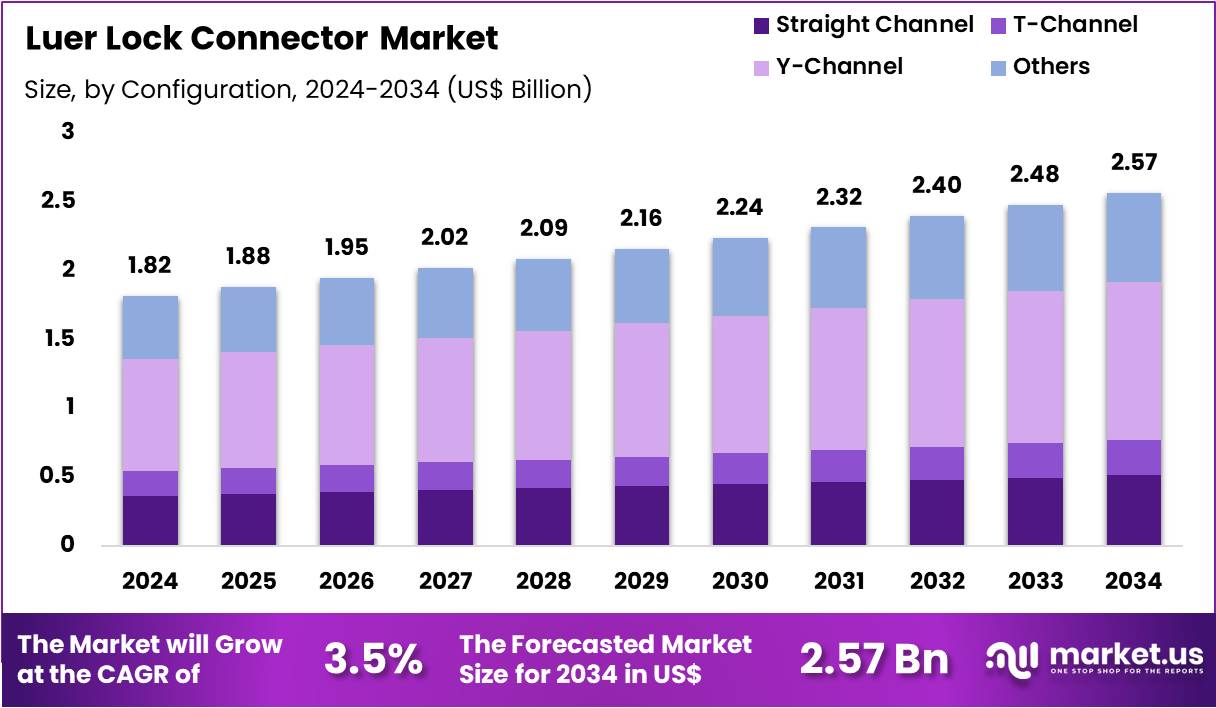
Key Takeaways
- The Luer Lock Connector Market generated a revenue of US$ 1.82 billion in 2024 and is projected to grow at a CAGR of 3.5%, reaching approximately US$ 2.57 billion by 2034.
- Based on Configuration, the market is segmented into Straight Channel, T-Channel, Y-Channel, and Others. The Y-Channel segment dominated in 2024, accounting for a market share of 44.8%.
- Based on Fluid-Displacement Type, the market is categorized into Positive Displacement, Neutral Displacement, and Negative Displacement. The Positive Displacement segment held the leading position in 2024, with a market share of 51.2%.
- Based on Connector Type, the market is segmented into Male Luer Lock Connector and Female Luer Lock Connector. The Female Luer Lock Connector segment led the market in 2024, capturing a share of 62.3%.
- Based on End-User, the market includes Hospitals, Clinics, Ambulatory Surgical Centers, Maternity Centers, Long-Term Care Facilities, Home-Healthcare Settings, and Others. The Hospitals segment dominated in 2024, with a market share of 37.9%.
- Regionally, North America emerged as the leading market in 2024, accounting for a significant market share of 36.5% due to advanced healthcare infrastructure, high adoption of medical devices, and increasing demand for infusion therapy solutions.
Market Segmentation Overview
- Configuration Analysis: The Configuration segment was led by Y-Channel connectors, accounting for a 44.8% market share in 2024. The strong adoption is driven by their ability to support multiple fluid pathways, synchronized medication delivery, and efficient infusion management across critical care, oncology, dialysis, and intensive care applications.
- Fluid-Displacement Type Analysis: The Fluid-Displacement Type segment was dominated by Positive Displacement connectors, holding a 51.2% market share in 2024. Their demand is increasing due to improved catheter performance, reduced reflux risks, and enhanced line patency, making them widely preferred in infusion therapy, oncology, dialysis, and long-term medication administration.
- Connector Type Analysis: The Connector Type segment was led by Female Luer Lock Connectors, capturing a 62.3% market share in 2024. These connectors are extensively used in IV systems, catheters, valves, and fluid-transfer devices due to their secure locking mechanism, compatibility with multiple medical devices, and role in maintaining sterile connections.
- End-User Analysis: The End-User segment was dominated by Hospitals, accounting for a 37.9% market share in 2024. Hospitals generate high demand due to extensive usage of Luer lock connectors in intensive care, surgery, emergency medicine, oncology, and infusion therapy procedures, supported by increasing patient admissions and healthcare service requirements.
Statistical Information
- Hospital Study Found Microbial Growth In Luer Connector Hubs: A clinical study cultured 243 intravenous catheter connector hubs and detected microbial growth in 56 hubs, equal to 23.0%. The sample included 68 PICC lines, 60 internal-jugular lines, 93 peripheral venous catheters, and 25 other central-line types. Of all hubs tested, 176 or 71.5% were in intensive-care units. This supports demand for disinfectable, closed, and infection-resistant Luer-lock connector designs.
- Luer Access System Demonstrated Lower Connector Contamination Rates: In a comparison of 50 Luer-lock-cap samples and 50 split-septum Luer-access samples, contamination was detected in 4 of 50 cap samples, or 8%. The split-septum system recorded 0 of 50 contaminated samples, equal to 0%. The study also reported bloodstream-infection rates of 9.49 versus 5.77 per 1,000 central-line days, respectively.
- Standard Cap Testing Shows Substantial Microbial Contamination Difference: A prospective trial tested 200 standard-capped three-way stopcock Luer connectors and found microorganisms on the internal surfaces of 20 connectors, or 10%. In comparison, only 1 of 193 connectors with an antiseptic microbial-barrier cap was contaminated, equal to approximately 0.5%. This represents a 9.5-percentage-point reduction in observed contamination and supports demand for antimicrobial Luer caps.
- Antiseptic Luer Caps Reduced Microbial Transmission By Ninety Eight Percent: In a laboratory trial, all 15 of 15 untreated Luer-activated connectors transmitted microorganisms. After conventional 70% alcohol disinfection, 20 of 30 connectors, or 67%, still transmitted microorganisms. With a passive antiseptic cap applied for 10 minutes, only 1 of 60 connectors, or 1.6%, showed transmission. This represents a relative reduction of approximately 97.6% versus alcohol-disinfected connectors.
- Oncology Connector Incompatibility Increased CLABSI Rates By Fifty Per cent: A hospital oncology evaluation recorded 68 CLABSIs across 34,575 central-line days before a connector implementation, equal to 2.0 infections per 1,000 line-days. During implementation, 22 CLABSIs occurred across 7,198 line-days, equal to 3.1 per 1,000 line-days. This was a 55% increase. The study identified Luer-lock incompatibility with the selected disinfection cap as a contributing implementation issue.
Regional Analysis
North America led the market by securing a market share of 36.5% in 2024.
North America held the leading position in the Luer Lock Connector Market in 2024, supported by advanced healthcare infrastructure, high adoption of infusion technologies, and strong medical device safety regulations. The United States records more than 130 million emergency department visits annually, creating significant demand for secure IV access and medication delivery systems.
The region also performs millions of surgical and infusion procedures each year, increasing the use of Luer lock connectors in anesthesia, critical care, and drug administration. Rising cancer incidence, with approximately 2 million new cancer cases expected annually in the U.S., further supports demand for infusion-related connector systems.
Asia Pacific is expected to witness significant growth due to expanding healthcare infrastructure, increasing surgical procedures, and rising demand for infusion therapy. China and other emerging economies are investing heavily in hospitals, critical care facilities, and medical device adoption. Growing chronic disease cases and increasing healthcare access are accelerating the requirement for reliable Luer lock connector systems across hospitals and outpatient settings.
Business Opportunities
The Luer Lock Connector Market offers significant business opportunities due to increasing demand for safe, efficient, and standardized medical connection systems. Growing adoption of infusion therapy, injectable drug delivery, and catheter-based treatments is encouraging manufacturers to develop advanced connectors with improved safety features.
Companies have opportunities to expand through needle-free connectors, antimicrobial technologies, and closed-system designs that help reduce contamination risks and improve patient safety.
The rising adoption of home healthcare and outpatient infusion services is creating demand for compact and easy-to-use connector solutions. Emerging markets are also providing growth opportunities as healthcare infrastructure, hospitals, and critical care facilities continue expanding.
Manufacturers can focus on customized connector solutions for oncology, dialysis, pediatrics, and intensive care applications. Strategic partnerships with hospitals, medical device companies, and healthcare providers, along with regulatory approvals for innovative products, can further support market expansion and strengthen competitive positioning.
Emerging Trends
- Growing Adoption of Safety-Enhanced Connectors: Healthcare facilities are increasingly using advanced Luer lock connectors with improved locking mechanisms, anti-reflux features, and needle-free designs to reduce connection errors and improve patient safety. The FDA promotes ISO 80369 standards to minimize medical device misconnections.
- Increasing Demand for Infection-Control Technologies: Hospitals are adopting closed-system and antimicrobial connector technologies to reduce contamination risks during IV therapy. CDC data shows approximately 1 in 31 hospitalized patients experiences at least one healthcare-associated infection, increasing demand for safer connector solutions.
- Expansion of Infusion Therapy Applications: Rising use of chemotherapy, biologics, and long-term injectable treatments is increasing demand for reliable Luer lock systems. WHO reported nearly 20 million new cancer cases globally in 2022, supporting higher requirements for infusion-based medical procedures.
- Development of Specialized Connector Designs: Manufacturers are focusing on application-specific connectors for oncology, dialysis, pediatrics, anesthesia, and critical care. Advanced designs aim to improve flow control, compatibility, and reliability across different healthcare environments.
- Increasing Use in Home Healthcare Settings: Growth in home-based infusion therapy and long-term care is creating demand for portable and easy-to-use Luer lock connector systems. These connectors support safe medication delivery for patients requiring extended treatments outside hospitals.
Use Cases
- Intravenous (IV) Medication Administration: Luer lock connectors are widely used in hospitals for secure attachment between syringes, IV tubing, and catheters. They support accurate delivery of fluids, antibiotics, chemotherapy drugs, and other medications while reducing leakage and accidental disconnection risks during treatment.
- Oncology Infusion Therapy: Cancer treatment centers use Luer lock connectors for chemotherapy and supportive drug delivery systems. With nearly 20 million new cancer cases reported globally in 2022, reliable multi-line connectors help healthcare professionals safely manage complex infusion procedures and medication combinations.
- Intensive Care Unit (ICU) Applications: ICUs use Luer lock connectors for continuous medication delivery, fluid management, and monitoring procedures. Critically ill patients often require multiple infusion lines, making secure and standardized connectors essential for maintaining safe and uninterrupted treatment.
- Dialysis and Renal Care: Luer lock connectors are used in dialysis systems for secure fluid connections and medication administration. Growing kidney disease prevalence, affecting more than 850 million people worldwide according to the International Society of Nephrology, increases demand for reliable connector technologies.
- Emergency and Trauma Care: Emergency departments rely on Luer lock systems for rapid IV access, blood sampling, and fluid replacement procedures. These connectors support quick and secure connections during urgent situations where accurate medication delivery and patient stabilization are critical.
Recent Development
- In June 2026, B. Braun Melsungen AG expanded its strategic collaboration with Dräger to develop a connected acute care ecosystem. The collaboration focuses on improving ICU and perioperative workflows by integrating infusion therapy, patient monitoring, and digital interoperability solutions to enhance medication safety and clinical efficiency.
- In 2026, B. Braun continued promoting NRFit® connector adoption for neuraxial and regional anesthesia applications. The connector system follows ISO 80369-6 standards and is designed to reduce wrong-route medication errors associated with universal Luer connector compatibility. B. Braun reported more than 3,000 successful NRFit® conversions globally.
- In 2026, ICU Medical continued supporting advanced IV connector solutions through its CLAVE® connector platform. The company’s needle-free connector systems are designed for intravascular applications, supporting secure access between syringes, catheters, and infusion systems used in hospitals and critical-care environments.
- In 2026, manufacturers continued focusing on reducing medical device misconnections through standardized connector technologies. Companies are aligning products with ISO 80369 standards to improve patient safety by reducing accidental connections between incompatible medical devices used in infusion, anesthesia, and vascular access procedures.
Frequently Asked Questions About Luer Lock Connector
- What is driving the growth of the Luer Lock Connector Market?
The Luer Lock Connector Market is growing due to increasing IV therapy procedures, rising chronic disease cases, expanding surgical volumes, and higher demand for safe medication delivery systems. Hospitals are adopting advanced connectors to improve patient safety and reduce connection-related risks. - Which configuration segment dominates the Luer Lock Connector Market?
The Y-Channel configuration segment dominated the market in 2024 with a 44.8% share. Its growth is supported by increasing use in multi-line infusion therapies, intensive care units, oncology treatments, and situations requiring simultaneous administration of multiple fluids. - Why are hospitals the largest end-users of Luer Lock Connectors?
Hospitals dominated the end-user segment with a 37.9% share in 2024 due to high usage across intensive care, surgery, emergency medicine, oncology, and infusion therapy. Large patient volumes and frequent medication administration increase demand for reliable connector systems. - How do Luer Lock Connectors improve patient safety?
Luer Lock Connectors improve patient safety by providing secure connections, reducing leakage, minimizing accidental disconnections, and supporting standardized medical device compatibility. Advanced needle-free and closed-system designs also help healthcare providers reduce contamination and infection risks. - What role does infection prevention play in market growth?
Infection prevention is a major factor influencing Luer Lock Connector adoption. Healthcare facilities are increasingly using advanced connectors with safety features to reduce contamination risks during IV procedures and support infection control practices recommended by healthcare organizations. - Which region leads the Luer Lock Connector Market?
North America led the Luer Lock Connector Market in 2024 with a 36.5% share. The region benefits from advanced healthcare infrastructure, high adoption of infusion technologies, strong regulatory standards, and increasing demand for safe medical device solutions. - What are the emerging trends in the Luer Lock Connector Market?
Key emerging trends include development of needle-free connectors, antimicrobial technologies, smart connector systems, ISO-standardized designs, and customized solutions for oncology, dialysis, and critical care applications. Manufacturers are focusing on improving safety, efficiency, and compatibility. - What is the future outlook for the Luer Lock Connector Market?
The Luer Lock Connector Market is expected to grow steadily due to rising healthcare demand, increasing infusion procedures, technological advancements, and expanding medical device applications. Innovation in safety-focused connector systems will continue shaping future market opportunities.
Conclusion
The Luer Lock Connector Market is experiencing steady growth due to increasing demand for safe, reliable, and standardized medical connection systems across hospitals, clinics, and home healthcare settings. Rising infusion therapy procedures, chronic disease prevalence, surgical volumes, and infection prevention initiatives are driving adoption of advanced connectors.
Y-Channel configurations, Positive Displacement systems, Female Luer Lock Connectors, and hospital applications continue to dominate market demand. Technological advancements, including needle-free connectors, antimicrobial designs, and standardized safety solutions, are creating new growth opportunities. With strong healthcare infrastructure development and increasing focus on patient safety, the market is expected to witness consistent expansion in the coming years.
Discuss your needs with our analyst
Please share your requirements with more details so our analyst can check if they can solve your problem(s)




