


Overview
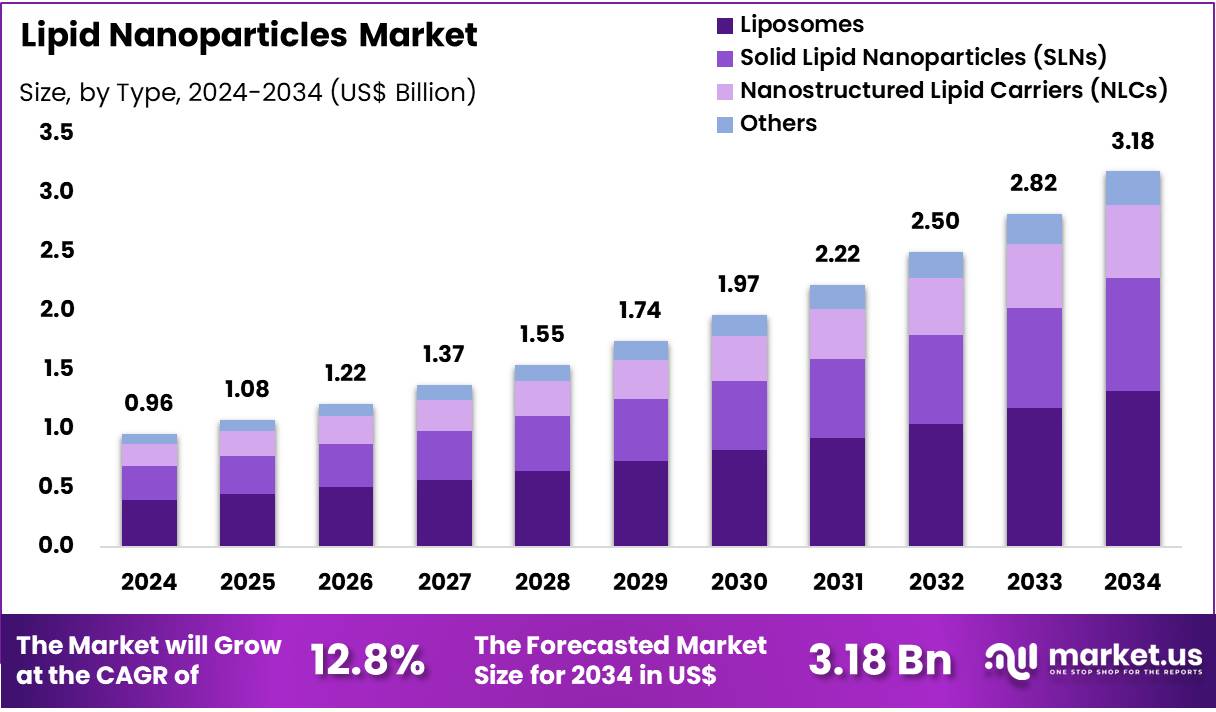
Global Lipid Nanoparticles Market size is expected to be worth around US$ 3.18 Billion by 2034 from US$ 0.96 Billion in 2024, growing at a CAGR of 12.8% during the forecast period from 2025 to 2034. In 2024, North America led the market, achieving over 35.2% share with a revenue of US$ 336.2 Million.
Lipid nanoparticles are designed to protect fragile nucleic acid molecules and improve their delivery into target cells. Their success in mRNA vaccine technology has accelerated research across infectious diseases, cancer immunotherapy, and rare genetic disorders. Pharmaceutical companies and biotechnology firms continue to increase investments in LNP formulation technologies to improve stability, delivery efficiency, and manufacturing scalability.
Technological advances in ionizable lipids, microfluidic manufacturing, and precision drug delivery are supporting broader commercial adoption. Growing clinical trials involving RNA-based therapeutics and expanding regulatory approvals for advanced biologics are further strengthening demand.
North America remains a leading regional market due to strong biopharmaceutical research, advanced manufacturing infrastructure, and significant public and private R&D investments, while Asia-Pacific is emerging as the fastest-growing region with increasing biotechnology capabilities.
As precision medicine and nucleic acid-based therapies continue to expand globally, lipid nanoparticles are expected to remain a critical platform for next-generation drug delivery, supporting innovation across vaccines, oncology, genetic disorders, and other advanced therapeutic applications.
Key Takeaways
- Market Size: The global Lipid Nanoparticles market was valued at US$ 0.96 billion in 2024 and is projected to reach US$ 3.18 billion by 2034.
- Market Growth: The market is anticipated to expand at a CAGR of 12.8% during the forecast period from 2025 to 2034.
- Type Analysis: The Liposomes segment held the largest share, accounting for 41.6% of the global market in 2024.
- Molecule Type Analysis: The mRNA segment dominated the market with a 56.4% share in 2024, driven by its widespread use in vaccines, protein replacement therapies, and immuno-oncology applications.
- Application Analysis: The Therapeutics segment led the market, capturing 62.3% of the global revenue share in 2024.
- End-Use Analysis: Pharmaceutical and biopharmaceutical companies emerged as the leading end-user segment, accounting for 50.7% of the total market share in 2024.
- Regional Analysis: North America dominated the global Lipid Nanoparticles market in 2024, holding a 35.2% market share and generating US$ 336.2 million in revenue.
Statistical Information
- A continuous mRNA-LNP manufacturing process achieved an encapsulation efficiency of 95.5 ± 4.0%, demonstrating highly efficient payload loading during production
- The same continuous manufacturing process produced lipid nanoparticles with an average particle size of 105 ± 6 nm, supporting consistent product quality in large-scale manufacturing (2025).
- The manufacturing process maintained a polydispersity index (PDI) of 0.10 ± 0.02, indicating a highly uniform nanoparticle population suitable for therapeutic use.
- Single-pass tangential flow filtration recovered approximately 90% of lipid nanoparticles while providing a 10× concentration factor during downstream purification.
- Continuous purification reduced residual ethanol in finished lipid nanoparticle formulations to just 0.003%, helping meet stringent pharmaceutical quality requirements.
- The same study reported only 0.4 ± 0.05% unloaded lipid nanoparticles after purification, demonstrating highly efficient payload incorporation.
- mRNA integrity remained at 86.2 ± 3.0% following continuous encapsulation and purification, indicating limited degradation during manufacturing.
- Researchers encapsulated proteins into lipid nanoparticles with encapsulation efficiency using microfluidic manufacturing with anionic lipids.
Regional Analysis
In 2024, North America accounted for more than 35.2% of the global lipid nanoparticles (LNP) market, generating approximately US$ 336.2 million in revenue. The region maintained its leading position due to its well-established pharmaceutical and biotechnology industry, strong research capabilities, and extensive investment in advanced drug delivery technologies.
High adoption of lipid nanoparticles for mRNA vaccines, gene therapies, siRNA therapeutics, and nucleic acid-based medicines continued to support market expansion. The presence of leading biotechnology companies, contract development and manufacturing organizations (CDMOs), and research institutions accelerated innovation and commercialization of LNP platforms.
In addition, support from organizations such as the National Institutes of Health (NIH) and regulatory oversight by the U.S. Food and Drug Administration (FDA) encouraged the development of next-generation lipid formulations and clinical research. Growing public and private funding, expanding manufacturing capacity, and increasing collaborations between academia and industry further strengthened the regional ecosystem.
These advantages are expected to help North America maintain its leadership in the global lipid nanoparticles market as new therapeutic applications continue to emerge.
Emerging Trends
- Expansion of mRNA-Based Medicines: Lipid nanoparticles (LNPs) are becoming the preferred delivery system for mRNA medicines beyond COVID-19 vaccines. Current research is expanding into cancer vaccines, rare diseases, and infectious diseases. Standard LNP formulations commonly contain 4 lipid components: ionizable lipid, cholesterol, phospholipid, and PEG-lipid, improving RNA stability and cellular delivery.
- Targeted Delivery to Multiple Organs: Researchers are developing next-generation LNPs that can deliver RNA beyond the liver to organs such as the lungs, pancreas, and spleen. This improves treatment precision while reducing unwanted exposure. Modified ionizable lipids and optimized formulations are enabling more organ-specific delivery than conventional LNP technologies.
- Advanced Lipid Engineering: The industry is focusing on designing safer and more effective ionizable lipids. Modern LNP formulations continue to use four essential lipid ingredients, while new lipid chemistries improve biodegradability, RNA release, and tolerability. These advances support repeated dosing for chronic diseases and gene therapies.
- Growth of Microfluidic Manufacturing: Microfluidic production is becoming the preferred manufacturing method because it produces highly uniform nanoparticles with better batch consistency. Controlled mixing improves particle size, RNA encapsulation efficiency, and manufacturing scalability, supporting commercial production of LNP-based therapeutics and vaccines.
- Improved Regulatory and Quality Standards: Healthcare regulators continue strengthening guidance for LNP-based medicines. The World Health Organization published regulatory recommendations covering manufacturing, quality control, non-clinical evaluation, and clinical assessment of mRNA vaccines delivered through lipid nanoparticles, helping improve global product quality and safety.
Use Cases
- mRNA Vaccine Delivery: LNPs protect fragile mRNA molecules and transport them into cells for protein production. This technology enabled the rapid development of COVID-19 vaccines and is now being applied to influenza, RSV, and other infectious disease vaccine programs using the same delivery platform.
- Cancer Immunotherapy: Lipid nanoparticles are increasingly used to deliver therapeutic mRNA that instructs immune cells to recognize tumors. Clinical research is evaluating personalized cancer vaccines and immune therapies for multiple cancer types, making LNPs an important platform for precision oncology.
- Gene Editing and RNA Therapeutics: LNPs are widely investigated for delivering gene-editing molecules such as CRISPR components, siRNA, and mRNA. Their non-viral delivery approach reduces manufacturing complexity while protecting nucleic acids until they reach target cells, supporting future genetic disease treatments.
- Rare and Genetic Disease Treatment: Healthcare researchers are developing LNP-based therapies for inherited metabolic and rare genetic disorders. By safely transporting therapeutic RNA into cells, lipid nanoparticles may replace defective proteins or restore normal biological function without using viral vectors.
- Rapid Pandemic Preparedness: LNP technology enables the quick formulation of new mRNA vaccines against emerging pathogens. The WHO recognizes LNP-packaged mRNA vaccines as an important platform because vaccine candidates can be designed and manufactured rapidly when new infectious disease outbreaks occur.
Frequently Asked Questions on Lipid Nanoparticles
- What factors are driving the growth of the Lipid Nanoparticles Market?
The market is growing due to increasing investments in RNA-based medicines, rising approvals of advanced biologics, expanding clinical trials, and continuous improvements in drug delivery technologies. Growing research on personalized medicine and gene editing also supports wider adoption of lipid nanoparticle platforms worldwide. - Which therapeutic areas use lipid nanoparticles the most?
Lipid nanoparticles are widely used in infectious disease vaccines, cancer immunotherapy, gene therapy, rare genetic disorders, and RNA interference treatments. Researchers are also exploring their use for cardiovascular diseases, neurological disorders, autoimmune conditions, and targeted delivery of anti-inflammatory medicines. - What are the main advantages of lipid nanoparticles?
Lipid nanoparticles improve drug stability, increase delivery efficiency, reduce degradation of nucleic acids, and enhance cellular uptake. They also support controlled release, targeted drug delivery, and lower dosing requirements, making them valuable for next-generation pharmaceutical products and precision medicine applications. - Which regions lead the Lipid Nanoparticles Market?
North America currently leads the market due to strong biotechnology infrastructure, extensive clinical research, significant healthcare investments, and supportive regulatory systems. Europe follows with active pharmaceutical innovation, while Asia-Pacific is experiencing rapid growth through expanding manufacturing capacity and increasing biotechnology research activities. - Who are the major end users in the Lipid Nanoparticles Market?
Major end users include pharmaceutical companies, biotechnology firms, contract development and manufacturing organizations (CDMOs), academic research institutes, and hospitals. These organizations use lipid nanoparticles for drug discovery, vaccine production, clinical development, and commercialization of advanced therapeutic products. - How are lipid nanoparticles different from traditional drug delivery systems?
Unlike conventional drug delivery systems, lipid nanoparticles effectively encapsulate delicate genetic materials such as mRNA and siRNA while protecting them from degradation. They enhance targeted cellular delivery, improve therapeutic performance, and reduce unwanted side effects compared with many traditional formulations. - What is the future outlook for the Lipid Nanoparticles Market?
The future outlook remains highly positive as pharmaceutical companies continue investing in RNA therapeutics, personalized medicine, and gene-editing technologies. Advances in formulation science, scalable manufacturing, and targeted drug delivery are expected to create new commercial opportunities across multiple therapeutic applications.
Conclusion
The global lipid nanoparticles market is poised for sustained growth, driven by rising demand for advanced drug delivery systems, expanding RNA-based therapeutics, and continuous innovation in nanomedicine. Liposomes remain the leading product type, while mRNA-based applications continue to strengthen market demand across vaccines and targeted therapies.
Pharmaceutical and biopharmaceutical companies are the primary end users, supported by increasing investments in clinical research and manufacturing capabilities. North America maintains its leadership due to strong biotechnology infrastructure, favorable regulatory support, and high research activity. Meanwhile, the Asia-Pacific is emerging as a high-growth region through expanding biopharmaceutical production and government-backed life sciences initiatives.
As precision medicine and nucleic acid therapies become more widely adopted, lipid nanoparticles are expected to play a critical role in the future of drug development, creating significant opportunities for technology providers, pharmaceutical manufacturers, and research organizations worldwide.
Discuss your needs with our analyst
Please share your requirements with more details so our analyst can check if they can solve your problem(s)




