


Overview
New York, NY – July 30, 2026 –Global Lipase Testing Reagents Market size is expected to be worth around US$ 1.8 Billion by 2034 from US$ 0.9 Billion in 2024, growing at a CAGR of 7.1% during the forecast period 2025 to 2034. In 2024, North America led the market, achieving over 39.5% share with a revenue of US$ 0.4 Billion.
Lipase testing reagents are specialized diagnostic chemicals used in clinical laboratories to measure lipase enzyme levels in blood or other biological samples. Lipase is a digestive enzyme primarily produced by the pancreas, and elevated or reduced lipase levels can help healthcare professionals diagnose and monitor pancreatic disorders such as acute pancreatitis, chronic pancreatitis, pancreatic cancer, and other gastrointestinal diseases. These reagents are commonly used with automated clinical chemistry analyzers to deliver fast, accurate, and reproducible test results.
The growing burden of pancreatic diseases, increasing hospital admissions for digestive disorders, and rising demand for early disease diagnosis are driving the adoption of lipase testing reagents worldwide. Advances in reagent formulations have improved assay sensitivity, stability, and compatibility with high-throughput laboratory systems, enabling faster turnaround times and greater testing efficiency. Many laboratories now use standardized enzymatic colorimetric methods that provide reliable performance while supporting quality assurance requirements.
Healthcare providers are increasingly integrating lipase testing into routine diagnostic panels for patients presenting with abdominal pain or suspected pancreatic dysfunction. The expansion of diagnostic laboratories, greater access to automated testing platforms, and continuous investments in healthcare infrastructure are further supporting market growth. In addition, regulatory emphasis on accurate clinical diagnostics and the growing use of laboratory automation are encouraging the development of innovative reagent solutions.
As demand for precise and efficient diagnostic testing continues to rise, lipase testing reagents are expected to remain an essential component of modern clinical chemistry, supporting improved patient care, timely clinical decision-making, and enhanced laboratory productivity across hospitals, diagnostic centers, and reference laboratories.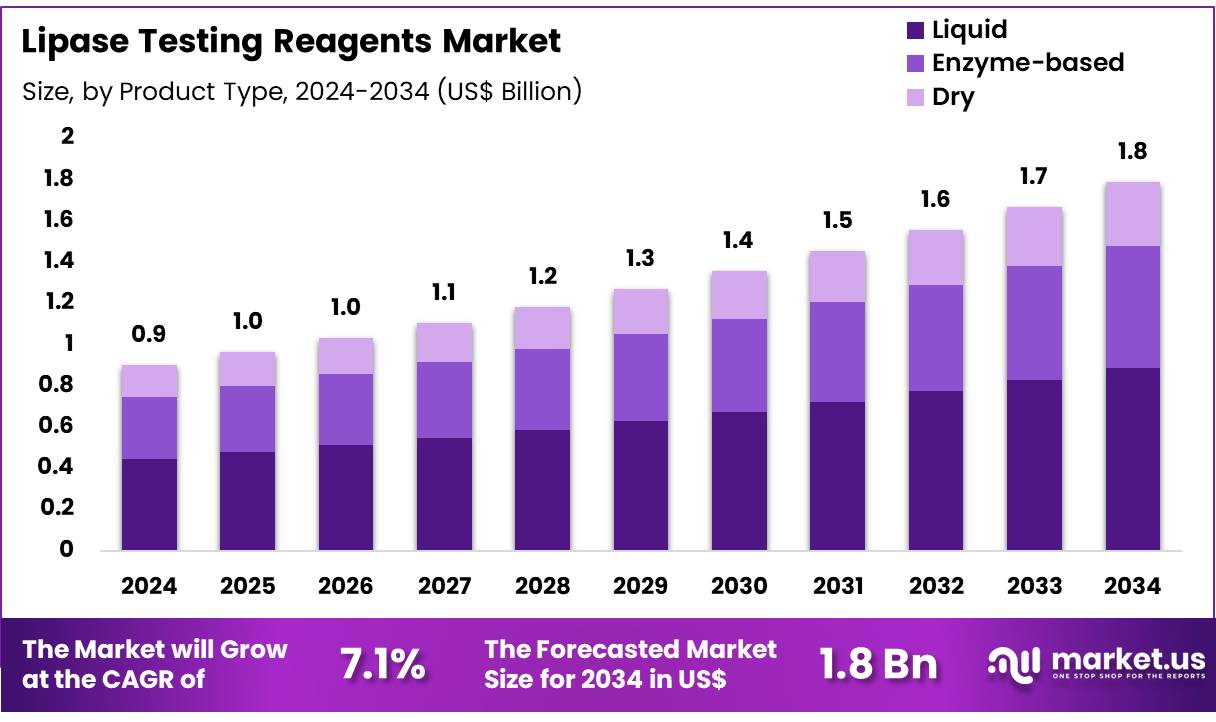
Key Takeaways
- In 2024, the global lipase testing reagents market was valued at US$ 0.9 billion and is projected to reach US$ 1.8 billion by 2034, expanding at a CAGR of 7.1% during the forecast period.
- By product type, the market is segmented into liquid, enzyme-based, and dry reagents. The liquid segment emerged as the leading category in 2023, accounting for 49.6% of the total market share, supported by its ease of use, high stability, and widespread adoption in diagnostic laboratories.
- Based on technology, the market is categorized into synthetic lipases, recombinant lipases, and natural lipases. Among these, synthetic lipases held the largest share of 44.7% in 2023, owing to their consistent performance, enhanced specificity, and broad application in laboratory testing.
- By application, the market is divided into clinical diagnostics, the food industry, and biochemical research. The clinical diagnostics segment dominated the market with a 52.9% revenue share, driven by the growing demand for pancreatic function assessment and digestive disorder diagnosis.
- By end users, the market is segmented into hospitals, research institutions, and diagnostic laboratories. The hospitals segment led the market, capturing 47.8% of the total revenue, supported by high patient volumes and increasing diagnostic testing.
- North America remained the leading regional market in 2023, accounting for 39.5% of the global market share, driven by advanced healthcare infrastructure, widespread diagnostic testing, and strong adoption of laboratory technologies.
Statistical Information
- A 2025 Clinical Biochemistry study reported that the Roche lipase reagent hemolysis interference threshold was reduced by 90%, from a hemolysis index (HI) of 1000 (10 g/L hemoglobin) to HI 100 (1 g/L hemoglobin), potentially increasing specimen recollection and affecting laboratory workflow.
- The same 2025 study found that mild-to-moderate hemolysis had minimal impact on lipase measurements except when lipase concentrations were below 40 U/L, indicating reliable reagent performance across most clinical samples.
- According to a 2025 IFU for a commercial lipase reagent, opened reagent bottles remain stable for 30 days when stored at 2–8°C, supporting extended laboratory use without frequent replacement.
- The same 2025 reagent documentation states that adult reference values are ≤60 U/L, verified according to the CLSI EP28-A3c protocol for clinical laboratory reference intervals.
- The 2025 reagent formulation specifies a lipase substrate concentration of at least 0.70 mmol/L and calcium ion concentration of at least 1 mmol/L, ensuring standardized enzymatic reaction conditions.
- The same 2025 technical insert specifies reagent composition including Tris buffer at 40 mmol/L, colipase at ≥1 mg/L, deoxycholate at ≥1.8 mmol/L, and taurodeoxycholate at ≥7.0 mmol/L for optimized assay performance.
- Researchers reported in 2025 that lowering the Roche hemolysis threshold from HI 1000 to HI 100 could substantially increase laboratory result flagging and slow reporting workflows because more specimens would require review or recollection.
- A 2025 Zoetis technical white paper summarized published validation studies showing DGGR lipase reagent sensitivity of up to 93.0% for canine pancreatitis and specificity up to 74.3% in dogs, demonstrating high analytical performance of DGGR-based lipase reagents.
- The same 2025 technical review reported DGGR lipase reagent specificity reaching 100% in feline validation studies, highlighting excellent analytical specificity under defined testing conditions.
- The 2025 reagent instructions state that reference intervals were verified using the CLSI EP28-A3c protocol, while measuring interval verification follows CLSI EP34-ED1:2018 requirements, ensuring compliance with recognized laboratory quality standards.
Regional Analysis
North America dominated the global lipase testing reagents market with a 39.5% share in 2024, supported by the widespread use of rapid serum lipase assays for diagnosing acute pancreatitis in emergency and hospital settings. Healthcare providers increasingly prefer lipase testing over amylase because of its higher diagnostic accuracy and better differentiation of pancreatic disorders.
Automated laboratory analyzers and chromogenic reagent technologies have reduced testing turnaround times to less than 15 minutes, improving clinical decision-making. Ongoing research initiatives by the National Institutes of Health and the National Institute of Diabetes and Digestive and Kidney Diseases have strengthened the adoption of reliable lipase assays for chronic pancreatic disease monitoring.
The Asia Pacific region is projected to register the fastest growth during the forecast period, driven by rising pancreatitis cases, expanding healthcare infrastructure, government support for diagnostic testing, and increasing availability of portable and point-of-care lipase testing reagents across developing countries, improving early diagnosis and access to pancreatic disease screening.
Emerging Trends
- Lipase testing is replacing amylase in many hospitals: Hospitals are increasingly using serum lipase reagents as the primary laboratory test for suspected acute pancreatitis because lipase offers 82–100% sensitivity and 82–100% specificity in clinical studies. Guidelines recommend lipase levels 3× above the upper normal limit for diagnosis, increasing demand for high-quality diagnostic reagents.
- High-specificity reagent chemistry is improving test accuracy: Diagnostic laboratories are adopting chromogenic and colipase-containing lipase reagents that provide better analytical performance than older methods. Clinical evaluations reported more than 80% clinical sensitivity, while reagent formulations with colipase improved analytical sensitivity, supporting faster and more reliable laboratory reporting.
- Automation is increasing reagent consumption in clinical laboratories: Large hospital laboratories continue shifting toward automated chemistry analyzers capable of processing hundreds of samples daily. Standardized lipase reagent kits improve workflow consistency, reduce manual handling, and support faster emergency testing for patients presenting with acute abdominal pain.
- Evidence-based laboratory testing is reducing unnecessary repeat assays: Healthcare organizations now recommend avoiding repeat lipase testing after acute pancreatitis has been confirmed because additional measurements provide little clinical benefit. Laboratories are introducing utilization policies, improving reagent efficiency while ensuring testing remains focused on new diagnostic cases.
- Integrated clinical guidelines are driving standardized reagent demand: International clinical guidelines increasingly recommend serum lipase as the preferred biochemical marker for acute pancreatitis. Lipase remains elevated longer than amylase, allowing diagnosis even when patients present later after symptom onset, encouraging broader adoption of standardized testing reagents across healthcare facilities.
Use Cases
- Diagnosis of acute pancreatitis in emergency departments: Lipase testing reagents are primarily used to diagnose acute pancreatitis. Clinical guidelines recommend confirming diagnosis when serum lipase reaches at least 3 times the upper limit of normal, together with clinical symptoms or imaging findings, enabling faster treatment decisions.
- Differentiating pancreatic disease from other abdominal disorders: Lipase reagents help clinicians distinguish pancreatic inflammation from other causes of abdominal pain. Research reported 97% specificity at selected diagnostic thresholds, reducing false-positive diagnoses and supporting more accurate emergency clinical management.
- Supporting diagnosis in delayed hospital presentations: Serum lipase remains elevated for a longer period than amylase, making reagent-based testing valuable for patients arriving several days after symptom onset. Studies found lipase sensitivity approaches 100% during the first 24 hours and remains clinically useful beyond that period.
- Routine testing in hospital clinical chemistry laboratories: Hospital laboratories use lipase reagent kits on automated analyzers as part of routine blood chemistry panels for patients with severe abdominal pain. Standardized reagents improve reproducibility, support quality assurance programs, and enable rapid turnaround for emergency physicians.
- Monitoring laboratory quality and diagnostic standardization: Healthcare laboratories use validated lipase reagents to maintain standardized analytical performance across instruments. Consistent reagent quality supports accreditation requirements and ensures reliable diagnostic results, helping laboratories deliver accurate pancreatic enzyme testing for large patient populations.
Frequently Asked Questions On Lipase Testing Reagents
- What factors are driving the growth of the lipase testing reagents market?
The market is expanding because of rising cases of pancreatic diseases, increasing demand for early disease diagnosis, wider adoption of automated clinical analyzers, and growing healthcare investments. Continuous improvements in reagent quality and laboratory efficiency also contribute to sustained market demand across healthcare facilities. - Which end users are the major consumers of lipase testing reagents?
Hospitals, independent diagnostic laboratories, academic research institutes, and specialty clinics are the primary users of lipase testing reagents. These organizations require accurate enzyme testing for disease diagnosis, patient monitoring, clinical research, and routine biochemical analysis, creating consistent demand for high-quality reagent products. - Which regions are leading the lipase testing reagents market?
North America currently leads the lipase testing reagents market due to advanced diagnostic infrastructure, high healthcare spending, widespread laboratory automation, and strong awareness of pancreatic disorders. Europe follows closely, while Asia-Pacific is witnessing rapid growth because of expanding healthcare access and diagnostic investments. - What diseases are commonly diagnosed using lipase testing reagents?
Lipase testing reagents are mainly used to diagnose acute pancreatitis, chronic pancreatitis, pancreatic injury, pancreatic cancer, and certain gastrointestinal disorders. Physicians often combine lipase test results with clinical symptoms and imaging findings to improve diagnostic accuracy and guide appropriate treatment decisions. - How do automated analyzers influence the lipase testing reagents market?
Automated clinical chemistry analyzers improve testing speed, reduce manual errors, and deliver consistent results. Their increasing adoption in hospitals and laboratories has significantly boosted demand for compatible lipase testing reagents that support high-throughput testing and efficient laboratory workflows. - What technological trends are shaping lipase testing reagents?
Manufacturers are developing more stable reagent formulations, ready-to-use kits, and highly specific enzyme substrates compatible with automated analyzers. Digital laboratory integration, improved quality assurance systems, and faster biochemical testing technologies are also strengthening the overall efficiency of lipase diagnostic testing. - What is the future outlook for the lipase testing reagents market?
The lipase testing reagents market is expected to experience steady long-term growth as healthcare systems prioritize early disease detection, laboratory modernization, and precision diagnostics. Increasing chronic disease burden, expanding diagnostic services, and continuous product innovation are expected to create new growth opportunities globally.
Conclusion
The global lipase testing reagents market is expected to witness steady growth over the coming years, supported by the rising prevalence of pancreatic disorders, increasing demand for early and accurate disease diagnosis, and expanding laboratory testing services. Hospitals and diagnostic laboratories continue to adopt high-performance lipase reagents to improve testing accuracy, reduce turnaround time, and support timely clinical decisions. Technological advancements in reagent formulations, automation, and point-of-care diagnostic platforms are further strengthening market expansion by improving workflow efficiency and test reliability.
Additionally, increasing healthcare investments, broader access to diagnostic services in emerging economies, and the growing integration of lipase assays into routine clinical chemistry panels are creating new opportunities for manufacturers. Companies focusing on product innovation, regulatory compliance, and strategic collaborations are expected to strengthen their competitive positions. With continued emphasis on standardized diagnostic practices and rapid biochemical testing, the lipase testing reagents market is well positioned for sustainable long-term growth across hospitals, diagnostic laboratories, and research institutions.
Discuss your needs with our analyst
Please share your requirements with more details so our analyst can check if they can solve your problem(s)




