


Overview
New York, NY – July 29, 2026 – The Global Life Science and Chemical Instrumentation Market Size is expected to be worth around US$ 115.4 Billion by 2034 from US$ 61.5 Billion in 2024, growing at a CAGR of 6.5% during the forecast period 2025 to 2034. North America held a dominant market position, capturing more than a 42.2% share and holds US$ 26 Billion market value for the year.
The global life science and chemical instrumentation market is witnessing strong growth due to rising pharmaceutical R&D investments, increasing adoption of precision medicine, and rapid advancements in analytical technologies. Pharmaceutical and biotechnology companies are expanding research activities focused on drug discovery, molecular diagnostics, biologics development, and personalized therapies, creating higher demand for advanced analytical instruments such as mass spectrometers, chromatographs, spectroscopes, and molecular analysis systems.
Pharmaceutical innovation continues to receive significant financial support, with global pharmaceutical companies investing hundreds of billions of dollars annually in research and development. According to industry reports, leading companies such as Merck and Johnson & Johnson allocate more than US$10 billion each year toward R&D activities, supporting demand for high-performance laboratory instruments used in compound screening, biomarker identification, and quality testing.
The increasing adoption of precision medicine is another key growth driver, as healthcare providers increasingly rely on genomic, proteomic, and metabolomic analysis for targeted treatments. Technological advancements, including artificial intelligence (AI), automation, and cloud-based laboratory solutions, are improving instrument efficiency, reducing analysis time, and enabling real-time data interpretation.
Strategic collaborations are further strengthening innovation in this market. For instance, Agilent Technologies partnered with the National University of Singapore and National University Hospital in 2022 to establish a US$ 38 million R&D facility focused on clinical diagnostics and biochemical research.
Additionally, the expansion of accessible research platforms is accelerating adoption. TeselaGen Biotechnology’s launch of a free cloud-based DNA design platform in 2022 highlights the growing trend toward open and collaborative scientific research. With applications across pharmaceuticals, biotechnology, environmental testing, and food safety, the life science and chemical instrumentation market is expected to remain a critical component of global scientific advancement.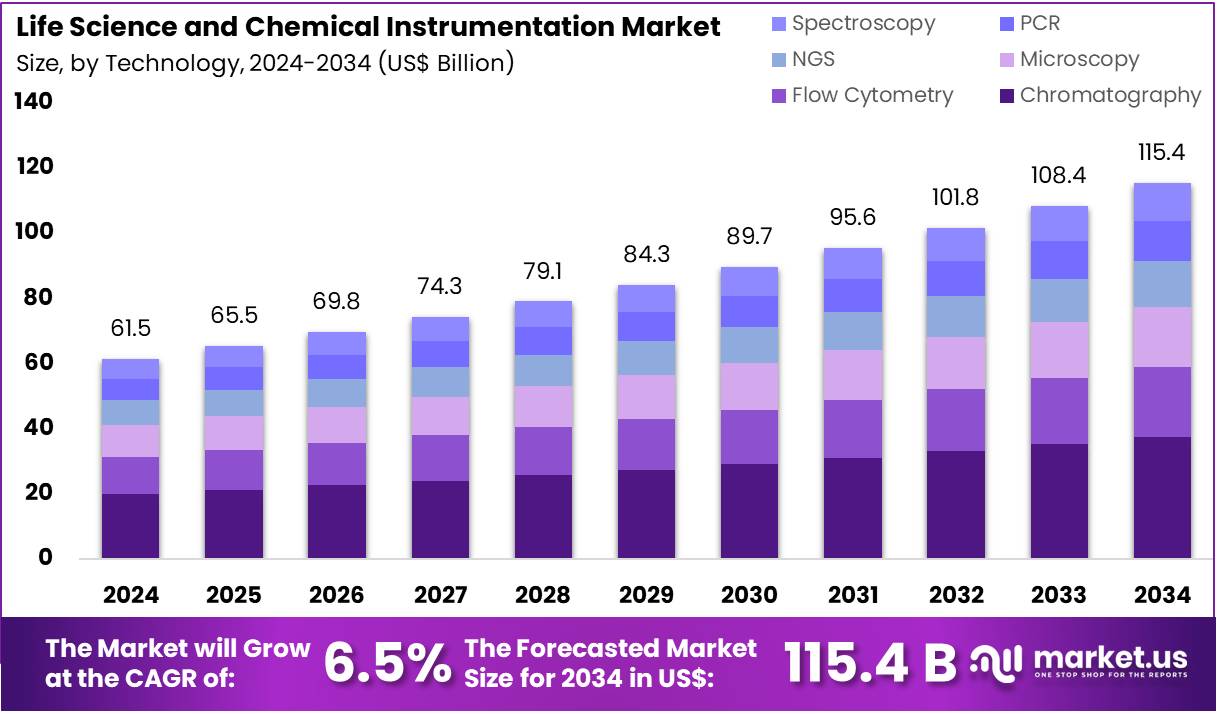
Key Takeaways
- In 2024, the life science and chemical instrumentation market generated revenue of US$ 61.5 billion and is projected to grow at a CAGR of 6.5%, reaching approximately US$ 115.4 billion by 2034.
- Based on technology, the market is segmented into chromatography, flow cytometry, microscopy, next-generation sequencing (NGS), PCR, and spectroscopy. Among these, chromatography dominated the market in 2024, accounting for a 32.5% share.
- By end-user, the market is categorized into pharmaceutical & biotechnology companies, hospitals & diagnostic centers, and contract research organizations (CROs) & research institutes. The pharmaceutical & biotechnology companies segment held a leading share of 45.2%.
- North America emerged as the leading regional market, capturing a 42.2% share in 2023, supported by strong pharmaceutical R&D activities, advanced healthcare infrastructure, and high adoption of analytical technologies.
Statistical Information
- Whole Genome Sequencing Programs Are Expanding the Need for NGS Instrumentation: The NIH Trans-Omics for Precision Medicine (TOPMed) program has generated large-scale genomic datasets to support disease research. The program has sequenced nearly 200,000 genomes from diverse populations, creating demand for next-generation sequencing (NGS) platforms, genomic analysis systems, and computational laboratory tools.
- Life science and chemical instrumentation context: The U.S. National Science Foundation (NSF) reports that global R&D expenditures reached approximately 3.1 trillion USD in 2022 (current PPP dollars), with the United States accounting for about 30% and China 27% of this total.
- Chromatography and analytical instruments in regulatory guidance: This FDA document requires validated analytical procedures to include fully qualified equipment and components, including instrument type and detector, and to define operating ranges (such as flow rate and temperature), demonstrating that chromatography and related instrumentation are embedded in regulatory-compliant quality control workflows for pharmaceuticals and biologics.
- North America as a leading region in R&D and instrumentation demand: The NSF reports that in 2022 the United States alone accounted for about 30% of global R&D expenditures, while the EU-27 accounted for 18% and China for 27%, underscoring North America’s leading role in global R&D investments.
- FDA Approvals Highlight Growing Clinical Adoption of Molecular Diagnostic Technologies: The U.S. FDA continues to approve advanced molecular diagnostic platforms using next-generation sequencing technology. In 2024, FDA approved the MI Cancer Seek NGS-based in vitro diagnostic device, which analyzes alterations across 228 genes along with biomarkers such as microsatellite instability (MSI) and tumor mutational burden (TMB) to support targeted cancer treatment decisions.
- Research Collaborations Are Increasing Investment in Advanced Laboratory Technologies: Industry-academic partnerships are strengthening innovation in diagnostics and biochemical research. Agilent Technologies announced a collaboration with the National University of Singapore and National University Hospital to establish a US$38 million research and development unit focused on clinical diagnostics and biochemical methods.
- Global R&D Expenditure Driving Instrumentation Demand: The top eight R&D-performing economies accounted for 82% of global R&D spending in 2022, with the United States accounting for 30%, China 27%, and the EU‑27 18% of global expenditures.
- OECD R&D Growth and Sectoral Focus: Government budget allocations for R&D (GBARD) in the OECD area grew only 0.6% in 2023 (vs. 5.5% in 2022), but R&D budgets oriented toward energy and environment increased by 29.1% and defence-related R&D budgets grew by 16.1%.
Regional Analysis
North America emerged as the leading regional market, capturing a 42.2% share
North America remains a major hub for life science and chemical instrumentation due to strong pharmaceutical research activity, advanced healthcare infrastructure, and significant public and private R&D investments. The National Institutes of Health (NIH) received a budget of approximately US$ 48 billion in fiscal year 2023, supporting biomedical research programs that depend on advanced analytical technologies, including sequencing, microscopy, spectroscopy, and mass analysis systems.
The region also benefits from strong innovation in drug development, with the U.S. FDA approving 50 novel drugs in 2024, supporting continued demand for laboratory instruments used in discovery and quality testing.Asia Pacific is experiencing rapid expansion due to increasing biotechnology investments, government-supported research programs, and growing pharmaceutical manufacturing capabilities.
China’s R&D expenditure reached about 3.6 trillion yuan in 2024, reflecting significant investment in scientific innovation. Rising healthcare needs, aging populations, and increased focus on precision medicine are further driving adoption of advanced life science and chemical instrumentation across the region.
Emerging Trends
- AI Integration in Laboratory Instruments: Artificial intelligence is transforming analytical workflows by automating data analysis, improving instrument performance, and reducing manual efforts. The U.S. FDA is implementing AI-based tools for scientific review processes to improve efficiency in regulatory evaluations.
- Expansion of Precision Medicine and Multi-Omics Analysis: Growing adoption of genomic, proteomic, and metabolomic technologies is increasing demand for advanced instrumentation. The NIH All of Us Research Program has enrolled more than 800,000 participants, generating large-scale health and genomic datasets for precision medicine research.
- Rising Adoption of Next-Generation Sequencing (NGS): NGS platforms are becoming essential for cancer research, rare disease diagnosis, and personalized treatment development. NIH-supported genomic initiatives such as TOPMed have generated data from more than 200,000 participants, supporting the need for high-throughput sequencing systems.
- Growth of Laboratory Automation and Robotics: Pharmaceutical and biotechnology laboratories are increasingly adopting robotic systems, automated sample preparation, and digital laboratory platforms to improve accuracy, productivity, and reproducibility in research and testing processes.
- Advanced Microscopy and Imaging Technologies: High-resolution imaging systems are gaining importance in cell biology, drug discovery, and disease research. NIH-supported imaging programs are advancing technologies that help researchers analyze biological structures and molecular processes with greater precision.
- Cloud-Based Laboratory Data Management: Cloud platforms are enabling researchers to store, process, and share large scientific datasets efficiently. The NIH STRIDES Initiative supports cloud adoption for biomedical research data management and computational analysis.
- Increasing Use of Mass Spectrometry in Life Science Research: Mass spectrometry is expanding in applications such as proteomics, biomarker identification, and drug development. NIH-funded research programs utilize advanced analytical methods to study proteins, metabolites, and disease mechanisms.
Use Cases
- Drug Discovery and Development: Life science instruments such as chromatography, mass spectrometry, and spectroscopy systems are widely used by pharmaceutical companies to identify drug candidates, analyze molecular structures, evaluate compound purity, and monitor formulation development. These technologies support faster and more accurate drug discovery processes.
- Precision Medicine and Genomic Profiling: Next-generation sequencing (NGS), PCR, and molecular analysis instruments are used to identify genetic variations and biomarkers for personalized treatment decisions. The NIH All of Us Research Program uses genomic technologies to analyze health data from more than 800,000 participants to advance precision medicine research.
- Cancer Research and Biomarker Discovery: Advanced analytical instruments, including sequencing platforms, flow cytometers, and mass spectrometers, are used to study cancer mutations, identify biomarkers, and develop targeted therapies. NIH-supported cancer research programs use these technologies to improve diagnosis and treatment strategies.
- Biopharmaceutical Manufacturing and Quality Control: Chemical and life science instruments are used for monitoring biologics production, testing product quality, and ensuring compliance with regulatory standards. Analytical technologies such as chromatography and spectroscopy help evaluate proteins, vaccines, and other complex biological products.
- Clinical Diagnostics and Disease Detection: PCR, molecular diagnostics, flow cytometry, and immunoassay instruments are used in hospitals and diagnostic laboratories for detecting infectious diseases, genetic disorders, and other health conditions. FDA-approved diagnostic technologies support faster and more reliable clinical decision-making.
- Proteomics and Molecular Research: Mass spectrometry and advanced chromatography systems are used to analyze proteins, metabolites, and molecular interactions. These technologies support biomarker identification, disease mechanism studies, and development of new therapeutic approaches.
Frequently Asked Questions on Life Science and Chemical Instrumentation
- What factors are driving the growth of the life science and chemical instrumentation market?
The market is growing due to increasing pharmaceutical R&D investments, rising adoption of precision medicine, expansion of biotechnology research, growing demand for advanced diagnostics, and technological developments such as artificial intelligence, automation, and high-throughput analytical solutions. - Which technologies are commonly used in the life science and chemical instrumentation market?
Major technologies include chromatography, flow cytometry, microscopy, next-generation sequencing (NGS), PCR, and spectroscopy. These technologies are widely applied in drug discovery, molecular diagnostics, genomic analysis, quality testing, and biological research activities across pharmaceutical and healthcare sectors. - How is precision medicine influencing the life science and chemical instrumentation market?
Precision medicine is increasing demand for advanced analytical instruments that support genomic, proteomic, and molecular profiling. Technologies such as NGS, PCR, and mass spectrometry help identify biomarkers, analyze genetic variations, and develop personalized treatment approaches. - Why are pharmaceutical and biotechnology companies major users of life science instrumentation?
Pharmaceutical and biotechnology companies use advanced instruments throughout drug discovery, development, manufacturing, and quality control processes. These technologies support compound identification, molecular analysis, biologics testing, and regulatory compliance, increasing demand for accurate and high-performance laboratory systems. - What role does artificial intelligence play in life science instrumentation?
Artificial intelligence improves laboratory operations by automating data analysis, enhancing instrument accuracy, identifying complex biological patterns, and optimizing workflows. AI-enabled systems are increasingly used in drug discovery, diagnostic research, imaging analysis, and laboratory automation applications. - What are the major applications of chemical instrumentation?
Chemical instrumentation is used in pharmaceutical testing, environmental monitoring, food safety analysis, material research, and chemical composition studies. Technologies such as chromatography and spectroscopy help detect substances, analyze samples, ensure quality, and support regulatory testing requirements. - Which region dominates the life science and chemical instrumentation market?
North America leads the market due to strong pharmaceutical research activities, advanced healthcare infrastructure, high government and private R&D funding, and the presence of major biotechnology companies. The region has significant adoption of advanced laboratory instruments. - Why is Asia Pacific expected to show strong growth in this market?
Asia Pacific growth is supported by increasing biotechnology investments, expanding pharmaceutical production, rising healthcare requirements, and government initiatives supporting scientific research. The region is rapidly adopting advanced analytical instruments for drug development, diagnostics, and biomedical research. - What are the key emerging trends in the life science and chemical instrumentation market?
Key trends include AI-powered laboratory systems, cloud-based data management, single-cell analysis, multi-omics technologies, automated research platforms, portable diagnostic instruments, and sustainable laboratory solutions. These advancements are improving efficiency, accuracy, and expanding the use of scientific instrumentation.
Conclusion
The life science and chemical instrumentation market is experiencing steady growth due to increasing pharmaceutical R&D investments, rising adoption of precision medicine, and advancements in analytical technologies. The integration of AI, automation, genomic analysis, and cloud-based laboratory solutions is transforming research and diagnostic workflows.
Pharmaceutical companies, biotechnology firms, academic institutions, and healthcare organizations are increasingly adopting advanced instruments to improve accuracy, efficiency, and innovation. North America remains a key market due to strong research infrastructure, while Asia Pacific is emerging with expanding biotechnology capabilities. Overall, continuous technological advancements and growing demand for scientific research are expected to support long-term market development.
Discuss your needs with our analyst
Please share your requirements with more details so our analyst can check if they can solve your problem(s)




