


Overview
New York, NY – Sep 18, 2026 –The Global Laparotomy Sponge Market size is expected to be worth around US$ 2.30 Billion by 2034 from US$ 1.32 Billion in 2024, growing at a CAGR of 5.7% during the forecast period 2025 to 2034. In 2024, North America led the market, achieving over 38.2% share with a revenue of US$ 504.2 Million.
Laparotomy sponges are witnessing steady growth due to the rising number of surgical procedures, increasing prevalence of chronic diseases, and growing focus on surgical safety.
Laparotomy sponges are essential absorbent surgical products used during abdominal, cardiovascular, trauma, and other major surgeries to control bleeding, absorb fluids, and maintain a clear operative field. The market is supported by the growing global demand for disposable surgical supplies, with more than 310 million major surgical procedures performed worldwide annually.
The increasing burden of diseases requiring surgical intervention is a major growth driver. Globally, chronic diseases account for approximately 74% of all deaths, increasing the need for surgical treatments and hospital-based care.
Rising cases of cancer, cardiovascular disorders, gastrointestinal diseases, and traumatic injuries are contributing to higher consumption of laparotomy sponges. Healthcare facilities are also adopting advanced products with radiopaque markers, antimicrobial coatings, and improved absorbency features to enhance surgical safety.
Patient safety initiatives are accelerating the adoption of sponge tracking technologies, including barcode and RFID-based systems. Retained surgical items, including sponges, are reported to occur in approximately 1 in 5,500 to 18,760 inpatient surgeries, encouraging hospitals to implement better counting and monitoring solutions.
North America remains a significant market due to advanced healthcare infrastructure, high surgical volumes, and strong regulatory standards. Europe is expanding with increasing healthcare quality initiatives, while Asia-Pacific is expected to experience rapid growth due to rising healthcare investments and improving access to surgical procedures.
The Laparotomy Sponge Market will continue to grow as hospitals prioritize infection control, surgical efficiency, and advanced patient safety solutions.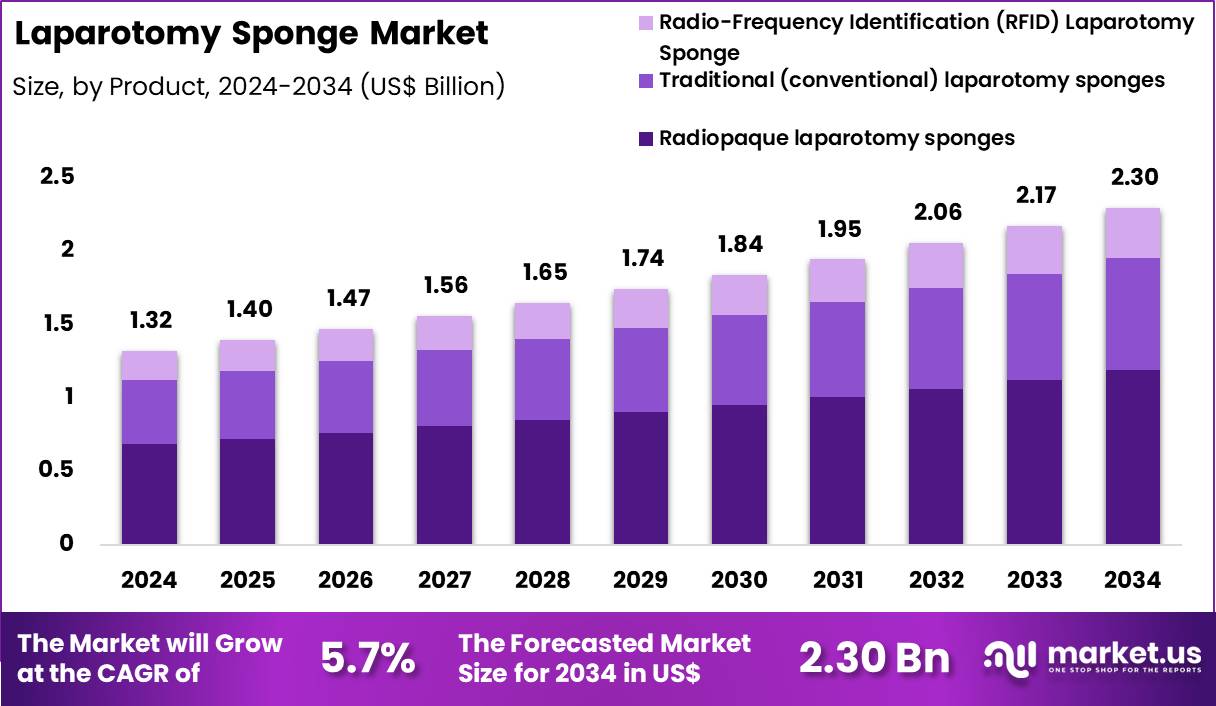
Key Takeaways
- The Laparotomy Sponge Market generated US$ 1.32 billion in revenue in 2024 and is projected to reach US$ 2.30 billion by 2034, expanding at a CAGR of 5.7% during the forecast period.
- Based on Product, the market is segmented into Radiopaque laparotomy sponges, Traditional (conventional) laparotomy sponges, and Radio-Frequency Identification (RFID) laparotomy sponges. Among these, Radiopaque laparotomy sponges dominated the market in 2024 with a 51.8% share.
- Based on Sterility, the market is categorized into Sterile laparotomy sponges and Non-sterile laparotomy sponges. Sterile laparotomy sponges accounted for the leading position in 2024, capturing a 77.4% market share.
- Based on End-User, the market includes Hospitals, Ambulatory Surgical Centers, Specialty Clinics, and Others. Hospitals held the largest market share in 2024, accounting for 64.8% of the market.
- North America emerged as the leading regional market in 2024, holding a significant 38.2% share due to advanced healthcare infrastructure, high surgical procedure volumes, and strong adoption of surgical safety solutions.
Market Segmentation Overview
- Product Analysis: The Radiopaque laparotomy sponge segment dominated the Product category with a 51.8% market share in 2024 due to increasing surgical safety standards, mandatory use of X-ray detectable markers, and rising adoption in abdominal, trauma, oncology, and other high-risk surgical procedures to minimize retained surgical item risks.
- Sterility Analysis: The Sterile laparotomy sponge segment led the Sterility category with a 77.4% market share in 2024 due to strict aseptic requirements in surgical procedures. Growing numbers of abdominal surgeries, cesarean deliveries, cancer resections, and gastrointestinal procedures are driving higher demand for sterile surgical absorbent products.
- End-User Analysis: The Hospitals segment accounted for the largest End-User share with 64.8% in 2024 owing to high surgical procedure volumes, increasing hospital admissions, and extensive use of laparotomy sponges in operating rooms, emergency departments, trauma units, and specialized surgical departments worldwide.
Statistical Information
- Retained Sponges Led Unintended Object Events During 2024: The Joint Commission received 1,575 sentinel-event reports during 2024, including 119 unintended retained foreign object events, or 8% of total reports. Sponges were the leading retained object, accounting for 34%, or 40 cases. Of these retained-sponges cases, 41% were associated with obstetrics and gynaecology services, indicating important demand for detectable laparotomy sponges in surgical and childbirth settings.
- Surgical Sponge Retention Risk Drives Traceability Product Adoption: AHRQ estimates retained surgical items occur in approximately 1.3 per 10,000 surgical procedures. In one reviewed dataset of 79 retained-item cases, 46 cases, or 58%, involved surgical sponges or towels. Retained items are considered “never events,” meaning they should not occur in patient care. This risk supports demand for radiopaque, RFID-enabled, barcoded, and count-controlled laparotomy sponges.
- Incorrect Sponge Counts Create Substantial Hospital Safety Costs: AHRQ cites 212 incorrect sponge counts over nine months in one hospital study. The associated annual cost exceeded $200,000. A retained foreign object can cost an estimated $166,000–$200,000 per incident, including additional treatment, investigation, legal exposure, and quality-management costs. Hospitals therefore have economic incentives to purchase dependable counting systems, radiopaque laparotomy sponges, and technology-supported sponge-tracking solutions.
- Manual Counting Limitations Encourage Technology-Enhanced Sponge Systems: The Joint Commission reports sponge-counting processes may have a 10%–15% error rate. It also states that 80% of retained sponges occur when surgical staff believe the count is correct. Among 772 reported retained-object events, only 52 cases had a documented discrepant count. These data support demand for radiopaque markers, RFID tagging, barcode-based count systems, and automated detection technologies.
- United States Inpatient Surgery Volume Supports Sponge Consumption: AHRQ recorded 9.6 million U.S. inpatient stays involving operating-room procedures in 2018. These stays included 14.4 million operating-room procedures, equal to 4,399.3 procedures per 100,000 population. Laparotomy sponges are used across major abdominal, obstetric, cardiovascular, orthopaedic, and trauma surgeries for fluid absorption, tissue protection, and surgical-field visibility, linking procedure volumes directly with consumable demand.
- Retained Surgical Items Generate Significant Hospital Financial Exposure: AORN estimates the cost of a retained surgical-item event at approximately $525,000 per case. With 119 unintentionally retained foreign-object reports during 2024, the potential financial exposure represented by reported events could exceed $62.5 million, before considering unreported incidents. This economic risk supports hospital investment in high-visibility laparotomy sponges, RFID systems, standardised count processes, staff training, and perioperative safety audits.
- Reoperation Frequency Highlights Retained Sponge Clinical Consequences: A study of 54 patients with 61 retained surgical items found that 69% of retained objects were sponges and 31% were instruments. Of the 54 patients, 37, or 69%, required reoperation one patient died. The estimated incidence ranged from 1 per 8,801 to 1 per 18,760 inpatient operations. These clinical risks increase demand for reliable laparotomy sponge detection and count-control products.
Regional Analysis
North America led the market by securing a market share of 38.2% in 2024.
North America holds a leading position in the Laparotomy Sponge Market due to advanced surgical infrastructure, high healthcare spending, and strong adoption of patient safety protocols. The United States performs millions of surgical procedures annually, increasing demand for sterile and radiopaque laparotomy sponges. Healthcare organizations such as The Joint Commission classify unintended retention of surgical items as a serious patient safety event, encouraging hospitals to implement sponge-counting and detection technologies.
Asia Pacific is expected to witness significant growth due to expanding healthcare facilities, rising surgical volumes, and increasing investments in operating room safety systems. Countries across the region are improving surgical standards by adopting advanced sterile products, radiopaque sponges, and digital tracking solutions. Growing cases of cancer, trauma, and gastrointestinal disorders are further increasing demand for surgical consumables. The modernization of hospitals and rising access to surgical care are supporting long-term market expansion in the region.
Business Opportunities
The Laparotomy Sponge Market offers significant business opportunities driven by rising surgical volumes, increasing focus on patient safety, and technological advancements in surgical consumables. Growing adoption of RFID-enabled and barcode-tracked laparotomy sponges provides opportunities for manufacturers to develop advanced solutions that reduce retained surgical item risks and improve operating room efficiency. The increasing number of abdominal, trauma, oncology, and obstetric surgeries is creating demand for high-absorbency, sterile, and radiopaque sponge products.
Companies can also explore opportunities in antimicrobial-coated sponges to support infection prevention initiatives in hospitals. Emerging healthcare markets are offering expansion potential due to improving hospital infrastructure and rising access to surgical care. Strategic collaborations with hospitals, surgical centers, and technology providers can further support innovation, product development, and market penetration.
Emerging Trends
- Rising Adoption of RFID-Enabled Laparotomy Sponges: Hospitals are increasingly using RFID-based sponge tracking systems to reduce retained surgical item risks. Studies show RFID systems can achieve up to 98.1% detection sensitivity with mats and 100% with handheld wands, improving operating room safety.
- Growing Preference for Radiopaque Laparotomy Sponges: Radiopaque markers are becoming standard in surgical sponges as healthcare providers focus on preventing retained sponges. With approximately 313 million surgical procedures performed each year globally, demand for easily detectable surgical absorbents continues to increase.
- Increasing Focus on Retained Surgical Item Prevention: Healthcare facilities are strengthening sponge counting protocols, team communication, and technology adoption to reduce surgical errors. Retained surgical items remain a preventable safety concern, with surgical sponges among the most frequently retained objects.
- Development of Advanced Sterile and Antimicrobial Sponges: Manufacturers are focusing on sterile, high-absorbency, and infection-control-focused laparotomy sponges to support safer surgeries. CDC recommends strict surgical site infection prevention practices during operative procedures to improve patient outcomes.
- Integration of Digital Operating Room Solutions: Hospitals are adopting automated counting systems, barcode tracking, and electronic inventory management to improve surgical efficiency. Digital solutions help reduce manual counting errors and support safer workflows across high-volume surgical departments.
Use Cases
- Abdominal and General Surgeries: Laparotomy sponges are widely used in abdominal procedures such as bowel resections, appendectomies, and gastrointestinal surgeries for absorbing blood and fluids. Increasing global surgical demand, with more than 300 million major surgeries performed annually, continues to support the use of surgical absorbent products.
- Trauma and Emergency Surgeries: Trauma centers use laparotomy sponges during emergency operations involving severe bleeding and complex injuries. High-absorbency and radiopaque sponges help surgeons manage blood loss and improve visibility during critical procedures where rapid intervention is required.
- Oncology and Cancer-Related Procedures: Laparotomy sponges are essential during cancer surgeries, including tumor removal and organ resections, where extensive tissue handling and bleeding control are required. Growing cancer cases worldwide are increasing the need for reliable surgical consumables.
- Obstetric and Cesarean Procedures: Surgical sponges are commonly used during cesarean deliveries and other gynecological operations for fluid absorption and maintaining a clean surgical field. Globally, approximately 21% of births occur through cesarean section, increasing demand for sterile surgical products.
- Cardiovascular and Transplant Surgeries: Complex cardiovascular and transplant procedures require effective fluid management and surgical visibility, creating demand for advanced laparotomy sponges. Hospitals performing high-risk surgeries increasingly prefer radiopaque and tracked sponges to improve safety and reduce retained surgical item risks.
Recent Development
- In 2026, Medtronic plc continued strengthening its surgical solutions portfolio through advancements in surgical technologies, operating room efficiency, and healthcare innovation. The company focused on improving clinical outcomes through advanced medical devices and integrated surgical solutions.
- In 2026, Owens & Minor, Inc. continued expanding its healthcare supply chain capabilities by supporting hospitals and surgical facilities with essential medical products. The company focused on improving supply reliability and strengthening healthcare distribution services.
- In 2026, Integra LifeSciences continued advancing its surgical technology portfolio, including solutions for wound care, neurosurgery, and regenerative medicine. The company focused on developing innovative products that support improved surgical outcomes and patient care.
- In 2026, Medical Action Industries, Inc. continued providing customized surgical procedure kits and medical consumables designed to improve operating room efficiency. The company focused on supporting hospitals with standardized and cost-effective surgical supply solutions.
- In 2026, B. Braun Melsungen AG continued investing in surgical safety, infection prevention, and sterile medical product solutions. The company focused on improving healthcare workflows through advanced medical technologies and patient-focused innovations.
- In 2026, Cardinal Health continued strengthening its medical product distribution network and healthcare services. The company focused on improving supply chain efficiency and supporting hospitals with reliable access to surgical and medical consumables.
Frequently Asked Questions About Laparotomy Sponge
- What is driving the growth of the Laparotomy Sponge Market?
The market growth is driven by rising surgical procedures, increasing healthcare expenditure, growing focus on infection prevention, and adoption of radiopaque and RFID-enabled sponges. Hospitals are investing in advanced surgical safety solutions to reduce retained surgical item risks. - What are the major product types in the Laparotomy Sponge Market?
The major product types include radiopaque laparotomy sponges, traditional laparotomy sponges, and RFID-enabled laparotomy sponges. Radiopaque sponges are widely adopted because they contain detectable markers that help healthcare professionals identify retained surgical items during procedures. - Which region dominates the Laparotomy Sponge Market?
North America leads the Laparotomy Sponge Market due to advanced healthcare infrastructure, high surgical volumes, strong regulatory standards, and early adoption of surgical safety technologies. Hospitals in the region increasingly use advanced sponge tracking systems to improve patient outcomes. - What are the emerging trends in the Laparotomy Sponge Market?
Emerging trends include RFID-based tracking, smart operating room technologies, antimicrobial sponge development, and improved absorbent materials. Healthcare providers are adopting innovative solutions to enhance surgical efficiency, reduce complications, and improve overall operating room safety standards. - How does technology impact laparotomy sponge development?
Technology is improving laparotomy sponge design through advanced tracking systems, better absorbency materials, and safety features. Digital identification solutions such as RFID and barcode technologies help healthcare facilities improve inventory management and reduce risks during surgical procedures. - What are the key applications of laparotomy sponges?
Laparotomy sponges are mainly used in abdominal surgeries, trauma procedures, oncology operations, cardiovascular surgeries, and obstetric procedures. They help control bleeding, absorb fluids, protect tissues, and maintain visibility during complex surgical interventions. - What opportunities exist in the Laparotomy Sponge Market?
Opportunities exist in developing advanced RFID-enabled products, antimicrobial surgical sponges, and customized procedure kits. Increasing healthcare infrastructure investments, rising surgical volumes, and demand for improved patient safety solutions create growth opportunities for manufacturers worldwide.
Conclusion
The Laparotomy Sponge Market is expected to witness steady growth due to increasing surgical procedures, rising focus on patient safety, and growing adoption of advanced surgical technologies. Radiopaque and RFID-enabled laparotomy sponges are gaining importance as hospitals prioritize reducing retained surgical item risks and improving operating room efficiency.
Hospitals remain the leading end users due to high surgical volumes and demand for reliable sterile products. North America continues to dominate with advanced healthcare infrastructure, while emerging regions offer new growth opportunities. Continuous innovation in sponge design, tracking systems, and infection prevention solutions will further support market expansion in the coming years.
Discuss your needs with our analyst
Please share your requirements with more details so our analyst can check if they can solve your problem(s)




