


Overview
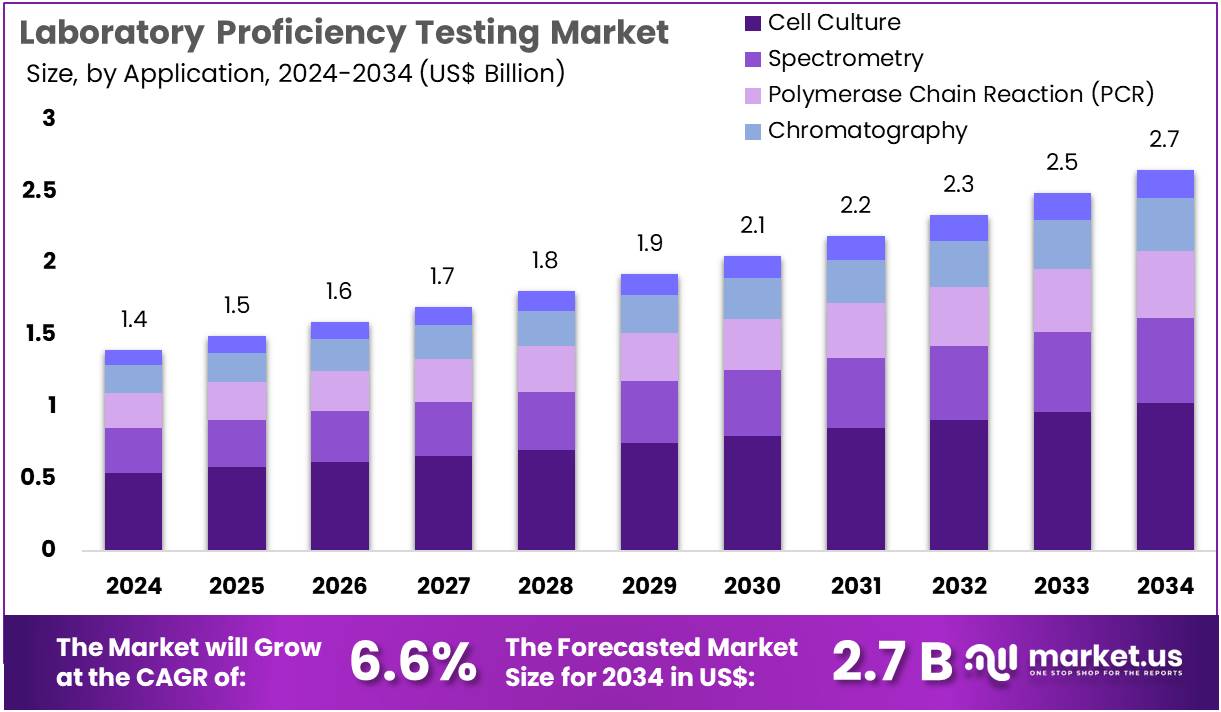
New York, NY – July 28, 2026 – The Global Laboratory Proficiency Testing Market Size is expected to be worth around US$ 2.7 billion by 2034 from US$ 1.4 billion in 2024, growing at a CAGR of 6.6% during the forecast period 2025 to 2034. North America held a dominant market position, capturing more than a 43.9% share and holds US$ 0.6 Billion market value for the year.
The laboratory proficiency testing market is growing steadily, driven by rising regulatory expectations for accurate testing in water, pharmaceutical, medical device, and emerging cannabis laboratories, with global revenues estimated at around USD 1.5 billion in 2024 and projected to reach about USD 2.1 billion by 2030 at a CAGR of roughly 6–7 %. Water-focused schemes remain a key growth engine as utilities and accredited laboratories must routinely verify their ability to detect microbial contaminants and trace-level pollutants that pose public health risks.
Proficiency testing providers distribute blinded water samples to participating laboratories, enabling independent evaluation of their capability to accurately identify pathogens such as Legionella, E. coli, enterococci, and Staphylococcus species in drinking and wastewater matrices. This is particularly critical given World Health Organization estimates that roughly 2 billion people worldwide still rely on drinking water contaminated with fecal matter, underscoring the need for robust and routinely verified microbiological testing capacity.
Beyond environmental and water applications, demand is expanding in pharmaceutical and medical device quality control, where laboratories must demonstrate reliable measurement of endotoxins and pyrogens in purified water, injectables, and sterile products to comply with stringent regulatory guidance from agencies such as the US Food and Drug Administration and to support harmonized measurement standards promoted by bodies like the National Institute of Standards and Technology. High-precision assays, including Limulus Amebocyte Lysate–based methods, are widely used to verify endotoxin levels and support lot-release decisions.
The market also benefits from rising testing needs in medical cannabis, where laboratories are increasingly required to prove competence in pesticide screening, heavy metal analysis, and cannabinoid potency measurement to protect consumer safety and satisfy evolving national and regional regulations. Coupled with the ongoing global burden of foodborne and waterborne disease, including recurrent Legionella outbreaks, this broadening application base is expected to sustain mid‑single to high‑single‑digit annual growth in laboratory proficiency testing worldwide through the next decade.
Key Takeaways
- In 2024, the laboratory proficiency testing market generated revenues of US$ 1.4 billion, growing at a CAGR of 6.6%, and is projected to reach US$ 2.7 billion by 2034.
- By type, the market is segmented into clinical diagnostics, pharmaceuticals, microbiology, and cannabis, with clinical diagnostics leading in 2023, accounting for 47.6% of the market share.
- By application, the market is categorized into cell culture, spectrometry, polymerase chain reaction, chromatography, and others, with cell culture representing a significant 38.9% share.
- In terms of end users, hospitals dominate the market, capturing the largest revenue share of 44.7% in the laboratory proficiency testing segment.
- Regionally, North America led the market in 2023, securing a 43.9% share.
Statistical Information
- Global Burden of Unsafe Drinking Water: According to the World Health Organization, around 2 billion people globally use a drinking water source contaminated with feces, placing them at risk of contracting diseases such as cholera, dysentery, typhoid, and polio.
- Participation Gaps in External Quality Assessment: A survey of European molecular genetics laboratories reported that 22% of laboratories did not participate in external quality assessment schemes, and 28% did not use reference materials, indicating significant gaps in quality assurance practices despite recommendations for universal participation
- Hospital Laboratory PT Implementation Performance: A 2024 evaluation of proficiency testing implementation in clinical laboratories found that proper implementation was achieved in 59.3% of tests across nine PT cycles, with an overall PT participation rate of 68.7% and overall laboratory performance score of 54.3%.
- Detection of Errors Across the Testing Process via PT: A 2024 study reported that effective participation in proficiency testing programs can uncover errors in 48% of pre‑analytical processes, 86% of analytical processes, and 76% of post‑analytical processes in participating laboratories
- PT Failure Rates in US Clinical Laboratories: The US CDC reported that proficiency testing (PT) failure rates in clinical laboratories ranged from 1.2% to 5.3% for hospital/institutional laboratories, 4.1% to 15.9% for physician office laboratories, and 2.1% to 11.6% for other test sites across the 10 most common analytes and specialties examined.
- Use of Reference Materials in Molecular Genetics Labs: In the same European study, 72% of molecular genetics laboratories reported using reference materials in their quality assurance processes, whereas 28% did not use any reference materials.
- Expected Distribution of Laboratory PT Results: Guidance cited by the American Association for Clinical Chemistry notes that in a properly performing population of laboratories, approximately 95% of reported proficiency testing results should fall within 2 standard deviations of the peer-group mean and 99% within 3 standard deviations.
Regional Analysis
North America led the market in 2023, securing a 43.9% share
North America remains the leading region in the laboratory proficiency testing market due to its advanced healthcare infrastructure, strong regulatory oversight, and widespread laboratory accreditation programs. The United States has a large network of clinical laboratories regulated under the Clinical Laboratory Improvement Amendments (CLIA), which require laboratories to participate in proficiency testing to ensure testing accuracy and reliability.
The Centers for Medicare & Medicaid Services (CMS) oversees CLIA-certified laboratories, supporting continuous quality improvement across diagnostic facilities. The region’s strong pharmaceutical, biotechnology, and clinical research sectors further increase demand for standardized laboratory performance evaluation. Asia Pacific is expected to witness rapid market growth due to expanding healthcare infrastructure, rising diagnostic testing volumes, and increasing investments in pharmaceutical and biotechnology research.
Countries such as China and Japan are strengthening laboratory quality systems through accreditation programs and advanced diagnostic facilities. Growing chronic disease burden and improved healthcare access are driving the need for accurate laboratory testing and proficiency assessment services across the region.
Emerging Trends
- Digital Transformation of Proficiency Testing Programs: Laboratories are adopting digital proficiency testing platforms to improve sample management, reporting speed, and performance tracking. Electronic quality systems support better data analysis and compliance monitoring. CMS oversees more than 300,000 CLIA-certified laboratories in the U.S., increasing demand for efficient quality management solutions.
- Increasing Regulatory Compliance Requirements: Strict laboratory regulations are driving demand for proficiency testing services. Under CLIA regulations, clinical laboratories must participate in approved proficiency testing programs to maintain quality standards. CMS continues strengthening proficiency testing rules to improve accuracy and reliability of diagnostic testing.
- Growth of Molecular Diagnostics and Genetic Testing: Expansion of molecular diagnostics, infectious disease testing, and genomic technologies is increasing the need for specialized proficiency testing. The CDC highlights that the U.S. healthcare system performs more than 14 billion laboratory tests annually, making accurate laboratory performance evaluation essential.
- Use of Automation and Data Analytics: Automated laboratory systems and analytics tools are becoming important for monitoring errors, evaluating performance trends, and improving testing accuracy. Digital dashboards allow laboratories to quickly identify quality issues and implement corrective actions, strengthening overall laboratory efficiency.
- Expansion of Laboratory Quality Programs in Emerging Markets: Growing healthcare investments in Asia Pacific, Latin America, and other developing regions are increasing demand for external quality assessment programs. Expansion of diagnostic facilities, pharmaceutical research, and disease monitoring initiatives is encouraging laboratories to adopt international quality standards.
Use Cases
- Clinical Diagnostics Quality Assurance: Hospitals and diagnostic laboratories use proficiency testing to validate accuracy in hematology, microbiology, chemistry, and molecular testing. CLIA requires laboratories performing regulated tests to participate in proficiency testing programs, ensuring reliable results for millions of patient diagnostic decisions.
- Infectious Disease Testing Evaluation: Proficiency testing supports laboratories involved in detecting infectious diseases such as respiratory infections, HIV, and emerging pathogens. CDC quality programs help improve laboratory standardization and ensure accurate testing outcomes, which are critical for disease surveillance and public health response.
- Pharmaceutical and Biopharmaceutical Testing: Drug manufacturers and research laboratories use proficiency testing to confirm analytical accuracy during pharmaceutical development and production. Increasing use of biologics, vaccines, and advanced therapies requires reliable laboratory methods to meet regulatory and safety requirements.
- Point-of-Care Testing Verification: The expansion of rapid diagnostic devices in clinics, pharmacies, and community settings is increasing the need for proficiency testing. These programs help ensure portable testing systems provide accurate results outside traditional laboratories, supporting safer decentralized healthcare delivery.
- Laboratory Workforce Training and Competency Assessment: Proficiency testing helps laboratories evaluate staff skills, identify testing errors, and improve operational procedures. Regular assessments support continuous improvement and strengthen laboratory quality systems, helping healthcare facilities maintain compliance with national and international laboratory standards.
Frequently Asked Questions on Laboratory Proficiency Testing
- Why is proficiency testing important for laboratories?
Proficiency testing helps laboratories maintain accuracy, improve testing quality, and meet regulatory requirements. It identifies analytical errors, supports accreditation processes, and ensures laboratories provide dependable results that are essential for accurate diagnosis, patient safety, and effective healthcare decision-making. - What factors are driving the laboratory proficiency testing market growth?
Increasing diagnostic testing volumes, strict laboratory regulations, expansion of molecular diagnostics, and rising demand for quality assurance are major growth factors. Growing healthcare infrastructure and pharmaceutical research activities are also increasing the need for reliable laboratory performance evaluation programs. - How do regulatory standards impact the laboratory proficiency testing market?
Regulations such as Clinical Laboratory Improvement Amendments (CLIA) require eligible laboratories to participate in proficiency testing programs. These standards ensure laboratories maintain competency, follow quality procedures, and deliver accurate test results, supporting continuous demand for proficiency testing services. - Which organizations use laboratory proficiency testing services?
Hospitals, diagnostic laboratories, pharmaceutical companies, research institutions, and public health laboratories use proficiency testing services. These organizations apply external quality assessments to verify laboratory performance, improve testing reliability, and maintain compliance with national and international quality standards. - How is technology influencing the laboratory proficiency testing market?
Digital platforms, automation, and data analytics are improving proficiency testing management by enabling faster reporting, better sample tracking, and real-time performance monitoring. These technologies help laboratories identify quality issues quickly and improve overall operational efficiency. - What role does molecular diagnostics play in proficiency testing?
Growing adoption of molecular diagnostics, genetic testing, and infectious disease assays is increasing demand for advanced proficiency testing solutions. These programs help laboratories validate complex testing methods and ensure accurate results for precision medicine, disease detection, and patient monitoring. - What are the major applications of laboratory proficiency testing?
Laboratory proficiency testing is widely used in clinical diagnostics, microbiology, hematology, molecular testing, pharmaceutical quality control, food safety, and environmental testing. These applications help laboratories confirm accuracy, improve standardization, and maintain consistent testing performance. - What is the future outlook of the laboratory proficiency testing market?
The laboratory proficiency testing market is expected to grow due to increasing healthcare testing demand, expanding diagnostic technologies, stricter quality regulations, and rising laboratory accreditation activities. Continuous focus on laboratory accuracy and global healthcare quality improvement will support future market expansion.
Conclusion
The laboratory proficiency testing market is expanding due to rising demand for accurate diagnostics, strict regulatory requirements, and increasing adoption of advanced testing technologies. Growing laboratory networks, molecular diagnostics, and pharmaceutical research activities are creating strong opportunities for proficiency testing solutions.
North America continues to lead due to established quality frameworks, while Asia Pacific is witnessing rapid growth through healthcare infrastructure development. Digital platforms, automation, and data analytics are improving testing efficiency and performance monitoring. As healthcare systems focus on accuracy, patient safety, and laboratory standardization, proficiency testing will remain a critical component of global laboratory quality management.
Discuss your needs with our analyst
Please share your requirements with more details so our analyst can check if they can solve your problem(s)




