


Overview
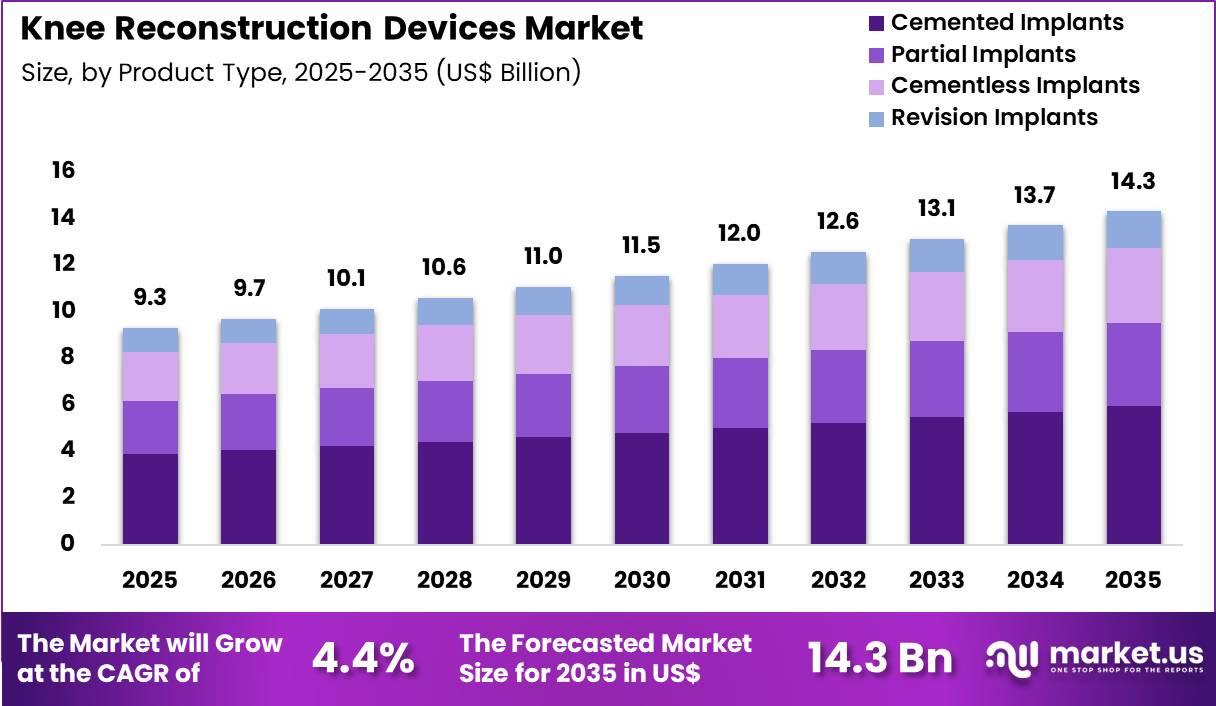
New York, NY – Nov 06 2026 – The Global Knee Reconstruction Devices Market size is expected to be worth around US$ 14.3 Billion by 2035 from US$ 9.3 Billion in 2025, growing at a CAGR of 4.4% during the forecast period 2026-2035. In 2025, North America led the market, achieving over 43.7% share with a revenue of US$ 4.1 Billion.
The Knee Reconstruction Devices Market plays an important role in modern orthopedic healthcare by providing advanced solutions for treating knee injuries, joint damage, and degenerative conditions. These devices are primarily used in surgical procedures to repair, replace, or restore the function of damaged knee joints. Common knee reconstruction devices include total knee replacement implants, partial knee implants, revision knee implants, fixation devices, and associated surgical instruments.
The growing prevalence of osteoarthritis, rheumatoid arthritis, sports-related injuries, and age-related joint disorders is increasing the demand for knee reconstruction procedures. Rising geriatric populations and longer life expectancy are also supporting market growth. Patients are increasingly seeking surgical treatments that improve mobility, reduce pain, and support daily activities.
Technological advancements are further transforming the market. Manufacturers are developing advanced implant materials, patient-specific implants, robotic-assisted surgical systems, and minimally invasive techniques to improve surgical accuracy and recovery outcomes. Healthcare providers are also adopting computer-assisted navigation and 3D printing technologies for better implant positioning and personalized treatment.
Additionally, increasing healthcare expenditure, improved access to orthopedic care, and growing awareness of joint replacement procedures are creating new growth opportunities. These factors are expected to support the expansion of the global knee reconstruction devices market in the coming years.
Key Takeaways
- In 2025, the global market was valued at US$ 9.3 Billion and is projected to reach US$ 14.3 Billion by 2035, expanding at a CAGR of 4.4% during the forecast period.
- By product type, cemented implants dominated the market, accounting for the largest revenue share of 41.7%, followed by partial implants, cementless implants, and revision implants.
- Based on indication, osteoarthritis emerged as the leading segment, capturing a market share of 47.3%, compared to trauma, rheumatoid arthritis, and other conditions.
- By end user, hospitals held the dominant position with a revenue share of 51.2%, while ASCs and orthopedic clinics accounted for the remaining market segments.
- Regionally, North America dominated the global market, capturing the largest revenue share of 43.7%.
Key Market Segments
- Product Type Analysis: Cemented implants dominated the product type segment with a 41.7% market share, driven by their proven clinical performance, strong fixation, and long-term stability. Their widespread use in knee replacement surgeries, combined with improved bone cement formulations and surgeon familiarity, supports adoption across hospitals and orthopedic centers.
- Indication Analysis: Osteoarthritis led the indication segment with a 47.3% market share, driven by the rising prevalence of degenerative joint disorders, aging populations, and obesity. Increasing demand for pain relief, improved mobility, and advanced knee replacement procedures continues to support the adoption of reconstruction devices.
- End-User Analysis: Hospitals dominated the end-user segment with a 51.2% market share due to their advanced surgical facilities, specialized orthopedic teams, and comprehensive post-operative care. Rising knee replacement procedures, robotic-assisted surgeries, and expanding orthopedic departments further strengthen hospital demand for knee reconstruction devices.
Regional Analysis
North America is leading the Knee Reconstruction Devices Market
North America dominated the knee reconstruction devices market with a 43.7% market share in 2024, driven by rising osteoarthritis cases, sports-related injuries, and an aging population. Growing adoption of advanced orthopedic technologies, including robotic-assisted surgery, modern implants, and minimally invasive procedures, further supports regional growth.
Well-established hospitals, specialized surgical centers, favorable reimbursement policies, and skilled orthopedic professionals encourage higher adoption of knee reconstruction procedures. Increasing awareness of joint replacement treatments and continuous improvements in implant materials also strengthen market demand.
The Asia Pacific region is expected to experience the highest CAGR during the forecast period
Asia Pacific is expected to record the fastest growth, supported by an aging population, rising knee disorders, and improving healthcare infrastructure. Countries such as China, India, and Japan are expanding access to orthopedic treatments and advanced surgical facilities.
Increasing healthcare investments, wider insurance coverage, surgeon training, and growing domestic medical device manufacturing are improving treatment accessibility. Rising awareness of early intervention and growing demand for affordable knee replacement procedures will further accelerate regional market growth.
Emerging Trends
- Growing Adoption of Robotic-Assisted Knee Surgery: Robotic-assisted surgery is becoming an important trend in knee reconstruction. These systems help surgeons plan procedures, position implants accurately, and remove damaged bone with greater control. According to the American Academy of Orthopaedic Surgeons (AAOS), robotic assistance was used in 16% of primary total knee replacement procedures in 2024, compared with 9% in 2021.
- Increasing Demand for Cementless Knee Implants: Cementless knee implants are gaining attention because they allow bone to grow onto the implant surface, helping secure the device naturally. AAOS registry data shows that cementless fixation in primary knee replacement increased from 1.8% in 2012 to 23.9% in 2025.
- Development of Advanced Implant Materials: Manufacturers are focusing on improved implant materials to support durability, stability, and long-term performance. Advanced polyethylene materials and specially designed metal surfaces are being used in knee implants to reduce material wear and support smoother joint movement. These developments are increasing interest in next-generation reconstruction devices.
- Rising Use of Outpatient Knee Replacement Procedures: Hospitals and surgical centres are increasingly adopting outpatient knee replacement procedures for suitable patients. Improved surgical techniques, pain management, and rehabilitation methods are helping patients return home sooner. The AAOS 2026 registry report recorded more than three times as many ambulatory surgery centre submissions in 2025 as in 2021.
- Greater Focus on Patient-Specific Knee Implants: Personalised knee reconstruction is gaining importance as surgeons seek implants that better match individual patient anatomy. Advanced imaging, computer-assisted planning, and customised surgical tools help improve implant sizing and positioning. This approach supports more accurate treatment planning and may improve patient comfort and functional recovery.
Use Cases
- Total Knee Replacement for Advanced Arthritis: Knee reconstruction devices are widely used in total knee replacement for patients with severe osteoarthritis. Metal and medical-grade plastic implants replace damaged joint surfaces, helping reduce pain, improve knee movement, and support everyday activities.
- Partial Knee Replacement for Localised Joint Damage: Partial knee replacement devices are used when arthritis affects only one compartment of the knee. These implants replace the damaged section while preserving healthy bone, cartilage, and ligaments. This approach is suitable for carefully selected patients.
- Revision Surgery for Failed Knee Implants: Revision knee reconstruction devices are used when an existing knee implant becomes loose, infected, damaged, or unstable. Specialised replacement components help surgeons rebuild the affected joint and restore knee stability and function.
- ACL Injury Reconstruction: Knee reconstruction devices support anterior cruciate ligament (ACL) reconstruction after serious sports injuries or ligament damage. Surgical screws, buttons, and other fixation devices secure replacement grafts to the thighbone and shinbone, helping restore knee stability.
- Treatment of Complex Knee Joint Damage: Knee reconstruction devices are used to address complex joint damage caused by previous injuries, fractures, or severe cartilage deterioration. Surgeons select suitable implants and fixation components to rebuild damaged structures, improve joint alignment, and support movement.
Frequently Asked Questions About Knee Reconstruction Devices
- What materials are used in knee reconstruction devices?
Knee reconstruction devices commonly use medical-grade metals, such as titanium and cobalt-chromium alloys, along with polyethylene plastic. These materials provide strength, support joint movement, and help withstand repeated pressure during everyday physical activities. - How long do knee reconstruction implants last?
The lifespan of knee reconstruction implants depends on patient age, activity levels, implant design, surgical technique, and overall health. Many modern implants provide long-term performance, although some patients may require revision surgery due to wear or loosening. - Who needs knee reconstruction surgery?
People with severe knee osteoarthritis, significant joint damage, or certain serious injuries may need knee reconstruction surgery. Doctors generally recommend surgery when pain, stiffness, and limited movement continue despite appropriate non-surgical treatments. - Which devices are commonly used in knee reconstruction procedures?
Commonly used devices include total knee replacement implants, partial knee implants, revision knee components, polyethylene inserts, femoral components, tibial components, and ligament fixation devices. These products help surgeons repair or replace damaged knee structures. - Which technological developments are influencing the Knee Reconstruction Devices Market?
Robotic-assisted surgery, computer navigation, patient-specific implants, advanced polyethylene materials, and cementless fixation technologies are influencing market development. These innovations support surgical accuracy, implant stability, and improved treatment planning for different patient requirements. - What challenges affect the Knee Reconstruction Devices Market?
High surgical costs, implant-related complications, infection risks, and limited access to advanced orthopaedic facilities can restrict market growth. Additionally, implant failure, revision surgery requirements, and lengthy rehabilitation may create challenges for patients and healthcare providers.
Conclusion
The global knee reconstruction devices market is expected to experience steady growth, driven by the rising prevalence of osteoarthritis, increasing sports-related injuries, and an aging population. Growing adoption of robotic-assisted surgeries, cementless implants, advanced biomaterials, and patient-specific solutions is improving surgical accuracy and treatment outcomes.
North America continues to dominate the market due to its advanced healthcare infrastructure and strong adoption of orthopedic technologies, while Asia Pacific offers significant growth opportunities. Increasing healthcare investments, expanding surgical facilities, and rising awareness of joint replacement procedures are expected to create new opportunities and support market expansion through 2035.
Discuss your needs with our analyst
Please share your requirements with more details so our analyst can check if they can solve your problem(s)



