


Overview
New York, NY – July 29, 2026 – The Global Isothermal Nucleic Acid Amplification Technology Market size is expected to be worth around US$ 16.7 Billion by 2034 from US$ 5.2 Billion in 2024, growing at a CAGR of 12.4% during the forecast period 2025 to 2034. North America held a dominant market position, capturing more than a 43.5% share and holding a US$ 2.3 Billion market value for the year.
The isothermal nucleic acid amplification technology (INAAT) market is witnessing strong growth due to increasing demand for rapid, accurate, and decentralized diagnostic solutions. Unlike traditional PCR testing, INAAT enables nucleic acid amplification at a constant temperature, reducing the need for complex thermal cycling equipment and making diagnostics more affordable and accessible. This technology is gaining importance in point-of-care (POC), clinical laboratories, and home-based testing applications, especially for infectious disease detection.
The rising burden of infectious diseases is accelerating adoption of INAAT-based solutions. According to the World Health Organization (WHO), lower respiratory infections caused more than 2.5 million deaths globally in 2021, highlighting the urgent need for faster disease identification and outbreak response. Advanced INAAT methods, including Loop-Mediated Isothermal Amplification (LAMP) and Recombinase Polymerase Amplification (RPA), are improving detection speed, sensitivity, and reliability.
Technological innovation is further expanding market opportunities through portable and battery-operated diagnostic platforms. In February 2023, the U.S. Food and Drug Administration (FDA) authorized the first over-the-counter molecular diagnostic test capable of detecting influenza A, influenza B, and SARS-CoV-2, demonstrating the growing role of decentralized molecular testing.
Additionally, increasing demand for multiplex testing is supporting market expansion. Multi-analyte INAAT platforms allow detection of multiple pathogens from a single sample, improving respiratory disease surveillance and clinical decision-making. Integration with digital health systems and real-time data monitoring is expected to further enhance the adoption of INAAT technologies across healthcare settings worldwide.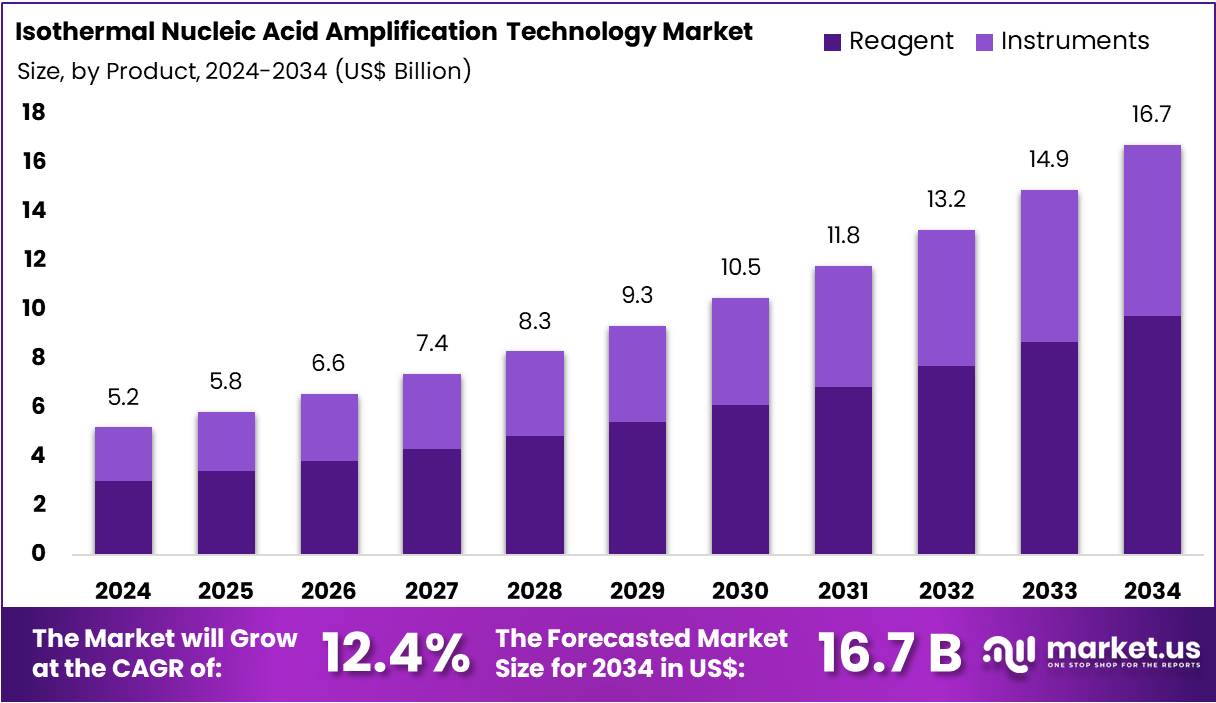
Key Takeaways
- In 2024, the isothermal nucleic acid amplification technology market generated revenue of US$ 5.2 billion and is projected to grow at a CAGR of 12.4%, reaching approximately US$ 16.7 billion by 2034.
- Based on product type, the market is segmented into reagents and instruments, with the reagents segment dominating in 2023, accounting for a market share of 58.3%.
- By technology, the market is categorized into LAMP, HDA, NASBA, NEAR, SDA, SPIA, and other technologies, with LAMP technology leading the segment with a significant share of 46.4%.
- Based on application, infectious disease diagnostics emerged as the leading segment, capturing the highest revenue share of 56.7% in the isothermal nucleic acid amplification technology market.
- By end use, the market is segmented into hospitals, central and reference laboratories, and others, with hospitals holding the dominant position with a revenue share of 51.9%.
- Regionally, North America dominated the global isothermal nucleic acid amplification technology market in 2023, accounting for a market share of 43.5%.
Statistical Information
- Rising Need for Rapid Infectious Disease Diagnostics: The growing burden of infectious diseases is increasing demand for faster molecular diagnostic technologies such as INAAT. According to the World Health Organization (WHO), lower respiratory infections caused approximately 2.5 million deaths globally in 2021, remaining one of the leading causes of communicable disease mortality. Rapid detection technologies are important for early treatment decisions and outbreak control.
- WHO-Recommended Rapid Molecular Diagnostics Adoption is Increasing Globally: Isothermal nucleic acid amplification technologies such as TB-LAMP (Loop-Mediated Isothermal Amplification) are included among WHO-recommended molecular diagnostic technologies. In 2024, WHO reported that 54% (4.5 million) of the 8.3 million people newly diagnosed with tuberculosis globally were initially tested using WHO-recommended rapid diagnostic tests (WRDs), showing increasing adoption of molecular amplification-based diagnostics.
- Rapid Molecular Testing Adoption in Tuberculosis Diagnosis: WHO’s 2025 Global Tuberculosis Report confirms that 8.3 million people were newly diagnosed with TB in 2024, of whom 4.5 million were initially tested with a WHO‑recommended rapid diagnostic (WRD), which includes low‑complexity NAATs (automated and manual). This corresponds to 54% global coverage, up from 48% in 2023 (8.2 million cases) and 47% in 2022.
- Expansion of Rapid Diagnostic Testing Across High‑Burden Countries: WHO tracks 49 countries on combined high burden lists for TB, HIV‑associated TB and MDR/RR‑TB for 2021–2025. Among these, 37 countries reported that more than 50% of their notified TB cases in 2024 were initially tested with a WRD, up from 31 countries in 2023, giving an adoption coverage of 75.5% (37/49) among the monitored high‑burden group.
- Long‑Term Growth of Molecular Diagnostic Use in TB Programs: WHO consolidated guidelines and the Global TB Report note that rapid molecular tests began to be rolled out at scale around 2011, and by the 2025 reporting cycle they have been in implementation for about 14 years. The 2025 report is based on inputs from 184 countries and areas, representing more than 99% of the world’s population and TB cases.
- Global Tuberculosis Burden Supporting Demand for INAAT Platforms: The Global TB Report 2025 states that 8.3 million people were reported as newly diagnosed with TB in 2024, representing 78% of the estimated incident cases. With WRDs used initially for 54% of these patients (4.5 million people), that leaves about 3.8 million newly diagnosed TB patients who did not receive an initial rapid molecular test and were diagnosed via other means.
- Need for Drug‑Resistance Detection Through Molecular Testing: A WHO news release on TB and funding challenges in 2025 reports that in 2024, more than 164,000 people with drug‑resistant TB were started on treatment worldwide. The same communication notes that treatment success for drug‑sensitive TB is about 88%, highlighting the importance of rapid drug‑resistance detection via molecular testing.
- COVID‑19 Molecular Testing Infrastructure Expansion: WHO’s COVID‑19 situation dashboard and associated UN news summarize that by early 2023, cumulative 765,222,932 confirmed cases and about 6,921,614 deaths had been recorded globally. Updated WHO dashboards around 2025–2026 show >760 million confirmed cases and >6.9 million deaths, reflecting the order of magnitude that drove massive global scaling of NAAT infrastructure.
Regional Analysis
North America led the market by securing a market share of 43.5% in 2023.
North America remains a leading region in the isothermal nucleic acid amplification technology (INAAT) market due to its advanced healthcare infrastructure, strong molecular diagnostics ecosystem, and high adoption of rapid testing technologies. The region benefits from significant infectious disease surveillance programs and regulatory support from organizations such as the Centers for Disease Control and Prevention and U.S. Food and Drug Administration, which encourage the development and approval of innovative diagnostic solutions.
Asia Pacific is expected to witness notable growth due to increasing healthcare investments, rising infectious disease prevalence, and expanding access to decentralized diagnostic services. According to the World Health Organization, countries in the region continue to face significant challenges from diseases such as tuberculosis and other infectious conditions, increasing demand for rapid, affordable, and point-of-care molecular testing technologies. Government initiatives and improving healthcare access are further supporting INAAT adoption across emerging markets.
Emerging Trends
- Growth of Portable Point-of-Care Molecular Diagnostics: Portable INAAT devices are gaining adoption as healthcare systems require faster testing outside laboratories. CDC reports that rapid molecular influenza assays can provide results within approximately 15–30 minutes, helping clinicians make quicker treatment decisions and improving infectious disease response.
- Expansion of At-Home Molecular Testing Solutions: Home-based molecular diagnostics are becoming a key trend due to rising consumer demand for convenient testing. In 2023, the FDA authorized the first OTC molecular test detecting influenza A, influenza B, and SARS-CoV-2, delivering results in around 30 minutes using nasal samples.
- Increasing Adoption of Multiplex INAAT Platforms: Multiplex molecular testing is expanding because it enables detection of multiple pathogens from one sample. CDC highlights that combination respiratory tests can identify infections such as COVID-19, influenza, and RSV, supporting faster diagnosis during seasonal outbreaks and improving patient management.
- Integration of Digital Health With Molecular Diagnostics: Digital connectivity is becoming important for INAAT systems by enabling faster reporting, disease tracking, and surveillance. WHO reported that lower respiratory infections caused approximately 2.5 million deaths globally in 2021, increasing demand for real-time diagnostic monitoring solutions.
- Rising Demand for Rapid Infectious Disease Screening: Healthcare providers are increasingly using rapid nucleic acid amplification technologies for infectious disease testing. CDC states that molecular diagnostic methods can detect viral genetic material quickly, supporting outbreak control and improving clinical decisions during periods of increased respiratory virus transmission.
Use Cases
- Infectious Disease Diagnosis in Hospitals and Clinics: INAAT technologies are used for rapid pathogen detection in healthcare settings due to their speed and simplified workflow. CDC reports that rapid molecular influenza assays can generate results within 15–30 minutes, supporting early treatment and infection control measures.
- Outbreak Surveillance and Public Health Monitoring: INAAT-based diagnostics support rapid identification of infectious agents during outbreaks. WHO reported that respiratory infections remain a major global health challenge, with lower respiratory infections causing approximately 2.5 million deaths in 2021, increasing demand for faster surveillance technologies.
- Home-Based COVID-19 and Influenza Testing: INAAT applications are expanding into consumer testing markets through OTC molecular diagnostic devices. The FDA authorized a home molecular test in February 2023 capable of detecting COVID-19 and influenza viruses with results available in approximately 30 minutes.
- Respiratory Virus Differentiation: INAAT-based multiplex testing helps differentiate respiratory infections with similar symptoms. CDC recognizes multiplex molecular assays as useful tools for detecting multiple respiratory viruses, including influenza A/B, SARS-CoV-2, and RSV, improving treatment decisions.
- Field and Resource-Limited Diagnostic Testing: Portable INAAT platforms are suitable for remote clinics, emergency settings, and areas with limited laboratory infrastructure. These technologies reduce dependence on complex equipment while enabling rapid molecular testing, supporting healthcare access in decentralized environments.
Frequently Asked Questions on Isothermal Nucleic Acid Amplification Technology Market
- What factors are driving the growth of the INAAT market?
The INAAT market is growing due to increasing demand for rapid diagnostics, point-of-care testing, outbreak monitoring, and decentralized healthcare solutions. Rising infectious disease concerns, technological advancements, and portable diagnostic device development are supporting wider adoption worldwide. - How is INAAT different from conventional PCR testing?
INAAT differs from PCR because it performs nucleic acid amplification at a constant temperature, eliminating the need for complex thermal cycling equipment. This reduces testing complexity, lowers infrastructure requirements, and enables faster molecular diagnosis in various healthcare settings. - Which technology dominates the INAAT market?
Loop-Mediated Isothermal Amplification (LAMP) is a leading INAAT technology due to its high sensitivity, rapid amplification capability, and suitability for point-of-care diagnostics. It is widely used for infectious disease detection and decentralized molecular testing applications. - What are the major applications of INAAT technology?
INAAT technology is mainly applied in infectious disease diagnostics, including respiratory virus detection, bacterial identification, and pathogen monitoring. Additional applications include food safety testing, veterinary diagnostics, environmental analysis, and genetic testing due to its rapid detection capabilities. - Why is INAAT important for infectious disease detection?
INAAT enables rapid identification of pathogens, helping healthcare professionals provide timely treatment and improve infection control. Its simplified workflow and portable design make it valuable for outbreak response, disease surveillance, and diagnostic access in areas with limited laboratory facilities. - How is the FDA supporting INAAT-based diagnostic solutions?
The U.S. FDA supports molecular diagnostic innovation by authorizing advanced testing solutions. In 2023, FDA authorized an over-the-counter molecular test detecting influenza A, influenza B, and SARS-CoV-2, providing results in approximately 30 minutes. - What role do hospitals play in the INAAT market?
Hospitals are major users of INAAT technologies because they require rapid and accurate diagnostic tools for patient care. These technologies support faster pathogen identification, improved treatment decisions, infection prevention, and efficient management of infectious disease cases. - What is the future outlook for the INAAT market?
The INAAT market is expected to expand with growing demand for decentralized diagnostics, portable testing devices, multiplex detection platforms, and digital health integration. Continuous innovation in molecular testing is likely to increase applications across healthcare, research, and public health sectors.
Conclusion
The isothermal nucleic acid amplification technology (INAAT) market is experiencing significant growth due to rising demand for rapid, accurate, and decentralized diagnostic solutions. Advancements in LAMP, RPA, multiplex testing, and portable molecular devices are expanding applications across infectious disease diagnostics, hospitals, and point-of-care settings.
Increasing focus on outbreak monitoring, home-based testing, and digital health integration is further strengthening market opportunities. Government initiatives and regulatory approvals, including FDA-authorized molecular testing solutions, highlight the growing importance of INAAT technologies. With continued innovation and increasing healthcare demand, INAAT is expected to play a critical role in the future of molecular diagnostics worldwide.
Discuss your needs with our analyst
Please share your requirements with more details so our analyst can check if they can solve your problem(s)




