


Overview
New York, NY – Sep 15, 2026 – – The Global Hemostasis Testing Systems Market size is expected to be worth around US$ 3.6 Billion by 2034, up from US$ 2.1 Billion in 2024, growing at a CAGR of 5.5% during the forecast period 2025 to 2034. In 2024, North America led the market, achieving over 37.4% market share with revenue of US$0.8 billion.
Hemostasis Testing Systems is expanding steadily due to the increasing prevalence of bleeding disorders, cardiovascular diseases, and the growing use of anticoagulant therapies. Rising demand for accurate coagulation diagnostics, combined with the adoption of automated laboratory systems, is improving testing efficiency across hospitals, diagnostic laboratories, and research institutions. Healthcare providers are also focusing on early disease detection and faster clinical decision-making, supporting the adoption of advanced hemostasis testing technologies.
The market was valued at USD 4.2 billion in 2024 and is projected to reach USD 7.1 billion by 2034, growing at a CAGR of 5.4% during the forecast period. North America accounted for approximately 39.4% of the global market in 2024, supported by advanced healthcare infrastructure, high testing volumes, and the presence of leading diagnostic manufacturers.
Automated hemostasis analyzers dominated the market with 61.3% of total revenue in 2024 due to their high throughput and analytical accuracy. Hospitals held around 46.8% of the market share, while diagnostic laboratories continued to increase adoption as demand for routine coagulation testing and monitoring of anticoagulant therapy expanded worldwide.
The market is expected to benefit from continuous technological advancements, increasing investments in laboratory automation, and the growing burden of thrombotic and bleeding disorders.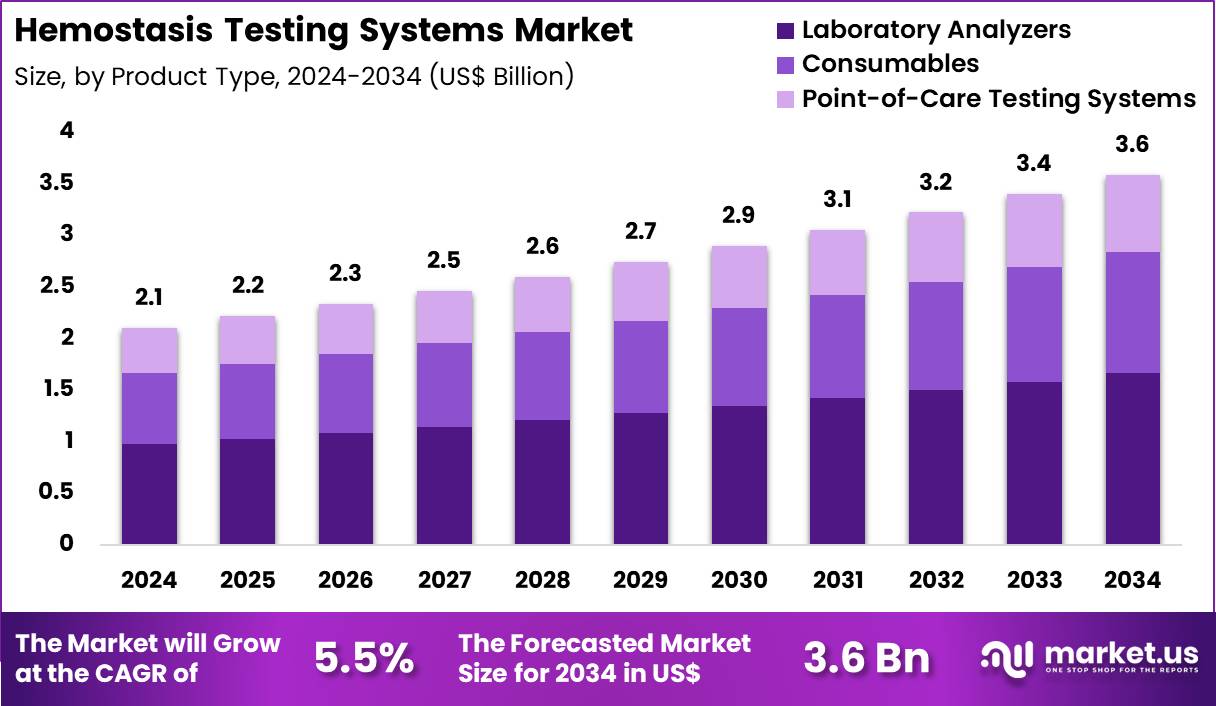 ” />
” />
Key Takeaways
- In 2024, the Hemostasis Testing Systems Market generated US$ 2.1 billion in revenue and is projected to reach US$ 3.6 billion by 2034, expanding at a CAGR of 5.5% during the forecast period.
- By product type, the market is segmented into laboratory analyzers, consumables, and point-of-care testing systems. Laboratory analysers dominated the segment in 2024, accounting for 46.5% of the total market share.
- Based on application, the market is categorized into hemophilia, acquired bleeding disease, and von Willebrand disease. Among these, hemophilia emerged as the leading application, capturing 49.1% of the market share in 2024.
- By end user, the market is classified into hospitals, diagnostic laboratories, academic institutions, and others. Hospitals held the dominant position, contributing 52.4% of the overall market revenue in 2024.
- North America remained the leading regional market, accounting for 37.4% of the global Hemostasis Testing Systems Market share in 2024.
Market Segmentation Overview
- Product Type Analysis: Laboratory analyzers dominated the product type segment with a 46.5% market share in 2024. Their leadership is driven by increasing demand for automated, high-throughput coagulation testing in clinical laboratories. These systems deliver accurate PT, aPTT, fibrinogen, D-dimer, and factor assays while improving laboratory efficiency. Rising cardiovascular diseases, bleeding disorders, and investments in diagnostic automation continue to support segment growth.
- Application Analysis: Hemophilia accounted for the largest application share of 49.1% in 2024. The segment leads due to the lifelong need for regular coagulation monitoring and clotting-factor assessment. Increasing adoption of prophylactic therapies, gene therapy research, and early diagnosis programs has expanded testing volumes. Growing access to specialized hematology services further strengthens demand for hemostasis testing in hemophilia management.
- End-User Analysis: Hospitals held the leading end-user share of 52.4% in 2024. Their dominance is supported by high patient volumes, increasing surgical procedures, emergency care, and treatment of bleeding disorders. Hospitals rely on automated hemostasis testing for rapid clinical decisions, perioperative monitoring, and anticoagulant management. Expanding healthcare infrastructure and advanced laboratory capabilities continue to drive demand in this segment.
Statistical Information
- Hemophilia Creates Long-Term Demand for Hemostasis Testing: Hemophilia is a lifelong inherited bleeding disorder that requires continuous laboratory monitoring. According to the U.S. CDC, approximately 33,000 males are living with hemophilia in the United States. Hemophilia A is 3–4 times more common than Hemophilia B, and more than 40% of patients have severe disease, requiring frequent coagulation testing and factor monitoring throughout life.
- Older Hemophilia Patients Require Increased Hospital Monitoring: The CDC evaluated more than 2,200 men aged 45 years or older with hemophilia between 2013 and 2021. Among these patients, nearly 75% had a history of hepatitis C infection, while approximately 25% had HIV infection, increasing the need for routine coagulation assessment before surgeries and during chronic disease management.
- Venous Thromboembolism (VTE) Drives Coagulation Testing Demand: According to the U.S. CDC, up to 900,000 people in the United States are affected by venous thromboembolism (VTE) each year, including deep vein thrombosis (DVT) and pulmonary embolism (PE). The CDC estimates that 60,000–100,000 deaths annually are associated with VTE, making coagulation testing essential for diagnosis and anticoagulation management.
- Aging Population Increases Demand for Coagulation Testing: According to the U.S. Census Bureau, 58 million Americans were aged 65 years and older in 2022, representing 17.3% of the total U.S. population. Older adults are more likely to undergo surgery, receive anticoagulant therapy, and develop cardiovascular diseases, increasing demand for routine hemostasis testing.
- Hemophilia A Represents the Majority of Hemophilia Cases: According to the World Federation of Hemophilia (WFH) Annual Global Survey 2023, 257,146 people with hemophilia were identified globally. Of these, 208,957 (81.3%) had Hemophilia A, while 42,203 (16.4%) had Hemophilia B, demonstrating the large patient population requiring coagulation testing and monitoring.
- Global Bleeding Disorder Population Continues to Increase: The WFH Annual Global Survey 2023 reported more than 427,000 people worldwide living with inherited bleeding disorders, including 257,146 hemophilia patients, 100,505 patients with von Willebrand disease, and over 69,000 patients with other rare bleeding disorders, increasing demand for laboratory hemostasis testing.
- WHO Estimates Rapid Growth of the Older Population: The World Health Organization (WHO) estimates that the global population aged 60 years and older will increase from 1 billion in 2020 to 1.4 billion by 2030, representing a 40% increase within a decade. Older adults have higher rates of surgery, cardiovascular disease, and anticoagulant use, driving demand for hemostasis testing.
Regional Analysis
North America led the market by securing a market share of 37.4% in 2024.
North America dominated the Hemostasis Testing Systems Market in 2024, accounting for 37.4% of the global market, supported by advanced healthcare infrastructure, widespread laboratory automation, and a high prevalence of cardiovascular and bleeding disorders.
According to the U.S. Centers for Disease Control and Prevention (CDC), up to 900,000 people develop venous thromboembolism (VTE) annually, contributing to 60,000–100,000 deaths each year and driving demand for PT/INR, aPTT, D-dimer, and fibrinogen testing.
Asia Pacific is projected to register the fastest CAGR during the forecast period due to expanding healthcare infrastructure and increasing coagulation testing demand. China’s National Health Commission reported 4.56 million new stroke cases in 2022, highlighting the growing need for coagulation monitoring.
Rising surgical procedures, expanding anticoagulant therapy, increasing investments in automated laboratory analyzers, and improving access to diagnostic services across China, Japan, South Korea, and Southeast Asia are expected to accelerate regional market growth.
Business Opportunities
The Hemostasis Testing Systems Market offers significant business opportunities as healthcare providers increasingly invest in advanced coagulation diagnostics and laboratory automation. Rising adoption of point-of-care testing (POCT) in emergency departments, outpatient clinics, and home healthcare is creating demand for portable and rapid testing systems.
Manufacturers can expand by developing high-sensitivity reagents and automated analyzers capable of delivering faster and more accurate PT, aPTT, D-dimer, fibrinogen, and factor assay results. Emerging economies present strong growth potential due to expanding healthcare infrastructure and increasing investments in diagnostic laboratories.
Strategic collaborations with hospitals, diagnostic laboratory networks, and research institutions can strengthen product adoption and market presence. The growing use of anticoagulant therapies, gene therapies, and personalized medicine also creates demand for specialized coagulation monitoring solutions.
Furthermore, integrating artificial intelligence, laboratory information systems, and cloud-based data management into hemostasis testing platforms can improve workflow efficiency, enhance diagnostic accuracy, and provide manufacturers with long-term opportunities for innovation and sustainable market growth.
Emerging Trends
- Growing Adoption of Automated Analyzers: Clinical laboratories are increasingly using automated hemostasis analyzers to improve testing accuracy and efficiency. According to the CDC, healthcare providers perform more than 14 billion laboratory tests annually in the United States, driving demand for automated diagnostic platforms.
- Rising Use of D-Dimer Testing: The increasing burden of thrombotic disorders is boosting demand for D-dimer assays. The CDC estimates up to 900,000 venous thromboembolism (VTE) cases and 60,000–100,000 related deaths annually in the United States, supporting higher coagulation testing volumes.
- Expansion of Hemophilia Monitoring: Routine coagulation monitoring is increasing as advanced therapies become more common. The CDC reports approximately 33,000 people living with hemophilia in the United States, while 20% of Hemophilia A patients develop inhibitors requiring regular laboratory testing.
- Increasing Laboratory Standardization: Healthcare systems continue to standardize coagulation testing to improve diagnostic consistency. The CDC notes that over 14 billion laboratory tests are performed annually in the U.S., encouraging adoption of standardized automated hemostasis platforms.
- Growing FDA Approvals for Advanced Systems: The U.S. FDA continues to clear new coagulation analyzers and reagents through the 510(k) pathway, enabling laboratories to improve automation, testing throughput, and analytical performance for coagulation diagnostics.
Use Cases
- Monitoring Anticoagulant Therapy: PT/INR and aPTT testing are routinely used to monitor patients receiving anticoagulants. The AHRQ estimates more than 6 million Americans receive anticoagulant medications each year, requiring regular coagulation monitoring.
- Emergency Diagnosis of Blood Clots: Hospitals use D-dimer testing to rapidly evaluate patients with suspected DVT and pulmonary embolism. According to the CDC, up to 900,000 VTE cases occur annually in the United States, increasing emergency coagulation testing demand.
- Hemophilia Diagnosis and Management: Hemostasis testing systems are essential for diagnosing hemophilia and monitoring clotting-factor therapy. The CDC estimates 33,000 people are living with hemophilia in the U.S., requiring lifelong coagulation testing.
- Pre-Surgical Bleeding Risk Assessment: Hospitals perform PT, aPTT, fibrinogen, and factor assays before major surgeries to reduce bleeding complications. Millions of inpatient surgical procedures each year continue to support demand for reliable hemostasis testing systems.
- Management of Stroke and Cardiovascular Patients: Hemostasis testing supports treatment decisions for stroke and cardiovascular disease patients receiving anticoagulants. The CDC reports up to 900,000 VTE cases annually, highlighting the importance of rapid coagulation assessment in acute care.
Recent Development
- In 2026, F. Hoffmann-La Roche Ltd. continued strengthening its diagnostics portfolio by focusing on laboratory automation, digital connectivity, and integrated diagnostic workflows. The company’s coagulation testing solutions support clinical laboratories in improving efficiency, accuracy, and patient management through advanced hemostasis testing technologies.
- In 2026, Siemens Healthineers AG continued expanding its hemostasis diagnostics capabilities through automated laboratory solutions and connected workflows. The company focuses on improving coagulation testing efficiency with advanced analyzers, IT integration, and standardized laboratory processes. Siemens Healthineers and Sysmex continue collaboration in hemostasis solutions, supporting global laboratory demand.
- In 2026, Sysmex Corporation strengthened its diagnostics business by expanding hemostasis testing solutions and advancing medical digital transformation initiatives. The company’s new mid-term plan highlights growth in diagnostics, AI-based data utilization, and expansion of hemostasis products across global markets.
- In 2026, Abbott Laboratories continued advancing its diagnostics business through automation, laboratory connectivity, and innovative testing platforms. The company focuses on improving clinical decision-making by providing efficient diagnostic technologies that support hospitals and laboratories managing increasing demand for blood testing services.
- In 2026, Danaher Corporation continued strengthening its diagnostics capabilities through its operating companies by focusing on laboratory automation, precision diagnostics, and workflow improvement solutions. The company’s diagnostic technologies support healthcare providers in managing increasing laboratory workloads and improving testing efficiency.
- In 2026, Helena Laboratories Corporation continued providing coagulation diagnostic solutions, including analyzers, reagents, and quality-control products for clinical laboratories. The company focuses on reliable and accurate hemostasis testing technologies that support hospitals, reference laboratories, and specialized diagnostic facilities.
- In 2026, HORIBA Ltd. continued expanding its medical diagnostics activities by developing advanced laboratory testing technologies and analytical solutions. The company focuses on improving diagnostic accuracy, automation, and accessibility for healthcare laboratories through innovative clinical testing platforms.
Frequently Asked Questions on Hemostasis Testing Systems
- What are the major factors driving the Hemostasis Testing Systems Market growth?
The market is driven by increasing prevalence of bleeding disorders, cardiovascular diseases, thrombotic conditions, and rising surgical procedures. Growing adoption of automated analyzers, demand for rapid diagnostic results, and increasing healthcare investments are further supporting the expansion of hemostasis testing technologies. - What is the expected growth rate of the Hemostasis Testing Systems Market?
The Hemostasis Testing Systems Market is projected to grow at a CAGR of 5.5% during the forecast period. Increasing demand for accurate coagulation monitoring, expansion of diagnostic laboratories, and rising cases of blood-related disorders are expected to support market growth. - Which product type dominates the Hemostasis Testing Systems Market?
Laboratory analyzers dominate the product type segment due to their ability to perform high-volume and accurate coagulation testing. These systems are widely used for PT, aPTT, fibrinogen, D-dimer, and factor assays, making them essential tools in clinical laboratories. - Why is hemophilia the leading application segment?
Hemophilia dominates the application segment because patients require continuous monitoring of clotting factor activity throughout their lifetime. Hemostasis testing systems help evaluate disease severity, monitor replacement therapy effectiveness, and detect inhibitors that may affect treatment outcomes. - Why do hospitals account for the largest end-user share?
Hospitals dominate the end-user segment because they manage emergency bleeding cases, surgeries, trauma patients, and chronic coagulation disorders. Hospital laboratories require automated hemostasis systems to provide rapid and reliable test results for diagnosis, treatment planning, and patient monitoring. - Which region dominates the Hemostasis Testing Systems Market?
North America leads the Hemostasis Testing Systems Market due to advanced healthcare infrastructure, high adoption of automated diagnostic systems, and increasing demand for coagulation testing. The region benefits from strong laboratory networks, technological innovation, and a high burden of cardiovascular and bleeding disorders. - What are the key trends in the Hemostasis Testing Systems Market?
Key trends include increasing adoption of automated analyzers, point-of-care coagulation testing, digital laboratory solutions, and artificial intelligence integration. These technologies improve testing speed, reduce manual errors, and enhance clinical decision-making in hospitals, emergency departments, and diagnostic laboratories. - How does anticoagulant therapy influence market growth?
Growing use of anticoagulant medications increases demand for PT/INR, aPTT, and other coagulation tests. Healthcare providers rely on hemostasis testing systems to monitor therapy effectiveness, maintain appropriate drug levels, and minimize risks associated with excessive bleeding or clot formation.
Conclusion
The Hemostasis Testing Systems Market is expected to witness steady growth due to the increasing prevalence of bleeding disorders, cardiovascular diseases, and thrombotic conditions. Rising demand for accurate coagulation monitoring, automation in clinical laboratories, and expanding adoption of advanced diagnostic technologies are driving market development.
Laboratory analyzers, hemophilia testing, and hospital applications remain key contributors to market expansion. North America continues to dominate due to strong healthcare infrastructure, while Asia Pacific offers significant growth opportunities through improving diagnostic access. Continuous innovation, point-of-care testing adoption, and strategic initiatives by leading companies are expected to strengthen the global hemostasis testing landscape.
Discuss your needs with our analyst
Please share your requirements with more details so our analyst can check if they can solve your problem(s)




