


Overview
New York, NY – July 29, 2026 – The Global Glycated Albumin Assay Market Size is expected to be worth around US$ 1.5 Billion by 2034 from US$ 0.7 Billion in 2024, growing at a CAGR of 8.2% during the forecast period 2025 to 2034. North America held a dominant market position, capturing more than a 39.1% share and holds US$ 0.3 Billion in market value for the year.
The global glycated albumin assay market is experiencing steady growth as the rising burden of diabetes increases the need for precise and timely blood glucose monitoring. According to the World Health Organization (WHO), more than 800 million people worldwide were living with diabetes in 2024, nearly four times the number recorded in 1990.
This growing patient population is driving demand for diagnostic tests that provide accurate insights into glycemic control, particularly in individuals where traditional HbA1c testing has limitations.
Glycated albumin assays measure average blood glucose levels over the previous 2–3 weeks, offering clinicians a valuable alternative for monitoring patients with anemia, chronic kidney disease, pregnancy, and other conditions affecting red blood cell lifespan. The increasing prevalence of these conditions, combined with the need for faster assessment of treatment response, is supporting wider clinical adoption of glycated albumin testing.
The market is also benefiting from expanding applications in gestational diabetes management and chronic disease care. The Centers for Disease Control and Prevention (CDC) estimates that gestational diabetes affects up to 10% of pregnancies in the United States annually, highlighting the need for reliable short-term glucose monitoring. In addition, advancements in automated enzymatic assay technologies are improving laboratory efficiency, accuracy, and accessibility across healthcare settings.
According to the International Diabetes Federation (IDF), diabetes caused approximately 3.4 million deaths in 2024, emphasizing the urgent need for improved disease monitoring solutions. Supported by ongoing clinical research, increasing healthcare investments, and technological innovation, the glycated albumin assay market is expected to maintain a strong growth trajectory over the coming years.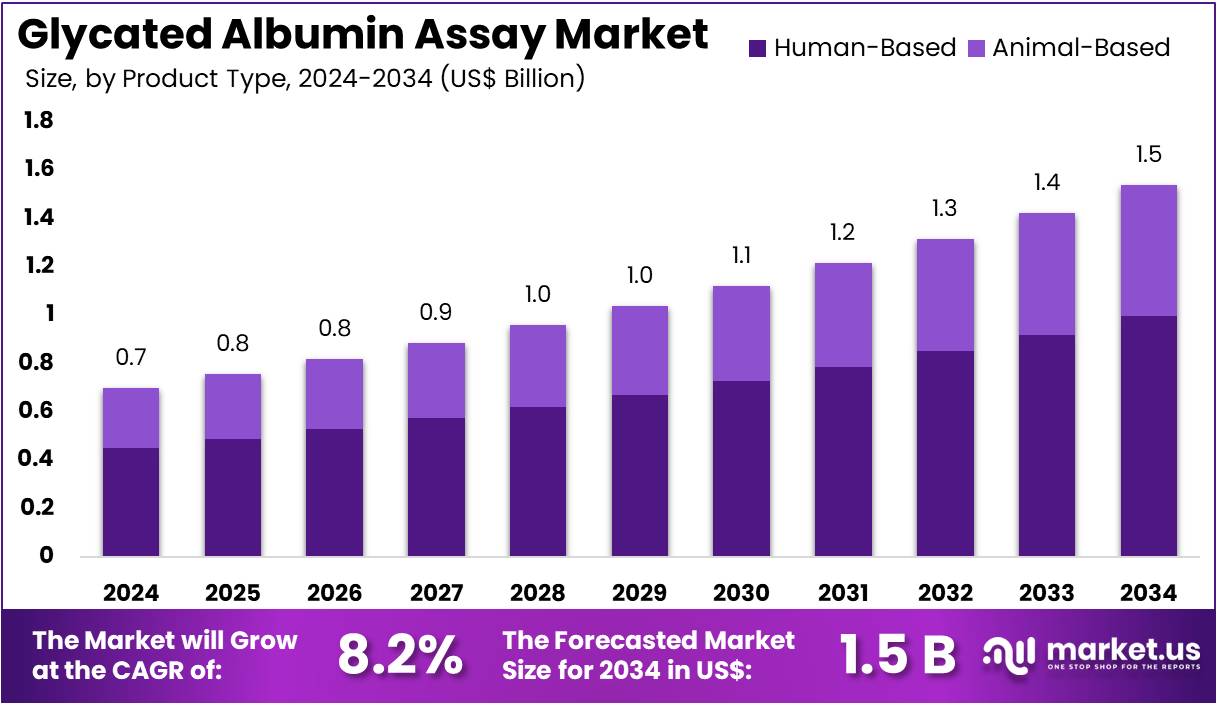
Key Takeaways
- In 2024, the global glycated albumin assay market was valued at US$ 0.7 billion and is projected to reach approximately US$ 1.5 billion by 2034, expanding at a CAGR of 8.2% during the forecast period.
- By product type, the market is categorized into human-based and animal-based assays. The human-based segment dominated the market, accounting for 64.7% of the total share.
- Based on application, the market is segmented into type 2 diabetes, type 1 diabetes, and prediabetes. Among these, the type 2 diabetes segment held the largest market share of 56.3%.
- In terms of end users, the market comprises hospitals & diabetic care centers, diagnostic laboratories, and others. The hospitals & diabetic care centers segment emerged as the leading end user, capturing 62.2% of the total market revenue.
- North America remained the leading regional market, accounting for a 39.1% share of the global glycated albumin assay market.
Statistical Information
- Rising Global Diabetes Burden is Increasing the Need for Advanced Glucose Monitoring: The global diabetes burden continues to grow rapidly, creating greater demand for accurate diagnostic tools such as glycated albumin assays. According to the WHO, more than 800 million adults worldwide were living with diabetes in 2022, nearly four times the number recorded in 1990. The International Diabetes Federation (IDF) also estimates that 588.7 million adults (20–79 years) had diabetes in 2024, representing 11.1% of the global adult population.
- Type 2 Diabetes Represents the Largest Patient Population: Type 2 diabetes accounts for the vast majority of diabetes cases, supporting the dominance of this application segment in the glycated albumin assay market. The U.S. CDC estimates that 40.1 million Americans were living with diagnosed or undiagnosed diabetes in 2023 (12.0% of the population). Globally, approximately 90–95% of diabetes cases are Type 2 diabetes, making it the primary disease area requiring routine glycemic monitoring.
- Gestational Diabetes Creates Demand for Short-Term Glucose Monitoring: Glycated albumin testing is increasingly valuable in pregnancy because it reflects glucose control over the previous 2–3 weeks, enabling rapid assessment of treatment effectiveness. The CDC reports that 5%–9% of pregnancies in the United States are affected by gestational diabetes each year. The IDF further estimates that 23 million live births (19.7%) worldwide were affected by hyperglycemia during pregnancy in 2024, with 79.2% linked to gestational diabetes.
- Chronic Kidney Disease Increases the Need for Alternative Glycemic Biomarkers: Patients with chronic kidney disease (CKD) often experience altered red blood cell survival, reducing the reliability of HbA1c testing. The CDC reports that approximately 1 in 3 adults with diabetes also has chronic kidney disease. This clinical challenge is driving the adoption of glycated albumin assays, which are unaffected by red blood cell lifespan.
- Hospitals and Diabetes Care Centers Perform the Majority of Diabetes Monitoring: Hospitals and specialized diabetes care centers remain the primary settings for diabetes diagnosis and follow-up. According to the CDC, there were approximately 38.2 million physician office visits in the U.S. with Type 2 diabetes as the primary diagnosis, demonstrating the high volume of clinical monitoring that supports demand for laboratory-based glycated albumin testing.
- Prediabetes Population Expands Future Testing Demand: The growing number of people at high risk of diabetes creates a substantial opportunity for improved glucose monitoring. The CDC estimates that 115.2 million U.S. adults had prediabetes in 2023, with 31.3 million adults aged 65 years or older affected. Earlier and more frequent glycemic assessment is becoming increasingly important for disease prevention.
- Diabetes Mortality Highlights the Need for Better Disease Management: Diabetes remains one of the world’s leading causes of premature mortality. The International Diabetes Federation estimates that approximately 3.4 million adults aged 20–79 years died due to diabetes or its complications in 2024, accounting for 9.3% of all deaths in this age group. Improved monitoring technologies are essential for reducing diabetes-related complications.
- Growing Burden of Undiagnosed Diabetes Supports Improved Diagnostic Testing: A large proportion of people with diabetes remain undiagnosed. According to the CDC, 27.6% of U.S. adults with diabetes, about 11 million people, were unaware of their condition in 2023. This highlights the ongoing need for accurate laboratory diagnostics and regular glucose monitoring to enable earlier intervention.
Regional Analysis
North America held the largest share of the Glycated Albumin Assay Market, accounting for 39.1% in 2024. The region’s leadership is supported by the high burden of diabetes, advanced diagnostic infrastructure, and widespread adoption of innovative laboratory testing. According to the U.S. Centers for Disease Control and Prevention (CDC), an estimated 40.1 million Americans were living with diabetes in 2023, while more than 115 million adults had prediabetes, creating strong demand for accurate glycemic monitoring tools.
Glycated albumin assays are increasingly used as complementary biomarkers because they provide a short-term assessment of blood glucose and are less affected by conditions such as anemia or chronic kidney disease that can limit HbA1c accuracy. In addition, growing awareness among healthcare professionals, favorable reimbursement systems, and continuous research into diabetes diagnostics further strengthen the market across the U.S. and Canada.
Asia Pacific is projected to register the fastest CAGR during the forecast period. The region’s rapid growth is driven by the rising prevalence of diabetes, expanding healthcare infrastructure, and increasing government-led screening and disease management initiatives. According to the International Diabetes Federation (IDF), Asia Pacific is expected to account for approximately 589 million people living with diabetes by 2050, highlighting a substantial need for advanced monitoring technologies.
Countries such as China, India, Japan, and South Korea are investing in improved diabetes diagnosis and laboratory services, while public health programs continue to promote early detection and effective disease management. These developments, combined with increasing healthcare expenditure and greater awareness of alternative glycemic biomarkers, are expected to accelerate the adoption of glycated albumin assays across the region.
Emerging Trends
- Growing use as a complementary diabetes monitoring test: Glycated albumin (GA) is gaining attention because it reflects average blood glucose over the previous 2–4 weeks, compared with about 3 months for HbA1c. The American Diabetes Association (ADA) recognizes glycated albumin as an alternative marker when HbA1c results are unreliable, supporting wider clinical adoption in specialized diabetes care.
- Higher adoption for patients with kidney disease and anemia: Healthcare providers are increasingly using glycated albumin assays in patients with chronic kidney disease (CKD), anemia, and hemoglobin disorders, where HbA1c may not accurately reflect blood glucose control. This trend is expanding demand in nephrology clinics and hospital laboratories treating complex diabetes cases.
- Integration with personalized diabetes management: Diabetes care is moving toward personalized monitoring, where glycated albumin is combined with HbA1c, continuous glucose monitoring (CGM), and routine glucose tests. Since GA reflects recent glucose changes within 15–30 days, clinicians can evaluate treatment effectiveness sooner and adjust therapies more quickly.
- Expansion of standardized laboratory testing technologies: Modern enzymatic glycated albumin assays are becoming more standardized, improving testing accuracy and reproducibility across clinical laboratories. Continuous improvements in laboratory automation are supporting faster turnaround times and greater use in hospitals managing the increasing global diabetes population.
- Rising demand driven by increasing diabetes burden: According to the International Diabetes Federation, the number of adults living with diabetes is projected to reach 853 million by 2050, creating sustained demand for advanced glycemic monitoring tools. Glycated albumin assays are expected to complement existing diagnostic methods in diabetes management worldwide.
Use Cases
- Monitoring short-term blood glucose control: Glycated albumin testing measures glucose control over the previous 2–4 weeks, making it valuable for evaluating recent medication changes, dietary improvements, or insulin adjustments. Healthcare providers use this faster feedback to optimize diabetes treatment without waiting for HbA1c results.
- Supporting diabetes care in chronic kidney disease patients: Patients with advanced CKD often experience inaccurate HbA1c readings due to altered red blood cell lifespan. Glycated albumin provides an alternative biomarker that better reflects recent glucose levels, improving clinical decision-making in nephrology and dialysis settings.
- Managing diabetes in patients with hemoglobin disorders: Individuals with sickle cell disease or other hemoglobin variants may receive unreliable HbA1c results. The U.S. National Institute of Diabetes and Digestive and Kidney Diseases (NIDDK) recommends considering glycated albumin or fructosamine testing when HbA1c cannot be accurately interpreted.
- Assessing treatment response after therapy changes: Physicians use glycated albumin assays to determine whether new diabetes medications, insulin regimens, or lifestyle interventions are effective within 15–30 days. Earlier assessment allows faster treatment adjustments and improved glycemic management for high-risk patients.
- Research on diabetes complications and disease progression: Clinical studies have linked glycated albumin levels with diabetic complications including retinopathy, chronic kidney disease, cardiovascular disease, and mortality risk. This growing evidence is encouraging wider research use of glycated albumin as an additional biomarker in diabetes outcome studies.
Frequently Asked Questions on Glycated Albumin Assay
- Why is the glycated albumin assay important in diabetes management?
The glycated albumin assay provides a short-term picture of blood glucose control, making it useful after medication or lifestyle changes. It complements HbA1c testing by helping physicians assess recent improvements or deterioration in diabetes management more quickly. - Who benefits most from glycated albumin testing?
Patients with chronic kidney disease, anemia, sickle cell disease, or other hemoglobin disorders benefit most because HbA1c results may be unreliable. Glycated albumin offers a more accurate measure of recent blood glucose levels in these clinical situations. - How is a glycated albumin assay different from an HbA1c test?
HbA1c reflects average blood glucose over approximately three months, while glycated albumin measures glucose control over two to four weeks. This shorter monitoring period allows healthcare professionals to evaluate treatment changes and disease progression much sooner. - Which healthcare settings commonly use glycated albumin assays?
Glycated albumin assays are widely used in hospitals, diagnostic laboratories, diabetes clinics, nephrology centers, and research institutions. They support patient monitoring, treatment planning, and clinical studies focused on improving diabetes outcomes and reducing long-term complications. - What factors are driving the growth of the glycated albumin assay market?
The market is expanding because of the rising global prevalence of diabetes, increasing awareness of alternative glycemic biomarkers, growing use in patients with kidney disease, and improvements in laboratory technologies that provide faster and more accurate diagnostic results. - Which region leads the glycated albumin assay market?
North America currently leads the glycated albumin assay market due to its high diabetes burden, advanced healthcare infrastructure, widespread laboratory testing capabilities, and strong adoption of innovative diagnostic technologies supported by established healthcare systems. - What is the future outlook for the glycated albumin assay market?
The market is expected to experience steady growth as diabetes cases continue to rise globally. Advances in diagnostic automation, personalized medicine, and increased adoption of complementary biomarkers alongside HbA1c testing will further strengthen future market opportunities.
Conclusion
The glycated albumin assay market is expected to witness steady growth as healthcare systems focus on improving diabetes monitoring and personalized patient care. Rising diabetes prevalence, increasing awareness of alternative glycemic biomarkers, and the limitations of HbA1c testing in patients with anemia and chronic kidney disease are driving adoption.
Technological advancements in laboratory diagnostics and expanding clinical applications are further supporting market development. North America remains the leading regional market due to advanced healthcare infrastructure, while Asia Pacific is expected to grow the fastest because of its large diabetic population, improving healthcare access, and government initiatives promoting early diagnosis and effective diabetes management.
Discuss your needs with our analyst
Please share your requirements with more details so our analyst can check if they can solve your problem(s)




